 BAUDOG The dictionary of dog–human communication
Contents
- The finished behavior
- Assessment: where is your dog now?
- The cue
- How to signal
- Teaching steps
- When to reward
- Which word: “Drop it,” “Give” or “Out”?
- Give, Drop it and Leave it: what’s the difference?
- Why trade instead of taking things away?
- A good sign to move on
- If it isn’t working
- Prescription: a suggested order
- In the moment: do / don’t
- When to see a professional
- Sources
The finished behavior
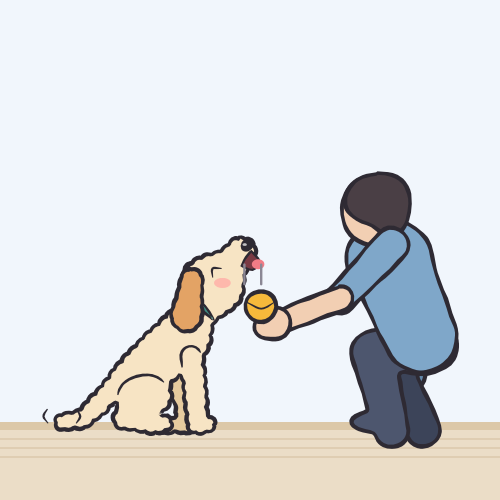
On the cue, your dog lets go of what’s in her mouth by herself and hands it to you. She knows that letting go pays — a treat, and often the toy comes straight back — so it doesn’t turn into keep-away or a tug-of-war.
Assessment: where is your dog now?
Before teaching anything, a visiting trainer might check something like these three things.
When someone comes near something in her mouth or her food bowl, does she freeze, growl, gulp it down fast or hunch over it?
→If so, this may be resource guarding. Don’t work through this page on your own — do it with your vet or a behavior professional.
Treats or toys: which does she get more excited about?
→If it’s treats, start at step 1 on this page. If she’d rather play than eat, teaching it inside a game of tug or with two toys (the Drop It page) may suit her better.
Has anyone in the family chased her to get things back, or pried her mouth open?
→Make “no chasing, no prying” a family rule. If she tends to run off with things, practice with a leash on for a while, even indoors.
The cue
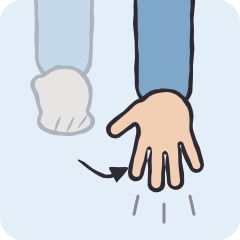
On BAUDOG, “give” and “drop it” are the same cue: let go of what’s in your mouth. Our examples use “Drop it,” but “Give,” “Out” or “Trade” work just as well. Pick one word and have the whole family use it. The hand signal is a loosely closed hand, palm down, that springs open. (“Give paw” is a different trick — on BAUDOG it’s called Shake.)
How to signal
- Voice
Say “Drop it” once, calmly, just before the item leaves her mouth. When it does, “Yes.” Don’t keep repeating the cue.
- Hand
At first, bring a treat to her nose. Once she’s getting the idea, show the hand signal as you say the word: a loosely closed hand, palm down, that springs open. Don’t grab the item and pull.
- Leash
None indoors. If she runs off with things, you can keep a leash on her during practice, even at home.
- Body
Crouch and wait. Don’t chase her. Don’t pull on the item.
Teaching steps
- 1
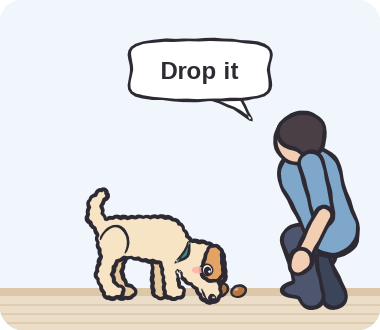
First, make the word itself mean something good At home, quiet
Make the word worth hearing
No toys yet. Say “Drop it” once and put a few treats on the floor. When she’s eaten them and looks up at you, say it again → treats on the floor. About 10 times, spread over a few short sessions.
A good sign to move onWhen she hears “Drop it,” she looks at the floor for treats
- 2
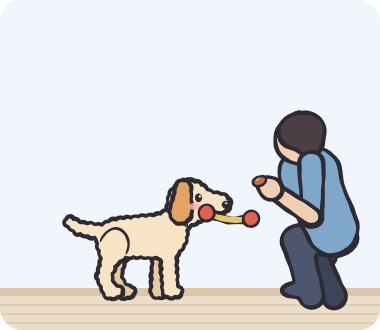
Treat at her nose. When she lets go, the toy comes back At home, quiet
Trade for a treat
When she’s holding a toy she isn’t too excited about, bring a treat to her nose. The moment it leaves her mouth, “Yes” → treat. Pick the toy up while she eats, and give it back when she’s finished.
A good sign to move onLets go as soon as she sees the treat, 8 times out of 10
- 3
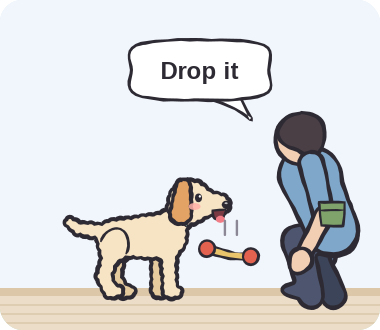
The cue comes just before the treat appears At home, quiet
Add the cue
Once she lets go as soon as she sees the treat, say “Drop it” just before you show it. When she’s used to that, say it, wait about a second, then show the treat.
A good sign to move onOn “Drop it,” she starts letting go before she sees the treat
- 4
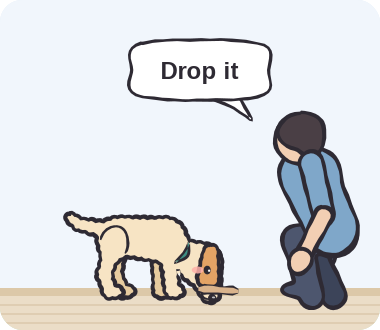
Even her favorite comes back to her At home, small distractions
Treat out of sight, then her favorite things
Treats stay in your pouch as you say “Drop it”; bring one out when she lets go. Once that works, do the same with a favorite toy or chew, and upgrade the treat too. When she lets go: treat — and give it back again.
A good sign to move onLets go without seeing a treat, even of favorite things, 8 times out of 10
- 5
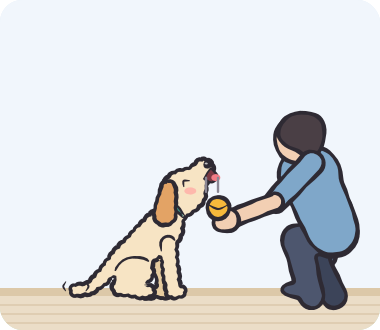
Last of all: into your hand At home, small distractions
Into your hand (the finish)
Once letting go is reliable, hold your palm under her mouth and say “Drop it.” The moment the item lands in your palm, “Yes” → treat. If it lands on the floor, hold your hand closer to her mouth and try again.
A good sign to move onShe lets go of the item into your palm
When to reward
Just right
“Yes” the instant the item leaves her mouth. Then the treat.
Too late
Praising after you’ve pulled the item away — the letting go itself never got rewarded.
Which word: “Drop it,” “Give” or “Out”?
Any word works. The American Kennel Club (AKC) suggests “drop it,” “trade” or “out”; the UK charity Dogs Trust uses “drop” or “out.” Some families say “Give.”
What matters is choosing one word and sticking to it as a family. If one person says “Give” and another says “Drop it,” your dog can’t tell which one is the cue. The UK veterinary charity PDSA also advises that everyone who looks after your dog uses the same cues. We prefer a word that’s easy to say in a friendly voice — it’s a trade, not a telling-off.
Give, Drop it and Leave it: what’s the difference?
- Give / Drop it: let go of something that’s already in her mouth. On BAUDOG these are one cue. This page teaches it by trading for treats.
- Leave it: ignore something she hasn’t picked up yet — food on the floor, a dropped pill (the Leave It page). The AKC points out that you won’t always spot things before your dog does, which is why it advises teaching both.
- The Drop It page teaches the same cue inside play — tug and two toys — for dogs who’d rather play than eat.
Why trade instead of taking things away?
If you chase a dog who has run off with something, it turns into a fun game of chase, and she learns to run away (Battersea). Being chased can also make her swallow the item so you can’t get it first (AKC). Prying her mouth open risks a bite. In a survey of the owners of 140 dogs seen at a veterinary behavior service, who were asked to recall the training methods they had used, 39% of dogs who’d had items physically forced out of their mouths responded aggressively.
Having things repeatedly taken away is described as the most common reason dogs guard toys and food (a resource from an RSPCA branch in the UK). And in a Canadian university’s survey of dog owners (2,207 owners, 3,589 dogs), dogs that reliably “dropped” on request were less likely to guard things aggressively — though a one-time survey can’t tell which causes which. That’s why “Drop it” is taught as a trade, not a take-away: during practice, her everyday toys go back to her.
A good sign to move on
- Steps 2–4: move on once she manages that step 8 times out of 10 (our rule of thumb)
- Step 5 (into your hand) comes once she lets go of her favorite things without seeing a treat
- Use the cue for things she picks up on walks only once she lets go of her favorite things at home (the walk step of the practice Trade)
- If she struggles, go back a step and use a better treat (our rule of thumb: two misses in a row)
If it isn’t working
She runs off with it
Don’t chase her. During practice, keep a leash on so she stays near you (AKC). If you can’t get close, lay a trail of treats across the floor to lead her away from the item.
She won’t let go unless she sees the treat
Try waiting one second between saying “Drop it” and showing the treat. Stretch the gap a little at a time, and she’ll start letting go on the word alone (AKC).
She tries to grab the item back as soon as she lets go
Don’t make it a race. Toss the treat a few feet away and pick the item up while she goes for it (AKC).
She’s got something dangerous (a battery, medication, a wooden skewer)
Don’t chase her and don’t pry her mouth open. Throw a handful of treats away from the item and pick it up while she eats them (Dogs Trust). If she may have swallowed it, or it could be toxic or cause a blockage, go to your vet straight away. There’s more on this on the Drop It page.
She growls or freezes when she has something
Don’t approach, don’t take the item, and move away. A growl is a warning: “don’t come any closer.” Punishing it only stops the growl, and she may learn to bite without warning (Dogs Trust). Talk to your vet or a behavior professional.
How long do I keep giving treats?
Every time she lets go on cue, reward her (Battersea). The more dangerous the thing she gave up, the bigger the jackpot.
Can I teach a puppy?
Yes. Dogs Trust recommends starting “fair trades” early, while puppies are exploring everything with their mouths, instead of snatching things away. Keep anything precious or dangerous out of a puppy’s reach.
Prescription: a suggested order
The practice Trade turns these steps into a visiting trainer’s homework: what to do today, how many times a day, for how long, and what the trainer checks on the next visit.
- ExerciseThe Trade Game: Teach Your Dog to Drop It by Swapping, Not GrabbingDoable at home (Steps 1–4 at home)The full step-by-step for “Drop it,” from everyday toys at home to things she picks up on walks.Read →
- ExerciseLeave It Practice: From a Closed Fist to Food on the SidewalkDoable at home (Steps 1–3 at home)Ignoring things she hasn’t picked up yet. Paired with “Drop it,” it helps stop her eating things off the ground.Read →
In the moment: do / don’t
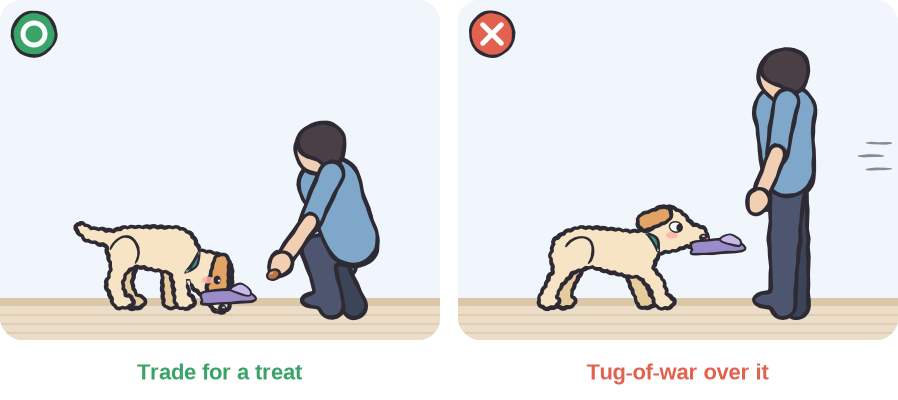
Do
- When she has something, crouch and bring a treat to her nose
- “Yes” the instant she lets go → treat
- Give practice toys back after she lets go
- Put away things you don’t want her to grab, for now
Don’t
- Chase her to get things back
- Pry her mouth open or pull the item away
- Scold her for growling
- Repeat “Drop it, drop it, drop it”
When to see a professional
- She freezes, growls or tries to bite over things in her mouth, her food bowl or toys (resource guarding). Don’t take things from her yourself — talk to your vet or a behavior professional
- She may have swallowed something dangerous. If it could be toxic or cause a blockage, go to your vet straight away
The skills behind this command
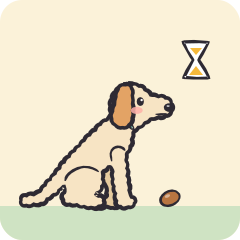 Core skill Impulse Control Letting go of something she wants, by her own choice — pausing for a breath in front of something tempting.
- ExerciseThe Trade Game: Teach Your Dog to Drop It by Swapping, Not GrabbingDoable at home (Steps 1–4 at home)Read →
- ExerciseLeave It Practice: From a Closed Fist to Food on the SidewalkDoable at home (Steps 1–3 at home)Read →
Sources
- Battersea Dogs & Cats Home — Teaching your dog to “drop it”
- American Kennel Club — Teaching Your Dog to Drop It
- American Kennel Club — Teach Your Dog to Trade Items With You
- Dogs Trust — How to train your dog to leave it (fair trades)
- Dogs Trust — Resource guarding in dogs
- Toronto Humane Society — How to Teach “Drop It” (PDF)
- RSPCA Brighton & the Heart of Sussex — Preventing resource guarding (PDF)
- ASPCA — Food Guarding
- Herron, Shofer & Reisner (2009). Survey of the use and outcome of confrontational and non-confrontational training methods in client-owned dogs showing undesired behaviors. Applied Animal Behaviour Science 117:47–54
- Jacobs et al. (2018). Factors associated with canine resource guarding behaviour in the presence of people: A cross-sectional survey of dog owners. Preventive Veterinary Medicine 161:143–153
- Edmonton Humane Society — Resource Guarding (PDF)
- PDSA — Reward-based training