 BAUDOG The dictionary of dog–human communication
Contents
What this skill is
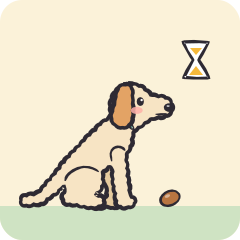
Impulse Control is your dog’s ability to pause for a breath in front of something she wants — and wait. Put another way, it’s learning that “waiting gets it; lunging makes it go away.” It’s easy to mix up with Settling Down. The difference is stopping versus unwinding. Impulse Control is the brake: she stops herself from doing something she wants to do. Settling Down is the excitement itself coming down. Asking a fully wound-up dog to just hit the brake doesn’t work. The Merck Veterinary Manual notes that highly aroused dogs tend to react reflexively, which interferes with their ability to learn, and that arousal sometimes has to come down before training can proceed. When that’s the case, build Settling Down first. And impulse control isn’t something you force by scolding. It’s helping her discover for herself that waiting is the better deal.
How your dog feels
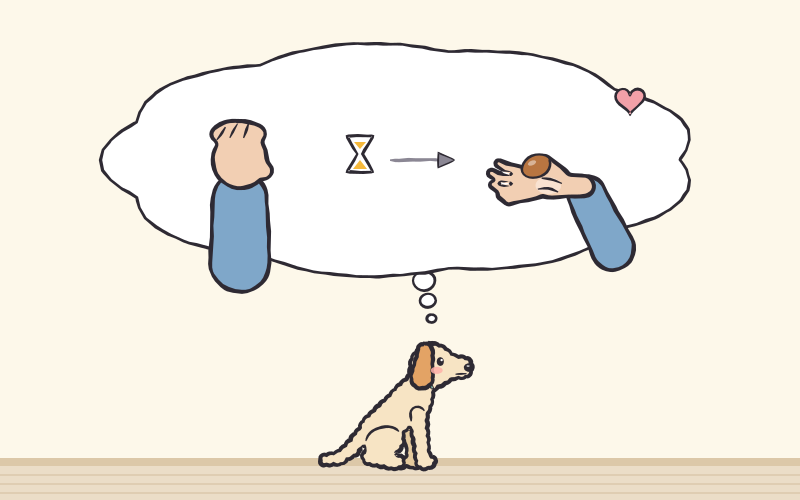
To a dog, the treat in front of her, the ball, the open door are all things to grab right now. The more often lunging has worked, the more she lunges. Even pushing her away or shouting can look like part of the game to her (Best Friends Animal Society). The job is to swap “lunge” for “wait” as the way to get what she wants.
Impulse control depends on the situation. In a study where 67 pet dogs did five commonly used tests of self-control, a dog who held back well on one test didn’t necessarily do so on another — scores didn’t correlate across tasks. A separate study of 30 dogs on three tasks found the same (both were lab tasks). BAUDOG’s takeaway: waiting nicely at the food bowl doesn’t guarantee waiting at the front door. So practice each situation.
Excitement makes waiting harder. A study comparing pet dogs with assistance dogs bred and trained for low arousal (106 dogs in all) found that when people encouraged them eagerly, the more excitable pet dogs did worst on a detour task — going around a barrier instead of straight at the reward. When you want her to wait, don’t pump her up with a high voice; wait quietly.
Assessment: where is your dog now?
A visiting trainer might start by having you try everyday situations at home. Actually try them rather than going on impressions — and check all three, because self-control differs from one situation to the next. Where she struggles is where you begin.
With a treat on your open palm, can she wait without pushing her nose into it?
→If not, start at Stage 1 (at home, quiet) with the practice Leave It, beginning with a closed fist.
When you put her food bowl on the floor, can she stay sitting for 3 seconds?
→If not, practice Stage 2 (at home, small distractions). One method the American Kennel Club describes: start lowering the bowl, and the moment her bottom lifts, raise it again; repeat.
When you open the front door, can she wait instead of heading out?
→If not, practice Stage 3 (doorways). If she might bolt, clip on a leash before you practice.
Problems when this skill is weak
Signs this skill is weak
- Jumping on people
- Scavenging on walks or eating poop
- Bolting out of open doors
- Getting frantic in front of food or treats
- Demand barking
- Pulling on the leash or biting the leash
- Problems Demand Barking: How to Stop It Without Just Ignoring Your Dog Read →
- Problems How to Stop Your Dog Jumping on People: Why Dogs Jump and What Works Read →
- Problems Dog Eating Everything on Walks? How to Stop Scavenging, Safely Read →
- Problems Dog Eating Poop? Why Dogs Do It, How to Stop It, and When to See a Vet Read →
- Problems Dog Chewing the Leash on Walks? 4 Reasons Dogs Bite the Leash — and How to Stop It Without a Tug-of-War Read →
- Problems Dog Escaping? How to Stop Door Dashing — and What to Do If Your Dog Gets Out Read →
- Problems Dog Barking at Visitors? How to Tell Why — and a Trainer’s Plan for the Front Door Read →
- Problems How to Stop Puppy Biting: When It Ends, What Works, and When It’s Not Play Read →
- Problems Dog Pulling on the Leash? Why Dogs Pull and How to Stop It — Plus the Right Harness and Leash Read →
- Problems Dog Humping: Why Dogs Hump and How to Stop It Read →
- Problems Dog Growling: What It Means, Why You Shouldn’t Punish It, and What to Do Read →
Prescription: a suggested order
BAUDOG’s suggested order. Start with Leave It. Once she can do it at home, you can work on the others side by side. If you came here from a specific problem, it’s fine to start the closest practice early alongside it — Four on the Floor Greetings for jumping, for example.
- ExerciseLeave It Practice: From a Closed Fist to Food on the SidewalkDoable at home (Steps 1–3 at home)Teaches “not grabbing is what gets it” in its simplest form. The way in.Read →
- ExerciseSay Please by SittingDoable at home (Steps 1–3 at home)Sitting to ask for food, the door or a toy. Every daily routine becomes practice.Read →
- ExerciseBuilding a Stay: Duration, Distance, Distraction — One at a Time, Up to the Front Door and GuestsDoable at home (Steps 1–3 at home)Builds waiting one thing at a time — duration, distance, distraction — until the release word.Read →
- ExerciseThe Trade Game: Teach Your Dog to Drop It by Swapping, Not GrabbingDoable at home (Steps 1–4 at home)Letting go of what’s in her mouth. Also helps prevent scavenging and guarding.Read →
- ExerciseFour on the Floor: Teaching Your Dog to Greet People PolitelyDoable at home (Steps 1–2 at home)People come closer only while all four paws are on the floor. The greeting that replaces jumping.Read →
- ExerciseLoose Leash Walking: Stop When It’s Tight, Reward at Your Side (Starting Indoors)Start at home, finish outside (Steps 1–2 at home)Pulling stops the walk; a loose leash moves it on. Self-control that lasts the whole walk.Read →
- ExercisePlay and Pause: Teach Your Dog an “Off Switch” With TugDoable at home (Steps 1–3 at home)Stopping even when play is exciting. Grows alongside Settling Down.Read →
How it grows
-
Level 1At home, quiet
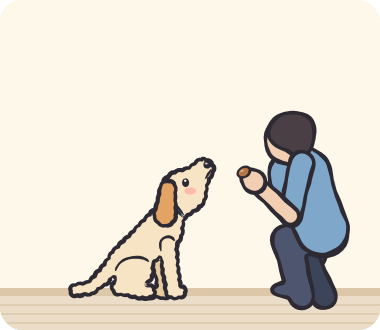
In a quiet room, she gives up on a treat in your closed hand, then your open hand, and waits. The first homework starts here.
A good sign to move on Leaves a treat on your open hand for 5 seconds, 8 times out of 10
-
Level 2At home, small distractions
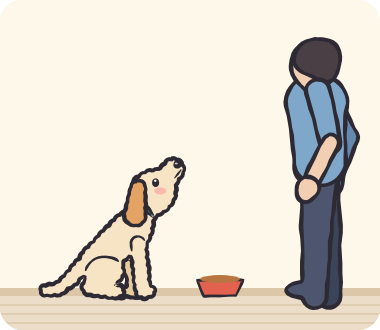
She waits for the cue even in front of a treat or her food bowl on the floor.
A good sign to move on Looks away from a treat on the floor on her own, 8 times out of 10
-
Level 3Front door or car door
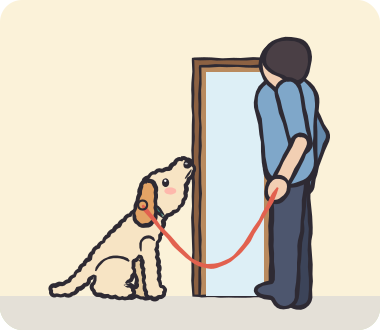
She waits at the front door or car door until the release word. Start on leash.
A good sign to move on Waits with the door open until “Free,” 8 times out of 10
-
Level 4Quiet street
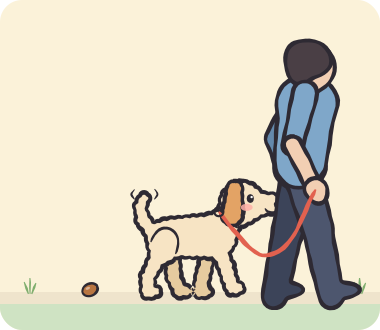
On walks, she can walk past a treat you’ve placed on the ground for practice.
A good sign to move on Walks past the placed treat, 8 times out of 10
-
Level 5Around distractions
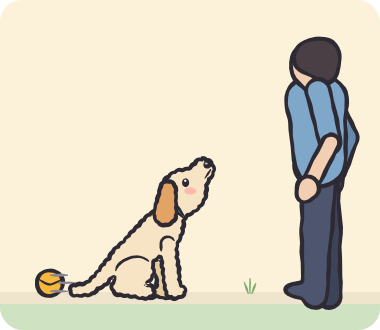
She can wait in front of visitors, a rolling ball or another dog. Start with mild temptations, far away.
A good sign to move on A 10-second stay with a temptation around, 8 times out of 10
Principles
- When she waits, make the thing she wanted the reward — going out the door, the ball being thrown, eating her dinner.
- Don’t let lunging pay off. Use gates and leashes so she can’t practice getting it wrong between sessions.
- Everyone in the family follows the same rules. If jumping up is fine one day and not the next, she can’t learn.
- Pick one release word (“Free”). Without it, she can’t know how long to wait.
- Start with short waits. Count even 1–2 seconds as success at first, then build up.
- Practice each situation: the food bowl, the front door, walks, visitors — starting with the easiest version of each place you need her to wait.
- If she struggles, go back to the stage where she was succeeding and progress more slowly (our rule of thumb: two misses in a row). No scolding.
- Reward-based training doesn’t mean anything goes. Boundaries can be taught too — without fear, intimidation or pain (American Veterinary Society of Animal Behavior, AVSAB).
- Keep sessions short — a few minutes; 3 to 5 is a good rule of thumb — and stop while she still wants more.
When to see a professional
- She freezes, growls or tries to bite over her food bowl, toys or things she’s picked up. This may be resource guarding rather than a self-control problem. Don’t try to take things from her yourself — talk to your vet or a behavior professional
Sources
- Brucks et al. (2017). Measures of Dogs’ Inhibitory Control Abilities Do Not Correlate across Tasks. Frontiers in Psychology 8:849
- Bray, MacLean & Hare (2014). Context specificity of inhibitory control in dogs. Animal Cognition 17:15–31
- Bray, MacLean & Hare (2015). Increasing arousal enhances inhibitory control in calm but not excitable dogs. Animal Cognition 18:1317–1329
- Merck Veterinary Manual (professional version) — Behavioral Problems of Dogs
- American Kennel Club — Impulse Control for Dogs: Dog Self-Control Training
- American Kennel Club — “Leave It” Command
- Dogs Trust — Teach your dog to leave it
- RSPCA NSW — Teaching your dog to chill (PDF)
- Santa Fe Humane Society — Teaching Your Dog to Say Please (PDF)
- American Kennel Club — What Is the Premack Principle in Dog Training?
- Humane World for Animals (formerly the Humane Society of the United States) — How to stop your dog jumping
- Best Friends Animal Society — How to Stop Dogs From Jumping on People
- AVSAB — Position Statement on Humane Dog Training (2021)
- ASPCA — Food Guarding