 BAUDOG The dictionary of dog–human communication
Contents
When to use this exercise
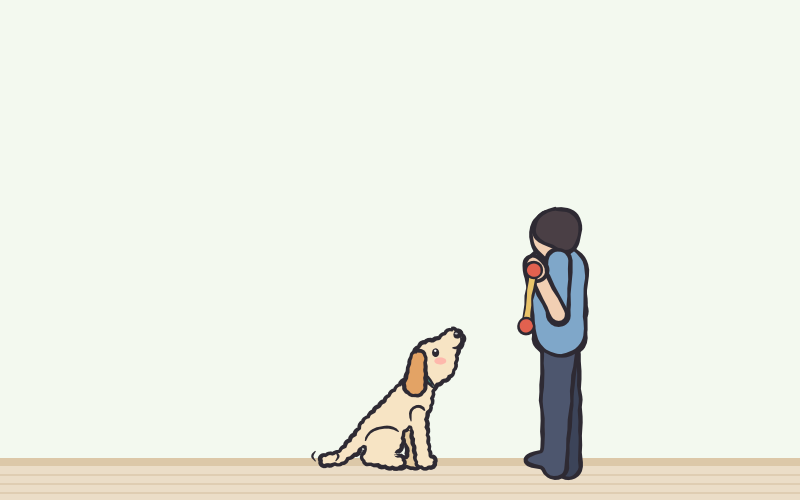
For dogs whose tug or chase games turn into mouthing, jumping or humping. You play in short bursts, pause, and start again once she’s calm. She learns that calming down brings the fun back, so she gets better at bringing her own excitement down. It builds Settling Down and Impulse Control. You can start at home with one toy.
GoalWhen play stops, she calms down by herself within a few seconds — sitting, lying down, relaxing or looking at you — and she knows that being calm gets the game going again.
Assessment: what a trainer might check on the first visit
Before starting, a visiting trainer might check something like these three things at home.
In normal play, how quickly do her teeth land on your hand, or does she start jumping up?
→If it takes only a few seconds, start step 1 with even shorter bursts of play — a few seconds.
When you stop the toy, can she calm herself down? Roughly how many seconds does it take?
→If she keeps biting or barking after you stop, practice somewhere you can step behind a baby gate straight away.
Does anyone in the family play with their hands or feet? Do the children play tug with her?
→Then part of the homework is: no hand-wrestling, and tug is for adults only.
What you need
- A tug toy with some length to it, like a rope — so if she re-grips, she won’t get your hand by mistake
- It helps if she already knows a little of letting go on cue (the practice Trade)
- A marker word she already understands, “Yes” (the practice Charging Your Marker Word)
How to signal
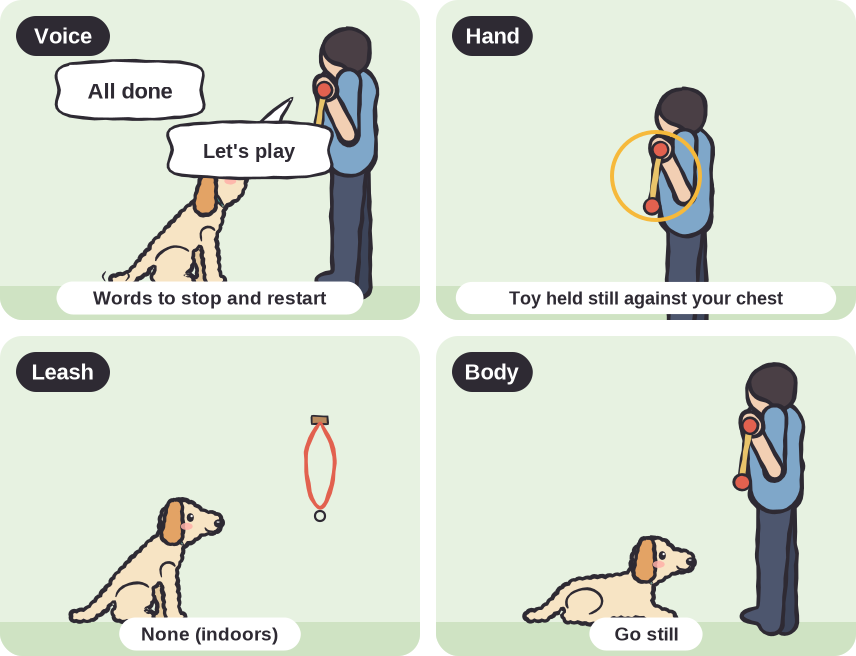
- Voice
To pause, “All done”; to restart, “Let’s play.” Both in a calm voice. If teeth touch skin, stop quietly — no telling off.
- Hand
To pause, hold the toy still against your body (or put it behind your back). Hold the toy far from your hand.
- Leash
None (at home).
- Body
When you pause, freeze, and turn your face slightly away from her.
Today’s session
With the trainer, you work on step 1.
Step 1Play briefly, then pause(At home, quiet)
The trainer demonstrates: about 5 seconds of tug → “All done,” toy held still against the body → when your dog sits, lies down or relaxes, “Let’s play” and the game restarts. Then family members take turns for about 5 minutes while the trainer fixes the pause on the spot (keep the toy still, no scolding).
Homework until the next visit
- How often
- Twice a day
- How long
- 3–5 minutes each
- How much
- 5–10 pauses per session
A good sign she’s readyEven after 30 seconds of play, she calms within 10 seconds of the pause
What the trainer checks next visit
In front of the trainer: 30 seconds of play, then pause. Five times.
If she canIf she calms within 10 seconds all five times, move on: step 3 (a room where the family is moving about, or at a time of day she gets wound up) becomes the next homework.
If not yetShorten the play bursts again, look at how you pause and how long the toy is, and do another week.
Next stages: steps
- 1
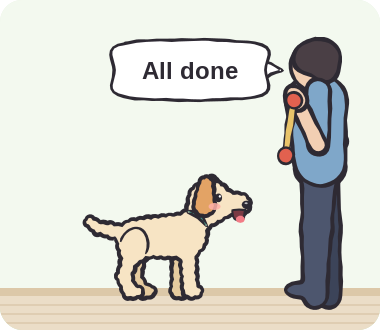
Play 5 seconds, then pause At home, quiet
Play briefly, then pause
About 5 seconds of tug → “All done,” toy held still against your body. When she sits, lies down, relaxes or looks at you, “Let’s play” and restart.
A good sign to move onCalms within 5 seconds of the pause, 8 times out of 10
- 2
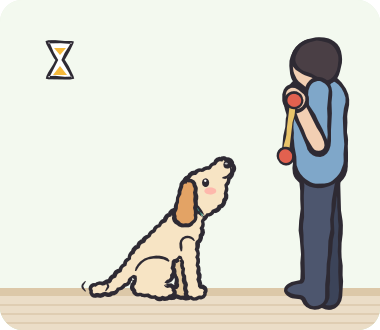
Long play, and she can still stop At home, quiet
Stretch the play
Stretch play to 10, 20, then 30 seconds, with the same number of pauses. With easily excited dogs, don’t stretch too far.
A good sign to move onEven after 30 seconds of play, calms within 10 seconds of the pause
- 3
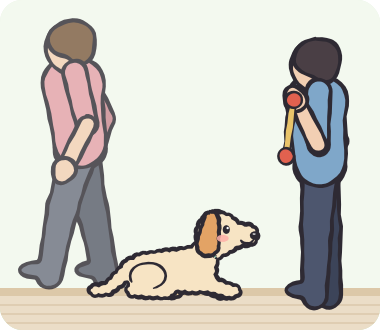
Even when it’s busy, she can stop At home, small distractions
At a busier time
Do the same in a room where the family is moving about, or at a time she tends to get wound up, like the evening. If teeth touch your hand or clothes, “All done” right there. If she keeps going, step behind a baby gate for a few seconds up to about 30, and come back once she’s calm.
A good sign to move onCalms within 10 seconds of the pause, 8 times out of 10, and teeth touch you less and less
- 4
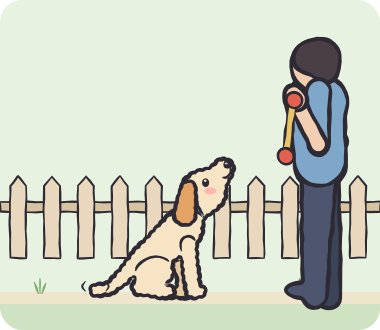
Outside, start with short play Yard, doorstep, outside the house
In a fenced yard or by the door
Do the same outside, in a fenced yard for example. Outside she gets excited more easily, so start again with short bursts of play.
A good sign to move onOutside too, calms within 10 seconds of the pause
Timing
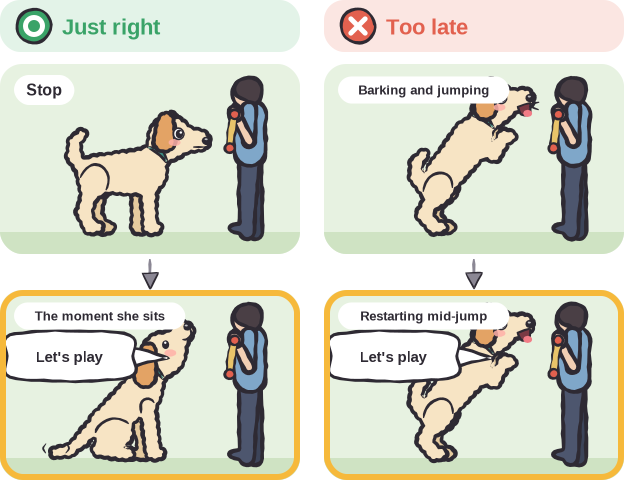
Just right
After the pause, restart with “Let’s play” the instant she sits, lies down or relaxes.
Too late
Restarting while she’s barking or jumping — that teaches her that making a fuss brings the game back.
Restarting the game is itself the reward for calming down. The American Kennel Club describes stopping in the middle of a game, waiting for a sit or down, and rewarding it by starting the game up again right away. Dogs Trust Ireland likewise says to end the game calmly and quietly if you feel teeth on your skin or clothes, and play again after a short break. One trainer quoted by the AKC keeps each round of tug short, around 10–15 seconds, and after a few rounds finishes with a “thinking” exercise and a treat (that’s one trainer’s approach, not a fixed number).
How much and how often
3–5 minutes a session, 5–10 pauses. About twice a day. You can also build this shape — play, pause, restart — into everyday play.
If it isn’t working
When I pause, she bites or barks even more
She’s too wound up. Make the play bursts even shorter. If she keeps going after you pause, step behind a baby gate for a few seconds up to about 30, and come back once she’s calm (see Puppy Biting).
She’s sleepy but wants to keep playing
Tiredness can mean more mouthing. End the game and let her rest in her playpen or crate.
If I let her win at tug, will she get bossy?
Research didn’t find that. A UK study filmed 50 dogs playing with their owners, then ran an hour of behavior tests: winning or losing the games had no consistent effect on the dogs’ test scores. In pairs where the dog started most of the games, though, the dog tended to be less amenable and more likely to show aggression. That was a one-time observation, and the researchers suggest the way dogs play reflects their temperament and their relationship with their owner. It’s fine to let her win sometimes and keep the toy.
Her teeth keep landing on my hand, so it never turns into proper tug
Switch to a longer toy. If she still keeps mouthing hands or clothes, stop playing tug for now and come back to it once the mouthing is under better control (the approach of a trainer writing in Whole Dog Journal).
Can I play tug with a puppy or a senior dog?
Keep the resistance light. The trainer quoted in the AKC article also recommends only light resistance with young puppies and senior dogs.
Avoid
- Using your hands or feet in place of a toy
- Hitting, grabbing her muzzle or shouting
- Letting children play tug with her
- Restarting while she’s barking or jumping
A good sign to move on
- Step 1: calms within 5 seconds of the pause, 8 times out of 10
- Steps 2–4: in that place and at that length of play, calms within 10 seconds of the pause, 8 times out of 10
- If she struggles, go back one step (shorter play) — our rule of thumb is two misses in a row
Sources
- American Kennel Club — Impulse Control for Dogs: Dog Self-Control Training
- American Kennel Club — Should You Play Tug-of-War With Your Dog?
- Dogs Trust Ireland — Tug of fun
- Dogs Trust — Mouthing, nipping and puppy biting
- Whole Dog Journal (Pat Miller) — How to Play Tug-of-War With Your Dog
- Whole Dog Journal — Rules for the Game of Tug
- Whole Dog Journal — Can Your Dog Settle Down on Cue?
- ASPCA — Mouthing, Nipping and Biting in Puppies
- Blue Cross — Puppy biting and mouthing
- Rooney & Bradshaw (2003). Links between play and dominance and attachment dimensions of dog-human relationships. Journal of Applied Animal Welfare Science 6(2):67–94
- Bradshaw, Pullen & Rooney (2015). Why do adult dogs ‘play’? Behavioural Processes 110:82–87