 BAUDOG The dictionary of dog–human communication
Contents
- In short
- When it happens
- How your dog feels
- Get professional help right away if… (don’t train this alone)
- Starting today: avoid the situations where she bites
- Keep a bite log
- Different reasons, different training
- If a trainer came to your home: the first session and the first homework
- A muzzle isn’t a punishment: teach it slowly with treats
- Started biting suddenly? Get her checked by a vet first
- It isn’t about dominance or “being the boss”
- If she bites someone: first aid and what to report
- Can a dog who bites be cured?
- The missing core skill
- Exercises
- In the moment: do / don’t
- When to see a professional
- Sources
In short
When an adult dog bites for real, it’s usually because she’s afraid, in pain, guarding something she values, or doesn’t want to be handled. It isn’t because she’s “bad” or trying to dominate you. Before a bite there are nearly always signals — freezing, a hard stare, a growl. The first job isn’t retraining; it’s safety. Avoid the situations where she bites, and have your vet check her for pain or illness. If a bite has broken skin, if you live with children or older or frail family members, or if you can’t predict when she’ll bite, don’t try to train this alone — get professional help right away. Hitting, pinning her down or yelling can make biting worse. (Puppy nipping and play mouthing are a different problem — see our page on puppy biting.)
When it happens
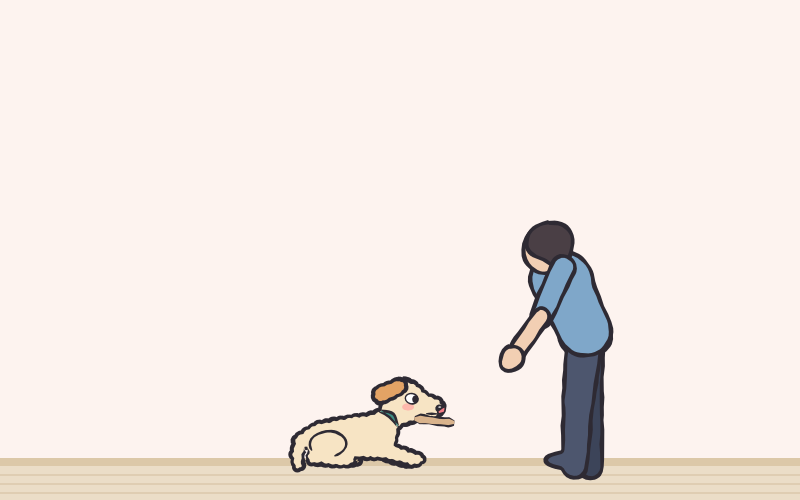
- Your dog growls and bites when you come near her food bowl, a chew or a toy
- She bites your hand when you wipe her feet, trim her nails or brush her
- She bites if you touch her while she’s asleep or on the sofa
- She bites when you try to pick her up or grab her collar
- She bites visitors, or strangers who reach toward her
- In play she gets wound up, and the mouthing turns into real bites
- She never used to bite, but recently she’s started out of nowhere
How your dog feels
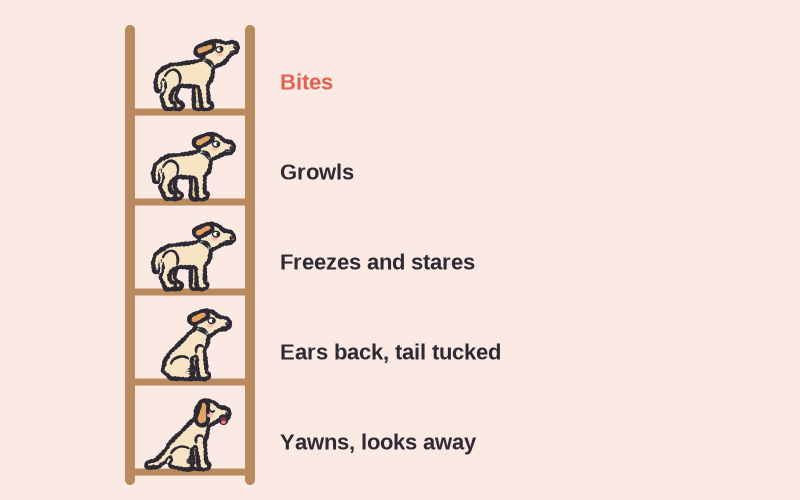
Most of the time, a bite is a last resort that means “get away from me.” The most common reason dogs bite is fear. When a dog can’t escape, or her “please stop” signals are ignored, she bites to make the threat go away.
There are usually signals first. They often start small — yawning, looking away, turning her body away — then build: ears back, tail tucked, then a stiff body and hard stare, a growl, bared teeth. The time between a warning and a bite can be a split second, but dogs rarely bite with no warning at all.
If biting makes the person back off, she learns that biting works. And if her signals keep being ignored, she may start skipping them and go straight to biting. That’s why you must never punish a growl: a growl is an important warning that comes before a bite.
Get professional help right away if… (don’t train this alone)
If any of these apply, please don’t start the exercises on this page on your own. Talk to your vet — ideally a vet who sees behavior cases — or a qualified trainer who doesn’t use punishment.
- A bite has broken the skin, drawn blood or left a bruise
- You live with children, older family members or anyone frail (people who can’t reliably get out of her way)
- You can’t predict when she’ll bite; you barely see any warning signs
- The bites are getting more frequent or harder
- She hangs on once she bites, or bites several times in a row
- She’s a large dog who could cause a serious injury
Starting today: avoid the situations where she bites
Before any training, remove the chances to bite. The veterinary edition of the MSD Veterinary Manual says treatment starts by avoiding all known and suspected triggers, and the situations where aggression is more likely. While you’re avoiding them, she also isn’t racking up more experiences of biting “working.”
- Write down the situations where she has bitten (see “Keep a bite log” below) and stop setting them up for now.
- If she bites over food, chews or toys, give them somewhere she won’t be disturbed — in a crate or pen. Put anything she might steal out of reach.
- If she bites when handled, stop all unnecessary picking up, grooming and petting for now (ask your vet or groomer about essential care until training has progressed).
- Put her bed or crate somewhere quiet where people don’t walk past. Don’t touch her while she’s asleep or resting.
- If she bites visitors, put her behind a baby gate or in another room before guests arrive.
- Never leave children alone with her. An adult stays in the room and keeps watching. Teach children not to approach a dog who is eating or sleeping.
- If there’s a trigger you can’t avoid (the vet, for example), teach her to wear a basket muzzle, a little at a time with treats (see “A muzzle isn’t a punishment”).
Keep a bite log
Each time she bites or nearly bites, write it down. The ASPCA suggests thinking through who she bit, when and where, what was going on, what had just happened, and what stopped her. This log is the most useful thing you can bring to a professional. If it’s safe, a phone video of the lead-up can help too.
- When and where (time of day, which room, on the sofa, at the front door…)
- Who (which family member, a child, a visitor, a stranger)
- What was happening (someone reached for her bowl, touched her foot, picked her up, was playing)
- The signals beforehand (froze, stared, growled, bared her teeth — and if you didn’t notice any, write that down too)
- How hard (teeth touched skin, a bruise, broke the skin, several bites)
- What stopped it (the person backed away, she dropped the item…)
Different reasons, different training
Look over your log and you’ll usually see a pattern. The training depends on the reason. In every case, plan it with a professional first, and start at a distance and intensity where she won’t bite.
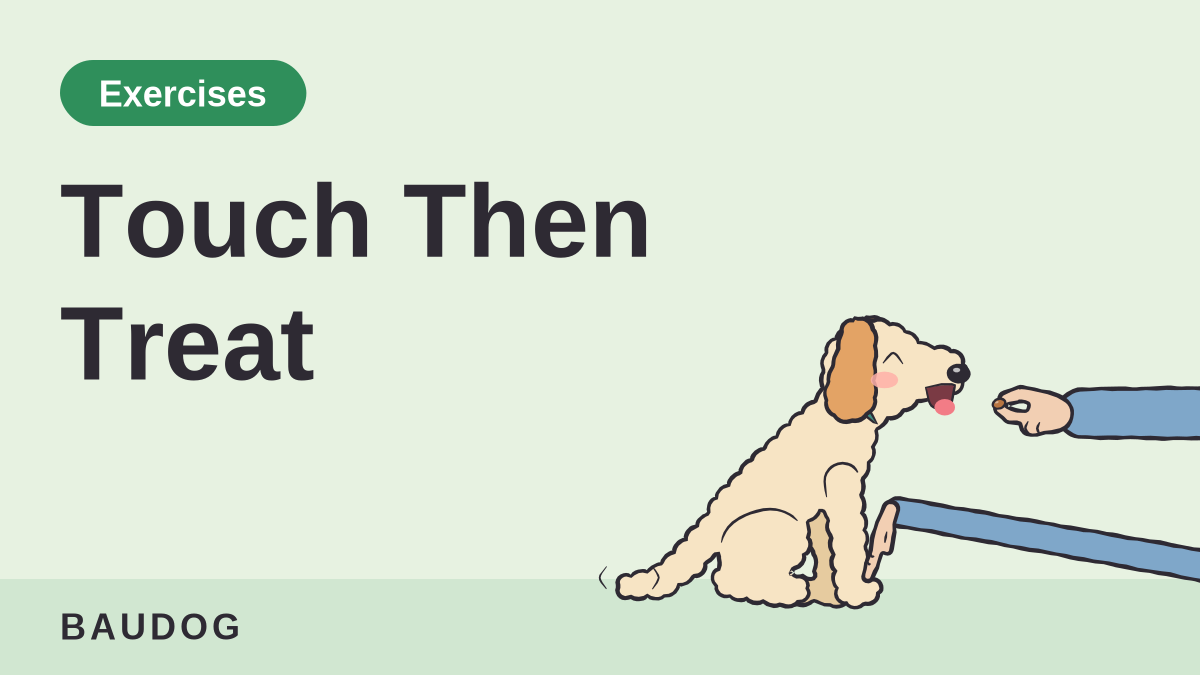
- Bites when touched (feet, ears, body, grooming): the root is anxiety about being handled. Use Touch Then Treat, starting with spots she’s happy with. For bites during grooming and care, the MSD Veterinary Manual recommends cooperative care — teaching her to take part using food rewards (see also our pages on nail trims and brushing).
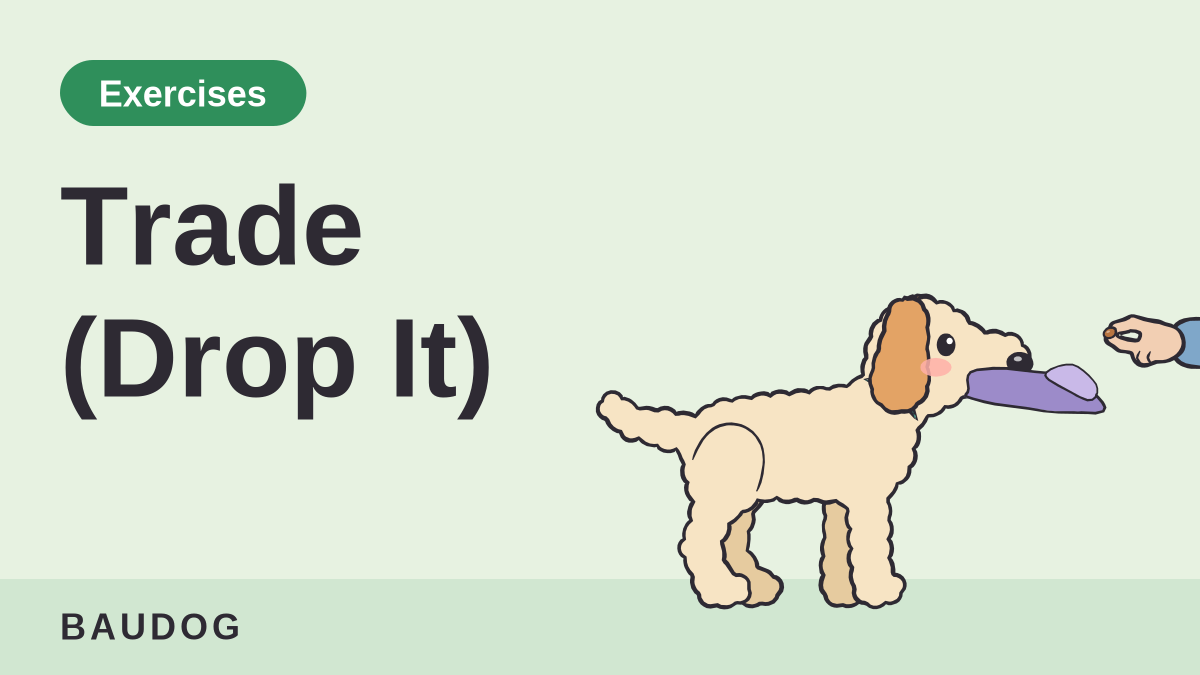
- Bites to guard things (food, chews, toys, her bed): taking things away makes her guard harder. The MSD Veterinary Manual suggests tossing her a high-value treat every time you walk past her bowl, and teaching “give” starting with low-value items swapped for high-value treats. See Trade (Drop It).
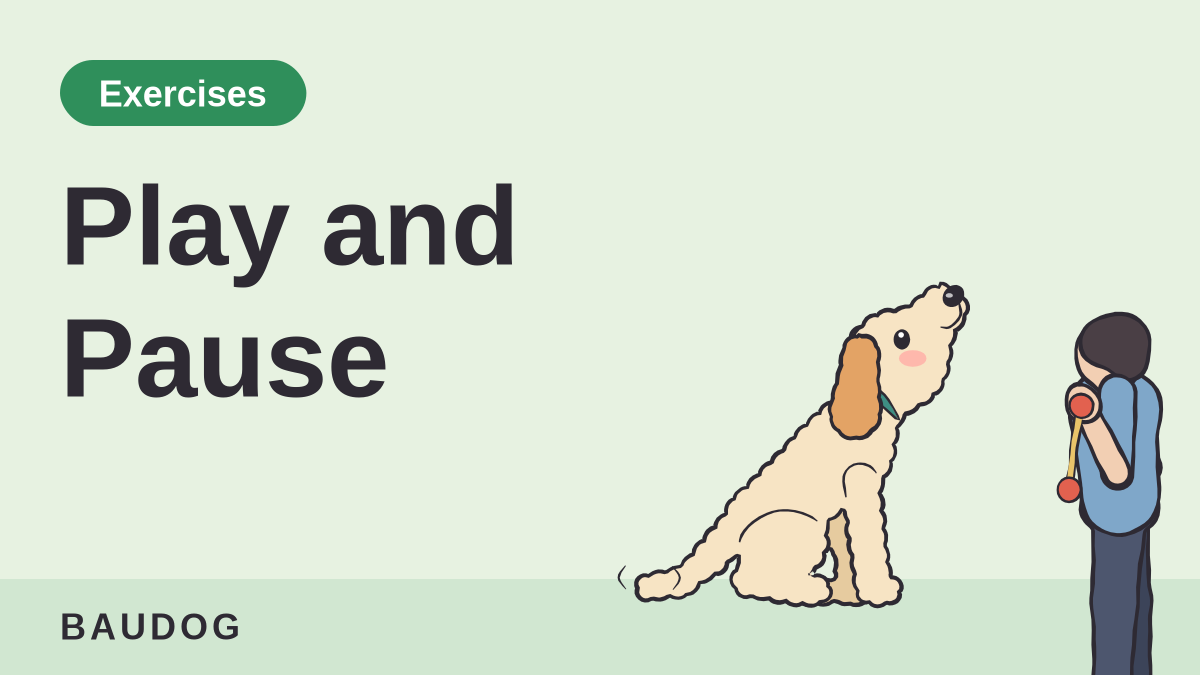
- Bites when play gets too exciting: the moment teeth touch skin, stop the game; once she’s calmer, go back to a game where biting a toy is fine. Scolding or pushing her away backfires. See Play and Pause.
- Bites when cornered by something scary (strangers, visitors, other dogs): first, create distance and don’t let them approach. Then, with a professional, work on showing her the scary thing from far away and pairing it with good things.
- No clear reason, or no pattern: don’t go it alone — have a professional assess her.
If a trainer came to your home: the first session and the first homework
Here is how we’d expect a first in-home session with a trainer or behavior professional to go for a dog who bites — one example from BAUDOG, not a fixed script. On day one, nobody tests her by putting her in a biting situation. The focus is on listening and making a safety plan.
- What the trainer looks at first: your bite log and any videos. Together you look at how she behaves when she’s relaxed and the signals that show she’s getting tense. If pain or illness might be involved, the trainer suggests seeing your vet first.
- Today: decide together how to set up your home so biting situations don’t happen (where she eats, baby gates, where she rests, which room she’s in when visitors come). Get the whole family reading her warning signals the same way.
- Homework (one example): every day, log any near-misses. Stick to the setup you agreed. Do just one exercise the trainer chose from the safest situation — for example, toss a treat each time you walk past her bowl at a distance, or touch the shoulder she’s fine with for one second, then treat. If she needs a muzzle, start by putting a treat inside so she pokes her nose in.
- At the next visit, the trainer checks: have the near-misses gone down? Are you spotting her signals earlier? During the homework exercise, did her body stay loose? If near-misses have gone up, the training doesn’t move forward; the plan is rethought (sometimes with medication, in discussion with your vet).
A muzzle isn’t a punishment: teach it slowly with treats
A muzzle isn’t a way to tell off a dog who bites; it’s a safety tool that protects people and your dog. The UK veterinary charity PDSA says a muzzle should never be used as a punishment and should always be a positive experience. A basket muzzle, which lets her open her mouth to pant and drink, is the one usually recommended. Muzzles that hold the mouth closed are for a few minutes only — at the vet, for example.
- Put the muzzle on the floor with tasty treats in and around it, until she’s relaxed seeing it.
- Feed treats through the gaps so she pokes her nose in — near the opening at first, then deeper.
- Once she’ll hold her nose all the way in, hold the straps behind her ears (don’t fasten them) → treat.
- Fasten the straps, give a treat, and take it off as soon as she’s finished. Gradually build up how long she wears it.
- If she only ever wears it on bad days, it will come to predict bad things. Put it on now and then on ordinary days too, with treats.
Started biting suddenly? Get her checked by a vet first
Pain and illness can make a dog more likely to bite. The ASPCA notes that besides acute pain, problems such as orthopedic conditions, thyroid or adrenal disease, cognitive decline, seizures and failing sight or hearing can make dogs more irritable and aggressive, and advises taking her to the vet before you do anything else. The MSD Veterinary Manual also says medical conditions must be identified before treating aggression.
This matters most for dogs who started biting in old age, or who bite only when picked up or touched on their hips or legs. Have your vet look for hidden pain.
It isn’t about dominance or “being the boss”
The idea that a dog bites because she thinks she outranks you — and that becoming the “alpha” will stop it — isn’t supported by modern veterinary behavior science. The MSD Veterinary Manual says aggression toward family members has been mislabeled as dominance, and that it mostly comes from fear, guarding and conflict.
The American Veterinary Society of Animal Behavior (AVSAB) says pinning down a frightened dog won’t address the root of her fear. It cites a survey (140 owners of dogs booked in at a behavior clinic, asked what methods they had tried before) in which confrontational techniques — hitting or kicking, the “alpha roll,” staring the dog down — frequently drew an aggressive response from the dog. Even a harsh telling-off or wagging a finger at her can provoke defensive aggression, such as growling or biting, if she feels threatened.
If she bites someone: first aid and what to report
Wash the wound straight away with soap and running water and get medical care. The World Health Organization advises washing the wound with soap and running water for about 15 minutes, getting medical care early, and a tetanus shot if the person isn’t up to date. Even small bites can become infected from bacteria in a dog’s mouth.
What happens next depends on where you live, so contact your local animal control or health department (US) or your council or the police (UK) to find out what applies to you. In the US, national rabies guidance says a healthy dog that bites someone should be confined and observed daily for 10 days, whether or not she’s vaccinated. In England and Wales, GOV.UK states that it’s against the law to let a dog be dangerously out of control anywhere — including in your own home — and a dog that injures someone counts as dangerously out of control. Scotland and Northern Ireland have their own rules.
Can a dog who bites be cured?
The ASPCA says some types of aggression can be reduced and sometimes eliminated, but there’s no guarantee that an aggressive dog can be completely cured; in many cases the solution is managing the problem by limiting her exposure to the things that set her off. Some families who keep avoiding the triggers and keep training do reach a point where they live together without bites.
A dog who warns before she bites is far safer to live with than one who bites without warning. Value the growl and the bared teeth — and when you see them, step back right away.
The missing core skill
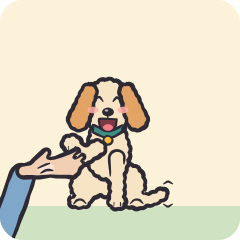 Core skill Comfort with Handling Feeling safe being touched and groomed. The root for dogs who bite when handled.
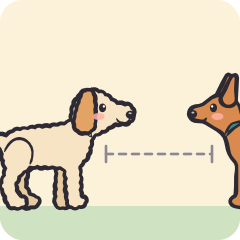 Core skill Confidence Taking people, things and places in stride. The root for dogs who bite when frightened and cornered.
 Core skill Settling Down Coming back down from play or excitement on her own. The skill to build for dogs who get so wound up they bite for real.
Exercises
- ExerciseTouch Then Treat: Help a Dog Who Hates Being Handled Learn to Enjoy ItDoable at home (Steps 1–5 at home)Even when a sensitive spot is touched, her body stays relaxed and she looks to you for the next treat.Read →
- ExerciseThe Trade Game: Teach Your Dog to Drop It by Swapping, Not GrabbingDoable at home (Steps 1–4 at home)On “Drop it,” she lets go of what’s in her mouth by herself — and she knows that letting go pays.Read →
- ExercisePlay and Pause: Teach Your Dog an “Off Switch” With TugDoable at home (Steps 1–3 at home)When play stops, she calms down by herself within a few seconds — sitting, lying down, relaxing or looking at you — and she knows that being calm gets the game going again.Read →
In the moment: do / don’t
Do
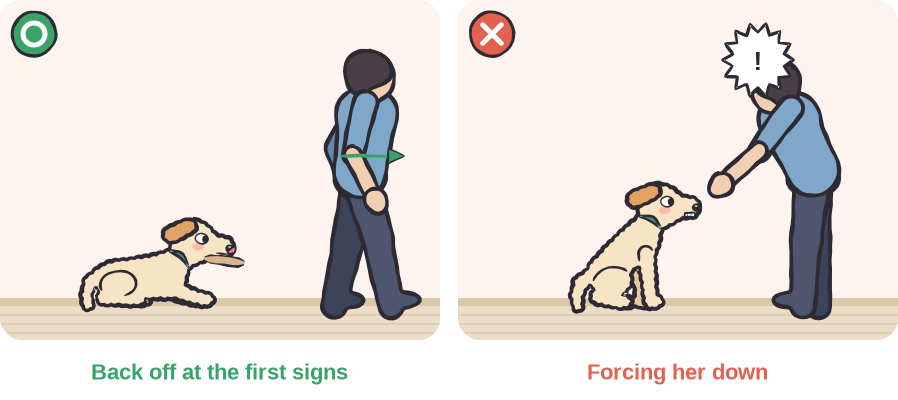
- When you see a signal (freezing, a hard stare, a growl), step back and take your hands away
- Give food and chews where she won’t be disturbed
- Keep a bite log and show it to a professional
- If she has started biting suddenly, see your vet first
- Teach a muzzle with treats and use it as a safety tool
Don’t
- Punish her for growling (she may start biting without warning)
- Hit her, roll her onto her back, grab her muzzle or stare her down
- Force things away from her when she’s guarding them
- Leave children alone with her
- Try to make her obey by force, believing that being the “alpha” will fix it
- Keep training on your own after a bite that broke the skin
When to see a professional
- A bite broke the skin or drew blood. Get help right away from a vet who sees behavior cases or a qualified trainer who doesn’t use punishment. In the US, the American College of Veterinary Behaviorists lists board-certified veterinary behaviorists; in the UK, the Animal Behaviour and Training Council keeps a register of assessed practitioners
- You live with children or older family members, or you can’t predict when she’ll bite
- She started biting suddenly, or only as an older dog. Pain or illness may be involved
- She bites only when touched in one area (hips, legs, ears). There may be hidden pain
- The bites are getting more frequent or harder, or aren’t improving with training
- She bit someone. The person should get medical care; ask your local authority what you need to report
Go to the root
Don’t stop at the quick fix. Growing the skill underneath makes other problems lighter too.
- Core skill Comfort with Handling
- ExerciseTouch Then Treat: Help a Dog Who Hates Being Handled Learn to Enjoy ItDoable at home (Steps 1–5 at home)Read →
- ExerciseThe Trade Game: Teach Your Dog to Drop It by Swapping, Not GrabbingDoable at home (Steps 1–4 at home)Read →
- ExercisePlay and Pause: Teach Your Dog an “Off Switch” With TugDoable at home (Steps 1–3 at home)Read →
Sources
- MSD Veterinary Manual (veterinary edition) — Behavioral Problems of Dogs (aggression)
- ASPCA — Aggression in Dogs
- Cornell Riney Canine Health Center — Dog Bite Prevention (April 2025)
- AVSAB — Position Statement on the Use of Dominance Theory in Behavior Modification of Animals
- AVSAB — Position Statement on Humane Dog Training (2021)
- Herron, Shofer & Reisner (2009). Survey of the use and outcome of confrontational and non-confrontational training methods in client-owned dogs showing undesired behaviors. Applied Animal Behaviour Science 117:47–54 (author PDF)
- PDSA — Muzzle training your dog
- WHO — Fact sheet: Animal bites
- National Association of State Public Health Veterinarians (2016). Compendium of Animal Rabies Prevention and Control, 2016. JAVMA 248(5):505–517
- CDC — Announcement: Release of the NASPHV 2016 Compendium of Animal Rabies Prevention and Control. MMWR 66(5):148
- GOV.UK — Controlling your dog in public
- GOV.UK — Controlling your dog in public: Report a dog
- legislation.gov.uk — Anti-social Behaviour, Crime and Policing Act 2014, section 106 (amending the Dangerous Dogs Act 1991)
- Veterinary Partner (VIN) — Top 10 Myths About Canine Behavior (Christine D. Calder, DVM, DACVB)
- American College of Veterinary Behaviorists (ACVB)
- Animal Behaviour and Training Council (ABTC)