 BAUDOG The dictionary of dog–human communication
Contents
What this skill is
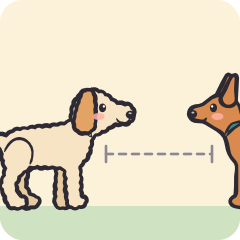
Confidence grows when your dog meets the things that worry her — strangers, other dogs, noises, new places — at a distance or volume where she can stay calm, and something good happens every time. Bit by bit, “scary” becomes “fine,” or even “great.” Pushing her closer to get her used to it can make the fear stronger. Puppyhood, up to about 3 months of age, matters most — but adult dogs can build confidence too, slowly. A dog who missed out as a puppy isn’t a lost cause.
How your dog feels
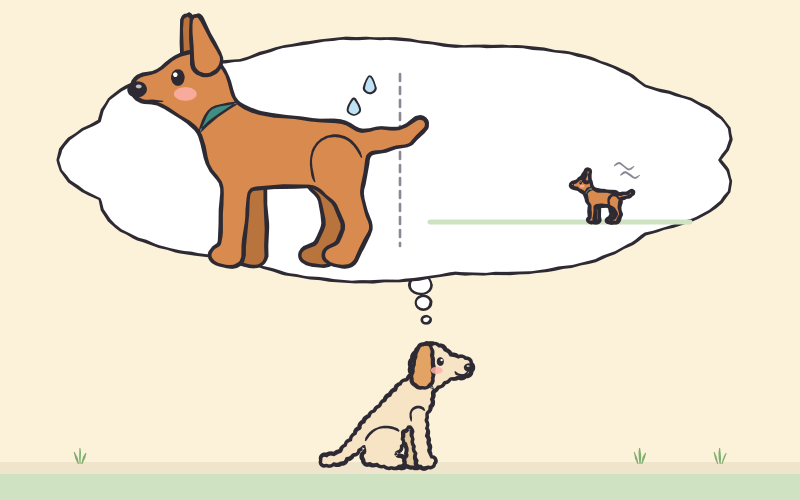
Barking and growling usually mean “don’t come closer.” Your dog wants more space between herself and the scary thing. Even barking at people outside the house that looks bold often comes from fear.
Signs of fear are small and quick, so they’re easy to miss: tail tucked, ears back, the whites of the eyes showing, body going stiff, refusing a treat she’d normally take. When you see these, she’s too close.
Comforting a frightened dog doesn’t make the fear worse. Dogs Trust says that if she comes to you for reassurance, calmly give her attention and comfort — ignoring her won’t help.
Fear of sounds and unfamiliar things is common. In a study based on an owner questionnaire covering more than 13,700 pet dogs in Finland, 32% were highly fearful of at least one noise (fireworks were the most common, at 26%), and 29% were fearful of things like strangers or other dogs. Noise fears became more common as dogs got older.
Assessment: where is your dog now?
A visiting trainer might start by watching what your dog is afraid of, and at what distance or volume. Check these three things.
How far away does the thing that worries her (a person, a dog, a sound) need to be for her to take her usual treats?
→That distance — or for a sound, that volume — is where practice starts. If she can’t eat, it’s too close (or too loud). If you’re starting with sounds indoors, that’s Stage 1; people or dogs outside, Stage 4 (from far away).
After a fright, how many minutes until she’s back to her normal self?
→The longer it takes, the more you should stop for the day and let her rest. After a day with several upsets, avoid her triggers for a while.
When she sees the thing she’s afraid of, what are her ears, tail, mouth and eyes doing?
→Ears back, tail down, mouth clamped shut, whites of the eyes showing, body frozen — she’s too close. Add distance. If she trembles non-stop, drools, or hurts herself trying to escape, see “When to see a vet” below.
Problems when this skill is weak
Signs this skill is weak
- Barks at other dogs or people
- Is scared of thunder, fireworks, the doorbell or household noises, or barks at them
- Won’t walk on walks, or freezes
- Growls or trembles
- Problems Dog Barking at Other Dogs on Walks: Why It Happens and How to Help Read →
- Problems Dog Barks at Strangers on Walks: Why It Happens and How to Help Without Scaring Her Read →
- Problems Dog Won’t Walk on a Leash? 5 Reasons Dogs Stop, Sit or Plant Their Feet — and What to Do Read →
- Problems Dog Scared of Thunder? What to Do During a Storm, and How to Help Long Term Read →
- Problems How to Stop a Dog From Barking: Find the Reason, Then Train Read →
- Problems Dog Barks at the Doorbell? Change What the Ding-Dong Means Read →
- Problems Dog Biting: Keep Everyone Safe First, Then Find Out Why and Fix It With a Professional Read →
- Problems Dog Growling: What It Means, Why You Shouldn’t Punish It, and What to Do Read →
- Problems Dog Barking at Visitors? How to Tell Why — and a Trainer’s Plan for the Front Door Read →
Prescription: a suggested order
Our suggested order: practices that can be finished at home come first, outdoor ones after. With a puppy (up to about 3 months), put Puppy Socialization first and run it alongside. If you came here from a specific problem, you can start the practice closest to it early.
- ExerciseGetting Used to Sounds Step by Step: Sound Desensitization for DogsDoable at home (Steps 1–3 at home)At home, start with the sound that bothers her at a volume so low she barely notices it, and follow every sound with a treat — so the sound starts to mean something good.Read →
- ExerciseScent Games for Dogs: Easy Treat Hunts With a Towel and Paper CupsDoable at home (Steps 1–3 at home)Treats scattered on the floor for her to find by smell. Learned at home, it gives her something calming to do outside when something worrying is in the distance.Read →
- ExerciseHand Target: How to Teach Your Dog “Touch” — and Use It for Recall and Passing Other DogsDoable at home (Steps 1–3 at home)Touching your palm with her nose. A clear signal for moving away from something scary, or coming back to you.Read →
- ExerciseLook at That (LAT): The Game That Helps Reactive Dogs Stay Calm Around Dogs and PeopleStart at home, finish outside (Step 1 at home)She sees the scary thing far away, then gets a treat. It builds the pattern “look at it, then look at you” (finished outdoors).Read →
- ExerciseEmergency U-Turn: Teach Your Dog to Turn and Walk Away HappilyStart at home, finish outside (Steps 1–2 at home)A quick turn and walk away when you’ve ended up too close. Her escape route, so she never feels cornered.Read →
- ExercisePuppy Socialization: How to Make New Things Good ExperiencesStart at home, finish outside (Steps 1–2 at home)For puppies: meeting lots of people, dogs, sounds and places without being frightened.Read →
How it grows
-
Level 1At home, quiet
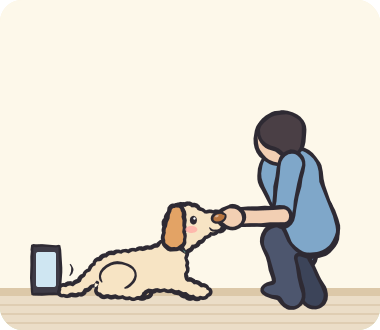
In a quiet room at home, she stays relaxed and eats treats while the sound that bothers her plays at a volume so low she barely notices it. The practice is Getting Used to Sounds Step by Step.
A good sign to move on At that volume she eats without stiffening, 10 times in a row (our rule of thumb)
-
Level 2At home, small distractions
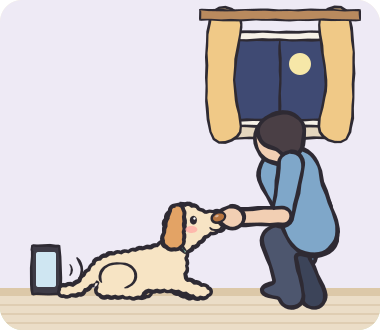
She can still eat in different rooms, at different times, and at a slightly higher volume. Don’t raise the volume every session — move it up and down, with an overall trend upward.
A good sign to move on In a different room and at a different time, she eats calmly at that volume
-
Level 3Quiet street
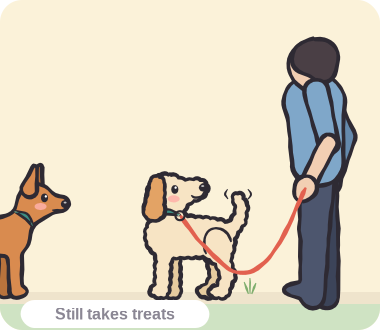
Outside, she can see the thing that worries her (a dog, a person, a car) far away and look at it, then back at you. Start at a distance where she can still eat — there’s no set number; around 65 ft (20 m) is one example.
A good sign to move on She looks back at you within about 3 seconds of seeing it, 8 out of 10 times (our rule of thumb)
-
Level 4Around distractions
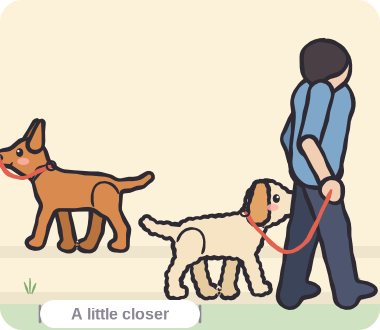
Close the distance little by little (passing at about 15 ft / 5 m, for example). During real thunder or a real doorbell, she can still enjoy a favorite game or treats.
A good sign to move on At that distance she passes without barking, 8 out of 10 times (our rule of thumb)
Principles
- If she can’t eat, she’s too close (or the sound is too loud). Take a step back.
- Order matters. The good thing comes after she sees or hears the scary thing.
- Never block her escape route, and don’t pick up a frightened dog and carry her closer. Forcing a dog to face her fear can make it worse — and a dog who can’t get away may bite.
- Don’t expose her suddenly and at length to loud sounds or close encounters to “get her used to it.” Veterinary guidance advises against this (it’s called flooding).
- If she comes to you scared, it’s fine to stroke her calmly and talk to her. Reassurance doesn’t make fear stronger.
- Keep sessions short and frequent. If she struggles, go back a stage (our rule of thumb: two misses in a row).
- Skip practice on a day full of upsets. Let her rest and do something fun instead.
When to see a professional
- She tries to bite, or growls and goes toward the thing she’s afraid of
- She panics (non-stop trembling, drooling, wetting or soiling herself, destroying things, hurting herself trying to escape)
- Fear is getting in the way of daily walks or visitors
- She used to be fine and has suddenly become fearful (pain or illness can be the cause)
- In these cases, talk to your vet (ideally one who sees behavior cases) or a professional who doesn’t use punishment. For strongly fearful dogs, medication alongside training can help it move forward.
Sources
- AVSAB — Position Statement on Puppy Socialization
- Dogs Trust — Why dogs get scared or frustrated and how to help them
- Dogs Trust — Reactive dogs: why it happens and how to help
- Dogs Trust — Helping your dog cope with fireworks
- MSD Veterinary Manual — Behavior Problems of Dogs (Fears, Anxiety, and Phobias)
- Salonen et al. (2020). Prevalence, comorbidity, and breed differences in canine anxiety in 13,700 Finnish pet dogs. Scientific Reports 10:2962
- Todd, Z. (2020). Survey Shows Which Treatments Are Effective for Fireworks Fears in Dogs (AVSAB blog, on Riemer 2020)