 BAUDOG The dictionary of dog–human communication
Contents
When to use this exercise
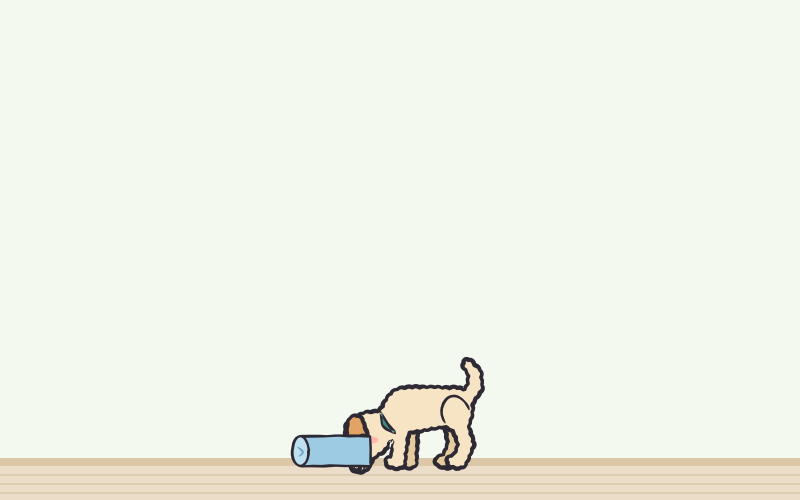
For rainy days, before she’s left alone, after exciting play, or for dogs who don’t enjoy walks. She uses her nose to find treats you’ve hidden. Sniffing is a natural dog behavior, and you can start with a towel, paper cups and a cardboard box from around the house. It builds Settling Down, Confidence and Being Alone. Every hunt ends with quiet rest.
GoalOn “Find it,” she sniffs out the treats you’ve hidden — and afterwards she can settle and rest.
Assessment: what a trainer might check on the first visit
Before starting, a visiting trainer might check something like these three things at home.
When a treat drops on the floor, does she look for it with her eyes or her nose?
→If she uses her eyes, spend longer on step 1 (in plain sight) and the start of step 2 (one cup).
Around food, does she growl, gulp it down fast or chase other dogs or people away?
→If so, talk to your vet or a behavior professional before playing food games. In a multi-dog home, play with one dog at a time.
After a hunt, can she settle and rest — or does it wind her up?
→If she stays wound up, hide fewer treats, and decide in advance where she’ll rest quietly afterwards.
What you need
- Small dry treats (not greasy or sticky), or part of her daily food — take it out of her daily allowance so she doesn’t overeat
- Things from around the house: a towel, paper cups, a cardboard box
- A marker word she already understands, “Yes” (the practice Charging Your Marker Word)
How to signal
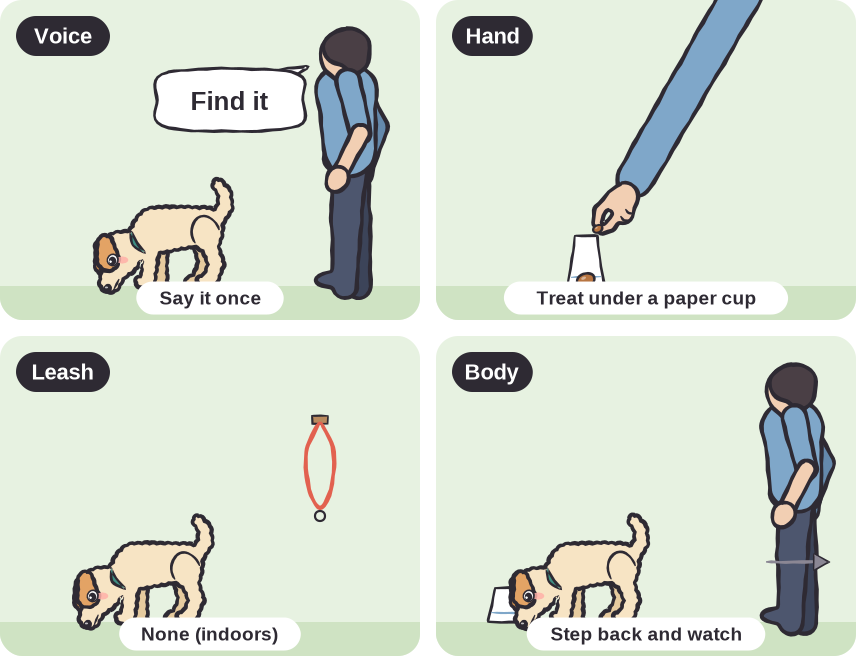
- Voice
Say “Find it” once before she starts. When she finds it, a quiet “Yes.”
- Hand
At first, place the treat where she can see it. Later, hide it out of sight. Don’t point everything out for her.
- Leash
None (at home). In the yard, only somewhere fenced.
- Body
Step back behind her and watch. If she gets stuck, go near the hiding spot with her and help.
Today’s session
With the trainer, you work on step 1.
Step 1In plain sight(At home, quiet)
First, you and the trainer check how she behaves around food (does she growl?). Put a treat on the floor right in front of your dog and say “Find it.” Next, while she watches, put one under a single paper cup and say “Find it.” Family members take turns, and you finish together by letting her rest somewhere quiet.
Homework until the next visit
- How often
- Once or twice a day
- How long
- About 5 minutes each
- How much
- Up to 5 hiding spots per session
A good sign she’s readyYou hide treats in 5 spots while she waits in another room, and she finds them all
What the trainer checks next visit
In front of the trainer: your dog waits in another room while you hide treats in 5 spots.
If she canIf she finds them all without getting stuck, move on: step 4 (scattering kibble in a fenced yard) becomes the next homework.
If not yetMake the hiding spots easier again (in plain sight, one cup) and do another week.
Next stages: steps
- 1
First, in plain sight At home, quiet
In plain sight
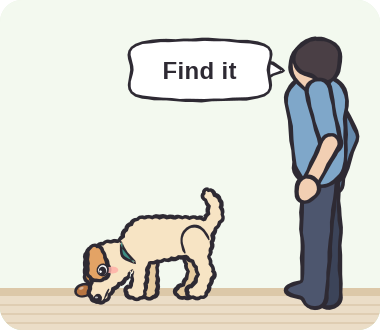
Put a treat on the floor right in front of her and say “Find it.”
A good sign to move onOn “Find it,” she goes straight to eat it
- 2
Start with one cup At home, quiet
Under a cup or in a towel
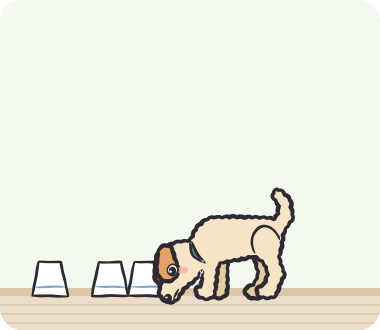
While she watches, put a treat under a single paper cup and say “Find it.” Once she’s got it, line up three cups with a treat under only one. Sprinkling treats on a towel and rolling it up works too.
A good sign to move onShe knocks the cup over with her nose, or unrolls the towel, and finds it
- 3
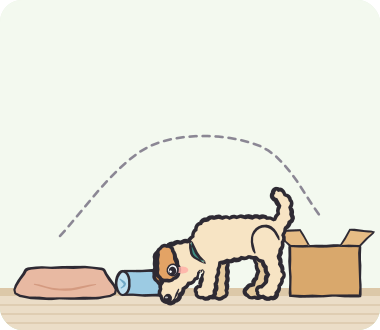
The whole room, searched by nose At home, small distractions
Around the room
Have her wait in another room while you hide treats in 5 spots around the room, then “Find it.” At the end, lure her out of the search area with a treat in your hand.
A good sign to move onFinds all 5
- 4
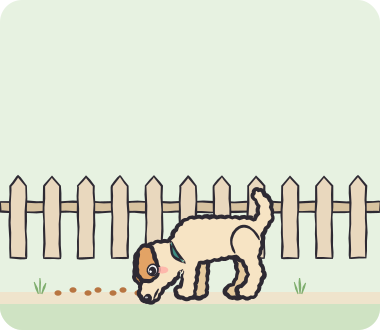
In the yard, she hunts for scattered kibble Yard, doorstep, outside the house
In a fenced yard
Scatter a handful of kibble on a clean patch of ground with nothing else lying around, and say “Find it.” Once she’s got it, scatter it on the grass.
A good sign to move onShe calmly sniffs along the ground to find it
Timing
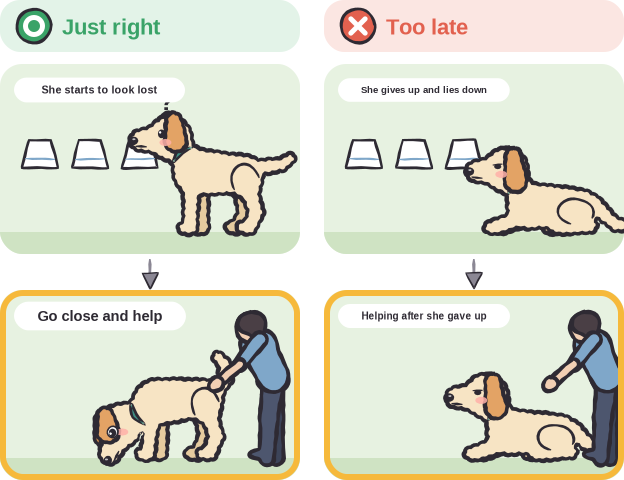
Just right
At first, put it right in front of her, so she can go straight to it the moment you say “Find it.”
Too late
Helping only after she can’t find it and has given up.
Battersea, a UK rescue charity, advises giving your dog a helping hand if she’s finding it too hard and getting frustrated. The American Kennel Club suggests luring your dog out of the search area with a treat at the end, which keeps her from searching on and getting frustrated when there’s nothing left to find.
How much and how often
About 5 minutes a session, up to 5 hiding spots. Once or twice a day — on rainy days, before she’s left alone, and after exciting play.
If it isn’t working
She gives up quickly
Make the hiding spots easier, use smellier treats, and if she’s getting frustrated, lend a hand.
Will it make her scavenge more?
Don’t hide food anywhere you don’t want her to rummage (Battersea). Keep the outdoor ground step to a fenced yard with nothing lying around. If she scavenges a lot, it’s fine to stick to the indoor steps.
She chews up the cups or towel and eats them
Play while you’re watching, and put things away if she starts tearing them up. Paper and cardboard are considered less likely to cause a blockage if a bit gets swallowed, but don’t let her eat fabric like towels (East Bay SPCA).
She growls over food, or there are other dogs
For a dog who growls over food, talk to your vet or a behavior professional before starting. In a multi-dog home, play with one dog at a time (Battersea).
Do sniffing games really calm dogs down?
Not much is known yet. In one study, 20 pet dogs were split into two groups of 10 and spent about five minutes a day for two weeks doing either nosework (searching by scent) or heelwork; only the nosework dogs responded more positively in a test afterwards. On the other hand, a separate study comparing the heart rates of 29 dogs found results suggesting higher emotional arousal while searching for food than while sniffing around on their own. And a small project report from Okayama University of Science in Japan (8 beagles; not a peer-reviewed paper) found the dogs spent more time searching with their noses the longer they kept practicing, while noting that evidence for nosework’s benefits is still very thin. That’s why BAUDOG recommends always ending a hunt with quiet rest.
Avoid
- Playing where there’s food lying around that she shouldn’t eat
- Taking away a treat she has found
- Letting a dog who growls over food play alongside other dogs or children
- Adding lots of treats on top of her daily food
A good sign to move on
- Steps 1–3: at that step, she finds them without getting stuck
- Step 4 (the yard) comes after she can find all 5 spots indoors
- If she struggles, go back one step — our rule of thumb is two hunts in a row where she can’t find them
Sources
- Dogs Trust Ireland — Scatter Feeding
- Dogs Trust Ireland — Towel treats
- Battersea — Brain Games for your dog (video transcript)
- American Kennel Club — Indoor Scent Games for Dogs
- American Kennel Club — How to Unleash Your Dog’s Super Sense of Smell
- Edmonton Humane Society — Canine enrichment: toys and games (PDF)
- East Bay SPCA — Canine Enrichment Handout (PDF)
- RSPCA Brighton & the Heart of Sussex — Enrichment (PDF)
- ASPCA — Food Guarding
- Duranton & Horowitz (2019). Let me sniff! Nosework induces positive judgment bias in pet dogs. Applied Animal Behaviour Science 211:61–66
- Berg et al. (2026). Behavior-related changes in canine heart rate and heart rate variability during short-term measurement. Applied Animal Behaviour Science 296:106899
- Saeki, Furumoto & Iwata (2021 project report, Okayama University of Science; in Japanese). Nosework and quality of life in dogs
- Dogs Trust — Mouthing, nipping and puppy biting