 BAUDOG The dictionary of dog–human communication
Contents
What this skill is
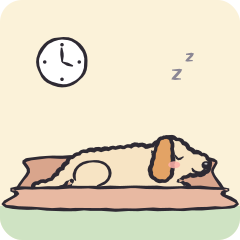
This skill grows by ending each stretch of time alone before your dog gets anxious — again and again — and lengthening it very slowly. Leave her alone for a long time all at once and she learns to be anxious instead. So while you’re training, not leaving her alone for longer than she can cope with matters as much as the practice itself. And scolding her when you get home doesn’t help: she can’t tell what she’s being scolded for, and her anxiety only grows.
How your dog feels
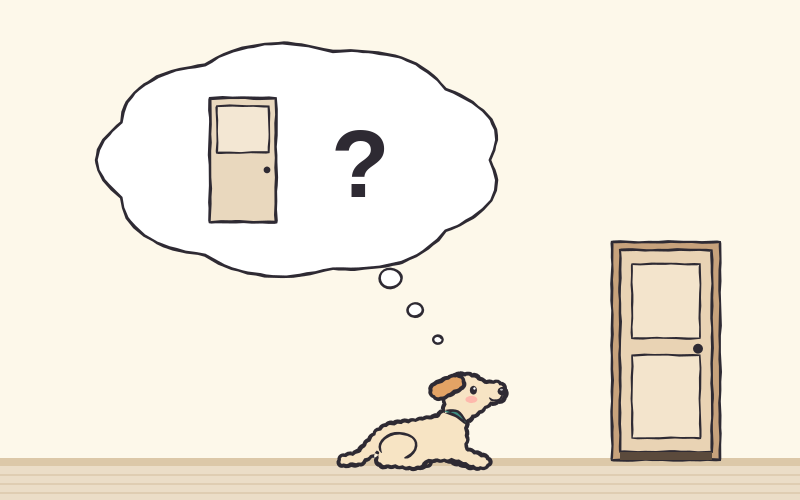
Dogs are social animals, so feeling worried when left alone isn’t strange. Dogs Trust explains that most often, a dog simply hasn’t learned yet that being alone is okay.
Barking, chewing and accidents while you’re out aren’t mischief or revenge — usually they’re signs of distress. The RSPCA says research suggests eight out of 10 dogs find it hard to cope when left alone, yet half don’t show any obvious signs, so owners can easily miss it. It recommends filming your dog from time to time while she’s alone.
When she flattens her ears and makes herself small as you come home, it isn’t because she “knows she did something wrong.” In a small experiment with 14 dogs, the owner left the room after telling the dog not to eat a treat, and researchers varied whether the dog had actually eaten it. The “guilty look” had nothing to do with whether the dog had eaten the treat — it showed up more when owners scolded, and most clearly when an obedient dog who hadn’t eaten it was scolded anyway.
A dog who follows you around the house isn’t something to worry about in itself. Veterinary guidance (the MSD Veterinary Manual) says dogs that follow family members around are at no greater risk of separation anxiety than dogs that don’t. What tells you more is how she behaves once she’s alone.
Assessment: where is your dog now?
A visiting trainer might start by watching a phone video of your dog home alone with you. Check these three things.
When you go into another room and close the door, how many seconds until she whines, scratches at the door or starts pacing? (Film it on your phone.)
→Start practice with a stretch shorter than that. If it takes only a few seconds, begin with one step behind a baby gate (Stage 1).
Does she get restless just from you picking up your keys, putting on a coat or putting on shoes?
→Her worry starts while you’re getting ready to leave. Practice with short “training departures,” separate from your real outings, and come back before she gets anxious.
What does she do in the first 30 minutes you’re gone? Does she eat from a treat-stuffed toy she loves when you’re home?
→If she eats it when you’re there but not when she’s alone, that’s a sign of anxiety. If she barks non-stop, drools, chews at doors or windows, or has accidents, see “When to see a vet” below.
Problems when this skill is weak
Signs this skill is weak
- Barks non-stop, chews things up or has accidents when left alone
- Whines or scratches at the door when you go into another room
- Cries at night when she’s in a room by herself
- Gets restless when you start getting ready to go out, and stands between you and the door
- Problems Puppy Crying at Night: What to Do — and When an Older Dog’s Night Crying Needs a Vet Read →
- Problems Leaving Your Dog Home Alone: How Long Is OK, and How to Build Up to It Read →
- Problems Dog Separation Anxiety: Signs, Treatment, and When to See a Veterinary Behaviorist Read →
- Problems Dog Hates the Crate? How to Tell Protest from Panic, and Start Over the Right Way Read →
- Problems How to Stop a Dog From Barking: Find the Reason, Then Train Read →
Prescription: a suggested order
Our suggested order: start by practicing calm time on her own while you’re still nearby. If she shows strong signs of distress when alone, talk to your vet (ideally one who sees behavior cases) alongside the practice.
- ExerciseRelaxing on a Mat: How to Teach Your Dog to SettleDoable at home (Steps 1–4 at home)She learns to relax on her mat even while you’re nearby doing other things. The groundwork for alone-time practice.Read →
- ExerciseBuilding Alone Time Step by Step: Training Your Dog to Stay Home AloneDoable at home (Steps 1–3 at home)Behind a baby gate → behind a door → outside the front door. Coming back before she gets anxious, over and over, slowly stretches her time alone.Read →
- ExerciseScent Games for Dogs: Easy Treat Hunts With a Towel and Paper CupsDoable at home (Steps 1–3 at home)Scent games and treat-stuffed toys give her something enjoyable to do while she’s alone.Read →
- ExerciseMaking the Crate a Happy Place: Step-by-Step Crate Training Your Dog Will ChooseDoable at home (Steps 1–4 at home)Only if your household uses a crate. For a dog who likes it, it’s a calm den — but some dogs find being shut in hard. Check on video that she’s settled.Read →
How it grows
-
Level 1At home (behind a baby gate)
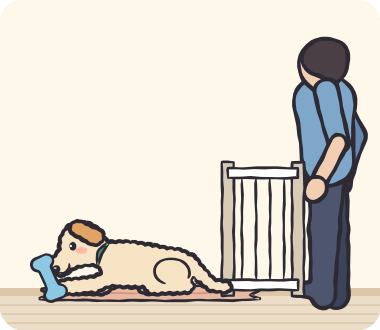
Give her a chew on her side of a baby gate and step to the other side. Start where she can still see, hear and smell you.
A good sign to move on You stay on the other side of the gate for 2 minutes and she keeps chewing (our rule of thumb)
-
Level 2At home (behind a door)
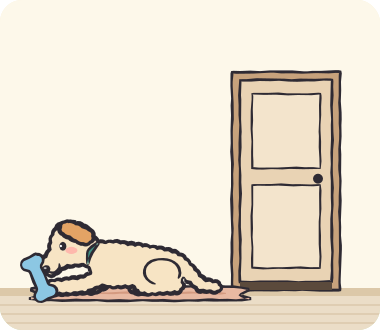
Go into another room and close the door. Mix short and long stretches, lengthening the time overall.
A good sign to move on You’re behind the door for 5 minutes and the video shows her relaxed, 5 times in a row (our rule of thumb)
-
Level 3Outside the front door
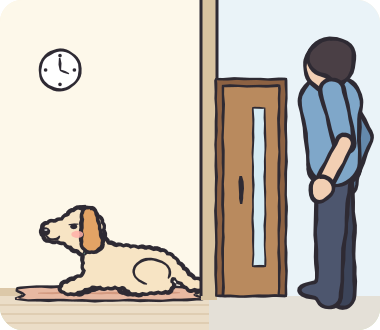
Step out of the front door and close it. Start with a few seconds.
A good sign to move on You’re outside for 5 minutes and the video shows her calm, 5 times in a row (our rule of thumb)
-
Level 4Real outings
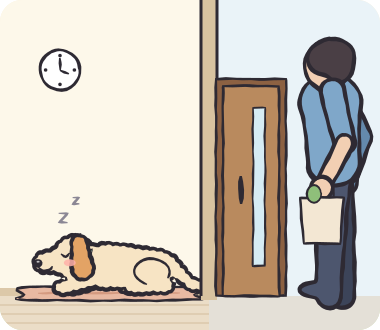
Build up from short trips — taking out the trash, a quick errand. Keep it to 4 hours at most.
A good sign to move on On a 30-minute outing, the video shows her calm, 5 times in a row (our rule of thumb)
Principles
- Come back before she gets anxious. Don’t make it a practice of coming back once she’s crying.
- While you’re training, don’t create longer stretches alone than she can handle — lean on family, friends, a dog sitter or doggy daycare. Without this, the progress from practice falls apart.
- Don’t leave her to “cry it out.” All she learns is that being alone is terrifying.
- Keep leaving and coming back low-key. A calm goodbye or hello is enough.
- Don’t scold her when you get home. If there’s a mess, let her out first, then clean up without a word.
- Before you go, give her a walk and a toilet break, and a special something she gets only when she’s alone, like a treat-stuffed toy. Put it away when you’re back.
- Don’t leave her alone for more than 4 hours at a time (much less for puppies).
When to see a professional
- When alone, she drools, trembles, licks or chews herself raw, damages doors or windows trying to get out, or won’t eat at all
- She used to be fine alone and has suddenly started hating it (failing hearing or eyesight, or illness, can be the cause)
- In these cases, talk to your vet (ideally one who sees behavior cases). For strong separation anxiety, medication alongside training can help it move forward. Training can take months.
Sources
- Dogs Trust — Separation anxiety in dogs: signs, causes and how to help
- Dogs Trust — How to help your dog get used to spending time alone
- RSPCA (UK) — How to train your dog to stay home alone
- RSPCA (UK) — Recognising separation-related behaviour and anxiety in dogs
- MSD Veterinary Manual — Behavior Problems of Dogs (Separation Distress Disorder)
- Horowitz, A. (2009). Disambiguating the “guilty look”: salient prompts to a familiar dog behaviour. Behavioural Processes 81:447–452