 BAUDOG The dictionary of dog–human communication
Contents
When to use this exercise
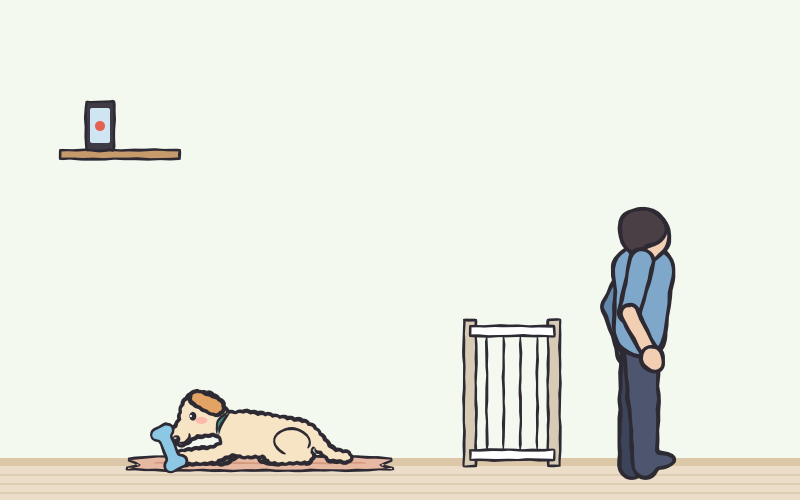
For a dog who barks or chews things up when left, cries in a room on her own at night, or whines whenever you’re out of sight in the house. You end each stretch alone before she gets anxious — again and again — and lengthen it a little at a time. The most important part: while you’re training, never leave her alone for longer than she can cope with. If that slips, the practice can’t move forward.
GoalEven when she can’t see you, she lies down, relaxed, and waits.
Assessment: what a trainer might check on the first visit
Before starting, a visiting trainer might check three things while watching a phone video with you.
After you leave the room, how many seconds until she whines, scratches at the door, paces or drools?
→Practice starts with a stretch shorter than that. If it takes only a few seconds, begin with one step behind the baby gate — or simply standing up.
Does she eat from a treat-stuffed toy when she’s alone, as she does when you’re there?
→If not, that’s a sign of anxiety. Before stretching her time alone, spend longer on calm time with you nearby (step 1).
Does she get restless just from you picking up keys, putting on a coat or shoes?
→Her worry starts while you’re getting ready. Use a “safety signal” for practice departures that’s different from your real ones (see “When it’s not working” below too).
What you need
- A phone or pet camera (record every session)
- A baby gate
- A long-lasting chew or a treat-stuffed toy (something special she gets only when alone)
- An item to use as a “safety signal” (a towel or small blanket that has never been part of your real departures)
How to signal
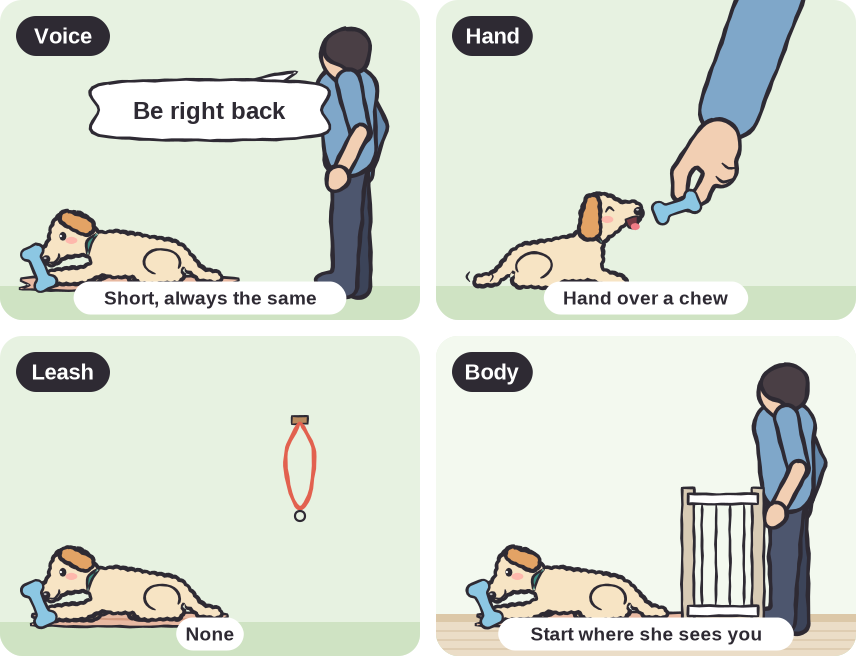
- Voice
Leaving: something short and always the same, like “See you later.” Coming back: a calm, low-key hello is enough.
- Hand
Before you go, hand her a chew or treat-stuffed toy. Put it away when you’re back.
- Leash
None.
- Body
Behind the gate → behind a door → outside the front door: out of sight a little at a time. Start where she can still see, hear and smell you.
Today’s session
With the trainer, you work on step 1.
Step 1Safety signal and a chew(At home (you’re nearby))
First you and the trainer watch a video of your dog home alone and see how many seconds it takes for signs of anxiety to appear. Next you choose a towel as her “safety signal” and do step 1: put the towel where she can see it, give her a chew, and sit quietly on a nearby chair. When she’s finished, put the towel away — and only then give her attention. If she’s calm, go as far as one step past the gate and straight back. You check the video with the trainer: did you come back before any signs of anxiety?
Homework until the next visit
- How often
- 1–3 times a day
- How long
- Sessions up to about 10 minutes (steps 1–4; our rule of thumb)
- How much
- A few departures per session at most
A good sign she’s readyYou stay beyond the gate for 2 minutes and she keeps chewing (our rule of thumb)
What the trainer checks next visit
Watch the homework videos with the trainer: the longest stretch, and — if there was one — the number of seconds before signs of anxiety appeared.
If she canIf she stayed relaxed throughout 2 minutes beyond the gate on video, move up: step 3 (behind a door) becomes the new homework.
If not yetGo back to just short of the point where signs of anxiety appeared. If strong signs keep showing up, talk to your vet (ideally one who sees behavior cases) as well.
Next stages: steps
- 1
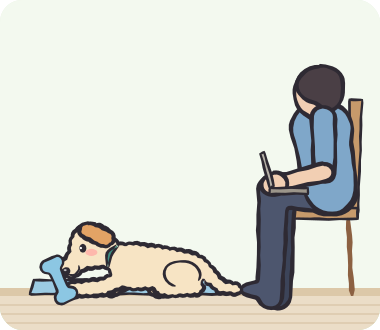
While the signal is out, no attention At home (you’re nearby)
Safety signal and a chew
Put the signal towel where she can see it and give her a chew. Sit quietly nearby and leave her be. When she’s finished, put the towel away, then give her attention. As she gets used to it, wait a little longer after she finishes before you put it away, and add standing up and taking a few steps.
A good sign to move onShe keeps chewing even when you stand up and walk about
- 2
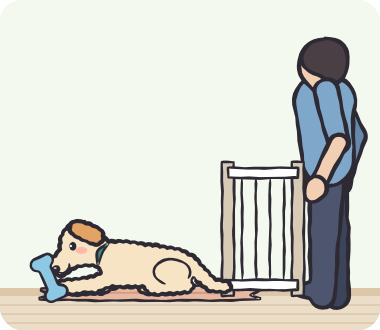
Start where she can see and hear you At home (behind the gate)
Beyond the gate
Give her a chew on her side of the gate, step one pace beyond it → come straight back. Using, say, 5 seconds → 30 seconds → 2 minutes as milestones, stretch it gradually. Add no more than 10–20% of the last successful length at a time (our rule of thumb). Don’t lengthen it every time — mix short and long.
A good sign to move onYou stay beyond the gate for 2 minutes and she keeps chewing (our rule of thumb)
- 3
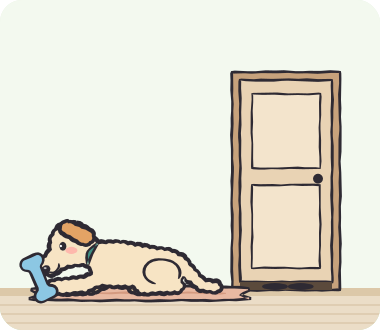
Even out of sight At home (behind a door)
Behind a door
Drape a cloth over the gate so she can’t see through, or go into another room and close the door, then come straight back. Stretch it gradually, mixing lengths (3 minutes, 1 minute, 4 minutes, for example). Use the camera to check she’s relaxed.
A good sign to move onYou’re behind the door for 5 minutes and the video shows her relaxed, 5 times in a row (our rule of thumb)
- 4
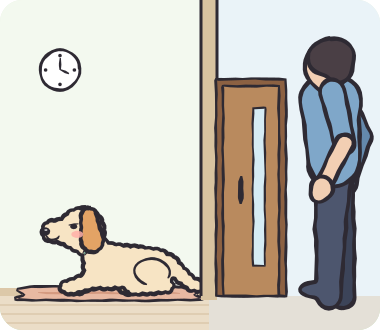
Outside the front door Outside the front door
Outside the front door
Step out of the front door, close it, a few seconds → back. Using, say, 30 seconds → 1 minute → 5 minutes as milestones, stretch it gradually while mixing lengths (no more than 10–20% at a time; our rule of thumb).
A good sign to move onYou’re outside for 5 minutes and the video shows her calm, 5 times in a row (our rule of thumb)
- 5
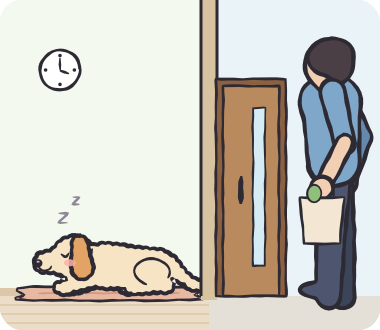
Start with short trips Real outings
Real outings
Taking out the trash, a quick errand: using, say, 10 minutes → 30 minutes as milestones, stretch it gradually (no more than 10–20% at a time; our rule of thumb). Walk her and give her a toilet break before you go. Keep it to 4 hours at most.
A good sign to move onOn a 30-minute outing, the video shows her calm, 5 times in a row (our rule of thumb)
Timing
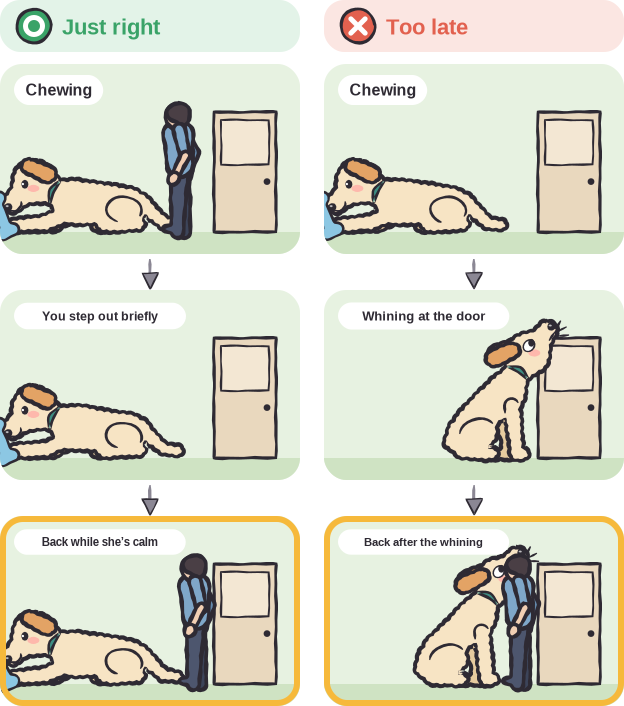
Just right
Come back while your dog is still calm. Learn from the video how many seconds it takes for her to get restless, and return before that.
Too late
Coming back once she has started crying. That teaches her “crying brings you back.”
Dogs Trust explains that returning while she’s still barking makes barking more likely next time — but simply waiting until she stops before you go back won’t change how she feels about being alone. So practice with stretches short enough that you’re back before she cries. Veterinary guidance (the MSD Veterinary Manual) likewise says practice departures should be short enough not to trigger anxiety, and recommends checking with video.
How much and how often
Sessions up to about 10 minutes (steps 1–4; our rule of thumb), about 1–3 times a day. Lengthen your time away overall, mixing short and long stretches, by no more than 10–20% of the last successful length at a time (our rule of thumb).
If it isn’t working
She starts crying within seconds
Start even earlier: just standing up, or just walking toward the gate. Spend longer on step 1 (you’re nearby).
I have to leave her for longer than she can manage — I work
Until the practice catches up, avoid any absence longer than she can cope with: family at home, friends, a dog sitter or doggy daycare. Dogs Trust says this is the only way to stop the problem getting worse, and the MSD Veterinary Manual likewise advises leaving a dog with separation anxiety alone as rarely as possible.
She gets restless as soon as I pick up my keys or put on my coat
The long-standing approach is to pick up the keys or put on the coat and then just sit down, over and over, so getting ready no longer predicts leaving (RSPCA Australia). More recent veterinary guidance (the MSD Veterinary Manual) recommends, for dogs with moderate to severe separation anxiety, a different route: before each practice departure, put out a “safety signal” that has never been part of your real departures, so she learns that departures with this signal are always short and you’ll be back before she gets anxious. Decide which to use with your trainer or vet.
Can I leave her in a crate?
If she likes her crate and relaxes in it, yes. But some dogs find being shut in hard in itself. Check on video that she’s calm; if not, leave her in the room where she usually rests.
How long until she can stay home alone?
It varies a lot from dog to dog. Veterinary guidance notes that for dogs with strong anxiety, the training can take months. Don’t rush; move on only when the video shows she’s calm.
Avoid
- Scolding her when you get home
- Suddenly leaving her for a long time partway through training
- Going back while she’s crying
- Leaving her to “cry it out”
A good sign to move on
- Step 1: she keeps chewing even when you stand up and walk about
- Step 2: you stay beyond the gate for 2 minutes and she keeps chewing
- Steps 3–5: at that place and length, the video shows her calm, 5 times in a row
- Stretch the time gradually (our rule of thumb: no more than 10–20% of the last successful length). These are all our rules of thumb
- If signs of anxiety appear, go back to just short of that point
Sources
- Dogs Trust — Separation anxiety in dogs: signs, causes and how to help
- Dogs Trust — How to help your dog get used to spending time alone
- RSPCA (UK) — How to train your dog to stay home alone
- RSPCA (UK) — Recognising separation-related behaviour and anxiety in dogs
- RSPCA Australia Knowledgebase — What can I do if my dog is anxious when I’m not at home?
- MSD Veterinary Manual — Behavior Problems of Dogs (Separation Distress Disorder)
- Dogs Trust — How to Stop Your Dog Barking: Causes & Triggers