 BAUDOG The dictionary of dog–human communication
Contents
- In short
- When it happens
- How your dog feels
- Assessment: where is your dog now?
- Start with a one-week barking diary
- If a trainer came to your home: the first session and the first homework
- Cut down the chances to bark
- What to do when she barks — or is about to
- What about teaching “quiet” — and the “3 bark rule”?
- The skill and the practice for each kind of barking
- Why we don’t recommend anti-bark collars, sprays or muzzles
- Neighbors complaining?
- The goal is less barking, not zero
- The missing core skill
- Exercises
- In the moment: do / don’t
- When to see a professional
- Sources
In short
There’s no such thing as “barking for no reason.” Your dog is telling you something: go away, I’m excited, I’m bored, I’m worried on my own. Scolding doesn’t remove the reason, so the barking comes back. First, note when and at what she barks, so you know which kind it is. Next, cut down the chances to bark — frosted film on the window, for example — and reward the moments she stays quiet. Then start the practice that fits her kind of barking (relaxing on a mat, getting used to sounds starting very quietly), at home first. The goal is less barking, not none. If the barking started suddenly, see your vet first.
When it happens
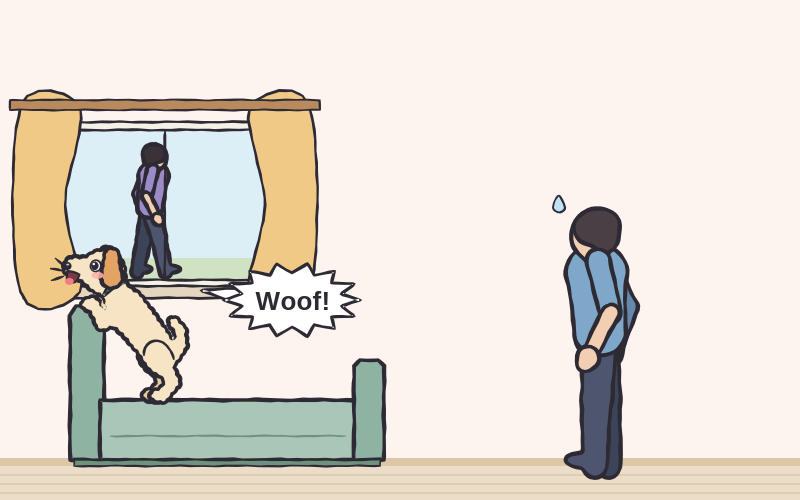
- Every time someone walks past, your dog rushes to the window and barks
- She barks inside at noises outside — a car door, the mail carrier, a delivery van
- When the family comes home or during play, she barks and can’t stop
- A neighbor mentioned that she barks while you’re out
- Since she got older, she has started barking in the middle of the night
How your dog feels
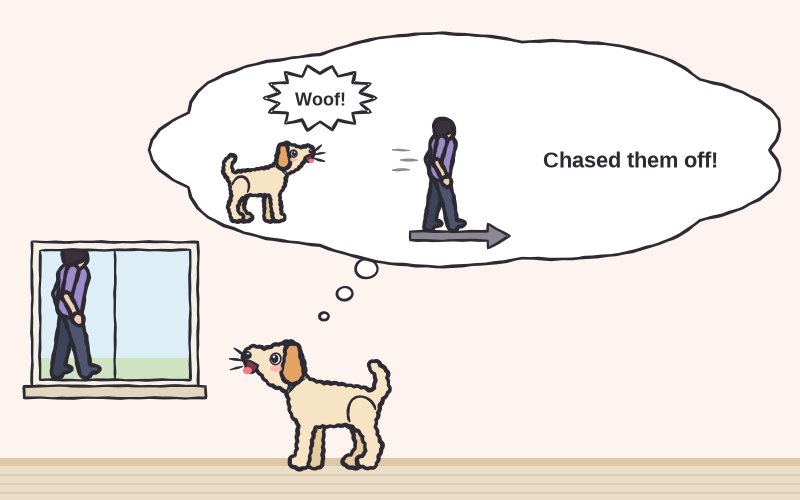
Barking is a normal way for dogs to communicate. The UK charity Dogs Trust puts it simply: dogs don’t bark to be mean or naughty — they’re just trying to communicate. Usually they’re trying to make something good happen (play with me, come here) or to stop something bad (stay away).
A dog who barks at people passing the window is usually a little scared, or too on edge to relax. And while she barks, the passer-by walks on. From her side, “I barked and it went away.” Every time this happens the barking works, and it becomes a habit. A dog who is always on lookout duty has, as Dogs Trust says, a stressful job with no time off.
If you scold her while she’s barking, she may think you’re joining in — or she may become afraid of you as well (Dogs Trust). Either way, the reason for the barking is still there.
Assessment: where is your dog now?
First, work out which kind of barking it is. A visiting trainer would ask questions like these, or ask to see a video. The ones that fit tell you where to start (more than one can apply).
Does she bark only when nobody is home — only when she’s alone?
→It may be barking from worry about being alone. Film her with your phone while you’re out to check. If you also see drooling, scratching at the door, accidents, or not eating anything, read the home-alone and separation-anxiety pages and “When to see a vet” below. The practice is Building Alone Time Step by Step.
Does she bark at the window, at noises or at the doorbell, body stiff and leaning forward?
→This is alert barking. First cut down the chances to bark (block the view at the window, for example), then start Relaxing on a Mat and Getting Used to Sounds Step by Step at home. If it’s the doorbell, see that page too.
Is her body loose, tail wagging, bark high-pitched — when people come home, when visitors arrive, during play?
→This is happy, excited barking. Play and Pause and Relaxing on a Mat build her ability to come back down from excitement on her own.
Does she look at you while she barks, and stop once you move or give her something?
→This is demand barking — see the demand-barking page. Don’t respond while she barks; respond the moment she goes quiet.
Does she bark when there’s nothing else to do? Or pace and bark on and on at nothing at all?
→If it’s boredom, add more time for her brain and body: walks and Sniffing Games. If she barks repeatedly and for long stretches at nothing, talk to your vet or a behavior professional.
Did the barking start suddenly when she never used to bark? Is she a senior who has started barking at night?
→See your vet first. Pain, failing hearing or eyesight, and changes in the aging brain can all make dogs bark more.
Start with a one-week barking diary
Dogs Trust in the UK and the ASPCA in the US both say the first step is finding out why your dog barks. Writing it down beats remembering. Our rule of thumb is one week — a notebook or your phone is fine.
- When (time and day): is she barking at the same times — trash collection, the mail, the school bus?
- Where: at the window, the front door, in the yard, in her crate
- At what: people walking past, other dogs, car noises, the doorbell, family members
- How much: how many barks, and how many seconds (or minutes) until she stopped
- What happened just before and just after: the person left, someone in the family spoke to her, a treat appeared
- Her body: stiff and leaning forward (alert), loose with a wagging tail (happy), trembling or drooling (scared or worried)
- While you’re out, watch a video (is she barking only when she’s alone?)
If a trainer came to your home: the first session and the first homework
Here is how we’d expect a first in-home session to go — one example, not a fixed script. Barking work usually starts right where the barking happens: inside your home. And the first job isn’t a training exercise at all — it’s cutting down the chances to bark. If barking keeps working several times a day, practice can’t catch up.
- Today: talk through the barking, then look together at the places your dog keeps watch from (the window, the back of the sofa, the front door). Decide what you can change today — window film, moving the sofa away from the window, a radio on. Then try step 1 of Relaxing on a Mat together (she steps on the mat → a treat on the mat).
- Homework: keep the barking diary (the list above) every day. Keep the changes in place. Relaxing on a Mat once or twice a day, about 5 minutes each. When you catch your dog being quiet, praise her softly and give her a treat. Don’t scold barking.
- Next visit: go through the diary together and pin down the kind of barking, and the times and places it happens most. Check whether she steps onto the mat and lies down straight away when you put it down (our rule of thumb: 8 out of 10 times). That decides the next homework — sound practice, the excitement switch, or alone-time practice.
- If she barks only when you’re out, or the video shows strong signs of distress, talk to your vet (ideally one who sees behavior cases) before the trainer, or alongside.
Cut down the chances to bark
Dogs Trust’s groundwork for barking is to change your home and routine so your dog can’t keep practicing barking — the more she barks, the stronger the habit gets.
- Windows: close the curtains or blinds, or put frosted film on the glass. Move the sofa or other furniture away from the window so she can’t climb up to look out. Use a baby gate to keep her away from the window
- Sound: put on a radio or TV to mask the noises outside. At night, let her sleep in the quietest part of the house
- Predictable triggers (trash collection, the mail, the school bus): at those times, keep her in a room away from the window, busy with a chew or a sniffing game
- Deliveries: have parcels sent to a pickup point or locker, and put a note on the door asking drivers to call or text instead of knocking or ringing
- Yard: don’t leave her out there on her own. Go out at quiet times of day and stay with her. If she starts staring out and keeping watch, bring her in before she barks
- On a stressful day — a vet visit, say — Dogs Trust advises assuming she’ll bark at every trigger for the next 24–48 hours and avoiding triggers altogether. Pick quiet walking routes and let her rest
What to do when she barks — or is about to
It’s far easier to stop barking before it starts than after. She looks toward the window and goes still, her ears swing forward: that’s the moment to step in.
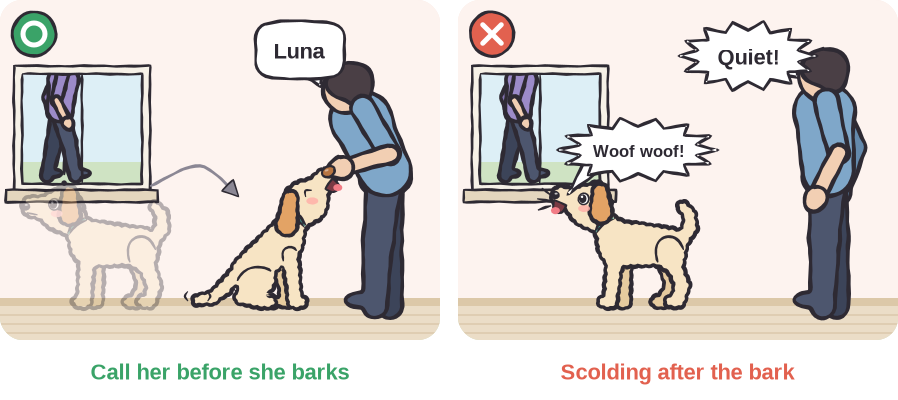
- Before she barks: say her name once, brightly, call her away from the window, and give her a treat when she arrives. If she then does a cue she knows (sit, or going to her mat), reward again
- Once she has started: don’t scold. Call her away from the window, or walk over calmly and move to another room. Opening the fridge or rustling a treat bag can interrupt the barking (Dogs Trust) — but don’t hand her the food right away: ask for a cue she knows, like sit, and reward that
- Don’t miss the quiet moments: whenever she stays quiet in a situation where she’d normally bark, give her several extra-special treats — what Dogs Trust calls a “jackpot” reward
- Open the crate or gate only once the barking stops — at first, even one second of quiet is enough. Then gradually lengthen the quiet wait, mixing long and short: 5 seconds, 12, 3, 20 (Humane World for Animals, the US charity formerly called the Humane Society of the United States)
- Don’t ask “Who’s there?” and look out of the window with her. That cheers the barking on (ASPCA)
- If she looks at you while she barks, it’s demand barking — follow the steps on the demand-barking page. When you start ignoring it, the barking may get worse for a while before it gets better (Dogs Trust)
What about teaching “quiet” — and the “3 bark rule”?
You’ll often see the advice to let your dog bark a few times, then say “quiet.” The ASPCA describes it this way: allow three to four barks, then say “Quiet” once, clearly and calmly — no shouting. If you’ve heard of a “3 bark rule,” this is the kind of advice people mean: a few alert barks are fine, and you step in after that.
The ASPCA’s reward-based version: as you say “Quiet,” feed a steady stream of tiny treats while she’s silent. After several days or more, once she stops barking as soon as she hears the word, slowly stretch the gap between “Quiet” and the treats — 2 seconds, then 5, then 10, then 20. The same ASPCA page also describes gently holding the dog’s muzzle closed with your hand, and — if “Quiet” still hasn’t worked after 10 to 20 tries — startling her by shaking keys or a can of pennies. We leave both out. They stop barking with something the dog finds unpleasant: the American Veterinary Society of Animal Behavior (AVSAB) lists shaker noise cans among the intimidation methods trainers should avoid, and RSPCA Australia notes that punishment may stop barking for a while but often makes the problem worse.
“Quiet” is a tool for the moment, not a cure. It doesn’t change why she barks, so use it alongside the steps above and the practice for her kind of barking.
The skill and the practice for each kind of barking
Under most barking sits one of three skills. Your assessment and diary decide where to begin; the practice list further down puts them in order, with the reason for each.
- Alert or fearful barking (window, noises, doorbell) → Confidence and Settling Down. Play the sound that bothers her at a volume so low she barely notices it, then follow it with a treat; pair this with Relaxing on a Mat. Don’t force her to face something she wants to get away from (Dogs Trust)
- Happy, excited barking → Settling Down. Stopping mid-game (Play and Pause) and Relaxing on a Mat
- Boredom barking → plenty of sniffing time on walks, and Sniffing Games at home. Keep daily routines — meals, walks, play — at about the same times each day (RSPCA)
- Barking from worry about being alone → Being Alone. Building Alone Time Step by Step: come back before she gets anxious, again and again. While you’re practicing, don’t leave her alone for longer than she can cope with (Dogs Trust). More on the home-alone and separation-anxiety pages
- Barking at other dogs or people (on walks, at visitors) → see the pages on barking at other dogs, at people, and at visitors
Why we don’t recommend anti-bark collars, sprays or muzzles
Anti-bark collars shock, vibrate, beep or spray when the dog barks — they stop barking by making something unpleasant happen. Dogs Trust says quick fixes like these rarely solve the problem without causing new ones.
- The reason for the barking (fear, worry) doesn’t change; only the sound is switched off. Dogs Trust warns that these collars can teach a dog to bite without warning
- If the timing is off, the collar punishes the wrong thing — like being quiet. Not knowing what set it off can leave a dog anxious all the time, and barking even more (Dogs Trust)
- She stops barking only while the collar is on. Take it off and the barking comes back (Dogs Trust, ASPCA)
- RSPCA Australia adds that yelling, spraying water or anti-bark collars may stop barking for a while but often make it worse, because they can increase fear, anxiety and even aggression
- The ASPCA calls anti-bark collars punishment devices, not a first choice — especially for barking driven by fear or anxiety. The AVSAB states there is no evidence that aversive methods are necessary for dog training or behavior modification
- Don’t use a muzzle to keep her quiet. A correctly fitted muzzle lets a dog open her mouth, so it doesn’t stop barking (Dogs Trust). Tying the mouth shut, or leaving a muzzle on for long periods, is dangerous and inhumane (ASPCA)
Neighbors complaining?
Let them know early that your dog is in training — Dogs Trust suggests this, and neighbors are often more patient when they know you’re working on it. Ask them when they hear it — if it happens while you’re out, they may be the only ones who hear it. A video of her home alone will show you, too.
Barking can also become a legal matter. In the UK, a neighbor who can’t sort it out with you can complain to the local council about the noise. In the US, the rules depend on your city or county. New York City, for example, treats an animal’s noise as unreasonable if it’s plainly audible inside a neighbor’s home for 10 minutes straight in the daytime, or 5 minutes at night (10 p.m. to 7 a.m.). Check your local rules — and start the steps above now rather than waiting for a complaint.
The goal is less barking, not zero
The ASPCA says it isn’t realistic to expect a quick fix, or to expect a dog to stop barking altogether — the goal is to reduce it. We wouldn’t ask a person never to speak, either. Some breeds bark more because of their history as guarding or herding dogs (Dogs Trust). And the longer a dog has been barking, the longer it takes to change (Humane World for Animals). So be wary of anything that promises to stop barking “in seconds.”
The missing core skill
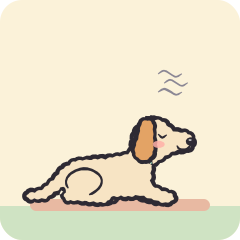 Core skill Settling Down If she can’t stop once she starts, she hasn’t learned to switch off her own excitement yet. This is the ability to relax when nothing is happening.
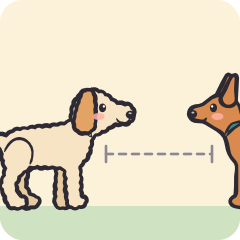 Core skill Confidence Barking at people outside the window or at noises often comes from “unfamiliar = scary.” This is the ability to turn scary things into things she can ignore.
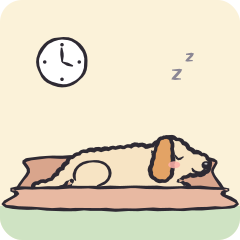 Core skill Being Alone If she barks only when she’s alone, the root is worry about being alone. This is the ability to feel safe even when she can’t see you.
Exercises
Our suggested order: practices that can be finished at home come first. But the right practice depends on her kind of barking — start the one that matches your assessment early, alongside the mat work.
- ExerciseRelaxing on a Mat: How to Teach Your Dog to SettleDoable at home (Steps 1–4 at home)Groundwork for every kind of barking. Once she learns to relax on the mat, it becomes her place to go when there’s a noise or a visitor.Read →
- ExerciseGetting Used to Sounds Step by Step: Sound Desensitization for DogsDoable at home (Steps 1–3 at home)For barking at noises, the doorbell or traffic. Start with a sound so quiet she barely notices it, and follow every sound with a treat.Read →
- ExerciseScent Games for Dogs: Easy Treat Hunts With a Towel and Paper CupsDoable at home (Steps 1–3 at home)For boredom barking. Searching with her nose tires her brain and settles her. It also works to redirect her when she’s about to bark.Read →
- ExercisePlay and Pause: Teach Your Dog an “Off Switch” With TugDoable at home (Steps 1–3 at home)For dogs who keep barking from happiness or excitement. She learns to pause mid-game and calm herself down.Read →
- ExerciseBuilding Alone Time Step by Step: Training Your Dog to Stay Home AloneDoable at home (Steps 1–3 at home)For barking only when she’s alone. Coming back before she gets anxious, over and over, slowly stretches her time alone.Read →
In the moment: do / don’t
Do
- When she’s about to bark, say her name, call her away from the window, and reward her when she comes
- When she stays quiet where she’d normally bark, give her several extra-special treats
- Block the view from the window and move the sofa away from it
- Keep a diary of when and at what she barks
Don’t
- Scold or shout (she’ll think you’re joining in, or become afraid of you)
- Ask “Who’s there?” and look out of the window with her
- Use shock, spray, vibration or ultrasonic anti-bark collars
- Push a scared dog who wants to get away closer to what scares her
When to see a professional
- She never used to bark and has suddenly started. Pain or illness can be behind it — see your vet first
- An older dog barks at night, gets lost in the house, or has a changed sleep pattern. It can be changes in the aging brain, failing eyesight or hearing, or joint pain
- She doesn’t turn when you call, or reacts to sounds differently. Hearing loss can make dogs bark more
- When alone, she doesn’t just bark — she drools, chews at doors or windows, has accidents, licks herself raw, or won’t eat while you’re out. This can be separation anxiety. Talk to your vet, ideally one who sees behavior cases; medication alongside training can help it move forward
- She barks for long stretches at nothing, repeating the same movements. Talk to your vet or a behavior professional
- She tries to bite or lunges at people or dogs while barking. Don’t push her closer; get help from a professional who doesn’t use punishment
Go to the root
Don’t stop at the quick fix. Growing the skill underneath makes other problems lighter too.
- Core skill Settling Down
- ExerciseRelaxing on a Mat: How to Teach Your Dog to SettleDoable at home (Steps 1–4 at home)Read →
- ExerciseGetting Used to Sounds Step by Step: Sound Desensitization for DogsDoable at home (Steps 1–3 at home)Read →
- ExerciseScent Games for Dogs: Easy Treat Hunts With a Towel and Paper CupsDoable at home (Steps 1–3 at home)Read →
Sources
- Dogs Trust — How to Stop Your Dog Barking: Causes & Triggers
- ASPCA — Barking
- RSPCA (UK) — How to stop your dog barking too much
- Humane World for Animals (formerly the Humane Society of the United States) — How to get your dog to stop barking
- RSPCA Australia Knowledgebase — My neighbour’s dog is constantly barking and disturbing me, what should I do?
- Dogs Trust — Separation anxiety in dogs: signs, causes and how to help
- MSD Veterinary Manual — Behavior Problems of Dogs
- AVSAB — Position Statement on Humane Dog Training (2021)
- New York City Administrative Code §24-235 (Animals), Noise Control Code