 BAUDOG The dictionary of dog–human communication
Contents
What this skill is
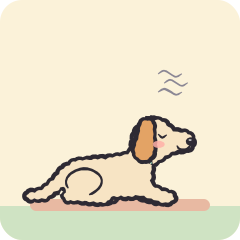
Settling Down is your dog’s ability to come back down from excitement by herself — and to let her body and mind go loose and rest when nothing is happening. It’s easy to mix up with Impulse Control. The difference is stopping versus unwinding. Impulse Control is the brake: she stops herself from doing something she wants to do. Settling Down is the engine slowing: the excitement itself drops. Holding the brake down while the engine is still racing is hard for dogs, too. A study that compared pet dogs with assistance dogs bred and trained for low arousal (106 dogs in all) found that when people encouraged them eagerly, the more excitable pet dogs did worst on a detour task — going around a barrier instead of straight at the reward. The Merck Veterinary Manual likewise notes that highly aroused dogs tend to react reflexively, which interferes with their ability to learn, and that arousal sometimes has to come down before training can proceed. That’s why BAUDOG treats Settling Down as the groundwork for Impulse Control. If your dog can’t stop mouthing, jumping or barking at the doorbell after play or visitors, start here.
How your dog feels
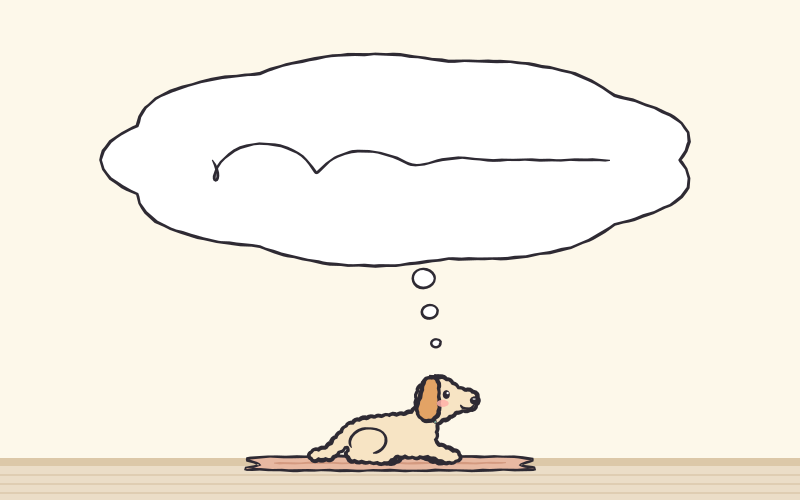
Excitement isn’t something that stops because you said “stop it.” It’s a state of the body. Telling her off can even wind her up further. The Merck Veterinary Manual says arousal can be brought down by teaching the dog to settle on cue and by keeping the intensity of what’s around her low.
A relaxed dog has an open, loose mouth, ears in their natural position, and eyes of a normal shape. A low body and head, a tucked tail, ears back, yawning and lip-licking together are signs of a worried, uncomfortable dog (the UK’s RSPCA). Learn to tell these apart, and reward the moments she’s loose.
Sleep is closely tied in. Dogs Trust in the UK and other organizations say puppies need around 18–20 hours of sleep a day. Yet a UK study that asked owners how long their dogs slept found an average of 11.2 hours a day at 16 weeks, among 352 dogs whose owners answered at both 16 weeks and 12 months. How sleep is counted — an owner’s estimate, and what counts as sleep — may explain the gap. Rather than counting hours, watch whether she keeps playing when she’s clearly tired.
If you want to test a new skill again right after a session, save the wild play for a bit later. In one study, 53 pet dogs learned new commands and then spent an hour sleeping, walking, learning something else, or playing with a Kong toy. Only the toy group did worse on the test straight afterwards, which the researchers put down to high emotional arousal. (About a week later this group had improved too, so what they learned wasn’t lost.)
Assessment: where is your dog now?
A visiting trainer might start by watching her everyday behavior at home. Try these three. Where she struggles is where you begin.
After a really good play session, how many minutes before she lies down on her own?
→If she won’t lie down and keeps moving, start at Stage 1 (at home, quiet): relaxing on a mat and scheduled naps.
Does she ever lie down and rest on her own in a room where the family is moving around?
→If not, keep up Stage 1 while moving to Stage 2 (at home, small distractions): resting on her mat while people walk past.
If you stop the toy in the middle of play, how many seconds before she calms down?
→If she keeps barking, jumping or biting after you stop, start Play and Pause with very short bursts of play. Our rule of thumb: once she calms within 10 seconds of stopping, 8 times out of 10, you can move on to the outdoor stage (Stage 4).
Problems when this skill is weak
Signs this skill is weak
- Puppy biting that won’t stop once play starts
- Barking on and on at the doorbell or noises
- Jumping on visitors, or humping when excited
- Lots of demand barking
- Trouble settling at night, or crying at night
- Problems How to Stop a Dog From Barking: Find the Reason, Then Train Read →
- Problems Dog Barks at the Doorbell? Change What the Ding-Dong Means Read →
- Problems Dog Barking at Visitors? How to Tell Why — and a Trainer’s Plan for the Front Door Read →
- Problems How to Stop Puppy Biting: When It Ends, What Works, and When It’s Not Play Read →
- Problems Dog Humping: Why Dogs Hump and How to Stop It Read →
- Problems Dog Hates the Crate? How to Tell Protest from Panic, and Start Over the Right Way Read →
- Problems Demand Barking: How to Stop It Without Just Ignoring Your Dog Read →
- Problems Puppy Crying at Night: What to Do — and When an Older Dog’s Night Crying Needs a Vet Read →
- Problems Potty Training a Puppy (or an Adult Dog): A Trainer’s Plan for Fewer Accidents in the House Read →
- Problems Leaving Your Dog Home Alone: How Long Is OK, and How to Build Up to It Read →
- Problems Dog Separation Anxiety: Signs, Treatment, and When to See a Veterinary Behaviorist Read →
- Problems How to Stop Your Dog Jumping on People: Why Dogs Jump and What Works Read →
- Problems Dog Chewing the Leash on Walks? 4 Reasons Dogs Bite the Leash — and How to Stop It Without a Tug-of-War Read →
- Problems Dog Scared of Thunder? What to Do During a Storm, and How to Help Long Term Read →
- Problems Dog Biting: Keep Everyone Safe First, Then Find Out Why and Fix It With a Professional Read →
Prescription: a suggested order
BAUDOG’s suggested order. Begin with Relaxing on a Mat and Play and Pause. Both can be done at home, so it’s fine to start them side by side.
- ExerciseRelaxing on a Mat: How to Teach Your Dog to SettleDoable at home (Steps 1–4 at home)A portable mat that means “here I can relax.” The most basic building block of Settling Down.Read →
- ExercisePlay and Pause: Teach Your Dog an “Off Switch” With TugDoable at home (Steps 1–3 at home)Practice bringing excitement back down: stop the game, and when she’s calm, play resumes.Read →
- ExerciseScent Games for Dogs: Easy Treat Hunts With a Towel and Paper CupsDoable at home (Steps 1–3 at home)For rainy days and after exciting play. A nose game always ends with quiet rest.Read →
- ExerciseMaking the Crate a Happy Place: Step-by-Step Crate Training Your Dog Will ChooseDoable at home (Steps 1–4 at home)A den she chooses to go into and rest. Use it to shape naps and night sleep.Read →
- ExerciseGetting Used to Sounds Step by Step: Sound Desensitization for DogsDoable at home (Steps 1–3 at home)For dogs wound up by the doorbell or noises. Start with quiet sounds.Read →
- ExerciseFour on the Floor: Teaching Your Dog to Greet People PolitelyDoable at home (Steps 1–2 at home)Turns the excitement of visitors and homecomings into a greeting with all four paws on the floor.Read →
How it grows
-
Level 1At home, quiet
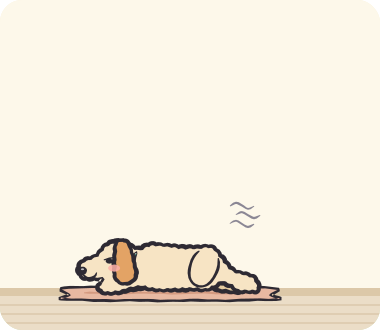
In a quiet room, she lies on her mat with her hips rolled to one side and her chin on the floor. Nap times are set and she sleeps well. The first homework starts here.
A good sign to move on Relaxes on the mat with her chin down for about 5 minutes (our rule of thumb)
-
Level 2At home, small distractions
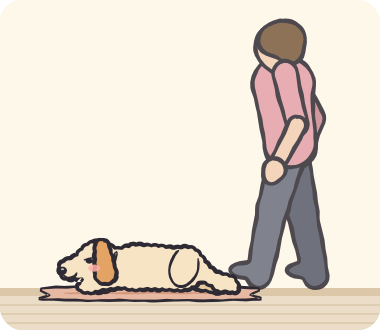
She can rest on her mat even when the family is moving around the room. When play stops, she calms quickly.
A good sign to move on Calms within 10 seconds of play stopping, 8 times out of 10
-
Level 3A quiet park or outdoor café
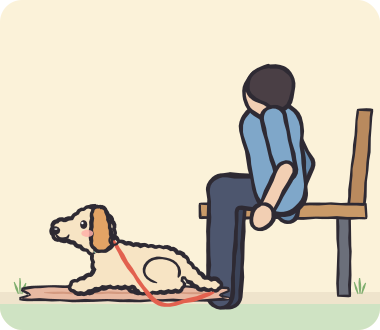
On a park bench or at an outdoor café, she lies on her mat and watches the world go by. Start at quiet times and places.
A good sign to move on Lies on her mat outdoors for 5 minutes, in 3 different places
-
Level 4Around distractions
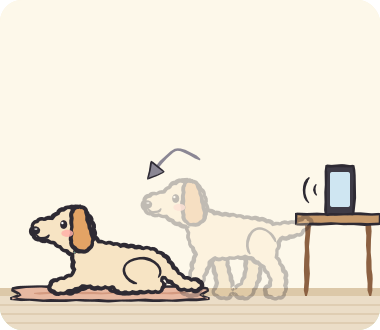
Even after the doorbell, a visitor or the sight of another dog, she can go back to her mat and calm down. Start far from what bothers her, or with quiet sounds.
A good sign to move on Lies down on her mat within 30 seconds of the trigger, 8 times out of 10
Principles
- When you catch her being calm, quietly reward it on the spot. Reward relaxed behavior, not excitement.
- Practice the mat when she’s already a little tired (after a walk or play). At first, reward as soon as she lies down; later, wait a couple of seconds before placing the treat on the mat. Build the waiting time at her pace.
- Never use the mat or crate as punishment. Keep it a place where good things happen.
- Tell her when she can leave the mat with a release word (“Free”).
- Build “nothing happening” time into her day. After play or a walk, make time to rest or chew.
- After exciting play, give her something calming to do: sniffing, licking, chewing. That said, searching for food can itself wind dogs up a little. A study that compared the heart rates of 29 dogs in five situations found results suggesting higher emotional arousal while searching for food than while sniffing around on their own. BAUDOG’s routine is that a food hunt always ends with quiet rest.
- Raise only one thing at a time — duration, distance, distractions or place. If she struggles, go back one stage (our rule of thumb: two misses in a row). No scolding.
- Keep sessions short — a few minutes; 3 to 5 is a good rule of thumb — and stop while she still wants more.
When to see a professional
- She can’t rest — she paces constantly, trembles, pants or whines nonstop. These can be signs of anxiety. Talk to your vet or a behavior professional
- She used to rest well and has suddenly become restless. Pain or illness can be behind it. Have your vet check her first
- She can’t settle at all when family members are out of sight. Read Being Alone, and if it’s severe, talk to a professional
Sources
- Battersea — My dog won’t settle: teaching your dog to be calm and relaxed
- RSPCA NSW — Teaching your dog to chill (PDF)
- Merck Veterinary Manual (pet owner version) — Normal Social Behavior in Dogs
- Merck Veterinary Manual (professional version) — Behavioral Problems of Dogs
- RSPCA — Understanding your dog’s body language
- Dogs Trust — Mouthing, nipping and puppy biting
- Kinsman et al. (2020). Sleep Duration and Behaviours: A Descriptive Analysis of a Cohort of Dogs up to 12 Months of Age. Animals 10(7):1172
- Kis et al. (2017). The interrelated effect of sleep and learning in dogs (Canis familiaris); an EEG and behavioural study. Scientific Reports 7:41873
- Bray, MacLean & Hare (2015). Increasing arousal enhances inhibitory control in calm but not excitable dogs. Animal Cognition 18:1317–1329
- Berg et al. (2026). Behavior-related changes in canine heart rate and heart rate variability during short-term measurement. Applied Animal Behaviour Science 296:106899
- American Kennel Club — Impulse Control for Dogs: Dog Self-Control Training
- American Kennel Club — How To Teach Your Dog To Go to Their Place
- VCA Animal Hospitals — Anxiety Vests for Dogs