 BAUDOG The dictionary of dog–human communication
Contents
- In short
- When it happens
- How your dog feels
- What kind of accident is it? Five questions
- If a trainer came to your home: the first session and the first homework
- How to potty train a puppy (or an adult dog — the method is the same)
- Is the “one hour per month of age” rule true? How often should you take her out?
- She pees inside right after coming in
- Puppy pads, apartments and the move outdoors
- House training an adult or rescue dog
- How long does potty training take?
- Excitement peeing and marking
- The missing core skill
- Exercises
- In the moment: do / don’t
- When to see a professional
- Sources
In short
Potty training is building one idea, over and over, without letting it fail: going in the right place makes something good happen. Your dog doesn’t arrive knowing where the bathroom is, and a puppy’s body can’t hold on for long yet. So take her to her spot at the times she’s most likely to need it — right after waking, after meals, after play — go out with her, and reward her the moment she finishes. Don’t scold accidents; it teaches dogs to hide. And if accidents suddenly increase, she goes very often, or there’s blood in her urine, see your vet before you change the training. A dog straining with little or nothing coming out needs a vet immediately.
When it happens
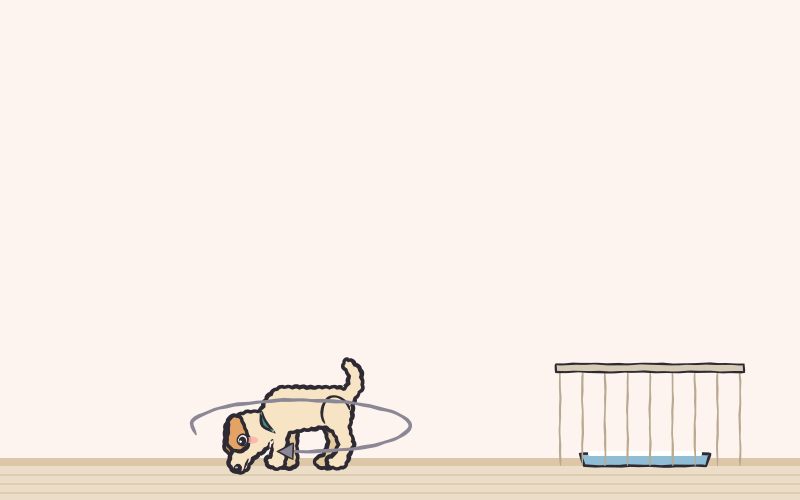
- Your dog stands on the pad, but the puddle ends up just over the edge
- She goes on the rug or behind the sofa — always somewhere you weren’t looking
- You come in from a ten-minute trip outside, and she pees on the kitchen floor
- She was doing so well, and now the accidents are back
- She holds it all the way through the walk, then goes the moment you’re home
- When you come home or pick her up, she leaks a little from sheer excitement
How your dog feels
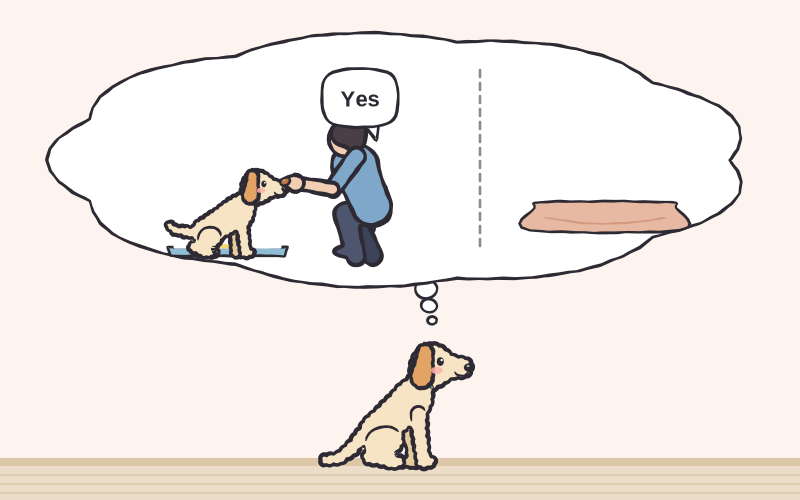
Dogs don’t come knowing where the bathroom is. They learn a “usual spot” through the feel of the ground under their paws and the smell of the place. The Merck Veterinary Manual notes that puppies start to develop a habit of eliminating in certain places at 8 to 9 weeks of age, which is why it pays to start house training early.
Dogs also prefer not to soil the place where they sleep. That’s why keeping her bed well away from her potty spot helps, and why a crate or playpen is useful when you can’t watch her: it works with that instinct instead of against it.
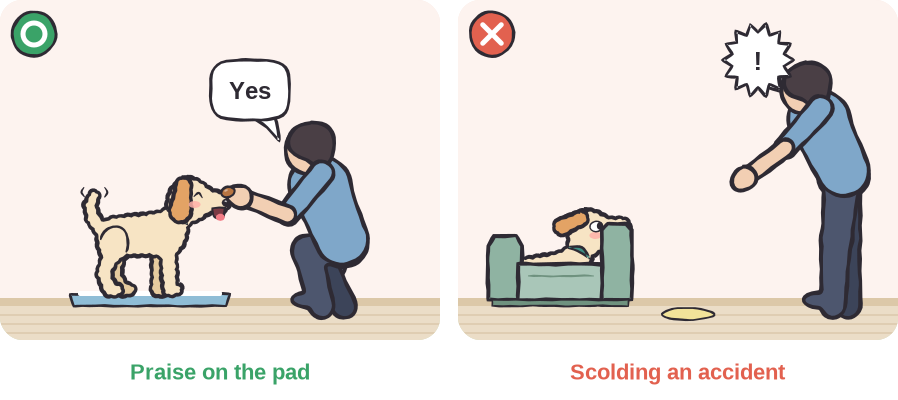
When you scold an accident, your dog doesn’t learn “not here.” She can learn “peeing in front of my person is dangerous.” Then she starts sneaking off to go behind the sofa — and may refuse to go in front of you even at the right spot. Scolding after you find a puddle doesn’t work either: she can’t link it to something she did earlier.
What kind of accident is it? Five questions
Some accidents are part of learning; others won’t be fixed by training at all. Go through these in order — the first “yes” tells you where to start.
- Is she suddenly going much more often, passing small amounts again and again, straining, drinking a lot, or is there blood in her urine? → See your vet before anything else. Straining with little or nothing coming out is an emergency (see “When to see your vet” below).
- Has she never yet had a solid run of going in the right place? (A new puppy, or a dog you’ve just adopted) → She’s still learning. Start the plan below from the beginning. It’s the same for adult and rescue dogs.
- Does she pee inside right after coming in from outside? → Very common, especially in puppies. See “She pees inside right after coming in” below.
- Does she go on the edge of the pad, or right next to it? → She has probably learned the place already. Often she simply doesn’t fit — try a bigger pad or tray first.
- Does she leak only when you come home, when guests arrive, or when you pick her up? → That’s excitement or submissive urination, not a house-training failure (see “Excitement peeing and marking”). Does she lift her leg and leave small amounts on walls or furniture, or have accidents only when she’s left alone? → That may be marking or separation anxiety (same section, and “When to see your vet”).
If a trainer came to your home: the first session and the first homework
Here is how we’d picture a visiting trainer’s first session — one example, not a fixed script. Potty training starts before you teach your dog anything: with where things are in your home and how her day runs.
- Today: choose her potty spot together — one patch of your yard or just outside the door you’ll always use, or, in an apartment, a pad spot at the opposite end of the playpen from her bed. Move her bed and food bowl away from it. For now, limit where your dog can go to her crate or playpen and the room you’re in. Stick a potty log on the fridge (time, pee or poop, right place or not). When your dog wakes up, take her out together with the trainer, and the moment she finishes, say “Yes” and give a small treat.
- Homework (one week): take her out right after she wakes, 15–30 minutes after meals, after play, after any excitement, and before bed. In between, invite her out regularly while she’s awake — start at roughly every 1–2 hours and adjust from your log. Go with her, on leash. When you can’t watch her, she’s in her crate or playpen. Never scold accidents; clean them with an enzyme cleaner while she’s out of sight. Practice the marker word (“Yes” → treat) two or three times a day, 2–3 minutes each.
- Next visit: you read the log together. How long can your dog go before an accident? When do accidents cluster? Then you reset the gap between trips to a little shorter than the time she can manage. As for giving her more of the house: the advice ranges from about a week without accidents (Best Friends Animal Society) to 8–12 weeks (VCA Animal Hospitals). Our rule of thumb sits in between: after about two weeks with no accidents, open up one more room at a time.
How to potty train a puppy (or an adult dog — the method is the same)
There are only three jobs: take her to her spot when she’s likely to need it, reward her the instant she goes there, and set up your home so accidents are hard to have. Punishment isn’t on the list. The American Veterinary Society of Animal Behavior (AVSAB) puts it plainly: house training can be managed by arranging the environment appropriately and reinforcing the behavior you want.
- Pick one potty spot and stick with it. Outside: one area of the yard or just outside your door, reached through the same door every time (VCA Animal Hospitals suggests always using the same exit). Keep it away from where she eats and sleeps.
- Go out with her, on leash. VCA is clear: always go along — don’t send a puppy into the yard alone. Until they’re trained, most puppies left outside alone get distracted and don’t go until they’re back indoors.
- Go at the times she’s most likely to need it: right after she wakes up, 15–30 minutes after a meal, right after play, after excitement (visitors, for instance), and before bed. The Merck Veterinary Manual says taking dogs out 15 to 30 minutes after eating and immediately after play or waking can help speed house training.
- In between, take her out regularly while she’s awake. Advice ranges from every 30 minutes during busy play to every 2–3 hours; the younger the puppy, the shorter the gap. The American Kennel Club notes that for a young puppy this can mean a dozen or more trips a day. Start at roughly every 1–2 hours, then tune it to your own dog using your log.
- Learn her signals: sniffing the floor, circling, pacing or restlessness, heading for the door. When you see them, take her out right away. Carry a young puppy so she makes it in time.
- At the spot, be boring. Stand still, don’t chat or play, and give her about 5 minutes. The moment she finishes, say “Yes” and give a small treat right there, within a few seconds. A treat handed over back in the kitchen doesn’t tell her what it was for.
- Then let her sniff around or play for a minute before you head in. The RSPCA and Battersea both suggest this so she doesn’t learn that going potty ends her time outside. Play and off-leash time in the yard come after she has gone, not before.
- Nothing after 5 minutes? Take her back in and watch her closely — in her crate, or on a leash beside you — and try again in a few minutes, or at the first sign of restlessness (VCA; Dogs Trust adds that she’s likely to need to go again very soon).
- If she starts offering tiny fake squats to earn treats, drop the treats and switch to calm praise. Battersea avoids food rewards for going potty altogether for this reason.
- Add a potty cue — “Go potty,” “Hurry up” — said softly just as she starts to go. Over time, the words help her go on cue, which is handy before a car trip, in the rain, or when you’re away from home.
- When you can’t watch her, she’s in her crate or playpen. When she’s out, keep her in the same room as you; Humane World for Animals suggests tethering her to you or a nearby piece of furniture on a 6-foot (1.8 m) leash when you’re not actively playing or training. Don’t give her the run of the house while nobody is watching.
- If you catch her mid-accident, don’t scold. Interrupt calmly — say her name, or quietly scoop her up — and take her straight to her spot. If she finishes there, praise her. If you find a puddle afterwards, say nothing and just clean it up.
- Clean accidents with an enzyme cleaner (often sold as a “pet odor remover”). Ammonia-based cleaners can draw dogs back to the same spot, because to a dog the smell says “bathroom.” Clean while she’s out of sight, so it doesn’t turn into a game.
- Nights: young puppies often need a trip outside during the night. VCA says puppies may need overnight outings until about 5 months of age, and Battersea says most puppies can’t hold it through the night; Humane World for Animals, on the other hand, says most puppies can comfortably sleep for seven hours without a bathroom break. Our advice: let your log decide whether you set an alarm — are there accidents in the night or first thing in the morning? Humane World also suggests picking up the water bowl about two and a half hours before bedtime. If you try it, make sure she’s had plenty to drink earlier in the evening, and don’t do it on hot days or if she’s drinking more than usual (that’s a reason to see your vet — see below). The RSPCA says dogs need constant access to clean drinking water and can become seriously ill within hours without it, and PDSA also says to make sure your dog always has access to water. If she wakes and cries, take her out quietly, and when she’s done, put her straight back to bed — no play.
Is the “one hour per month of age” rule true? How often should you take her out?
You’ll often read that a puppy can hold it for about one hour per month of age — but the rule isn’t even consistent between the organizations that give it. Humane World for Animals says “about one hour for every month of age” on its potty training page, yet its crate training page says puppies shouldn’t be crated longer than their age in months plus one hour. The American Kennel Club says roughly the same number of hours as their age in months, up to about 9 months to a year. None of them cites a study behind the number, and it doesn’t appear in the owner advice from the Merck Veterinary Manual, the RSPCA, Dogs Trust or Battersea.
Humane World’s potty page turns the rule into a schedule: a 3-month-old puppy may need to pee every 3 hours. We read it the other way round — as the longest she might manage, not as how often to take her out. Even a 3-month-old who can hold it for 3 hours will still need to go right after waking, eating or playing, whatever the clock says. The RSPCA notes that dogs don’t reach full bladder capacity until they’re about 12 months old.
The most reliable guide is your own dog’s record. Battersea recommends keeping a short log to spot patterns. For one week, write down every time she goes and whether it was in the right place. Look at when the accidents happened and how long it had been since she last went: that tells you how long she can really hold it, and which times of day are risky. Our rule of thumb is to set the gap between trips a little shorter than that.
If she’ll be alone for more than 3 hours, she needs a potty break. VCA’s puppy guidance, written by a veterinary behaviorist and a veterinary behavior technician, says so. Ask a friend or dog walker to stop by, or set up a playpen with her bed at one end and a pad at the other, so she’s never forced to hold it.
She pees inside right after coming in
Battersea calls this very common, especially in puppies who are still linking “outside” with “bathroom.” Common reasons include: outside was too exciting to concentrate; the trip was too short; or she has learned that going potty means being taken straight back in.
- Stay out a little longer, and be boring — stand still and let her sniff. Battersea suggests standing or sitting still for 10–15 minutes if she’s distracted.
- When you come back in without a result, keep her on a leash beside you or in her crate or playpen, take her out again after a few minutes, and repeat until she goes outside.
- Once she has gone, stay out for a minute or two of sniffing or play, so finishing isn’t the end of the fun.
- Keep your log going: the pattern often shows that the accidents follow the shortest trips.
Puppy pads, apartments and the move outdoors
Pads have their place. Battersea says they can help if you live in an apartment, don’t have a yard, or your puppy isn’t fully vaccinated yet, and that they’re most useful for short periods or overnight — not as a replacement for taking her outside. The trade-off is that pads give a puppy two right answers. The American Kennel Club’s Mary Burch puts it this way: “You’re reinforcing two different options for the puppy.” Humane World for Animals warns that indoor potty training can make outdoor house training take longer, and Best Friends Animal Society notes that a puppy trained on paper or a litter box may keep a lifelong preference for that surface.
- Use one pad spot, in a quiet place away from her bed and food. Don’t scatter pads around the house — Battersea warns that this can encourage her to go anywhere.
- If you have outdoor access, put the pad near the door, so it still points toward outside, and keep the biggest rewards for going outdoors.
- To phase pads out, move the pad closer to the door, then just outside, then remove it. Once you’ve started going outside, don’t switch back and forth — that can slow learning.
- Help her find the new spot by smell: soak up a little of her urine with a paper towel and put it where you want her to go next.
- Dogs often prefer the surface they learned on — grass, gravel, a pad. If you want her to use a different one, change it gradually, guiding her there on leash and praising every success.
- In an apartment, allow for the time it takes to get downstairs. Carry a young puppy through hallways and elevators so she doesn’t have an accident on the way.
House training an adult or rescue dog
Adult dogs learn exactly the same way. Dogs Trust says all dogs learn potty training the same way, whether they’re a puppy or a golden oldie; the RSPCA adds that for an adult who was never properly trained the stages are the same, but it may take longer. Battersea says many adult dogs already understand house training and only need about a week to learn the routine in a new home, while dogs who have lived in kennels or were never house trained may take longer.
Dogs who spent long stretches caged, came from a pet store, or always lived outdoors may never have had to hold it at all. The Merck Veterinary Manual notes that puppies from pet stores are usually much harder to house train, and Humane World for Animals says dogs who weren’t allowed outside as puppies — those rescued from puppy mills, for example — may need more potty breaks. Start from day one exactly as you would with a puppy.
How long does potty training take?
There’s no fixed timeline. Some dogs get it in days; others take months. Humane World for Animals says house training a puppy typically takes 4–6 months. Battersea says most puppies settle into a routine within 4–6 weeks, but true reliability usually comes later, at around six months old, and Dogs Trust says it can take a few months before the odd accident stops completely.
Even after she seems to have it, accidents can come back — during adolescence, or after a big change such as moving house or a new family member. Don’t scold. Take her out more often, shrink her space again for a while, and rebuild.
Excitement peeing and marking
Excitement or submissive urination is a small leak that happens when a dog is very excited, or a bit worried, usually during greetings. It’s not a lapse in house training, and it’s most common in puppies. Scolding or startling her makes it worse; the Merck Veterinary Manual says dogs with submissive urination should never be startled.
Marking is peeing to leave a scent message: usually a lifted leg and a small amount on a wall or a piece of furniture. It’s most common in unneutered males, but females and neutered dogs mark too. Neutering often reduces it, but it won’t necessarily stop it on its own. In one study, owners of 57 male dogs that had at least one of nine problem behaviors (such as marking, roaming or aggression) and were neutered after the age of two were interviewed by phone about the changes afterwards: for marking in the house, mounting and roaming, at least 60% of dogs improved by half or more, and 25–40% improved by 90% or more.
- Excitement peeing: when you come home or guests arrive, don’t greet her straight away. Wait until she’s calm, then say hello. Avoid leaning over her, reaching for her or staring at her — crouch down and turn a little sideways instead. You can also greet her outside.
- Excitement peeing: if she leaks, don’t scold or raise your voice. Clean it up without comment.
- Marking: clean marked spots thoroughly with an enzyme cleaner so no scent is left, and keep her in her crate or playpen when you can’t supervise.
- Marking: talk to your vet about neutering, and about any marking that starts suddenly.
The missing core skill
Exercises
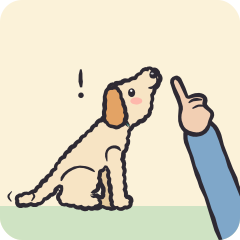
- ExerciseCharging Your Marker Word: How to Teach Your Dog That “Yes” Means a RewardDoable at home (Steps 1–4 at home)The instant your dog hears “Yes,” she snaps her attention to you — she knows a reward is on its way.Read →
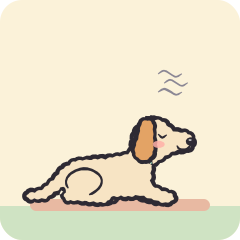
- ExerciseMaking the Crate a Happy Place: Step-by-Step Crate Training Your Dog Will ChooseDoable at home (Steps 1–4 at home)At “Crate,” she walks in on her own, and lies down and rests even with the door closed.Read →
In the moment: do / don’t
Do
- Take her out right after waking, 15–30 minutes after meals, after play and before bed
- Go out with her, and say “Yes” and give a small treat the moment she finishes
- Clean accidents quietly with an enzyme cleaner
- Use her crate or playpen when you can’t watch her
- Keep a potty log for a week to learn her real schedule
Don’t
- Scold, shout at or hit her for accidents
- Rub her nose in it
- Punish a puddle you find later — she can’t connect it to what she did
- Clean with ammonia-based products
- Put her out in the yard alone and assume she went
When to see a professional
- Accidents suddenly increase, she keeps asking to go out, passes only small amounts, has blood in her urine or seems uncomfortable — these can be signs of a bladder infection or another urinary problem. See your vet. If your dog is male and straining but producing only a little, the next point may apply — treat it as urgent.
- Your dog strains but little or no urine comes out. The urethra (the tube that carries urine out) may be blocked, often by bladder stones; this is most common in male dogs. It is an emergency: take her to a vet immediately — at night or on a weekend, go straight to an emergency vet. The Merck Veterinary Manual warns that a complete blockage lets toxins build up in the body within 1–2 days and can be fatal.
- She drinks much more than usual and pees more, or in larger amounts — this can be a sign of diabetes, kidney disease or other illnesses.
- She leaves wet patches where she has been lying, or dribbles urine while walking. If this has been happening since puppyhood, it may be a problem she was born with.
- An older dog who was reliably house trained starts having accidents indoors — joint pain that makes it hard to get outside, or cognitive decline (canine dementia), are possible causes.
- Accidents happen only when she’s left alone, along with nonstop barking, destruction or heavy drooling — this may be separation anxiety. Talk to your vet or a veterinary behaviorist.
Go to the root
Don’t stop at the quick fix. Growing the skill underneath makes other problems lighter too.
Sources
- Merck Veterinary Manual (Dog Owners) — Behavior Problems in Dogs (Landsberg)
- Merck Veterinary Manual (Veterinary) — Behavior Problems of Dogs
- Merck Veterinary Manual (Dog Owners) — Infectious Diseases of the Urinary System in Dogs
- Merck Veterinary Manual (Dog Owners) — Noninfectious Diseases of the Urinary System in Dogs
- Merck Veterinary Manual (Dog Owners) — Disorders of the Pancreas in Dogs
- AVSAB — Position Statement on Humane Dog Training (2021)
- VCA Animal Hospitals — House Training for Puppies and Dogs
- Humane World for Animals (formerly HSUS) — How to potty train your dog or puppy
- Humane World for Animals — Crate training 101
- American Kennel Club — How to Potty Train Your Puppy and Prevent Accidents Indoors
- Best Friends Animal Society — How to potty train a puppy or dog
- RSPCA (UK) — Toilet training your dog
- RSPCA Australia — How to toilet train your puppy
- Dogs Trust — House or toilet training
- Dogs Trust — Toileting in the house
- Battersea — How to toilet train a puppy or dog
- Battersea — Toilet training problems
- PDSA — Toilet training your puppy
- Cornell Riney Canine Health Center — Cognitive Dysfunction Syndrome
- Neilson, Eckstein & Hart (1997). Effects of castration on problem behaviors in male dogs with reference to age and duration of behavior. JAVMA 211(2):180–182