 BAUDOG The dictionary of dog–human communication
Contents
What this skill is
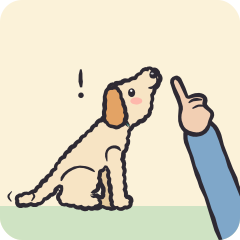
Dogs don’t come knowing what words mean. “Sit” and “Crate” are just sounds at first. A dog learns what a sound means from whether something good happens right after it. Understanding Cues is the skill of recognizing the exact moment she got it right — from your marker word, “Yes” — linking your voice and hand signals to what she just did, and doing the same thing for the same cue in a new place or for a different person. Potty training, recall, “stay”: it’s the shared language for building all six of the other skills, which is why it comes first of the seven.
How your dog feels
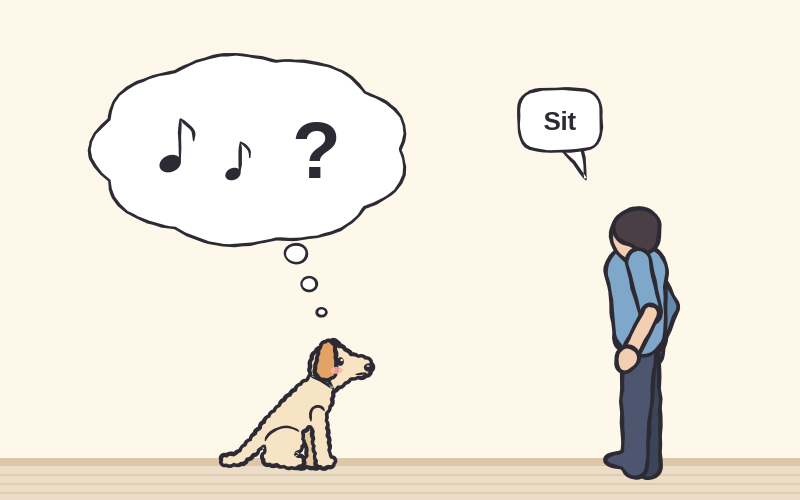
Most dogs who “don’t listen” aren’t being defiant, in our view. Either they don’t yet know what the cue means, or doing something else simply pays better.
Dogs can hear small differences between words. In a small study, six dogs trained to respond to tape-recorded “sit” and “come” were played versions with one sound changed — and their performance dropped sharply, whichever sound was changed. Reacting differently to a slightly different sound means they could tell the difference. Yet a study measuring the brain activity of 17 dogs found no difference between their responses to a cue they knew and to a nonsense word with a single vowel changed. Dogs may be able to hear fine differences without using them when they process everyday words. So it’s safest not to choose cue words that sound like a family member’s name or like one of her other cues.
Dogs also take in your posture, your eyes and your distance as part of the cue. In another experiment, well-trained dogs responded to “sit” and “come” less reliably when the cue was played from a recording, when the trainer wore sunglasses on top of using the recording, and when the trainer stood about 2.5 m (8 ft) away, half hidden behind a screen. When a dog does it at home but not outside, part of the reason may be that at home she’s also reading your hands and body.
The newer a cue is, the more easily a change of place breaks it. In an experiment with 12 dogs taught a new cue, moving to an unfamiliar place lowered correct responses to the new cue but not to cues they already knew well. In the same study’s field survey, researchers filmed 56 owners asking their dogs to sit: 68% of dogs sat on the first cue. Dogs obeyed less often when they weren’t paying attention to their owner, and when the owner added extra words before the actual cue.
A word used for scolding becomes unpleasant in itself. The American Veterinary Society of Animal Behavior (AVSAB) notes that dogs taught a cue with aversive methods went on showing stress-related behaviors when they heard it.
Assessment: where is your dog now?
A visiting trainer might start by checking, indoors, how far your dog has got. Try these four. The first one she can’t do yet shows you where to begin.
When you say “Yes,” does your dog snap her head toward you?
→If not, start with the practice Charging Your Marker Word. It comes before every other practice.
Say a cue she knows (“Sit,” for example) once. Does she do it within 3 seconds — with your voice alone, no hand movement?
→If not, begin at Stage 1 (indoors, quiet). Practice saying the cue only once, and making your hand signals smaller step by step.
Does she respond the same way when another family member gives the cue, or in another room?
→If not, work at Stage 2 (indoors, a little distraction). Make a family word list, so the same behavior always gets the same word.
Does the same cue work in front of your house or on a walk?
→If not, move outside starting at Stage 3 (yard, doorstep, in front of your home). Outside, use better treats than you use indoors.
Problems when this skill is weak
Signs this skill is weak
- She does it at home but not outside or in unfamiliar places
- You have to repeat the cue several times before she moves
- She only does it if your hand moves — or only if she can see food
- Family members use different words, and she responds to some people but not others
- Scolding words and cues get mixed up (“No! Luna! Sit!”)
- Problems Potty Training a Puppy (or an Adult Dog): A Trainer’s Plan for Fewer Accidents in the House Read →
- Problems Dog Not Listening? 5 Real Reasons (It’s Not Stubbornness) and How to Retrain Read →
- Problems Dog Won’t Come When Called? Why It Happens and How to Fix It Read →
- Problems Demand Barking: How to Stop It Without Just Ignoring Your Dog Read →
Prescription: a suggested order
Our suggested order. Start with Charging Your Marker Word. Once “Yes” clearly means something to her, you can work on the others side by side. If you’re in the middle of potty training, the first place to use “Yes” is the moment she finishes in the right spot.
- ExerciseCharging Your Marker Word: How to Teach Your Dog That “Yes” Means a RewardDoable at home (Steps 1–4 at home)Builds “Yes,” the word that marks the exact moment she got it right. Do this before any other practice.Read →
- ExerciseThe Name GameDoable at home (Steps 1–2 at home)Turns her name into a signal that turning to you pays off — the doorway to every cue.Read →
- ExerciseHand Target: How to Teach Your Dog “Touch” — and Use It for Recall and Passing Other DogsDoable at home (Steps 1–3 at home)Touching your palm with her nose: the simplest way to link a hand signal to a behavior.Read →
- ExerciseRecall GamesDoable at home (Steps 1–3 at home)Grows “come” from a cue that works in the kitchen into one that works outdoors, whoever in the family says it.Read →
How it grows
-
Level 1At home, quiet
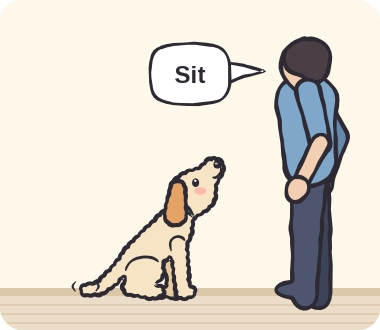
In a quiet room at home, she responds instantly to “Yes,” and a cue she knows works on the first ask, with no hand lure. The first homework starts here.
A good sign to move on She responds within 3 seconds of a single cue, 8 out of 10 times
-
Level 2At home, small distractions
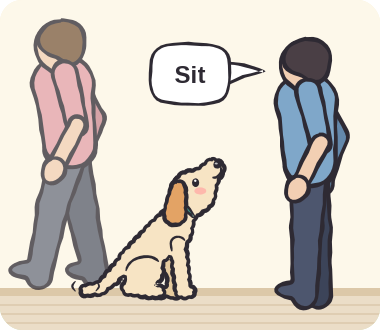
In other rooms, or with the family moving around. The same cue works when another family member gives it.
A good sign to move on 8 out of 10 in at least two rooms, with two family members
-
Level 3Yard, doorstep, outside the house
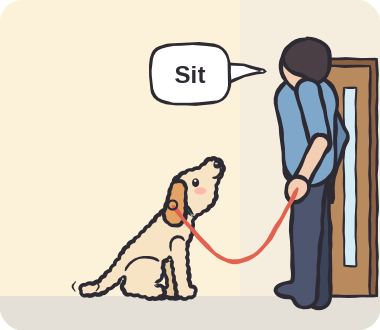
On leash in the yard, on the doorstep or in front of your home. Outside, use better treats than indoors.
A good sign to move on 8 out of 10 in front of your home
-
Level 4Quiet street
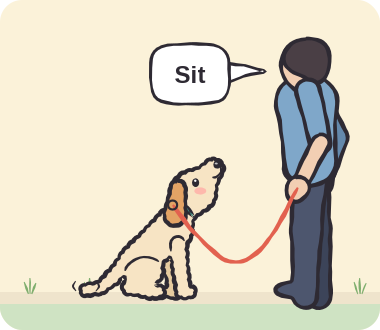
In different places — a quiet street, an empty park.
A good sign to move on 8 out of 10 in each of two or three places
-
Level 5Around distractions
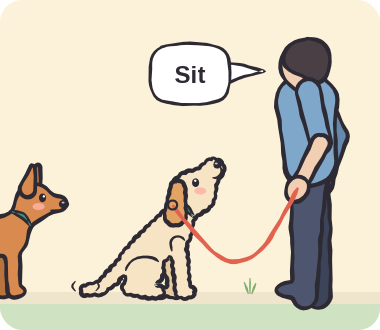
Where people or dogs are in view, or food is on the ground — and whoever in the family gives the cue.
A good sign to move on 8 out of 10 around distractions, with at least two family members
Principles
- Your marker word, “Yes,” marks the exact moment she got it right. Every time you say it, a reward follows.
- Add the spoken cue once she can already do the behavior. Don’t name something she can’t do yet.
- Say a cue once. If she doesn’t respond, don’t repeat it — make the next try easier.
- Don’t pile words in front of a cue (“Come on, hey, what do we do, sit?” — just “Sit”). Saying her name and then the cue straight away is fine.
- Make a family word list so the same behavior always gets the same word, and avoid cue words that sound alike.
- Teach new things in a quiet room at home first. Once she has it, take it to the front of your house, then quiet streets, then places with distractions. It’s fine to go back to an easier step each time you change place.
- Never use her name or a cue to scold her. Her name should only ever predict something good.
Sources
- Fukuzawa, Mills & Cooper (2005). The effect of human command phonetic characteristics on auditory cognition in dogs (Canis familiaris). Journal of Comparative Psychology 119(1):117–120
- Fukuzawa, Mills & Cooper (2005). More than just a word: non-semantic command variables affect obedience in the domestic dog (Canis familiaris). Applied Animal Behaviour Science 91:129–141
- Braem & Mills (2010). Factors affecting response of dogs to obedience instruction: a field and experimental study. Applied Animal Behaviour Science 125:47–55
- Magyari et al. (2020). Event-related potentials reveal limited readiness to access phonetic details during word processing in dogs. Royal Society Open Science
- AVSAB — Position Statement on Humane Dog Training (2021)
- Maxwell, M. E. (2017). Teaching Name Recognition (AVSAB blog)
- RSPCA (UK) — Teaching your dog to sit
- Dogs Trust — Sit training
- Dogs Trust — Stay training
- Dogs Trust — Top ten dog training tips
- Dogs Trust — Introducing a marker
- PDSA — Reward-based training
- PDSA — Clicker training
- American Kennel Club — Clicker Training Your Dog: Mark and Reward
- Dogs for Good — Advanced training: clicker training and shaping (PDF)
- RSPCA Australia — How can I teach my dog recall (to come when called)?
- RSPCA (UK) — How to teach your dog recall (PDF)