 BAUDOG The dictionary of dog–human communication
Contents
When to use this exercise
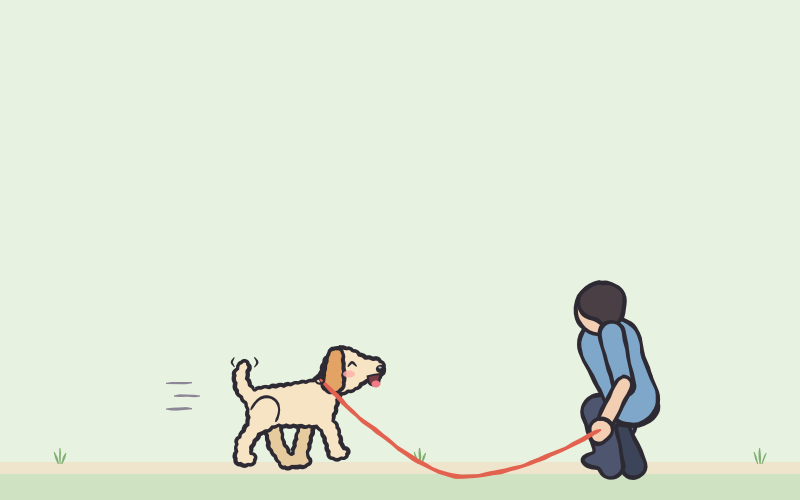
She won’t come when called, you can’t get her back when she slips out, she won’t leave the dog park. “Come” is the cue that can save her life when something goes wrong. In this practice, running to you becomes a game she wins again and again. It builds Focus and Understanding Cues. Once she turns to her name, start close up indoors, then move to the yard or the front of your home, a big open space on a long line, and finally places with distractions.
GoalYou say (if her name is Luna) “Luna, come” once, and whatever she’s doing, she runs straight to your feet.
Assessment: what a trainer might check on the first visit
Before starting, a visiting trainer might check three things indoors, like these.
In a quiet room, does she turn as soon as you say her name once?
→If not, start with The Name Game. Come back to this practice once she turns to her name.
When you call “come” from 3–6 ft (1–2 m) away, does she come straight away — or stop halfway, or wander off to sniff?
→If she doesn’t come, call from closer (one step away), crouch down, and back away as you call.
Does she come close and then dodge away just before your hand reaches her?
→If so, “come” may have been followed by unpleasant things (the leash going on to go home, a bath). Some dogs also dislike being grabbed suddenly. Start with collar-touch practice (see “Hand” below) and with letting her go back to playing after she comes.
What you need
- Top-value treats kept just for recall (small pieces of cooked chicken, for example). For indoor games, her daily kibble is fine
- A dog who turns to her name — she has passed the indoor steps of The Name Game
- A harness and a long line (from the outdoor steps). There’s no standard length; 15–30 ft (5–10 m) is a common choice
How to signal
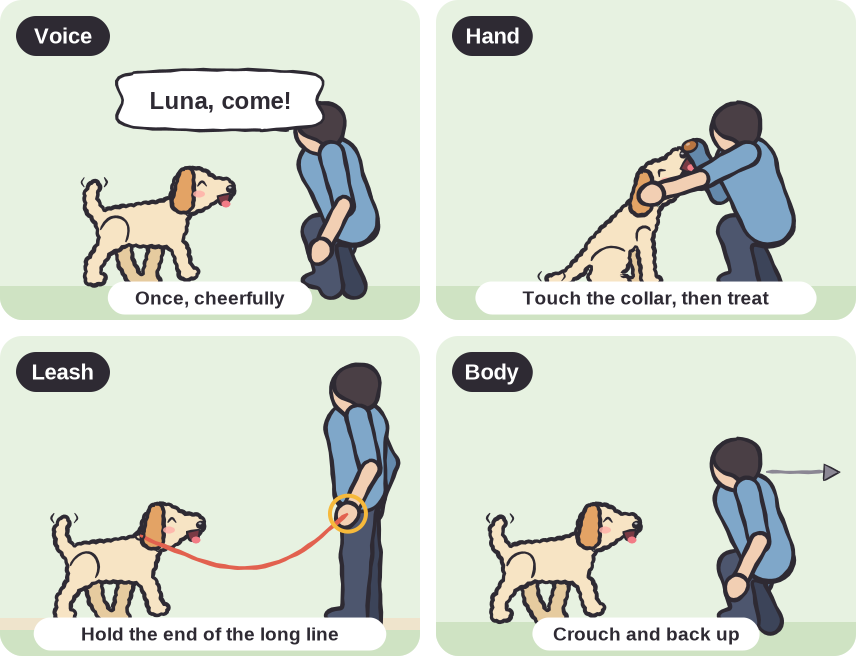
- Voice
Say “Luna, come” once, brightly and happily. While she’s on her way, encourage her (“Good, good!”). Don’t repeat it when she doesn’t come. If you’re not sure she’ll come, don’t call.
- Hand
When she arrives, gently touch her collar or harness, then give the top treat. For a dog who dodges just before your hand reaches her, the AKC suggests practicing collar grabs separately. Let her lick a treat while you gently touch her collar, then give the treat → once that’s easy, hold the collar lightly, then give the treat → gradually make the hold quicker and firmer, still followed by a treat → finally, hold first, without the licking, then treat. At every stage, a hold is always followed by a treat. Once a collar grab doesn’t bother her when she comes in, she’s much less likely to dodge you.
- Leash
No leash indoors. Outside, a long line clipped to a harness. Hold the end; let it trail only where local rules allow — in a fenced area, for example — and once she’s used to it. Many places require a dog to be on a held leash in public, and some cap its length (New York City at 6 ft). Never pull her in with the line when she doesn’t come.
- Body
When you call, crouch down or take a few steps backward. Dogs love to chase something moving away from them.
Today’s session
With the trainer, you work on step 1.
Step 1A close-up call(At home, quiet)
The trainer shows you once, then hands over. Indoors, drop a piece of kibble on the floor and take a few steps back while your dog eats it. When she finishes, crouch and say “Luna, come” once. When she starts toward you, “Yes”; when she reaches your feet, gently touch her collar, then treat. Five to ten times. If there are two of you, try ping-pong (step 2) right after. The trainer watches for calling too loudly, showing the treat before she comes, and grabbing at her when she arrives, and fixes them on the spot.
Homework until the next visit
- How often
- About twice a day
- How long
- About 3–5 minutes each
- How much
- Up to 5–10 calls per session
A good sign she’s readyYou call once from another room and she comes running straight away, 8 out of 10 times (our rule of thumb)
What the trainer checks next visit
In front of the trainer, call “Luna, come” once from another room — 10 times.
If she canIf she comes running straight away 8 out of 10 times → next stage: step 4 (your yard or the front of your home, on leash) becomes the next homework.
If not yetGo back to ping-pong in one room (step 2). Look together at the value of the treats and at your voice and posture when you call, and keep going for another week.
Next stages: steps
- 1
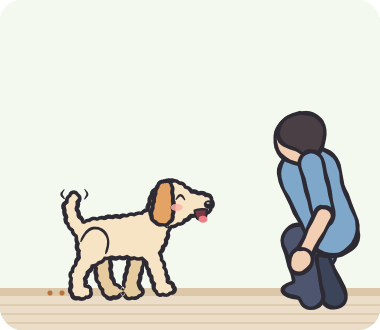
From close up, once At home, quiet
A close-up call
Indoors, drop a piece of kibble on the floor and take a few steps back. When she finishes eating, crouch and say “Luna, come” once. When she starts toward you, “Yes”; when she reaches your feet, gently touch her collar, then treat.
A good sign to move onCalled from 3–6 ft (1–2 m) away, she comes straight away, 8 out of 10 times (our rule of thumb)
- 2
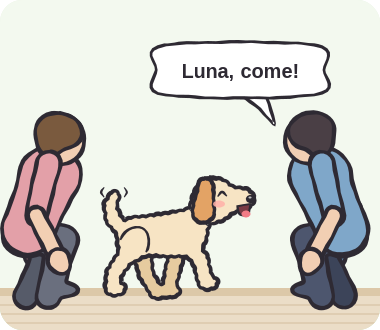
To whoever called At home, quiet
Ping-pong for two
Two family members stand at opposite ends of a room and take turns calling “Luna, come.” Whoever called gives the treat when she arrives.
A good sign to move onShe runs straight to whoever called her, 8 out of 10 times (our rule of thumb)
- 3
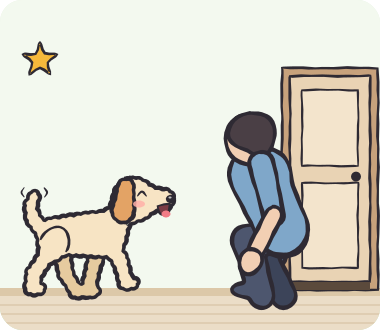
Found you — jackpot At home, small distractions
Hide-and-seek, and calls during play
While she isn’t looking, hide in another room and call “Luna, come.” When she finds you, jackpot — several treats. Call her in the middle of a toy game too: when she comes, treat, then “Free” — back to the game.
A good sign to move onCalled from another room, she comes running straight away, 8 out of 10 times (our rule of thumb)
- 4
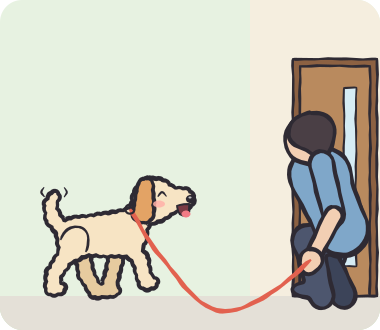
Outdoor practice starts at your door Yard, doorstep, outside the house
In the yard or in front of your home
Still on leash, go into your yard or out in front of your home. Call her in a pause between sniffs. When she comes, treat → “Free,” and she goes back to sniffing. Outside, use better treats than indoors.
A good sign to move onIn front of your home, she comes straight away, 8 out of 10 times (our rule of thumb)
- 5
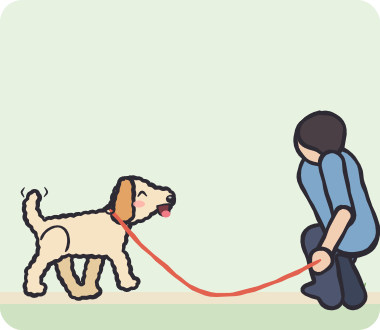
The line is there for safety Quiet street
Open space, on a long line
In a big open space with few people and no traffic, clip a long line to her harness and hold the end. When she has wandered a little way and is sniffing, call her in a pause. When she comes, treat → “Free,” and back to exploring.
A good sign to move onOutside, she comes straight away, 8 out of 10 times (our rule of thumb)
- 6
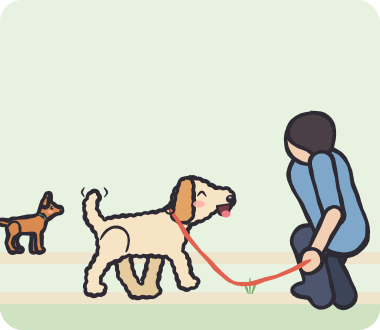
From far away, little by little Around distractions
Around distractions
Somewhere another dog is visible in the distance, or a toy is lying nearby — long line still on. Start at a distance where she notices the distraction but still turns when you call (there’s no set number). If she comes straight away against the odds, jackpot.
A good sign to move onAround distractions, 8 out of 10 times (our rule of thumb). If she doesn’t come, add a lot more distance
Timing
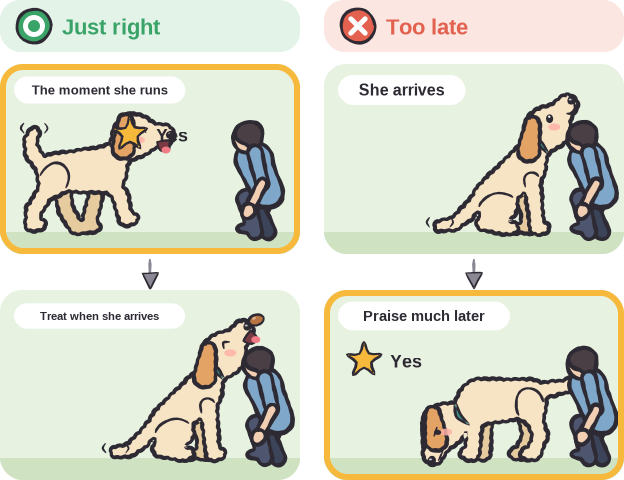
Just right
Say “Yes” the instant she starts running toward you. When she reaches your feet, gently touch her collar right away and give the top treat.
Too late
Praising her a while after she has arrived — or scolding her for taking so long (next time she’ll want to come even less).
Say “Yes” the moment she decides to come and starts moving; give the treat once she arrives. RSPCA Australia, and behaviorist Dr. Megan Maxwell on the AVSAB blog, both describe it in this order.
How much and how often
Up to 5–10 calls per session (about 3–5 minutes), about twice a day. For indoor games, you can use her daily kibble.
If it isn’t working
She dodges away just before I can reach her
Don’t chase her. Crouch down, or run the other way, and she’ll follow. At home you can practice collar grabs separately (see “Hand”: touch, light hold, firm hold — always followed by a treat). Stop ending every recall with the leash and going home; mix in plenty of comes that end with a treat and “Free” — back to playing.
I’ve said “come” a hundred times — or used it to scold her
The word has lost its power. Choose a new one (“here,” for example) and teach it from step 1 of this page.
She won’t come at all outside
Go back to the indoor steps (1–3). Outside, use far better treats than at home. When you’re not sure she’ll come, don’t call: walk over quietly, clip on the leash, and reward a cue she knows, like sit.
She isn’t interested in food
Make her favorite toy the reward that only comes out for recall. Don’t leave it lying around the rest of the time.
How long do I keep using treats?
Even once she comes reliably, keep giving a top reward every so often. Recall is a lifelong skill, not a one-time lesson.
Once she comes every time, can she go off leash?
No recall is 100% reliable. In public places, keep her on a leash you’re holding, and follow local leash laws. Let her off only in fenced or enclosed areas away from traffic.
Avoid
- Calling her to scold her, or scolding her when she arrives
- Calling her only for unpleasant things (leash on to go home, a bath, a nail trim)
- Chasing her when she doesn’t come
- Saying “Come, come, come!” over and over
- Reeling her in with the long line
A good sign to move on
- Steps 1–3 (indoors): she comes straight away at that step, 8 out of 10 times
- Steps 4–6 (front of home → open space → distractions): she comes straight away in that place, 8 out of 10 times
- If she struggles, go back one step — our rule of thumb is two failed calls in a row. RSPCA Australia advises the same: if your dog doesn’t come after the cue twice, go and collect her and practice again somewhere easier
Sources
- RSPCA Australia — How can I teach my dog recall (to come when called)?
- RSPCA (UK) — Train your dog to come when called
- Dogs Trust — Recall training
- American Kennel Club — How to Train a Reliable Recall for Your Dog
- American Kennel Club — How to Train Your Dog to Come When Called: Step-by-Step Recall
- Animal Welfare League NSW — Teaching your dog recall
- Maxwell, M. E. (2017). Teaching Name Recognition (AVSAB blog)
- Battersea — How to use a long line lead
- Battersea — How to teach your dog a recall
- UC Davis (Clinical Animal Behavior Service) — Recall Training in Dogs, a handout created by veterinary students as a class exercise
- AVSAB — Position Statement on Humane Dog Training (2021)
- Whole Dog Journal — Beware of the Poisoned Dog Cue
- New York City Health Code Article 161, §161.05