 BAUDOG The dictionary of dog–human communication
Contents
- In short
- When it happens
- How your dog feels
- Find where it breaks down: the “where can she do it?” chart
- What to do for each reason
- If a trainer came to your home: the first session and the first homework
- Four rules for retraining
- She stopped listening around her first birthday
- The missing core skill
- Exercises
- In the moment: do / don’t
- When to see a professional
- Sources
In short
Your dog isn’t ignoring you to be dominant, and she isn’t being defiant. Usually it’s one of five things: (1) she hasn’t learned the cue in that place yet — she’s only practiced at home; (2) something else pays better, like smells or other dogs; (3) the cue isn’t getting through — you said it while she wasn’t looking, said it five times, or every family member uses a different word; (4) the cue has come to predict something unpleasant; (5) she’s in pain or can’t hear well. For each cue, check where it breaks down — inside, in front of the house, on a quiet street, around distractions — and rebuild from one step before that.
When it happens
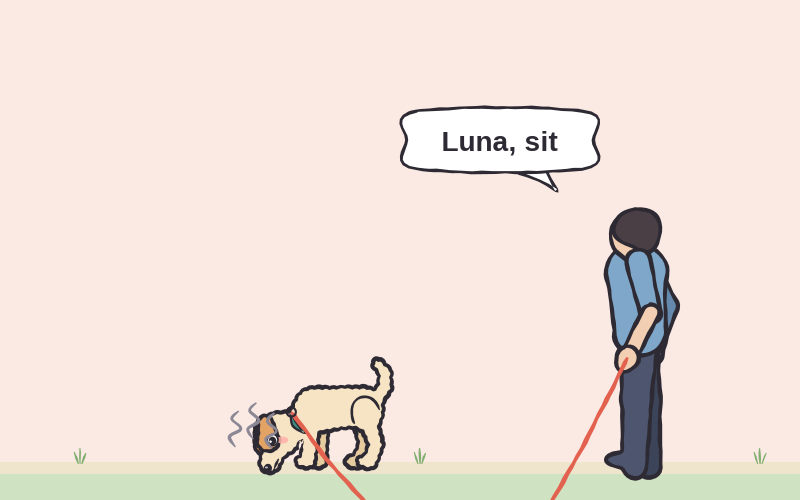
- Your dog sits every time in the kitchen, and never on a walk
- “Sit. Sit. Sit! SIT!” — and on the fourth try she finally sits
- She listens to one person in the family and nobody else
- She only does it if she can see the treat
- Around her first birthday, she suddenly stopped listening
How your dog feels
You don’t need to think in terms of rank or being the “alpha.” The American Veterinary Society of Animal Behavior (AVSAB) says most of the behaviors owners want to change — excessive barking, jumping up, not coming when called — have nothing to do with rank. They happen because they’ve been rewarded without anyone meaning to, and because nobody has taught the dog a better alternative.
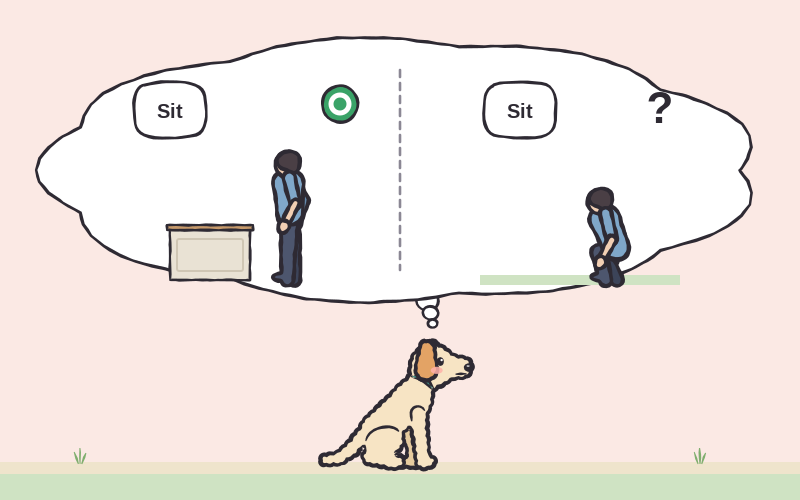
Dogs learn a cue together with the place, the person and even your posture. “Sit” from someone standing in the kitchen may mean nothing when it comes from someone crouching in the park. The American Kennel Club says it simply: each new location is a new challenge.
Outside there are rewards everywhere — smells, moving things, other dogs. A piece of kibble that works in the living room can’t compete.
A cue that has been used to scold, or that is usually followed by something she dislikes (a nail trim, a bath), can become unpleasant in itself. What looks like ignoring you may actually be avoiding.
Find where it breaks down: the “where can she do it?” chart
A simple chart tells you whether she “knows it but won’t” or just doesn’t know it yet in that place. For each cue, try it once in each of these five places and mark a ✓ or an ✗. Say the cue once, and keep treats out of sight.
- Indoors, quiet: when nothing is going on
- Indoors, a little distracting: near a toy, or while family members move around
- Yard, doorstep or in front of the house (on leash)
- A quiet street
- Somewhere with distractions (another dog in the distance, a park)
- Start training one step before the first ✗. If she gets an ✗ even indoors when it’s quiet, that cue needs teaching again from scratch.
What to do for each reason
- She hasn’t learned it in that place yet: start from the last ✓ and widen it one step at a time. Change one thing at a time — a different room, the cue given while you’re sitting down, the cue given outside — and reward her every time she gets it.
- Something else pays better: outside, use much better treats than at home (small pieces of cooked chicken, for example). Raise the difficulty one thing at a time — distance, place or distraction, never two at once.
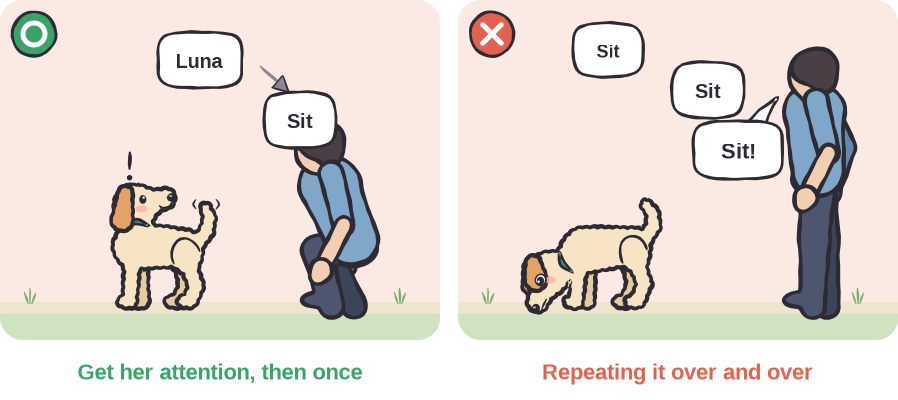
- The cue isn’t getting through: if she isn’t looking at you, get her attention with her name first, then give the cue once. Don’t repeat it. If she can’t do it on one cue, that place is still too hard — go back to an easier one.
- Every family member says it differently: make a family cue chart and stick it on the fridge — sit, down, wait, come, free, yes, plus the hand signals. Everyone uses the same words, said the same way.
- She only does it if she sees the treat: keep treats hidden in a pocket or pouch. Reteach the behavior with the hand signal alone; once she follows the hand signal reliably, add the word — word first, then the hand signal, not both at the same time.
- The cue has turned unpleasant: if a cue has been used to scold her, it’s quicker to switch to a new word and teach it from scratch. Pick one that doesn’t sound like the old one — if “sit” has been shouted at her for months, for example, try “park.”
If a trainer came to your home: the first session and the first homework
Here is how we’d expect the first in-home session to go — one example, not a fixed script.
- Assessment: indoors, each family member gives cues the way they normally do — the words, the tone, the hand movements, how many times they repeat them. The trainer also says her name once to see if she turns. If she has stopped listening suddenly, the trainer considers pain or an ear problem
- Today: you make the family cue chart together, and try the first two rows of the “where can she do it?” chart (the two indoor places) on the spot. If a cue gets an ✗ even indoors when it’s quiet, you start with Charging Your Marker Word and reteaching that cue with a hand signal
- Homework: twice a day, 3–5 minutes each. In the last place she got a ✓: cue once → “Yes” the moment she does it → reward, 5–10 times. One cue, never repeated. Mark the ✓s and ✗s on the chart each day
- Next visit: in front of the trainer, she gets one cue in the next place up. Our rule of thumb: if she does it 8 out of 10 times there, that place becomes the next homework. If not, you look again at the rewards and the way the cue is given, and keep going for another week
Four rules for retraining
- One cue. Before you say it, make sure she’s aware of you
- The instant she does it, say “Yes,” then reward. At first, reward every time. Once she’s reliable, gradually swap treats for everyday rewards — her dinner, a walk, a thrown ball (see Say Please by Sitting)
- Move on when she gets it right 8 out of 10 times (our rule of thumb — about 4 out of 5). Trainer Nancy Tucker, writing in Whole Dog Journal, suggests aiming for the same: four out of five
- If she struggles, go back to the previous place (our rule of thumb: two misses in a row). No scolding
She stopped listening around her first birthday
There’s research showing a phase around 8 months when dogs respond less to their usual person. A study of 69 guide-dog puppies tested at 5 and 8 months found that at 8 months they were more likely to repeatedly ignore “sit” from their caregiver (about twice the odds). With a stranger, though, their response to “sit” actually improved. In a questionnaire about 285 dogs, caregivers rated them harder to train at 8 months — and by 12 months, easier to train than at 5 months. That’s one study, in guide-dog puppies.
During this phase, don’t try to clamp down. Step back to an easier place and reward more often. RSPCA Australia gives the same advice for a recall that’s falling apart: go back to basics and increase the amount and value of the rewards.
The missing core skill
Exercises
- ExerciseCharging Your Marker Word: How to Teach Your Dog That “Yes” Means a RewardDoable at home (Steps 1–4 at home)The instant your dog hears “Yes,” she snaps her attention to you — she knows a reward is on its way.Read →
- ExerciseThe Name GameDoable at home (Steps 1–2 at home)You say (if her name is Luna) “Luna” once, and within 2 seconds she turns toward you.Read →
- ExerciseCheck-Ins: Teach Your Dog to Look at You Without Being AskedDoable at home (Step 1 at home)Without being called, your dog glances up at you now and then. On walks, after she looks at something interesting, she looks back at you.Read →
- ExerciseRecall GamesDoable at home (Steps 1–3 at home)You say (if her name is Luna) “Luna, come” once, and whatever she’s doing, she runs straight to your feet.Read →
- ExerciseSay Please by SittingDoable at home (Steps 1–3 at home)When she wants something, she sits and waits — on her own, without being asked.Read →
- ExerciseBuilding a Stay: Duration, Distance, Distraction — One at a Time, Up to the Front Door and GuestsDoable at home (Steps 1–3 at home)Your dog holds a sit or down from “Stay” until “Free” — with duration, distance and distraction each built up one at a time.Read →
- ExerciseLeave It Practice: From a Closed Fist to Food on the SidewalkDoable at home (Steps 1–3 at home)Your dog turns her face away from the treat (or the thing on the ground) on her own and looks at you.Read →
In the moment: do / don’t
Do
- Give one cue — and get her attention with her name first
- Go back to where she can do it and widen it one step at a time
- Use better rewards outside than at home
- Agree on the words as a family and put the chart on the fridge
Don’t
- Repeat the same cue, louder each time
- Use her name or a cue to scold her
- Decide she’s “testing you” and pin her down or hit her
- Expect her to do it outside just because she can do it at home
When to see a professional
- She stopped listening suddenly and doesn’t react to other sounds either (the doorbell, the treat bag). Her hearing may be going — see your vet
- She’s reluctant to sit, sits oddly, or hesitates at stairs or getting into the car. That can be back or joint pain — see your vet
- An older dog no longer responds to cues she knew, or gets lost in familiar places at home. That can be cognitive decline — see your vet
- When you give a cue, she crouches, tucks her tail or runs off. She’s scared. Stop any scolding and talk to your vet or a qualified behavior professional
Go to the root
Don’t stop at the quick fix. Growing the skill underneath makes other problems lighter too.
 Core skill Understanding Cues
- ExerciseCharging Your Marker Word: How to Teach Your Dog That “Yes” Means a RewardDoable at home (Steps 1–4 at home)Read →
- ExerciseThe Name GameDoable at home (Steps 1–2 at home)Read →
- ExerciseCheck-Ins: Teach Your Dog to Look at You Without Being AskedDoable at home (Step 1 at home)Read →
Sources
- AVSAB — Position Statement on the Use of Dominance Theory in Behavior Modification of Animals
- AVSAB — Position Statement on Humane Dog Training (2021)
- Whole Dog Journal — The 3 Reasons Dogs Ignore Our Cues (Nancy Tucker, CPDT-KA)
- American Kennel Club — How to Teach Your Dog to Wait at Doorways
- American Kennel Club — How to Teach Your Dog Their Name
- American Kennel Club — Why Does My Dog Only Listen When I Have Treats?
- ASPCA — Barking (the “Go to Your Spot” routine)
- Asher, England, Sommerville & Harvey (2020). Teenage dogs? Evidence for adolescent-phase conflict behaviour and an association between attachment to humans and pubertal timing in the domestic dog. Biology Letters 16(5):20200097
- Dogs Trust — Recall training
- RSPCA Australia — How can I teach my dog recall (to come when called)?
- Merck Veterinary Manual (dog owners) — Deafness in Dogs
- Cornell Riney Canine Health Center — Recognizing pain in dogs
- Cornell Riney Canine Health Center — Cognitive Dysfunction Syndrome
- Cornell Riney Canine Health Center — Dog Bite Prevention
- Oregon Humane Society — Sit to Say “Please”