 BAUDOG The dictionary of dog–human communication
Contents
- The finished behavior
- Assessment: where is your dog now?
- The cue
- How to signal
- Teaching steps
- When to reward
- If a trainer came to your home: the first session and the first homework
- When can a puppy learn to sit? And can older dogs learn?
- Where sit comes in handy
- She used to sit — now she suddenly won’t
- A good sign to move on
- If it isn’t working
- Prescription: a suggested order
- In the moment: do / don’t
- When to see a professional
- Sources
The finished behavior
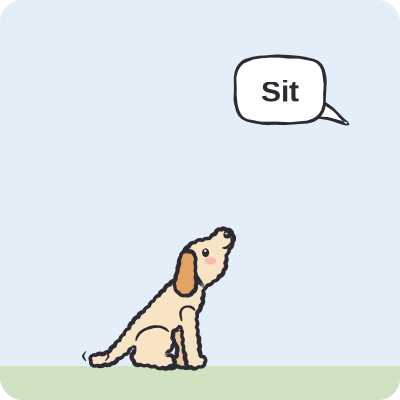
One “Sit,” and her bottom goes to the floor and stays there until you give the next cue or say “Free.” Indoors and out, whether you’re standing or sitting in a chair. Once she learns to sit on her own when she wants something — instead of jumping up — everyday life gets a lot easier.
Assessment: where is your dog now?
A visiting trainer might check something like this at home before starting. The first thing she can’t do yet is your starting step.
If you hold a treat at her nose and move it slowly up over her head, does her bottom go down?
→If she backs up instead, your hand is moving too fast or too far back. If she jumps for it, your hand has moved away from her nose. Start at step 1, more slowly.
Does she sit, then pop straight back up?
→Check whether the treat arrives only after she has stood up. Deliver it to her mouth while she is still sitting.
Does she sit when you just say “Sit” without moving your hand?
→If she only sits for the hand signal, the word doesn’t mean anything to her yet. Start at step 3 (adding the word).
Is the floor non-slip? Does she sit squarely? Is she happy to sit?
→On a slippery floor, start on a mat. If she sits with one leg kicked out to the side, avoids sitting, or struggles to get up, get her checked by your vet before training (see “When to see a vet or behavior professional” below).
The cue

The hand signal is a smaller version of the lure — your hand moving up from her nose. On BAUDOG’s cue card it’s a raised index finger. There’s no official hand signal for dogs, so what matters more is that everyone in the family uses the same signal and the same word.
How to signal
- Voice
Say “Sit” once. If she doesn’t sit, wait a few seconds, then help with the hand signal. Don’t keep repeating it. Agree on one word as a family.
- Hand
At first, keep the treat touching her nose and move it slowly up over her head. Once that’s easy, make the same movement with an empty hand and give the treat from your other hand. Shrink the movement little by little and it becomes the raised-index-finger signal.
- Leash
No leash needed indoors. Outside, practice with the leash in your hand, and check the leash rules where you live. Never pull up on the leash to make her sit.
- Body
Start facing her. Don’t push her bottom down. Once she has it, change your position: sitting in a chair, standing side-on.
Teaching steps
- 1
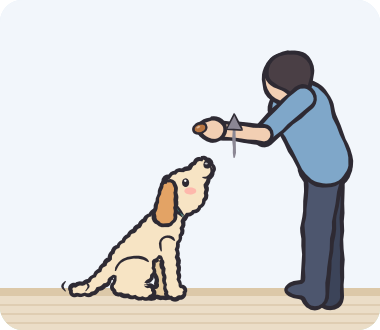
From her nose, slowly up over her head At home, quiet
Lure with a treat
While your dog is standing, hold a treat at her nose and move it slowly up over her head. The instant her bottom touches the floor, “Yes” → treat to her mouth while she’s still sitting.
A good sign to move onShe sits for the lure 8 out of 10 times (our rule of thumb)
- 2
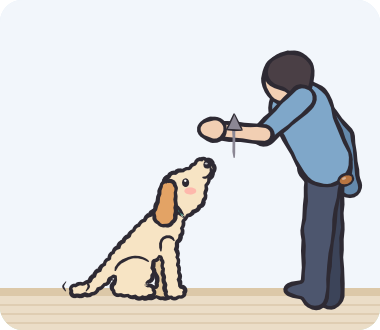
One hand guides, the other pays At home, quiet
Lose the treat from the luring hand
Make the same movement with an empty hand. When she sits, “Yes” → treat from your other hand.
A good sign to move onShe sits for the empty hand 8 out of 10 times
- 3
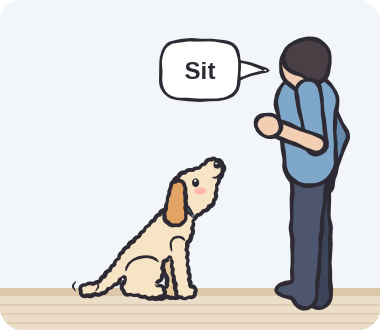
Word first, hand second At home, quiet
Add the word
Say “Sit” once, then give the hand signal. When she sits, “Yes” → treat. Make the hand movement a little smaller each time.
A good sign to move onShe sits to the word alone 8 out of 10 times
- 4
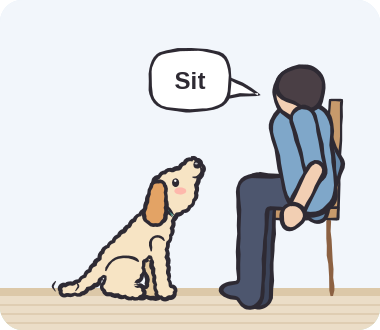
Even when you’re sitting down At home, small distractions
Change your position — and who asks
Ask while you’re sitting in a chair, standing side-on, or standing behind her. Does she sit for everyone in the family? Go back to rewarding more often here.
A good sign to move onShe sits 8 out of 10 times from any position
- 5
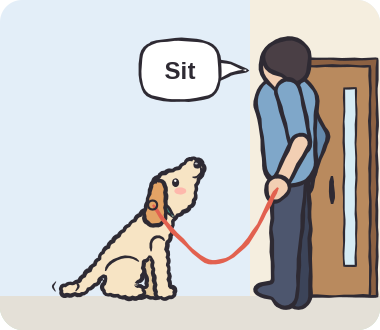
New place? Go back a little and rebuild Yard, doorstep, outside the house
In the yard, by the door, in front of your home
With the leash in your hand, try it in the yard or in front of your home. In a new place, go back to a bigger hand signal and rebuild. Use better treats than usual.
A good sign to move onIn front of your home, she sits to the word alone 8 out of 10 times
- 6
Start at a distance from distractions Around distractions
Around distractions
On a street where people pass, or in a park with dogs in the distance. Start well away from whatever she finds interesting, and keep it short. Use it before crossing a road and before saying hello to people.
A good sign to move onIn that place, she sits to the word alone 8 out of 10 times
When to reward
Just right
“Yes” the instant her bottom touches the floor. The treat goes to her mouth while she’s still sitting.
Too late
The treat arrives after she stands — or you make her stand up while you dig for it. Then “sit and pop straight up” is what gets paid.
If a trainer came to your home: the first session and the first homework
Here is one example of how a visit from an in-home dog trainer might go, put together by BAUDOG. Many dogs learn sit quickly, so some get as far as sitting to the word alone in the first session.
- Today: the trainer demonstrates, then hands over to you for ten reps of step 1 (luring with a treat). Right there, they check that you aren’t pushing her bottom and that the treat arrives while she’s still sitting.
- Homework (for example): two or three times a day, about five minutes each. Work through steps 1–3. In everyday “I want that” moments — before meals, before clipping on the leash — when she sits, that thing becomes the reward (the Say Please by Sitting practice).
- What gets checked next visit: does she sit to one “Sit” without your hand moving? Our rule of thumb is 8 out of 10; then changing your position and practicing in front of your home become the next homework.
When can a puppy learn to sit? And can older dogs learn?
You can start the day your puppy comes home. The UK charities Dogs Trust and Battersea both say training can begin as soon as a puppy arrives, and Battersea says puppies often learn sit within a few short sessions. The American Veterinary Society of Animal Behavior (AVSAB) says puppies can start puppy classes as early as 7–8 weeks of age.
In England, licensed breeders and pet sellers may not sell a puppy under 8 weeks old. In the US there’s no single national rule: Michigan State University’s Animal Legal & Historical Center counts about 27 states plus D.C. with a minimum age for selling puppies, and most of them set it at 8 weeks. So, many puppies come home at around 8 weeks or later. Give your puppy a few days to settle in first, then start with sessions of just a few minutes.
Age doesn’t matter. Adult dogs and rescue dogs learn the same way. For senior dogs or dogs with sore joints, the act of sitting itself can hurt. Don’t ask for lots of repetitions; if it looks uncomfortable, talk to your vet — teaching a different position, such as stand or down, is one option.
Where sit comes in handy
The RSPCA says asking your dog to sit before crossing a road makes crossing safer, and sitting to greet people makes jumping up less likely. The American Kennel Club (AKC) makes a similar point: “sit to say hello” is an easier rule for a dog to follow than “don’t jump.”
Keep rewarding her when she sits on her own, and sit becomes her way of saying “please.” Before meals, walks or toys, sitting is what makes the good thing happen. The Say Please by Sitting practice walks you through this.
She used to sit — now she suddenly won’t
Research suggests there’s a stage, around 8 months, when dogs respond less to their usual person’s “Sit.” One study followed 69 guide-dog puppies at 5 and 8 months: at 8 months they were more likely to ignore their caretaker’s “Sit” several times in a row (about twice the odds). Yet they responded better, not worse, to a stranger’s “Sit.” A questionnaire of the caretakers of a larger group of puppies (285) told the same story: they rated their puppies harder to train at around 8 months, and easier at 12 months than at 5 months. This is one study, of guide-dog puppies.
Battersea also says it’s common for puppies and young dogs to go through a phase where they seem to have forgotten everything. Don’t scold — go back a few steps and reward more often. If she has suddenly started avoiding sitting, consider pain, too.
A good sign to move on
- Steps 1–3 (indoors, quiet): once she sits to the word alone 8 out of 10 times, move on to changing your position and who asks (our rule of thumb)
- In a new place, it’s fine to go back to a bigger hand signal and rebuild from there (new places usually go faster than the first time)
- Raise only one kind of difficulty at a time (place, your position, or distractions)
- If she struggles, go back one step (our rule of thumb: she misses twice in a row)
If it isn’t working
She backs up instead of sitting
Your hand is moving too fast, or too far back over her head. Keep the treat on her nose and move it more slowly, and only a little way up. Practicing with a wall or the corner of a room behind her is one idea — with nowhere to back into, sitting gets easier.
She jumps up at the treat
When the treat leaves her nose, she goes for it. Keep it touching her nose and move slowly. If she’s wary of hands or dislikes a hand passing over her head, switch to capturing: wait for her to sit on her own, and mark that moment with “Yes.”
She sits, then pops straight back up
Give the treat while she’s still sitting. If it arrives after she stands, she learns “sit, then stand straight up.”
She only sits if she can see a treat
Get the treat out of your luring hand early and pay from your other hand (step 2). Once she’s reliable, give treats not every time but for the quickest, neatest sits. The rest of the time, use praise, play, heading out for a walk or getting out of the car as the reward.
She sits for the hand signal but not the word
Many dogs read hand movements more easily than words. Shrink the hand signal gradually, and reward her for even starting to sit after the word.
She sits at home but not outside
Outside is full of smells, sounds and moving things. In a quiet spot outdoors, go back one step and reward more often. Some dogs dislike sitting on cold, wet or bumpy ground, so start somewhere comfortable, like grass.
Can I push her bottom down?
No. Dogs Trust says not to push your dog’s bottom down, even if learning takes a while. Pushing can scare or confuse her. Waiting and marking the moment she sits on her own works faster.
How long does it take to teach a dog to sit?
We couldn’t find a study that measured it in days. Battersea says puppies often learn sit within a few short sessions. Rather than counting days, move on when she meets a benchmark, such as sitting to the word alone 8 out of 10 times.
My Greyhound or Dachshund seems to find sitting awkward
Battersea notes that some breeds, such as Greyhounds and Dachshunds, find sitting uncomfortable because of how they’re built. Reward small movements and take your time; if sitting looks uncomfortable, teach another position, like down.
Prescription: a suggested order
BAUDOG’s recommended order. Teach the sit itself with the steps above; these two practices then grow it into a dog who sits anytime — and on her own.
- ExerciseCharging Your Marker Word: How to Teach Your Dog That “Yes” Means a RewardDoable at home (Steps 1–4 at home)Lets you pinpoint the moment her bottom touches the floor with “Yes.” Building it before you teach sit makes teaching easier.Read →
- ExerciseSay Please by SittingDoable at home (Steps 1–3 at home)Before meals, walks and doors, sitting on her own gets her what she wants. Sit becomes her “please,” and her impulse control grows.Read →
In the moment: do / don’t
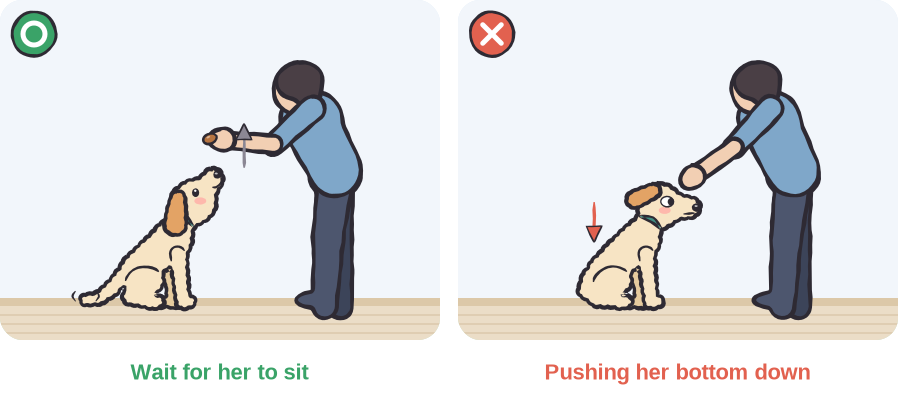
Do
- Say “Sit” once. If she doesn’t sit, wait a few seconds, then help with your hand
- “Yes” the moment her bottom touches down; treat while she’s still sitting
- Keep sessions to about 5–10 minutes and finish on a success
- In a new place, go back a little and rebuild
Don’t
- Pushing her bottom down
- Pulling up on the leash to make her sit
- Saying “Sit, sit, sit”
- Scolding her for not sitting
When to see a professional
- She avoids sitting, or seems sore or wobbly when sitting down or getting up. This can be a sign of hip or other joint pain
- She used to sit squarely but now sits with one leg kicked out to the side. If she also struggles to get up or can’t jump into the car, it may be a problem with the cruciate ligament in her knee — in dogs this usually wears down gradually rather than tearing in one sudden injury. If she limps for more than a day or seems in pain, see your vet soon
- She scoots along the floor on her bottom. This is often the first sign of anal sac trouble (the small sacs either side of the anus). See your vet, too, if she keeps licking or chewing at the base of her tail
The skills behind this command
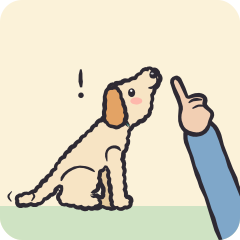 Core skill Understanding Cues Understanding that the word “Sit” and its hand signal mean the same thing, whatever the place and whoever is asking.
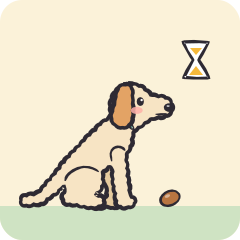 Core skill Impulse Control Sitting and waiting in front of something she wants, instead of jumping for it. Sit is the gentlest way in.
- ExerciseCharging Your Marker Word: How to Teach Your Dog That “Yes” Means a RewardDoable at home (Steps 1–4 at home)Read →
- ExerciseSay Please by SittingDoable at home (Steps 1–3 at home)Read →
Sources
- Battersea Dogs & Cats Home — How to teach your dog to sit
- Dogs Trust — How to train your dog to sit
- RSPCA — How to train a dog to sit
- American Kennel Club — Teach Your Dog to Sit
- American Kennel Club — How to Stop Your Dog From Jumping Up on People
- Dogs Trust — Top ten dog training tips
- Dogs Trust — Getting started with puppy training
- AVSAB — Position Statement on Puppy Socialization
- AVSAB — Position Statement on Humane Dog Training (2021)
- The Animal Welfare (Licensing of Activities Involving Animals) (England) Regulations 2018, Schedules 3 and 6 (legislation.gov.uk)
- Michigan State University Animal Legal & Historical Center — Table of State Laws Concerning Minimum Age for Sale of Puppies (Wisch, 2025)
- Asher, England, Sommerville, Harvey (2020). Teenage dogs? Evidence for adolescent-phase conflict behaviour and an association between attachment to humans and pubertal timing in the domestic dog. Biology Letters 16(5):20200097
- VCA Animal Hospitals — Hip Dysplasia in Dogs
- Colorado State University Veterinary Health System — Canine Cruciate Ligament Injury
- VCA Animal Hospitals — Anal Sac Disease in Dogs
- New York City Health Code Article 161, §161.05
- The Highway Code (UK) — Rules about animals, Rule 56