 BAUDOG The dictionary of dog–human communication
Contents
- In short
- Common at this age
- Your dog at this age
- Assessment: where is your dog now?
- An age-by-age guide
- Your puppy’s first week at home
- Should you wait until her vaccinations are finished? And when can she start puppy classes?
- When a trainer comes to your home: the first session and the first homework
- Is 6 months too late? Starting with an older puppy or an adult dog
- A good sign to move on
- Skills to build now
- Exercises
- At this age: do / don’t
- When to see a professional
- Sources
In short
Start the day your puppy comes home. Many puppies go home at around 8 weeks: in England, licensed breeders may not sell a puppy under 8 weeks old. In the US, a federal rule bars shipping puppies in commerce before they’re 8 weeks old and weaned, and about 27 states and D.C. have their own minimum age for selling, transferring or bringing in puppies — usually 8 weeks, though many of these laws cover only pet stores, dealers or certain breeders. The American Kennel Club (AKC) says puppies can begin very simple training as soon as they come home, usually at around 8 weeks old. But you don’t start with commands. You start with a marker word (“Yes”), her name, potty breaks, a crate or bed she likes, being handled, and getting used to new things (socialization). The most important time for socialization is short — roughly the first three months of life — so start it in safe ways without waiting for her vaccinations to finish. And if she came home later, or you’re starting with an adult dog, it isn’t too late.
Common at this age
- She’s so tiny. Is it really okay to start training already?
- Someone told us to keep her inside until all her shots are done
- We brought her home at 3 or 4 months — or she’s already 6 months. Is it too late?
- How old does she need to be for sit, or for working on puppy biting?
Your dog at this age
The veterinary behavior specialists who wrote VCA Animal Hospitals’ puppy guide put it this way: your puppy is learning during every waking moment, and every interaction with her is a form of training. Even when you aren’t trying to teach her anything, she is learning every day what pays off. That’s why it matters to notice the things you like from the very start, and reward them.
The American Veterinary Society of Animal Behavior (AVSAB) explains why the early weeks count for so much: in the first three months, a puppy’s sociability outweighs her fear, so this is her main window for getting used to new people, animals and experiences. From the day she comes home, carrying that on is your job.
Assessment: where is your dog now?
Where you start depends less on her age in weeks than on what she can already do.
She’s only been home 2–3 days?
→First, let her settle in. Decide where her potty spot and her bed are, and keep things quiet. Just “Yes” → treat can start today.
Has she had her first set of vaccines?
→AVSAB says puppies can start puppy classes from 7–8 weeks of age, at least 7 days after their first set of vaccines. Choose the date with your vet.
Is she past 3 months (12 weeks)?
→The most important socialization window is closing. Make pairing new sounds, people and things with something good a priority — without pushing her.
Is she past 6 months?
→She’s heading into adolescence. If cues she knew suddenly fall apart, see Dog adolescence.
An age-by-age guide
These ages are rough guides; breed and personality shift them either way. The full order of what to teach is on What to teach a puppy first.
- From around 8 weeks (the day she comes home): the “Yes” marker, her name, potty training, a crate she likes, being handled, and getting used to new sounds, people and things (socialization).
- After a week or two: sitting for things she wants (in front of her food bowl or a toy). Trainer Kate Naito, interviewed by the AKC, says you can start as early as 8 weeks, as long as you use reward-based training.
- 3–6 months: come (recall games), trade (“drop it”), wait, down — and once walks begin, loose-leash walking. One AKC timeline sets these goals for around 6 months: steady progress with stopping play politely, housetraining, coping with short spells alone, and coming happily when called.
- 6 months to about 2 years: adolescence. There may be stretches when things she could do fall apart. Don’t scold; rebuild from one step easier (see Dog adolescence).
- By about 1 year: the same AKC timeline’s goals are sit, down and stay even with distractions, coming when called, loose-leash walking, and “drop it” and “leave it.”
Your puppy’s first week at home
One example of how BAUDOG would lay it out. The days are approximate — go at the pace she settles in.
- Day 1: set up her bed (a crate) and her potty spot. Keep the day quiet, and don’t have lots of people meet her at once.
- From day 1: take her to her potty spot when she wakes up, 15–30 minutes after meals, right after play and after any excitement. Wait quietly, and the moment she finishes, “Yes” → treat right there — within a few seconds, not back inside.
- From day 2 or 3: “Yes” → treat in a quiet room at home, 2–3 minutes at a time. Once she’s got that, start the Name Game.
- Every day: touch → treat (paws, ears, around her mouth, a little at a time). Carry her to the doorway to watch and listen to the world outside.
- Within the first week: have your vet check her over, and ask about her vaccinations and when she can start a puppy class.
Should you wait until her vaccinations are finished? And when can she start puppy classes?
No need to wait. AVSAB says it should be the standard of care for puppies to be socialized before they are fully vaccinated. The World Small Animal Veterinary Association (WSAVA) vaccination guidelines put the last puppy vaccine at 16 weeks of age or older — and also say careful socialization can begin before the vaccination series is complete.
Safe ways to start: carry her (or use a carrier) to watch people and sounds outside, have healthy, fully vaccinated dogs and people visit your home, and go to an indoor puppy class with floors that can be disinfected. Avoid dog parks and places lots of unknown dogs pass through until her vaccinations are finished. Decide with your vet when she can walk on the ground outside. There’s more on Puppy socialization.
Puppy classes: AVSAB says puppies can generally start socialization classes as early as 7–8 weeks of age, with at least one set of vaccines 7 days before the first class and a first deworming — and that a puppy class before three months of age can be an excellent way to improve training and socialize her where the risk of illness can be kept low. Pick a class that asks for proof of vaccination. Advice on class timing differs, though: in the UK, the Royal Kennel Club says you can start classes as soon as her vaccinations are complete, but that how early you can go may vary from class to class — and it also says keeping a puppy confined to the house and garden may be counterproductive. Ask your vet and the class.
When a trainer comes to your home: the first session and the first homework
One example, put together by BAUDOG, of how a visit from an in-home dog trainer might go. Whatever her age, the first session starts with “Yes” and a look at your household’s daily routine.
- Today: “Yes” → treat, 10 times. The trainer asks about her potty, meal and sleep times, and works out when to take her to her potty spot.
- Homework until next time: “Yes” practice 2–3 times a day, 2–3 minutes each. No more than 2–3 new sounds, objects or people a day (just watching from your arms counts — it’s a cap, not a daily target).
- What the trainer checks next visit: when she’s looking somewhere else, does she turn to “Yes” 5 times in a row? If she does, the Name Game and sitting to say please are added to the homework.
Is 6 months too late? Starting with an older puppy or an adult dog
No, it isn’t too late. Dogs Trust puts it simply: age is just a number, and puppy training starts as soon as you bring your dog home. The UK veterinary charity PDSA says it’s best to start while your dog is young, but it’s never too late — old dogs can learn new tricks too. In a study that taught 95 pet Border Collies (5 months to 13 years old) to tell pictures apart on a touchscreen, older dogs needed more sessions to learn, but 93 of the 95 learned the task (a study of one breed).
A puppy who came home after about 4 months spent the most important socialization window in her previous home. Keep socializing her — AVSAB strongly encourages it for puppies past the three-month mark — and if something scares her, start at a distance and pair it with good things. If you’ve brought home an adult dog, see Training an adult dog.
A good sign to move on
- “Yes”: when she turns to it 5 times in a row while looking somewhere else, move on to the Name Game (BAUDOG’s rule of thumb)
- Her name: in a quiet room at home, when she turns within 2 seconds of one call 9 times out of 10, move on to recall games
- Socialization: when she can watch things at home without freezing, move on to watching the world from the doorstep or a balcony (the guide in Puppy Socialization)
Skills to build now
Exercises
Three practices you can start the day she comes home. Work through them in this order, but do socialization alongside, every day.
- ExerciseCharging Your Marker Word: How to Teach Your Dog That “Yes” Means a RewardDoable at home (Steps 1–4 at home)A word everyone in the family uses to say “that’s it.” You can start in the first few days.Read →
- ExerciseThe Name GameDoable at home (Steps 1–2 at home)Turns her name into a signal that looking at you pays.Read →
- ExercisePuppy Socialization: How to Make New Things Good ExperiencesStart at home, finish outside (Steps 1–2 at home)The key window lasts until about 3 months. Even before vaccinations are done, start with what you can do at home or while carrying her.Read →
At this age: do / don’t
Do
- Start the “Yes” marker, potty training and crate time the day she comes home
- Keep sessions to a few minutes, a few times a day
- Start socialization before her vaccinations are finished, in safe ways
- Ask your vet when she can start a puppy class
Don’t
- Waiting until she’s 6 months old to start
- Taking her to dog parks or places lots of unknown dogs visit before her vaccinations are finished
- Having lots of people and dogs meet her on day one
- Scolding to teach
When to see a professional
- After she comes home she has diarrhea or keeps vomiting, isn’t eating well, or seems low on energy. Contact your vet as soon as possible, before you think about training; PDSA notes diarrhea can be more serious in a puppy
- Around new things she keeps cowering, peeing or refusing treats. Don’t push her to get used to them; talk to your vet
Grow the skill underneath
 Core skill Focus
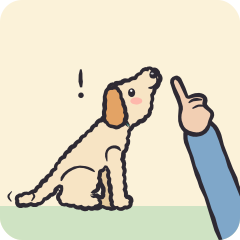 Core skill Understanding Cues
- ExerciseCharging Your Marker Word: How to Teach Your Dog That “Yes” Means a RewardDoable at home (Steps 1–4 at home)Read →
- ExerciseThe Name GameDoable at home (Steps 1–2 at home)Read →
- ExercisePuppy Socialization: How to Make New Things Good ExperiencesStart at home, finish outside (Steps 1–2 at home)Read →
Sources
- VCA Animal Hospitals (Lindell, Feyrecilde, Horwitz, Landsberg) — Puppy Behavior and Training: Training Basics
- American Kennel Club — Teach Your Puppy These 5 Basic Cues (Paisley Lunchick, RVT, KPA-CTP)
- American Kennel Club — Puppy Training Timeline: Teaching Good Behavior Before It’s Too Late (Mary Kearl; sponsored by Purina Pro Plan)
- The Animal Welfare (Licensing of Activities Involving Animals) (England) Regulations 2018, Schedules 3 and 6 (legislation.gov.uk)
- Michigan State University Animal Legal & Historical Center — Table of State Laws Concerning Minimum Age for Sale of Puppies (Wisch, 2025)
- AVSAB — Position Statement on Puppy Socialization
- WSAVA — 2024 Guidelines for the Vaccination of Dogs and Cats
- Herron & Stull — Balancing Puppy Socialization with Infectious Disease Prevention (The Ohio State University College of Veterinary Medicine)
- VCA Animal Hospitals — When to Start Puppy Training Classes
- The Royal Kennel Club (UK) — Vaccinations for dogs and puppies
- RSPCA — Caring for your puppy
- Battersea Dogs & Cats Home — How to settle in your new puppy or dog
- MSD Veterinary Manual (owners) — Behavior Problems in Dogs
- RSPCA — Toilet training your dog
- Dogs Trust — House or toilet training
- Humane World for Animals — How to potty train your dog or puppy
- RSPCA Australia — How to toilet train your puppy
- VCA Animal Hospitals — House Training Your Puppy
- Veterinary Behavior Specialties of Minnesota — From Cute to Chaos: Understanding Your Adolescent Dog
- Battersea Dogs & Cats Home — How to socialise your puppy
- Dogs Trust — Getting started with puppy training
- PDSA — Reward-based training
- Wallis, Virányi, Müller, Serisier, Huber & Range (2016). Aging effects on discrimination learning, logical reasoning and memory in pet dogs. Age 38:6
- PDSA — Dog diarrhoea (Pet Health Hub)
- PDSA — Vomiting in dogs (Pet Health Hub)