 BAUDOG The dictionary of dog–human communication
Contents
When to use this exercise
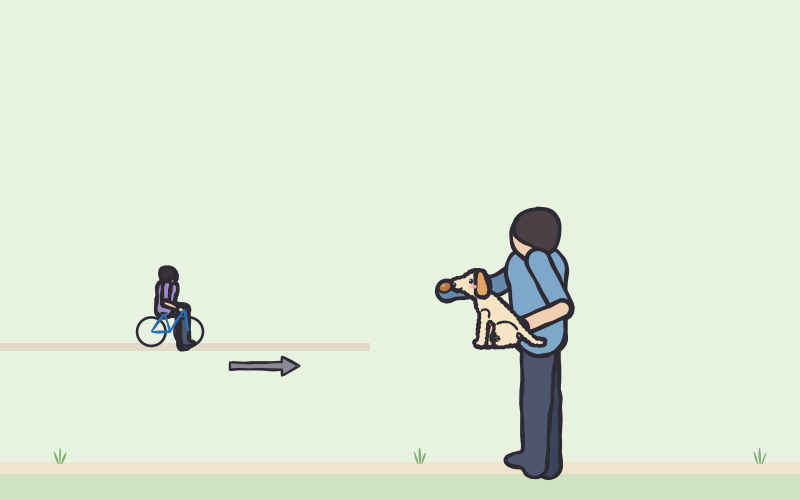
For the first few months after your puppy comes home. Show her people, dogs, sounds, different floors, cars, being touched and being groomed — together with treats or play, and at a level where she stays relaxed. What matters isn’t the number of things; it’s that each one ends as a good experience. If she gets scared, add distance. This builds Confidence and Comfort with Handling. The same approach works for helping an adult dog get used to things, too.
GoalWhen she meets a new person, object or sound, she approaches on her own or watches calmly. When she’s touched, she looks at you expecting a treat.
Assessment: what a trainer might check on the first visit
A visiting trainer might check these at the first visit.
How many weeks old is she? Which vaccinations has she had, and when?
→Ask your vet when she can walk outside and when she can join a puppy class. Even before she can walk outside, you can carry her out to see the world.
Is there anything at home — the vacuum, the hair dryer, the doorbell — she’s already scared of?
→If so, don’t put it first on the list. Start with it switched off, far away, or very quiet.
What signals does she give when she’s scared? (Freezing, tucking her tail, backing away, running off, refusing treats) How quickly does she bounce back?
→Make “if she signals, add distance” a rule for the whole family. If she’s slow to bounce back, introduce fewer new things and go more slowly.
Is she comfortable having her mouth, paws and ears touched?
→Add handling practice (Touch Then Treat) to the daily homework. It’s the groundwork for toothbrushing and nail trims.
What you need
- A list of things to get her used to (people, dogs, sounds, places, floors, vehicles, handling). Tick off each one she’s done
- Really good treats, cut small
- A carrier, sling or stroller for outings before her vaccinations are finished
How to signal
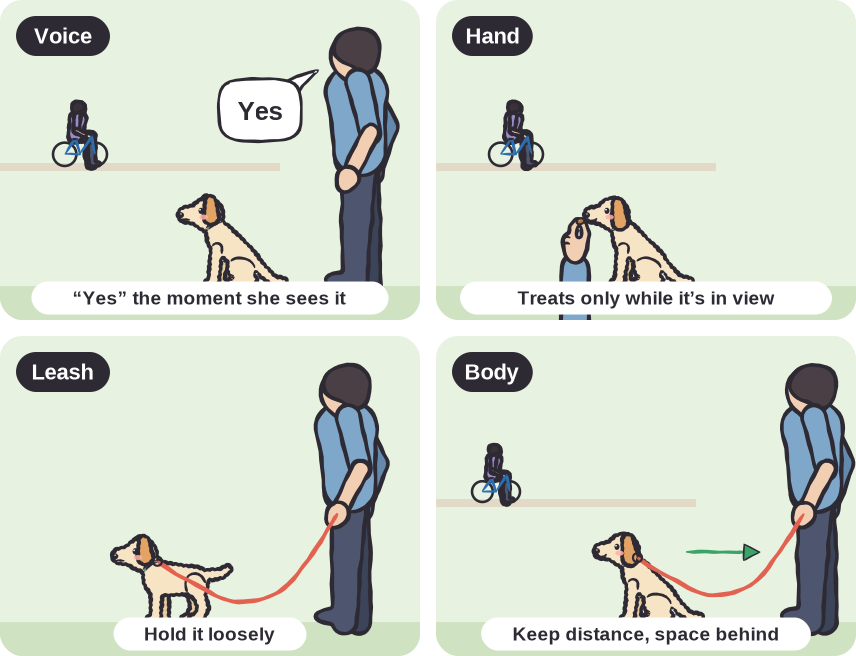
- Voice
“Yes” the moment she sees or hears something new. Don’t hold a scared puppy in place saying “it’s okay, it’s okay.”
- Hand
Treats come while the new thing is in view or can be heard. When it goes away, the treats stop. Don’t use treats to lure her closer to it.
- Leash
Hold it loosely. Never pull to make her go closer.
- Body
Keep plenty of distance between your puppy and the new thing. Leave space behind her so she always has a way out.
Today’s session
With the trainer, you work on step 1.
Step 1Things at home (switched off)(At home, quiet)
You and the trainer make the list of things to get her used to. Then you show her things at home — the vacuum switched off, different floors — with treats. The trainer shows you how to wait for her to approach on her own, and how to add distance the moment she signals she’s scared.
Homework until the next visit
- How often
- A few times a day
- How long
- A few minutes each (up to about 5)
- How much
- No more than 2–3 new things a day
A good sign she’s readyShe can watch things at home without freezing. When she’s touched, she looks at you expecting a treat
What the trainer checks next visit
Going through the list together: how does she react to things at home, and to being touched?
If she canIf she stays settled with things at home, step 3 (watching the outside world from the doorstep or a balcony — carried, if her vaccinations aren’t finished) becomes the next homework.
If not yetTake the things that scared her back to switched off, far away or very quiet, and do another week. If she is very scared or doesn’t bounce back, talk to your vet or a behavior professional.
Next stages: steps
- 1
At home, quiet
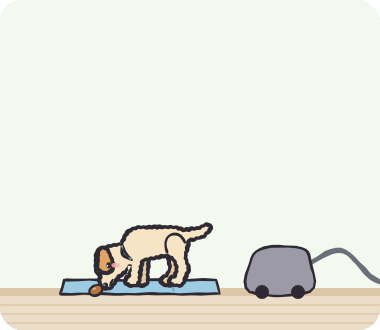
Things at home (switched off)
The vacuum or hair dryer switched off; walking on different surfaces (a towel, a bath mat, a doormat) — all with treats.
A good sign to move onShe watches without freezing, and goes up to sniff on her own
- 2
At home, small distractions
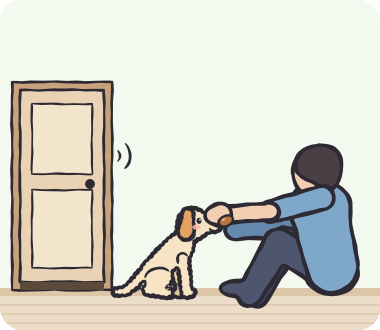
Sounds and handling
Run the vacuum in another room → treat. A little touch → treat on the side of her mouth, her paws and her ears (Touch Then Treat) every day.
A good sign to move onEven with the noise running, or while being touched, she looks at you expecting a treat
- 3
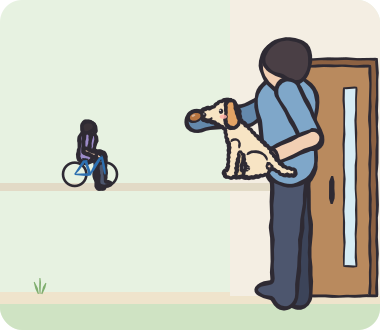
Doorstep or balcony (carried is fine)
Watching the outside world
Carry her if her vaccinations aren’t finished. From the doorstep or a balcony, let her watch people, cars and bicycles in the distance while you give treats.
A good sign to move onShe can eat treats while watching the outside world
- 4
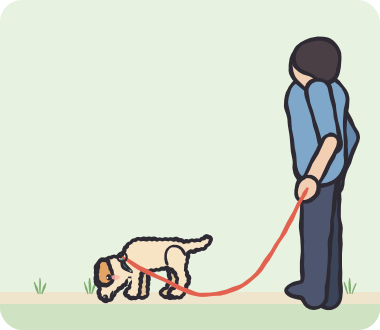
Quiet street
On a quiet street
A short time on a quiet street. Carry her or use a stroller until your vet says she can walk outside. Give her time to sniff, too.
A good sign to move onOutside, she can watch without freezing, and sniff around
- 5
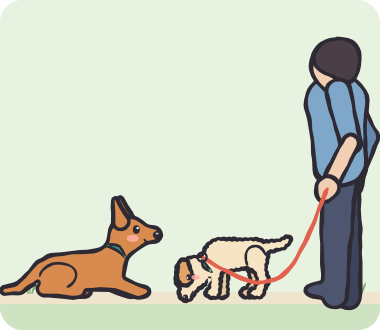
Around distractions
Meeting people and dogs
Short meetings with a calm adult dog and gentle people. A puppy class is one option. If she shows she doesn’t like it, move away at once.
A good sign to move onShe approaches on her own, and moves away on her own
Timing
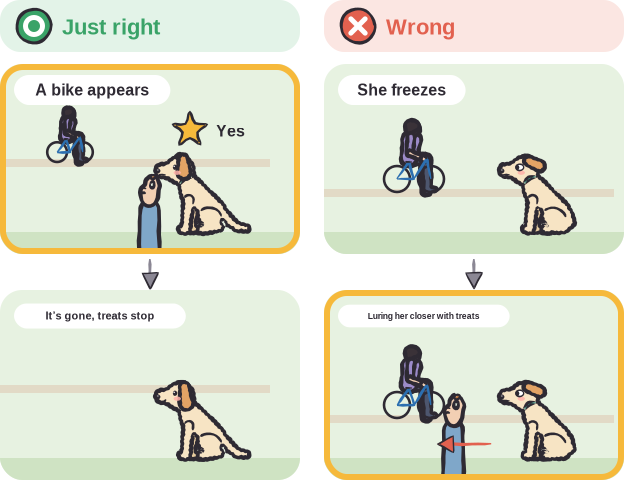
Just right
The new thing appears → “Yes” and a treat. The new thing goes away → the treats stop too.
Too late
Waiting until she has frozen in fear, then luring her closer with treats.
If she can’t eat, the fear is too strong. When that happens, don’t add more treats — add distance.
How much and how often
A few minutes per session (up to about 5). No more than 2–3 new things a day. A few sessions a day, a little every day.
If it isn’t working
When is the socialization period?
Many sources put the window when puppies most readily accept new things at roughly 3 to 12 weeks of age, and certainly no later than about 14 weeks. The American Veterinary Society of Animal Behavior (AVSAB) says the first three months of life are the most important time for puppy socialization. Many puppies go home at around 8 weeks: in England, licensed breeders may not sell a puppy under 8 weeks old. In the US, a federal rule bars shipping puppies in commerce before they’re 8 weeks old and weaned, and about 27 states and D.C. have their own minimum age for selling, transferring or bringing in puppies — usually 8 weeks, though many of these laws cover only pet stores, dealers or certain breeders. So by the time she’s home, you’re often in the second half of the window. Start gently from her first day. In a study of about 6,000 pet dogs in Finland, dogs who had fewer socialization experiences between 7 and 16 weeks of age were more likely to be fearful of other dogs or of strangers (an owner survey that found a link; it can’t show cause and effect).
Is 12 weeks too late to socialize a puppy?
No. Keep going — AVSAB strongly encourages owners of puppies past the three-month mark to keep socializing them to as many people, pets and places as is practical. The same approach works for older puppies and adult dogs, too; it just takes longer.
My vet says she can’t go out until her vaccinations are finished
You can still carry her out or use a stroller, and work on sounds, floors and handling at home. Dogs Trust and The Royal Kennel Club both recommend carrying your puppy outside before her vaccinations are complete. When you do, only let her meet dogs you know for certain are vaccinated, and avoid places many different dogs pass through, such as dog parks. Ask your vet when she can walk outside and when she can start a puppy class.
Should she go to a puppy class?
It’s a good option. AVSAB says puppies can start puppy classes as early as 7–8 weeks of age, as long as they’ve had their first set of vaccines at least 7 days before. A Japanese study (Azabu University, 142 dogs) found that dogs who attended a once-a-week, six-week puppy class responded more positively to strangers than dogs who didn’t. But other research suggests the evidence for puppy classes is less clear. Avoid classes that just let puppies play freely with little supervision, and big “puppy parties” — they can be too much for a young puppy.
She freezes or runs away
Add distance. That’s enough for today. Don’t try to push her through it. Keeping a dog exposed to something frightening until she stops reacting can make the fear stronger.
What about the 7-7-7 rule, or “100 people by 12 weeks”?
Online, the name often points to a version of the “Rules of Seven,” a breeder’s checklist: by about 7 weeks old (mostly before she comes home), a puppy meets seven different surfaces, objects, places, new people and so on. Versions differ. What matters more than numbers is that each experience ends well. Checklists like these are rules of thumb; research hasn’t established how much socialization a puppy needs. When she’s tired or scared, stop there.
When should I get help?
When her fear signals (hiding, backing away, freezing, barking on and on, licking her nose, yawning, looking away) are strong and she doesn’t bounce back. If a puppy keeps showing fear, talk to your vet early, and ask them to refer you to a behavior professional who doesn’t use punishment.
Avoid
- Introducing lots of people or dogs all at once
- Carrying a scared puppy up to the thing that scares her
- Taking her straight into a dog park
- Scolding her for being scared
A good sign to move on
- Steps 1–2 (at home): she can eat without freezing in front of that object or sound → move on
- Steps 3–5 (outside): she can eat without freezing in that place or with that person or dog → move on. If she can’t eat, add distance
- Anything that scared her goes back a step (switched off, far away, very quiet)
Sources
- AVSAB — Position Statement on Puppy Socialization (2008)
- Merck Veterinary Manual — Social Behavior of Dogs
- Howell, King & Bennett (2015). Puppy parties and beyond: the role of early age socialization practices on adult dog behavior. Veterinary Medicine: Research and Reports 6:143–153
- The Animal Welfare (Licensing of Activities Involving Animals) (England) Regulations 2018, Schedule 6
- Animal Legal & Historical Center (Michigan State University College of Law) — Table of State Laws Concerning Minimum Age for Sale of Puppies (2025)
- Puurunen et al. (2020). Inadequate socialisation, inactivity, and urban living environment are associated with social fearfulness in pet dogs. Scientific Reports 10:3527
- Kutsumi et al. (2013). Importance of puppy training for future behavior of the dog. Journal of Veterinary Medical Science 75:141–149
- Dogs Trust — Introducing your puppy to the world around them
- The Royal Kennel Club — Your puppy’s first weeks at home
- RSPCA — Caring for your puppy
- WSAVA — Guidelines for the Vaccination of Dogs and Cats (Day et al., 2016)
- Battersea Dogs & Cats Home — How to socialise your puppy
- Blue Cross — Socialising (leaflet DOG 17)
- MSD Veterinary Manual (owners) — Behavior Modification in Dogs
- MSD Veterinary Manual (owners) — Behavior Problems in Dogs
- VCA Animal Hospitals — Overcoming Fears with Desensitization and Counterconditioning
- VCA Animal Hospitals — Introduction to Desensitization and Counterconditioning