 BAUDOG The dictionary of dog–human communication
Contents
- In short
- When it happens
- How your dog feels
- Assessment: where is your dog now?
- Check her body and the heat first
- If the leash or harness is the problem
- If she’s scared
- If a trainer came to your home: the first session and the first homework
- If she won’t go home, or plants her feet to go her way
- If your puppy won’t walk
- The missing core skill
- Exercises
- In the moment: do / don’t
- When to see a professional
- Sources
In short
A dog who won’t walk usually isn’t being stubborn. There are five common reasons: she’s scared (traffic, noises, people, other dogs), sore (paws, joints, nails), too hot (the sidewalk is burning), tired (age, fitness), or she’d rather be somewhere else — still playing, heading for the park, or she has learned that stopping gets her a treat or a lift. A dog who isn’t used to a leash or harness can also find the equipment itself strange. The UK charity Dogs Trust advises a vet check first for any dog who refuses to walk. If her body and the weather check out, work out which reason it is. Never drag a frightened dog along on the leash; help her move away from what scares her, and build her confidence from a distance where she can stay calm.
When it happens
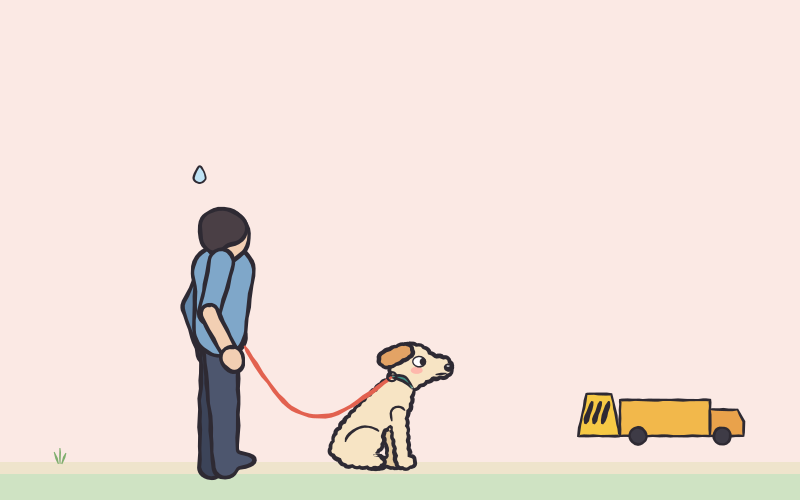
- Your dog sits down just outside the front door and won’t budge
- She freezes at the busy road or the building site with the loud machines
- On the way home she plants all four feet and leans back
- Your new puppy won’t take a step the first time you put her down outside
- She used to love her walks; lately she stops halfway (an older dog)
How your dog feels
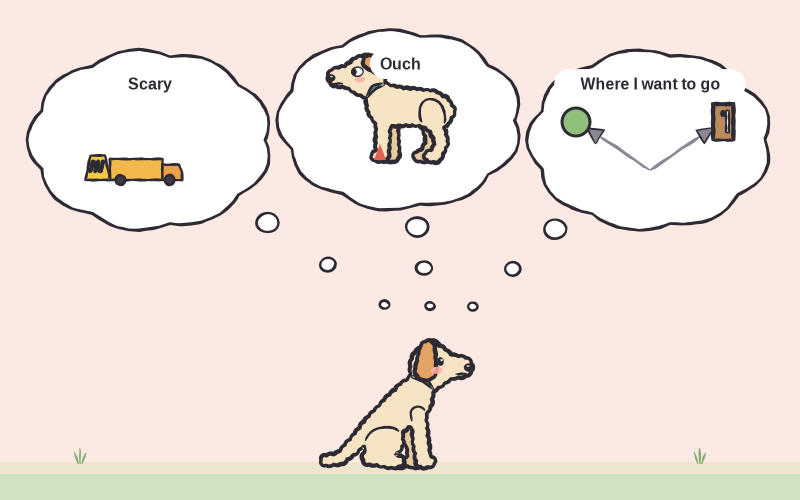
A frightened dog stops to keep herself safe. The MSD Veterinary Manual, written for vets by veterinary behavior specialists, lists loud, unpredictable noises such as thunder and fireworks, and unfamiliar people and dogs, among the things dogs commonly fear. Dogs Trust adds that dogs who switch between pulling and stopping on a walk are often feeling unsure, and sometimes need you to help them move away from what is worrying them.
Pain can make fear worse. The MSD manual notes that pain is a major factor in behavior problems and can lower a dog’s threshold for fear and aggression. A small study compared the records of 20 noise-sensitive dogs — 10 with musculoskeletal pain and 10 without. In the dogs with pain, the noise fear started nearly four years later on average, and it had spread further — to avoiding certain places or other dogs. If an older dog suddenly becomes scared outside, think about pain too.
Other dogs stop while looking perfectly relaxed. Dogs Trust lists wanting to go somewhere they enjoy (the park, a shop that hands out treats), being in the middle of play and wanting to carry on, and having learned that refusing to move means treats come out to persuade them. If a treat appears every time she stops, stopping pays. In our view, picking her up every time can pay in the same way.
Assessment: where is your dog now?
When she stops, run through these in order. Body and heat come first so you don’t miss a health problem.
Did it start suddenly? Is she limping, sensitive to touch, avoiding the sofa or stairs, slow to get up?
→She may be in pain. See your vet before any training (see “When to call the vet” below).
Is it a hot day? Is the sidewalk too hot to hold your hand on for five seconds?
→The ground is too hot. Walk her early in the morning or later in the evening instead (see “Check her body and the heat first”).
When she stops, does she crouch, tuck her tail, flatten her ears, tremble or lick her lips? Does it happen at the same places or sounds?
→She’s stopping because she’s scared. Don’t pull — move away from what scares her (see “If she’s scared”).
Is she relaxed but leaning toward where she wants to go, or stopping only on the way home?
→She may have somewhere she’d rather go, want to keep playing, or have learned that stopping pays (see “If she won’t go home, or plants her feet to go her way”).
Has she hardly worn a leash or harness before, or does she only stop when it’s on?
→The equipment itself may feel strange or worrying. Get her used to it at home first (see “If the leash or harness is the problem”).
Is she a puppy who has barely been outside?
→She’s still getting used to the world (see “If your puppy won’t walk”).
Check her body and the heat first
Dogs Trust advises taking a dog who refuses to walk to the vet to rule out medical problems first, and only then working out what is making her stop. Limping, a change in how she walks, stiffness or difficulty getting up, slowing down on walks: the UK veterinary charity PDSA lists these as signs of arthritis and advises contacting your vet if you notice them. Overgrown nails that dig into the paw pads are very painful and can make walking difficult (Dogs Trust).
Heat matters too. The ASPCA warns against letting dogs linger on hot asphalt in very high temperatures: being so close to the ground, a dog’s body heats up quickly, and paw pads can burn. Dogs Trust recommends the five-second test — hold your hand on the sidewalk for five seconds, and if it’s too hot for you, walk later once it has cooled — and walking in the early morning or later in the evening. Take extra care if your dog is old, overweight, has breathing difficulties or is a flat-faced breed such as a Pug or French Bulldog (Dogs Trust). In UK dogs, exercise brings on far more heat-related illness than hot cars do. A UK study of the veterinary records of about 900,000 dogs seen in 2016 found 1,259 cases of heat-related illness. Of the 879 where the trigger was recorded, 74% were brought on by exercise; of the 551 where the type of exercise was known, 68% happened after a walk.
For older dogs, Dogs Trust suggests several shorter walks rather than one long one, at your dog’s own pace.
If the leash or harness is the problem
Some dogs only refuse when the leash is on. Dogs Trust lists finding a leash strange because they aren’t used to it among the reasons dogs won’t walk, and notes that if a healthy dog only stops on the leash, the leash itself may be worrying her. In our view, a new harness or coat can have the same effect on some dogs. All walking equipment should be introduced gradually and positively, harness included (Dogs Trust). Dogs Trust’s harness steps, in short: put the harness on the floor and scatter treats around it; feed treats through the head opening so your dog pushes her nose through by herself; let her hear the clips before you do them up; once it’s on, keep her busy with a game, then go out, with a treat now and then along the way. If she backs away at any stage, take it off and go back a stage. For fit, Dogs Trust suggests you should be able to slide a finger comfortably between the straps and her body, and she shouldn’t be able to slip out.
If she’s scared
Taking a frightened dog right up to what scares her and waiting until she gets used to it (flooding) isn’t recommended — the MSD Veterinary Manual says it can be extremely distressing and may even be traumatizing. Dragging her along on the leash does the same thing. Instead, show her the scary thing at a level she can stay calm with — farther away, or quieter — pair it with something she loves, and close the gap gradually. The MSD manual’s guidelines: work at an intensity where the dog stays calm the whole time; if she reacts, stop, help her settle, and go back to a level she didn’t react to; and short, frequent sessions work better than long, occasional ones.
- If she freezes, don’t pull. Turn around and move away from what scares her. With a small dog, you can pick her up, leave, and put her down again somewhere she can relax.
- Make a note of where she stops and what she could hear or see at that moment (a busy road, building-site noise, bikes).
- For a while, avoid those places and times. Walk at quieter times, on quieter streets.
- Practice “Look at That” at a distance where she can still eat treats and stay loose while the scary thing is in view. If she stops taking treats or stiffens up, you’re too close. There’s no fixed distance.
- If sounds are the problem, work on recorded sounds at home, starting very quietly (“Getting Used to Sounds Step by Step”), alongside your walks.
- If simply being outside scares her, some days can be nothing more than a sniffing game for treats in front of your house. Count the minutes she spends calm outside, not the distance walked (our rule of thumb).
If a trainer came to your home: the first session and the first homework
Here’s how we’d expect a first in-home session to go — one example, not a fixed script. A trainer can’t tell why a dog stops without seeing where and how she stops, so they might step out of the front door with you and walk a little way from your house.
- Today: indoors, the trainer watches how your dog moves and how the harness fits (is she favoring a leg?). Then you walk together from the front door to where she stops, and watch her body when she does. If she’s scared, you go back a little to a spot where she’s calm and scatter a few treats on the ground for a sniffing game.
- Homework: walk at quiet times and on quiet streets, only as far as she walks calmly. When she stops, don’t hurry her — look at her body first. If she freezes in fear, don’t pull: turn around, or pick her up and leave. Note where, when and what she heard each time she stopped. Indoors, practice Hand Target twice a day, about 3 minutes each.
- Next visit: you go through your notes together to narrow down what scares her, and check whether the area where she walks calmly has grown. If it has, the next homework is “Look at That” where the scary thing is visible in the distance. There’s no set number — the guide is that she can eat treats and her body stays loose.
If she won’t go home, or plants her feet to go her way
If her body is relaxed and she leans toward where she wants to go, or stops only on the way home, she probably isn’t scared — she wants more walk, or she wants to go somewhere. Showing her a treat every time she stops to coax her along can teach her that stopping pays (Dogs Trust). Picking her up can pay in the same way (our view).
- When she stops, wait a moment without hurrying her, leash loose. When she starts walking, praise her.
- If she stops on the way home, try making sure something good is waiting when you get back (our suggestion) — dinner, a toy, a treat hunt — so going home doesn’t always mean the fun is over.
- Give her plenty of time on every walk to sniff and wander. If that still doesn’t seem enough, try a different time or a different route.
- If she plants her feet because she wants to greet another dog or get to the park, teach Loose Leash Walking: she learns that a loose leash is what gets her where she wants to go.
If your puppy won’t walk
To a puppy, the outside world is full of first-time things. The American Veterinary Society of Animal Behavior (AVSAB) says the first three months of life are the most important time for socialization, and that starting socialization safely before vaccinations are complete should be the standard of care — while avoiding places where lots of unknown dogs go. Ask your vet when she can walk on the ground, in line with her vaccination schedule.
Dogs Trust points out that you can take a puppy out in your arms or a sling before she can walk on the ground, going slowly so she isn’t frightened. PDSA says puppy walks are about seeing, hearing and sniffing new things in a positive way, building up her stamina gradually. If your puppy freezes on her first patch of ground, let her get used to the sounds and smells from your arms first, then put her down somewhere quiet. If she’s scared once she’s down, pick her up and call it a day.
The missing core skill

Exercises
Choose where to start by why she stops. If you know what scares her, start with the exercise that matches.
- ExerciseGetting Used to Sounds Step by Step: Sound Desensitization for DogsDoable at home (Steps 1–3 at home)For dogs who stop at building-site noise, traffic or thunder. Start with very quiet recorded sounds at home.Read →
- ExerciseHand Target: How to Teach Your Dog “Touch” — and Use It for Recall and Passing Other DogsDoable at home (Steps 1–3 at home)Your palm becomes a “come here” target — a way to get a few steps without pulling when she stalls.Read →
- ExerciseScent Games for Dogs: Easy Treat Hunts With a Towel and Paper CupsDoable at home (Steps 1–3 at home)Sniffing out treats helps a dog unwind. The first exercise in front of the house for a dog who’s scared just being outside.Read →
- ExerciseLook at That (LAT): The Game That Helps Reactive Dogs Stay Calm Around Dogs and PeopleStart at home, finish outside (Step 1 at home)She learns to look at scary things from a distance and turn back to you. For dogs worried by people, dogs or bikes.Read →
- ExercisePuppy Socialization: How to Make New Things Good ExperiencesStart at home, finish outside (Steps 1–2 at home)For puppies and dogs with little experience of the outside world: pair new things with good things.Read →
- ExerciseLoose Leash Walking: Stop When It’s Tight, Reward at Your Side (Starting Indoors)Start at home, finish outside (Steps 1–2 at home)For dogs who plant their feet to go their own way: a loose leash is what moves you forward.Read →
In the moment: do / don’t
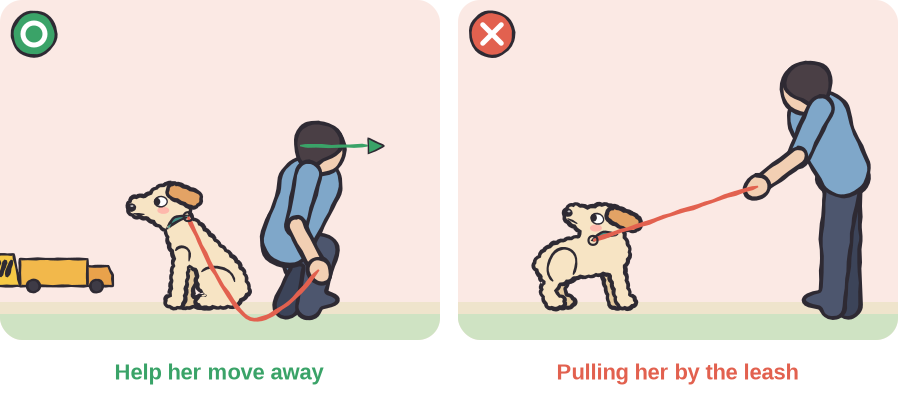
Do
- When she stops, check her body and the heat first
- If she’s scared, help her move away — turn around, or pick her up
- Start with quiet times and quiet streets
- Praise her when she starts walking on her own
Don’t
- Drag her along on the leash
- Take her up to what scares her and wait for her to “get over it”
- Scold her or hurry her with a raised voice
- Coax her with a treat or pick her up every time she stops while she’s relaxed (stopping starts to pay)
When to see a professional
- She’s limping. If it lasts more than a day of rest, or the way she walks changes suddenly, see your vet (Dogs Trust)
- She’s limping and also off her food, crying, hiding or otherwise seems in pain, or she’s breathing heavily or fast — see your vet straight away (Dogs Trust)
- Stiffness, trouble getting up, slowing down on walks, reluctance to jump or use stairs can be signs of arthritis (PDSA). In an older dog, tell your vet early about any change in behavior (Dogs Trust)
- On or after a walk on a hot day, she keeps panting heavily even after you stop, seems unusually drowsy, stiff or wobbly, collapses, or is struggling to breathe: this could be heatstroke. Act straight away — Dogs Trust says to act immediately to stop it getting worse. If she has collapsed or is struggling to breathe, call your nearest vet immediately — cool first, transport second. Stop the walk and move her to a cool, shaded spot. Offer her drinking water if she can drink. Start cooling her straight away. If she’s young, healthy and fully conscious, Dogs Trust’s first choice is to put her in cold water — a kiddie pool, for example — keeping her head above the water. Any water will do as long as it’s cooler than she is, and if you can’t put her in, keep pouring cold water over her. For an older dog or one with health problems, wet her with room-temperature water, avoiding her face, and keep air moving over her (a breeze, a fan or air conditioning). Watch her closely while you cool her, and stop if she starts shivering. Don’t put a wet towel over her — it can trap heat and raise her temperature. Call your vet urgently for advice and get her there as quickly as is safely possible (Dogs Trust)
- She panics just stepping outside, or her fear is getting steadily worse. Talk to your vet or a qualified behavior professional; pain can be part of the picture (MSD Veterinary Manual)
Go to the root
Don’t stop at the quick fix. Growing the skill underneath makes other problems lighter too.
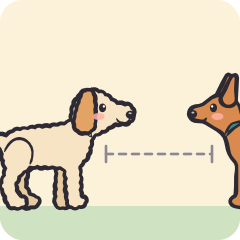 Core skill Confidence
- ExerciseGetting Used to Sounds Step by Step: Sound Desensitization for DogsDoable at home (Steps 1–3 at home)Read →
- ExerciseHand Target: How to Teach Your Dog “Touch” — and Use It for Recall and Passing Other DogsDoable at home (Steps 1–3 at home)Read →
- ExerciseScent Games for Dogs: Easy Treat Hunts With a Towel and Paper CupsDoable at home (Steps 1–3 at home)Read →
Sources
- Dogs Trust — Dog walking problems: pulling on lead (incl. “When your dog won’t walk on the lead”)
- Dogs Trust — Caring for your dog during hot weather
- ASPCA — Hot Weather Safety Tips
- Hall, Carter & O’Neill (2020). Dogs Don’t Die Just in Hot Cars — Exertional Heat-Related Illness (Heatstroke) Is a Greater Threat to UK Dogs. Animals 10(8):1324
- MSD Veterinary Manual — Behavioral Problems of Dogs
- MSD Veterinary Manual — General Guidelines for Effective Controlled Exposure Behavior Modification in Dogs (table)
- MSD Veterinary Manual — Treatment of Behavioral Problems
- Lopes Fagundes, Hewison, McPeake, Zulch & Mills (2018). Noise Sensitivities in Dogs: An Exploration of Signs in Dogs with and without Musculoskeletal Pain Using Qualitative Content Analysis. Frontiers in Veterinary Science 5:17
- Dogs Trust — When to take your dog to the vet
- PDSA — Arthritis in dogs
- Dogs Trust — Caring for an older dog
- Dogs Trust — How to clip your dog’s nails
- AVSAB — Position Statement on Puppy Socialization (2008)
- Dogs Trust — Introducing your puppy to the world around them
- PDSA — Exercising your puppy
- RSPCA — Walking your dog
- RSPCA — Understanding your dog’s body language
- Dogs Trust (Ireland) — The importance of sniffing
- AVSAB — Position Statement on Humane Dog Training (2021)