 BAUDOG The dictionary of dog–human communication
Contents
When to use this exercise
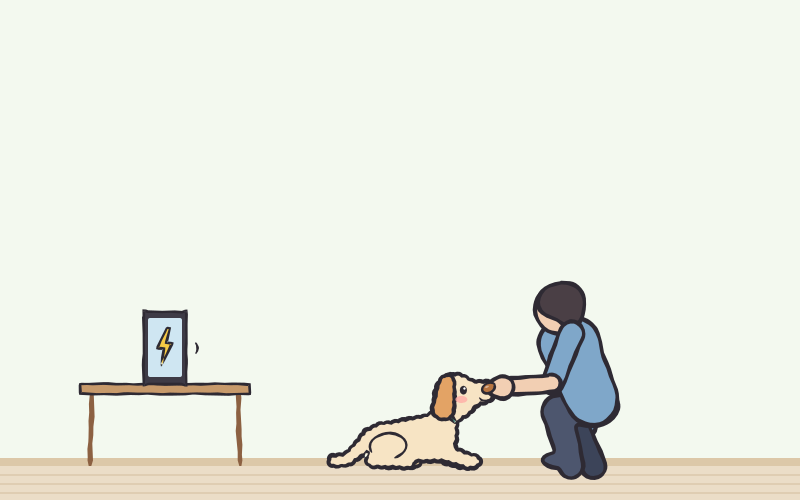
For a dog who barks at the doorbell, runs from the vacuum or hair dryer, freezes at traffic, or trembles at thunder and fireworks. You play a recording of the sound at a volume so low she barely notices, and give a treat each time. Fear of sounds is common: in a study based on an owner questionnaire covering more than 13,700 pet dogs in Finland, 32% were highly fearful of at least one noise — the most common of the seven kinds of anxiety the researchers looked at.
GoalWhen the sound that bothers her plays, she stays relaxed and keeps eating or playing.
Assessment: what a trainer might check on the first visit
Before starting, a visiting trainer might check three things at home.
Which sounds does she react to, and from what volume? (An ear twitches, she goes stiff, runs off, barks.)
→Start at the volume where she just notices — an ear twitches slightly — and goes straight back to her treat. Dogs Trust’s Sounds Scary guide finds the starting level the same way: turn it up slowly from zero until the first slight twitch of the ears. If even the quietest sound makes her freeze, play it from another room.
Once the sound stops, how long until she’s back to normal?
→If she recovers at once, you can work on this at home. If it takes minutes, start even quieter and don’t push on.
Does she get so scared she trembles non-stop, drools, or breaks things trying to escape?
→With fear that strong, see your vet before starting. Fears like thunder and fireworks involve more than sound, so recordings alone seldom resolve them fully; medication is sometimes used alongside training.
What you need
- A recording of the sound (a doorbell you recorded on your phone, a sound effect or a video). Dogs Trust offers free recordings of household noises, traffic, fireworks and thunder, each with a how-to guide, put together by two veterinary behavior specialists
- A phone or small speaker whose volume you can change in fine steps
- Really good treats, cut small
- A place where your dog relaxes (her mat, for example)
How to signal
- Voice
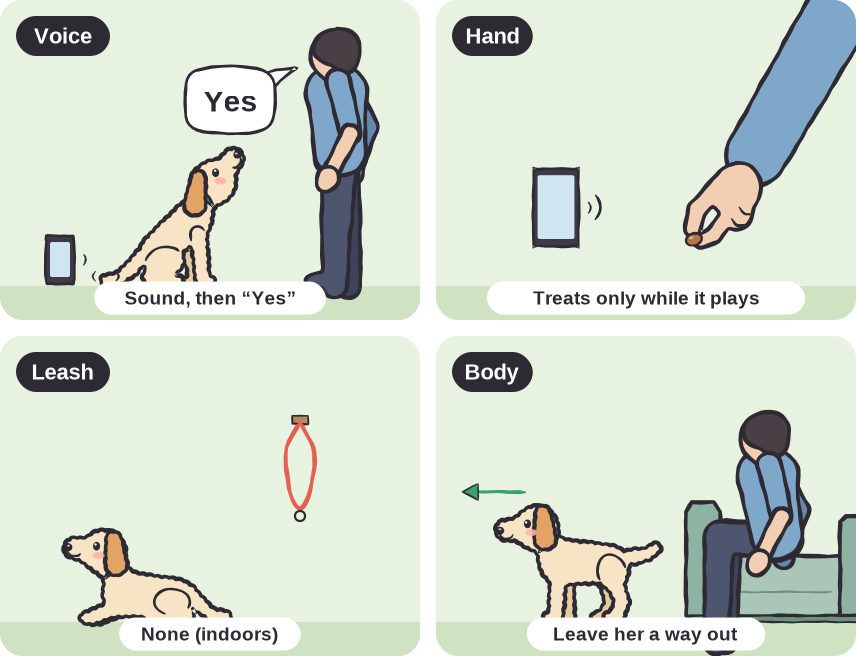
When the sound plays, a bright “Yes!” → treat. If she comes to you scared, it’s fine to talk to her calmly.
- Hand
Treats come only while the sound is playing (right after it starts). When the sound stops, the treats stop.
- Leash
None (indoors).
- Body
Sit near your dog. Make sure she can move away if she wants to (don’t block her way out).
Today’s session
With the trainer, you work on step 1.
Step 1So quiet she barely notices(At home, quiet)
You and the trainer decide the starting volume together. Play the sound from your phone for a few seconds at the lowest volume, and watch your dog’s ears, body and whether she eats, turning it up until an ear twitches slightly. At that volume, “sound → treat → sound off” about 10 times (our rule of thumb). The trainer fixes it on the spot if the treat is coming before the sound. It takes about five minutes.
Homework until the next visit
- How often
- 1–2 times a day
- How long
- About 5 minutes each
- How much
- Play the sound up to about 10 times per session (our rule of thumb)
A good sign she’s readyAt that volume she eats without stiffening, 10 times in a row (our rule of thumb)
What the trainer checks next visit
In front of the trainer, play the volume you reached in your homework. About 10 times (our rule of thumb).
If she canIf she stays relaxed and eats 10 times in a row, move up: step 3 (change the room, the time and the length) becomes the new homework.
If not yetGo back to the previous volume, and look again together at the treats and at the order of sound and treat.
Next stages: steps
- 1
Start where just an ear twitches At home, quiet
So quiet she barely notices
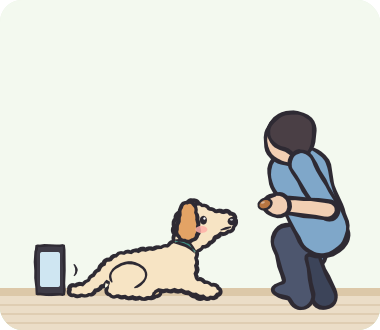
While your dog is relaxed, play a sound quiet enough that only an ear twitches, for a few seconds → treat. When the sound stops, so do the treats. About 10 times (our rule of thumb).
A good sign to move onWhen the sound plays, she looks at you and waits for the treat
- 2
Up and down, trending up At home, quiet
Louder, little by little (up and down)
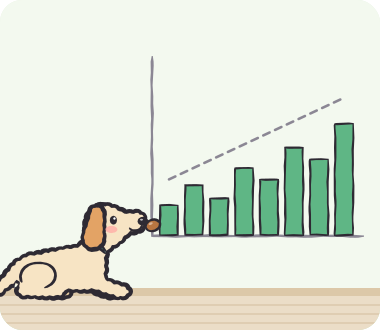
On different days, raise the volume a little. Don’t keep turning it up — drop back to a quieter level now and then, with an overall trend upward. If she goes stiff, stop at once and go back to the previous volume.
A good sign to move onAt that volume she eats without stiffening, 10 times in a row (our rule of thumb)
- 3
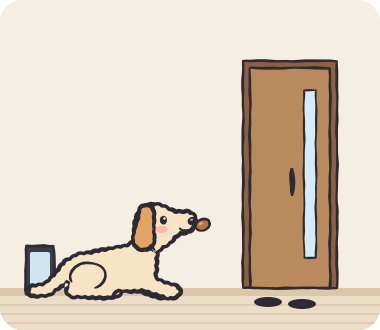
Even in a different place or at a different time At home, small distractions
Change the room, the time, the length
Play it in a different room, in the evening, before dinner — change the setting. Make the sound last a little longer, too. On a day you change the setting, lower the volume for a while (our suggestion).
A good sign to move onIn any room, she eats calmly at that volume
- 4
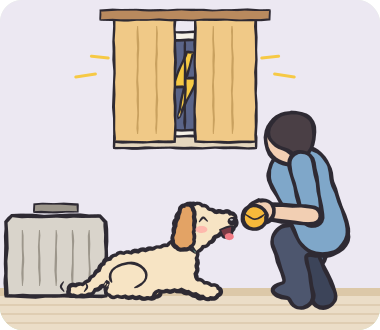
Something good after the real sound, too Around distractions
When the real sound happens
When the real doorbell, thunder or construction noise happens, follow it right away with a treat or a favorite game. On thunder or fireworks nights, close the windows and curtains, mask the noise with music or the TV, and stay home with her. If she wants to hide, let her stay where she feels safe.
A good sign to move onEven with the real sound, she can eat
Timing
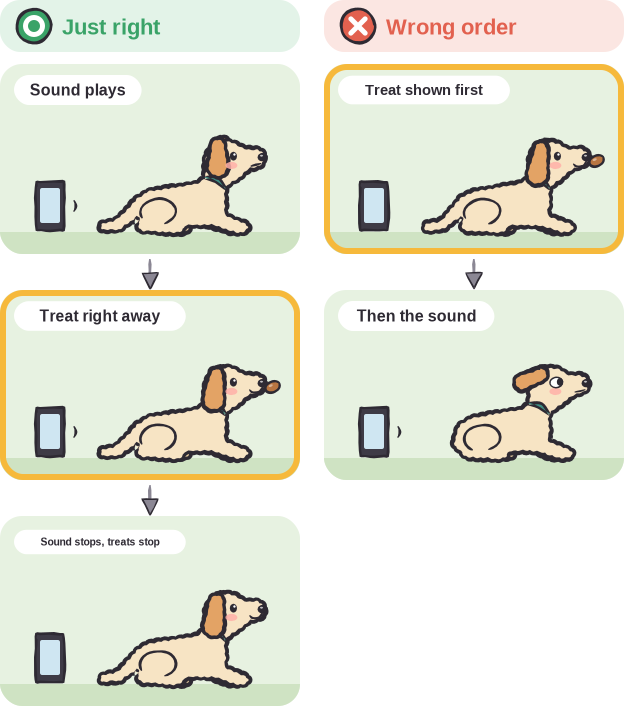
Just right
Sound starts → treat straight away. Sound stops → treats stop. The sound becomes the signal that treats are coming.
Too late
Showing the treat first, then playing the sound. The treat becomes a warning that the scary sound is on its way.
Keep the same order with real sounds: right after the bang, a treat or a game. In a survey of 1,225 dog owners about how they handled their dogs’ firework fears and how well it worked, more than 70% of the 694 who used this approach — a treat or play right after the noise — said it worked (this is owners’ impressions, not an experiment comparing treatments).
How much and how often
About 5 minutes per session, playing the sound up to about 10 times (our rule of thumb), 1–2 times a day. Short sessions, often. Dogs Trust’s Sounds Scary booklet splits the work into stages: first it plays the sounds on their own, with no food, for 5–10 minutes 3–4 times a day, and only later pairs them with a meal or a game, daily. If you’d rather follow the booklet, follow it from the start, in its order.
If it isn’t working
She trembles or runs even at the quietest volume
Play it from another room, more quietly still. If she’s still afraid, stop and see your vet — medication can make practice possible.
Fireworks season is coming and we won’t be ready
Sound practice takes several weeks of daily sessions; the Sounds Scary guide says a couple of weeks before an event isn’t enough time to treat the fear. For now, set up a safe place (a room without windows, or her crate), close the windows and curtains, mask the noise with music, and stay with her. Do the practice outside the season. Build good associations with the safe place well before the big night.
Is it OK to comfort her when she comes to me scared?
Yes. Calmly stroking her or talking to her doesn’t make fear stronger. Dogs Trust also advises calmly giving attention and comfort if she seeks reassurance.
She stopped eating partway through
The sound is too loud or too long. Stop at once; once she’s calm, go back to the previous, quieter volume.
She’s fine with the recording but still scared of real thunder
Thunder and fireworks involve more than sound (dogs afraid of thunderstorms can even become afraid of rain, wind or changes in air pressure), so veterinary guidance says recordings alone seldom resolve these fears fully. Keep going with step 4 for real events, and talk to your vet if she’s very afraid.
Avoid
- Exposing her suddenly, and at length, to loud sounds to “get her used to it”
- Scolding a frightened dog
- Picking up a trembling dog and carrying her outside toward the noise
- Turning the volume up every single session
A good sign to move on
- Steps 1–2: at that volume she eats without stiffening, 10 times in a row (our rule of thumb)
- Step 3: in any room and at any time, she eats calmly at that volume
- Step 4: even after the real sound, she can eat
- If she goes stiff, stop at once and go back to the previous volume
Sources
- MSD Veterinary Manual — Behavior Problems of Dogs (Fears, Anxiety, and Phobias)
- Dogs Trust — Sound therapy and firework training (free Sounds Scary, Sounds Sociable and other recordings)
- Dogs Trust — Sounds Scary booklet (Sarah Heath & Jon Bowen)
- Dogs Trust — How to prepare your dog for visitors
- Dogs Trust — Helping your dog cope with fireworks
- Salonen et al. (2020). Prevalence, comorbidity, and breed differences in canine anxiety in 13,700 Finnish pet dogs. Scientific Reports 10:2962
- Riemer, S. (2020). Effectiveness of treatments for firework fears in dogs. Journal of Veterinary Behavior 37:61–70
- Todd, Z. (2020). Survey Shows Which Treatments Are Effective for Fireworks Fears in Dogs (AVSAB blog)
- Dogs Trust — How to Stop Your Dog Barking: Causes & Triggers