 BAUDOG The dictionary of dog–human communication
Contents
- The finished behavior
- Assessment: where is your dog now?
- The cue
- How to signal
- Teaching steps
- When to reward
- Why shouting “Quiet!” doesn’t work
- A cue won’t remove the reason she barks
- No holding her mouth, no shaker cans, no bark collars
- A good sign to move on
- If it isn’t working
- Prescription: a suggested order
- In the moment: do / don’t
- When to see a professional
- Sources
The finished behavior
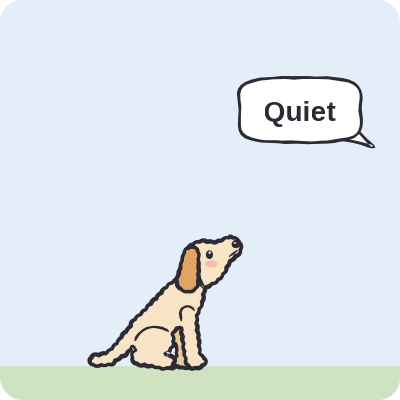
Say “Quiet,” and your dog stops barking, closes her mouth and looks at you. It isn’t a telling-off. You build it by rewarding the moment she goes quiet, again and again, until she learns that going quiet after this word pays. But even when the cue stops the barking for now, the reason she barks — fear, guarding, boredom, worry about being alone — is still there. That needs its own plan: see our Stop Barking page and the practices below.
Assessment: where is your dog now?
Before teaching the cue, check a few things — for example, these three.
When does she bark, and at what? (The window, the doorbell, visitors, other dogs, at you, when alone)
→What you do before the cue depends on the kind of barking. For fear, guarding or worry about being alone, the assessment and practices on our Stop Barking page come first.
Have you been shouting “Quiet!” at her when she barks?
→If so, she may have learned it as a telling-off. Pick a fresh word (“Hush,” “Thanks,” “Enough”) and get the whole family using it.
Could you teach “Speak” (barking on cue)?
→For a dog without a barking problem, pairing it with “Speak” makes it easy to create quiet moments in practice. For a dog who already barks a lot, start instead from the quiet moment after an ordinary bark or two.
The cue
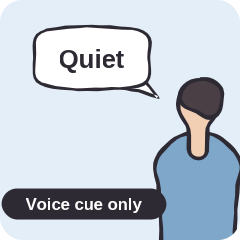
The spoken cue is “Quiet,” said once in a calm, normal voice. BAUDOG’s hand-signal cards don’t have a shape for it: a barking dog often isn’t looking at your hands, so we use voice only. Keep it separate from anything you say when you’re cross, like “Shut up!” or “No!”
How to signal
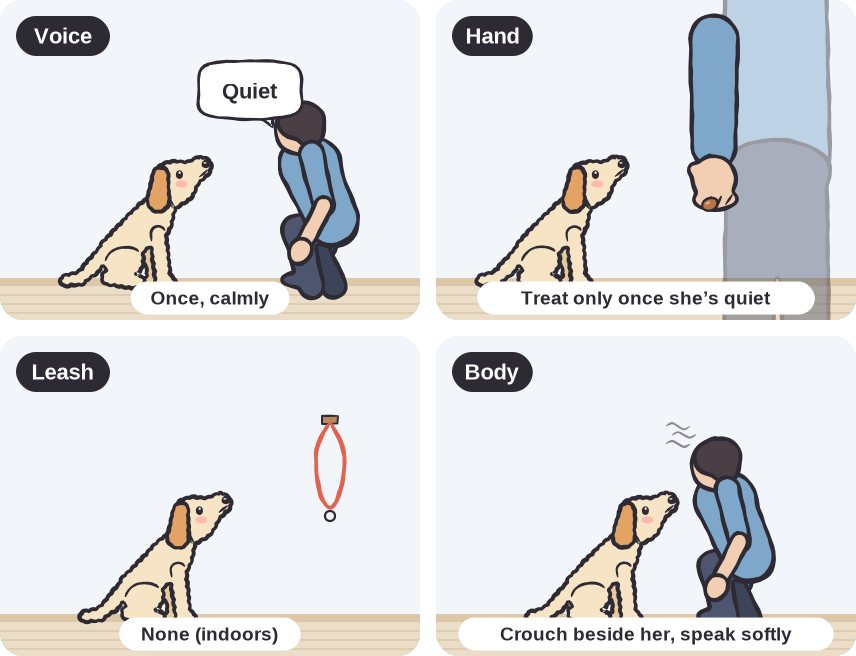
- Voice
Say “Quiet” once, calmly. No shouting, no repeating. When she goes quiet, “Yes.”
- Hand
No hand signal. Treats come out only once she’s quiet (don’t show them while she’s barking).
- Leash
None at home. If you use it on a walk, hold the leash fairly short in your hand — never jerk it to silence her.
- Body
Don’t step in between her and whatever she’s barking at. Speak quietly from beside or behind her.
Teaching steps
- 1
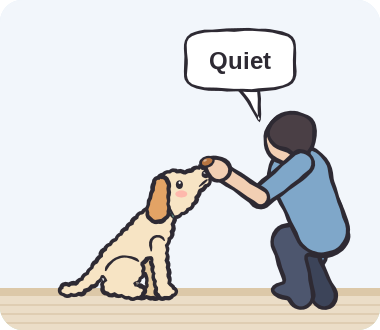
Say it the moment she’s quiet At home, quiet
“Quiet” the moment she stops
After she barks on “Speak” (or after an ordinary bark or two), the instant she stops, say “Quiet,” then right away “Yes” → treat. Don’t say it while she’s still barking yet.
A good sign to move onShe stops, looks at you and waits for the treat
- 2
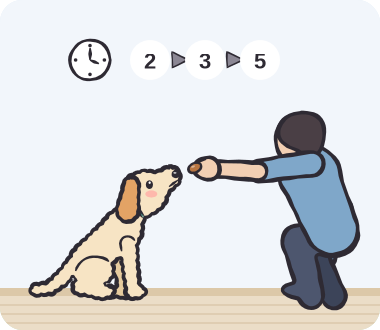
Build the wait gradually At home, quiet
Stretch the quiet, a few seconds at a time
After “Quiet,” wait 2 seconds of silence, then treat. Then 3 seconds, 5 seconds — a few seconds more at a time. When she manages the same length about 5 times, move on. Mix in some shorter ones (5 seconds, 12, 3, 20…).
A good sign to move onAfter “Quiet,” she can stay quiet for a few seconds
- 3
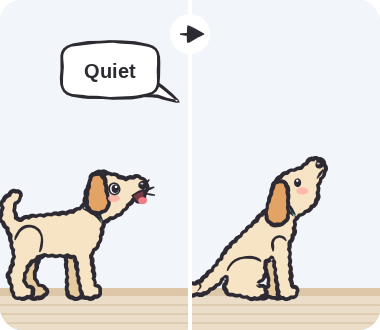
Word first, quiet second At home, quiet
Once, while she’s barking
As she starts barking on “Speak,” say “Quiet” once in a calm voice. When she stops, “Yes” → treat. If she keeps barking, say nothing, give nothing, and wait for her to go quiet.
A good sign to move onOne “Quiet” mid-bark, and she stops
- 4
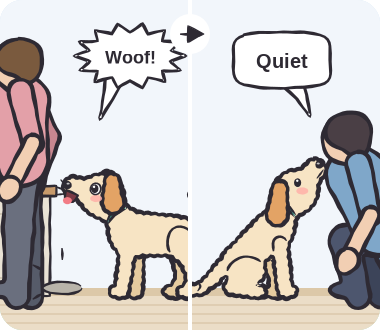
From small moments to everyday life At home, small distractions
With everyday little barks
Use it when something gets a bark or two out of her — someone drops a pan lid, a car door slams outside. After a bark or two, say “Quiet” once. When she stops, several really good treats. You can also call her away from whatever she’s barking at.
A good sign to move onEveryday little barks stop on “Quiet”
- 5
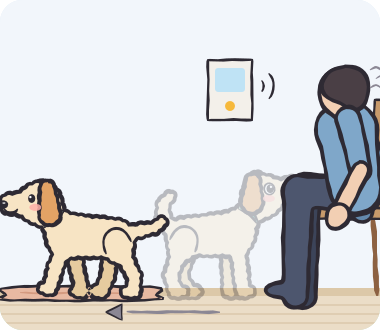
Don’t rely on the cue alone Around distractions
Doorbell and window barking
Don’t try to stop doorbell or window barking with the cue alone. Barking from fear or guarding needs sound practice (Getting Used to Sounds Step by Step, starting quiet) and mat practice first, with “Quiet” used along the way. See our Stop Barking and Doorbell Barking pages for the details.
A good sign to move onTogether with the sound practice, she barks less and less
When to reward
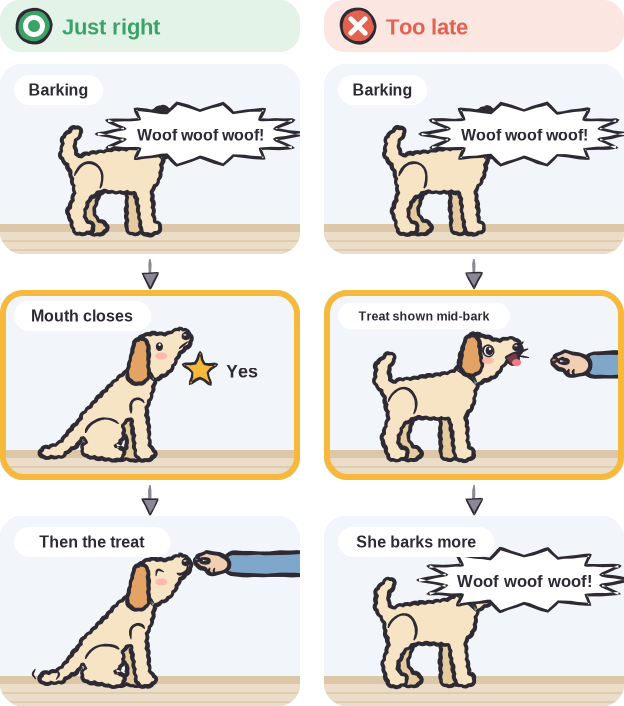
Just right
The moment she stops and closes her mouth, “Yes.” Even a single second of quiet counts.
Too late
Showing or giving a treat while she’s still barking. She may learn that barking makes treats appear.
Battersea starts teaching the cue by waiting for the dog to stop barking, then saying “quiet” and rewarding once she’s quiet. Humane World for Animals also says to wait until she’s stopped — even for a second — before rewarding, and to build up the quiet time with a mix of longer and shorter waits.
Why shouting “Quiet!” doesn’t work
Yelling at your dog to be quiet won’t reduce her barking (Humane World for Animals). Even talking to her when she barks can reward it with attention (Dogs Trust).
That’s why you build “Quiet” at calm times, in a normal voice, by rewarding the moment she goes quiet. Using it mid-bark comes after that.
A cue won’t remove the reason she barks
Barking is your dog telling you something. If “Quiet” stops it for now but the reason — fear, guarding, boredom, worry about being alone — is still there, she’ll bark again. We cover what to do for each reason on our Stop Barking page.
- Guarding or fear (the window, noises, the doorbell) → sound practice starting with quiet sounds, plus relaxing on a mat
- Barking at you to demand things → our Demand Barking page. Don’t respond while she barks; respond once she’s quiet
- Barking only when left alone → our Home Alone and Separation Anxiety pages
- When she stays quiet in a moment she’d normally bark, give several special treats (Dogs Trust calls it a “jackpot” reward)
No holding her mouth, no shaker cans, no bark collars
We don’t recommend grabbing her mouth to close it, shaking a can of coins or a bottle to startle her, or using a shock, spray or vibration bark collar. The American Veterinary Society of Animal Behavior (AVSAB) states there is no evidence that aversive methods are necessary in dog training. Dogs Trust also explains that anti-bark collars rarely solve the problem without causing new ones (more on our Stop Barking page).
A good sign to move on
- When to start using it mid-bark: after “Quiet” at the quiet moment, she can stay quiet for a few seconds
- When to start using it in everyday life: in practice, one “Quiet” mid-bark stops her. Our rule of thumb is 8 times out of 10
- If stretching the quiet time falls apart, go back to a shorter time and build it up again
If it isn’t working
Saying “Quiet” makes her bark more
You’re either too loud or too early. Stop saying it mid-bark and go back to saying it at the quiet moment. If you used to use the word to tell her off, switch to a new one.
It works in practice but not at the doorbell
Doorbell barking often comes from strong fear or guarding, so a cue alone rarely stops it. Work on getting used to the sound (Getting Used to Sounds Step by Step), starting quiet. Read our Doorbell Barking page too.
She only goes quiet if I show her a treat
Treats come out only after she’s quiet. Showing a treat to silence her mid-bark can teach her that barking makes treats appear. Dogs Trust also warns that if you open the fridge to interrupt barking and then feed her from it, barking may increase. Using the fridge door or a rustling packet as an interruption is fine (see our Stop Barking page), but don’t feed her there — ask for something she knows, like “Sit,” and reward that.
“Quiet” works, but she starts again straight away
You haven’t built up the quiet time yet. Go back to stretching the quiet a few seconds at a time after “Quiet.” Look again at what she’s barking at, too.
I want her to stop barking completely
Zero barking isn’t realistic. The ASPCA says it’s just not realistic to expect a dog to stop barking altogether. Barking is as natural for dogs as talking is for us.
Prescription: a suggested order
Our suggested order. Which practice comes first depends on the kind of barking (see the assessment on our Stop Barking page).
- ExerciseGetting Used to Sounds Step by Step: Sound Desensitization for DogsDoable at home (Steps 1–3 at home)For barking at noises or the doorbell. Start with sounds so quiet she doesn’t react, and follow each one with a treat. It builds the groundwork for guarding barks, where “Quiet” struggles.Read →
- ExerciseRelaxing on a Mat: How to Teach Your Dog to SettleDoable at home (Steps 1–4 at home)A mat as somewhere to go when she’d otherwise bark. If she can relax on it, she has something to do instead of barking.Read →
In the moment: do / don’t
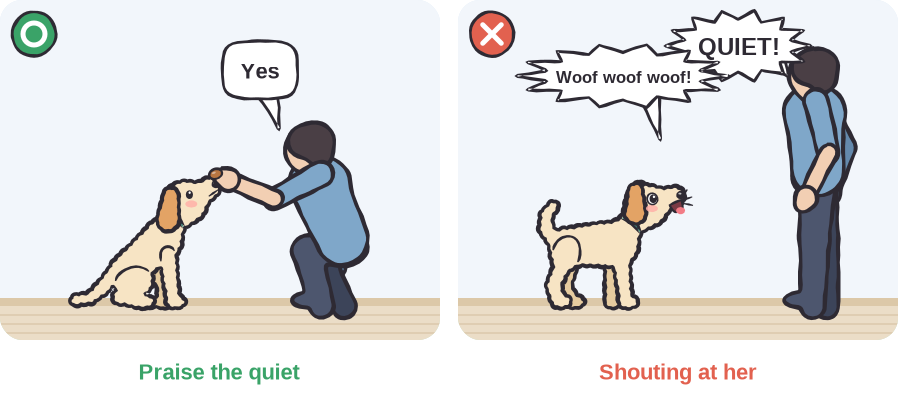
Do
- “Yes” the moment she goes quiet
- Say “Quiet” once, calmly
- Stretch the quiet a few seconds at a time
- If she stays quiet when she’d normally bark, several special treats
Don’t
- Shout “Quiet!” or say it over and over
- Show a treat to silence her mid-bark
- Grab her mouth or shake a can to startle her
- Use a shock, spray or vibration bark collar
When to see a professional
- She never used to bark and has suddenly started. Dogs Trust advises seeing your vet, because sudden behavior changes can mean a medical problem
- An older dog has started barking at night or has suddenly become sensitive to sounds. It can be a change in brain function, failing eyesight or hearing, or joint pain (Dogs Trust)
- She doesn’t turn when called, or reacts to sounds differently. Her hearing may be going (RSPCA)
- She doesn’t just bark when alone, but also drools, chews at doors or has accidents. This may be separation anxiety. Talk to your vet (ideally one who sees behavior cases)
The skills behind this command
 Core skill Settling Down Being able to come down from excitement by herself, even once she’s started barking. “Quiet” is a prompt that draws on this ability.
- ExerciseGetting Used to Sounds Step by Step: Sound Desensitization for DogsDoable at home (Steps 1–3 at home)Read →
- ExerciseRelaxing on a Mat: How to Teach Your Dog to SettleDoable at home (Steps 1–4 at home)Read →
Sources
- Battersea — Teaching your dog to ‘speak’ on command (includes the ‘quiet’ cue)
- American Kennel Club — How to Train Your Dog to Speak
- Humane World for Animals (formerly HSUS) — How to get your dog to stop barking
- ASPCA — Barking (we don’t recommend the mouth-holding or startle methods on the same page)
- Dogs Trust — How to Stop Your Dog Barking: Causes & Triggers
- RSPCA (UK) — How to stop your dog barking too much
- AVSAB — Position Statement on Humane Dog Training (2021)
- MSD Veterinary Manual — Behavior Problems of Dogs