 BAUDOG The dictionary of dog–human communication
Contents
- In short
- When it happens
- How your dog feels
- How scared is she? Three levels
- What to do during a storm
- If a storm might hit while you’re out
- If a trainer came to your home: the first session and the first homework
- Thunder recording practice, in a season with few storms
- Recordings alone may not be enough
- Ask your vet about medication
- Suddenly scared of storms as an older dog? Think about pain
- Puppies and dogs who aren’t scared yet: you can prevent it
- The missing core skill
- Exercises
- In the moment: do / don’t
- When to see a professional
- Sources
In short
Fear of thunder is common in dogs. If your dog comes to you for comfort, talk to her calmly and stroke her — it won’t make her fear worse. During a storm, close the windows and curtains, put on some music, and make sure she has a hiding place she can choose for herself. For longer-term training, BAUDOG suggests using thunder recordings, starting very quietly, in a season when storms are rare where you live. Recordings alone rarely make thunder fear disappear completely, though. If she panics — drooling, losing control of her bladder, hurting herself trying to escape — see your vet early. They may prescribe a medication to give before a storm.
When it happens
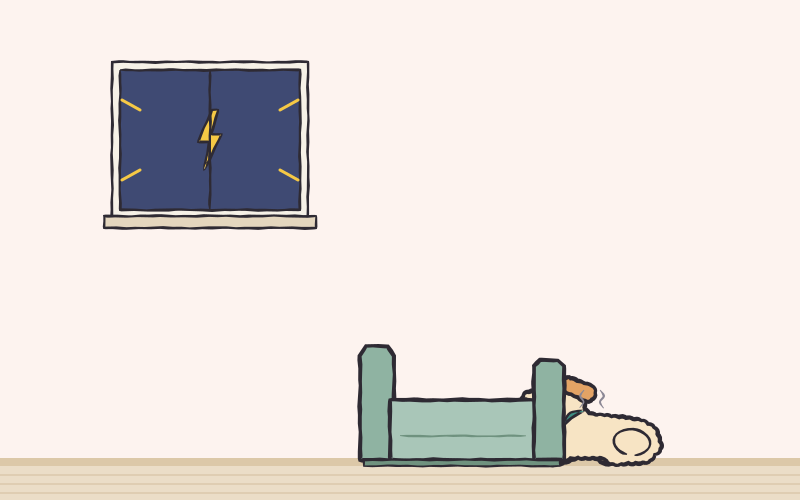
- At the first distant rumble, your dog starts shaking and won’t leave your side
- She hides in the bathroom, a closet or behind the sofa and won’t come out
- She pants hard, drools and won’t take treats
- Now even rain, wind or a darkening sky make her restless
- She was never bothered before, but started fearing thunder as she got older
How your dog feels
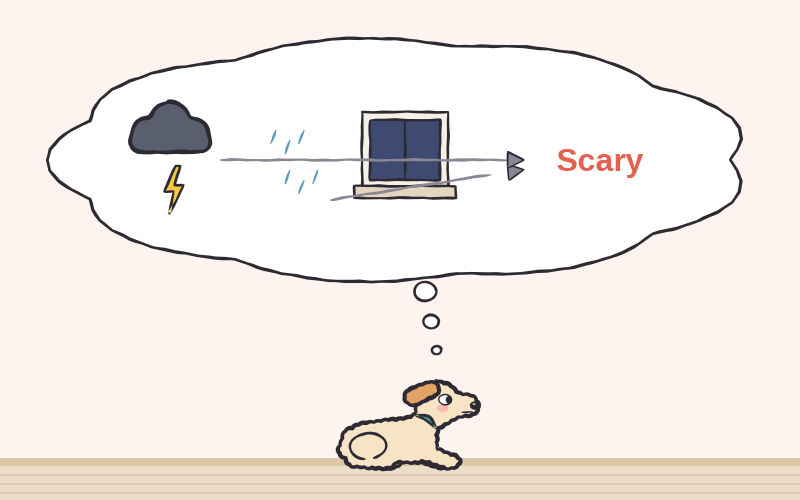
To a dog, a loud bang is a signal to get away — now. Her body tenses, her heart races and she looks for somewhere to hide. She isn’t being spoiled or dramatic. She can’t switch the fear off.
A storm is more than noise. There are flashes, rain, wind and a darkening sky. After a few frightening storms, some dogs start to brace at rain, wind or dark clouds alone — “here it comes again.”
Comforting a scared dog doesn’t “reward” the fear. Fear isn’t something that grows because it gets attention. Having a calm person she trusts nearby helps her settle.
How scared is she? Three levels
What to do now depends on how she reacts. During the next storm, see which of these she is closest to. (These three levels are BAUDOG’s rule of thumb.)
- Mildly bothered: ears twitch, she looks outside, comes closer to you. She can still eat and is back to normal as soon as the storm passes. → During storms, pair thunder with treats or play. In a season with few storms, start recording practice.
- Clearly afraid: shaking, hiding, panting, won’t eat. She recovers the same day. → Use the steps in “What to do during a storm” to take the edge off. Start recording practice in a quiet season, at a very low volume. Check in with your vet once too.
- Panicking: tries to escape and damages windows or doors, injures herself, drools, has accidents or diarrhea, or is still not herself the next day. → See your vet before you start training. Medication is often part of the plan.
What to do during a storm
This is how the UK charity Dogs Trust and the veterinary edition of the MSD Veterinary Manual suggest getting through a storm.
- Close windows and curtains and turn the lights on, to hide the flashes and muffle the noise a little. If you can, stay in a room in the middle of the house with few windows.
- Put on music or the TV to cover the thunder. According to one review, a masking sound works best when it’s similar to the noise you want to cover, so a loud fan or music with a heavy, repetitive drumbeat may suit thunder.
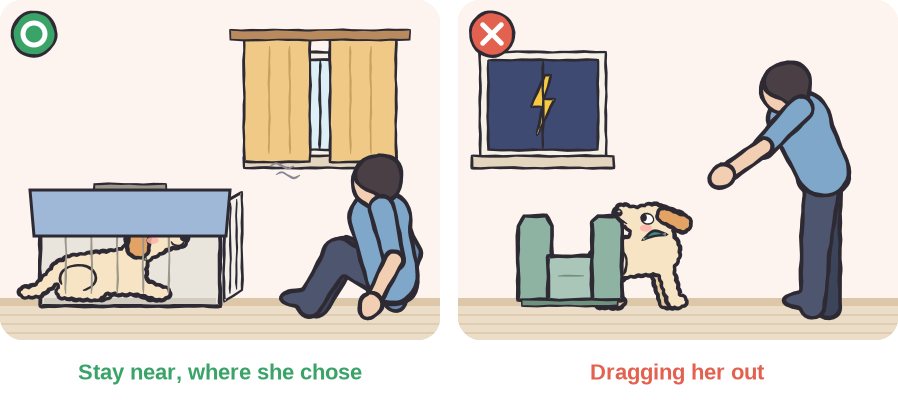
- If she wants to hide, let her. If she goes behind the sofa or into the bathroom, don’t pull her out. The spot she picks herself is where she feels safest.
- If you use a crate as a hiding place, leave the door open (or take it off) and drape a blanket over the top. Shutting her in can make the fear worse, because she can’t get out.
- If she comes to you, talk to her calmly and stroke her — but only when she comes to you. Don’t pick up a dog who’s hiding or hold her still to calm her.
- If she can eat, give her a treat every time it thunders; if she can play, play. You’re building “rumble, then something good.” If she’s too scared to eat, don’t push food on her.
- Stay as normal as you can. If you keep going to the window or pace around, she’ll take it as a sign that something really is wrong.
- When storms are forecast, get her walk and toilet break done early. Don’t take her out while it’s thundering.
- Check that doors, windows and garden or yard gates are secure so she can’t bolt, and that her ID tag and microchip details are up to date. Frightened dogs sometimes run off during storms and get lost.
If a storm might hit while you’re out
Dogs who fear loud noises are more likely to panic if they’re alone when the noise starts. For fireworks, which you can see coming, Dogs Trust advises staying with your dog. Storms are harder to plan for, so BAUDOG suggests that on days when storms are forecast, someone stays home with her if at all possible. If you have to go out, make sure her usual hiding place (an open crate, for example) is available, close the curtains and leave some music playing quietly.
If you come home to damage or accidents after a storm, don’t scold her. She was frightened, and telling her off only makes her more afraid.
If a trainer came to your home: the first session and the first homework
Here is how we’d expect a first in-home session with a visiting trainer to go — one example from BAUDOG, not a fixed script. A trainer can’t book a thunderstorm, so day one is about getting ready for the next storm and finding the right starting point for recording practice.
- What the trainer looks at first: where she hides during storms. Whether she can eat. How long she takes to recover afterward (videos help). If there are signs of panic, the trainer suggests seeing your vet before training.
- Today: set up a hiding place near where she usually hides (an open crate, or a blanket over a table). Give her treats and chews there so it’s a good place on ordinary days too. Then play a thunder recording from your phone for a few seconds, just loud enough that her ears twitch slightly, and treat only while it plays. With the trainer, find a volume she doesn’t react to.
- Homework (BAUDOG’s rule of thumb): once or twice a day, about 5 minutes. Up to 10 rounds of “sound → treat” at the volume you chose. When the sound stops, the treats stop. If she stops eating or freezes, turn the sound off at once and go quieter next time.
- At the next visit, the trainer checks: at the homework volume, can she stay relaxed and keep eating? Our rule of thumb: if she’s relaxed and eating 10 times out of 10, turn it up a little. If she freezes even once, stay at that volume for another week.
Thunder recording practice, in a season with few storms
Play a recording of thunder so quietly that she doesn’t react, and pair it with something delicious (desensitization and counterconditioning; the method itself is in Getting Used to Sounds Step by Step). The MSD Veterinary Manual says controlled exposure to noises is best done with recordings.
BAUDOG recommends doing this practice in a season with few storms where you live. The MSD Veterinary Manual explains that each exposure solidifies fear learning and makes it harder to overcome, so meeting several real, loud storms midway through training could set her back each time. (No source names a particular season — choosing the season is BAUDOG’s call.) When storms are rare depends on where you live. In the US, the National Weather Service says thunderstorms typically develop in the warmer months of spring, summer and fall, though they can occur at any time of year over most of the country — and in winter they favor the southern states. In the UK, the Met Office says thunderstorms can occur at any time of year but the most severe usually come in summer, and that summer is the most thundery season. So for many people, the colder months are a good time to practice; if you live somewhere storms come in winter too, pick whichever months are quietest where you are.
- Starting volume: barely audible to you. Quiet enough that she can keep playing or keep waiting for treats.
- Sound plays → treats. Sound stops → treats stop too. You’re making thunder a signal that good things are coming.
- If she stays relaxed, turn it up just slightly next session. Don’t only ever go up: vary the volume up and down, with an overall trend upward.
- If she reacts (ears flat, freezing, stops eating), stop the sound immediately. Once she’s calm, start again from a volume she doesn’t react to, and next time you turn it up, go up by an even smaller amount.
- Frequent short sessions work better than occasional long ones.
- Practice in different rooms, at different times of day, with different family members around.
- Don’t try to get her used to loud noises all at once. Waiting for her to “get used to it” by playing loud sounds over and over (flooding) can make the fear stronger and isn’t recommended.
Recordings alone may not be enough
A real storm brings flashes, rain, wind and changes in air pressure as well as noise. The MSD Veterinary Manual says that with fears involving many senses, like thunderstorms or fireworks, practicing with the sound alone seldom resolves the fear completely. So keep doing the things in “What to do during a storm” alongside training, and for strongly fearful dogs, combine training with medication.
There are plenty of supplements, herbal remedies, aromatherapy and pheromone products on the market. A review describes a survey of more than 1,200 owners about how they helped their dogs during fireworks (not thunder): of owners who used supplements, 27% said they worked — the lowest success rate of any option. The review’s author says no conclusions can be drawn about individual products, but that most supplements appear to do no better than a placebo effect on the owner. Snug-fitting pressure vests did best of the non-drug options in the same survey (44% said they worked), and a systematic review suggests a small benefit is possible. If you try one, get her used to wearing it before storm day.
Ask your vet about medication
For strongly fearful dogs, your vet may prescribe medication. The MSD Veterinary Manual describes fast-acting, short-lasting medications for noises you can predict (such as dexmedetomidine oromucosal gel, trazodone or alprazolam), sometimes combined with a daily medication through storm season. Which medication suits your dog is your vet’s decision.
Many storm-day medications work poorly unless they’re given before the thunder starts or before panic sets in. Talk to your vet before storm season and do a trial run. Never give her medicine meant for people on your own — and that includes over-the-counter antihistamines like Benadryl (diphenhydramine). It isn’t among the medications the MSD Veterinary Manual names for noise fears, and BAUDOG’s advice is simple: ask your vet before giving anything.
Your vet can also check whether a medical problem is behind the fear. For complex or severe cases, ask about a referral: in the US, the American College of Veterinary Behaviorists (ACVB) lists board-certified veterinary behaviorists; in the UK, the Animal Behaviour and Training Council (ABTC) keeps a national register of assessed practitioners.
Suddenly scared of storms as an older dog? Think about pain
In a survey of the owners of 13,700 Finnish dogs, 32% of dogs were highly fearful of at least one noise, and 53% of those feared more than one. Noise sensitivity became more common with age — especially fear of thunder.
A small study at a UK university behavior clinic compared the records of 20 noise-sensitive dogs. The 10 dogs found to have pain (in joints or the back, for example) started showing noise sensitivity nearly 4 years later on average than the 10 without pain, and their fear tended to spread more widely. Many improved once the pain was treated. If an older dog suddenly starts fearing thunder, or her fear is spreading, have your vet check for pain too.
Puppies and dogs who aren’t scared yet: you can prevent it
Dogs Trust recommends letting puppies hear recordings of thunder and fireworks at a volume low enough that they don’t react, paired with toys and treats. Exposing a puppy to the real, loud thing suddenly can frighten her.
In a survey of the owners of 1,225 dogs, 52% of dogs were at least partly affected by fear of fireworks, and most developed it in their first year. Fear of fireworks was strongly linked with fear of thunder and gunshots. The data suggested that training puppies, or adult dogs who weren’t yet afraid, to link the noise with good things was highly effective at preventing fear later (this was a survey study).
The missing core skill
Exercises
- ExerciseGetting Used to Sounds Step by Step: Sound Desensitization for DogsDoable at home (Steps 1–3 at home)When the sound that bothers her plays, she stays relaxed and keeps eating or playing.Read →
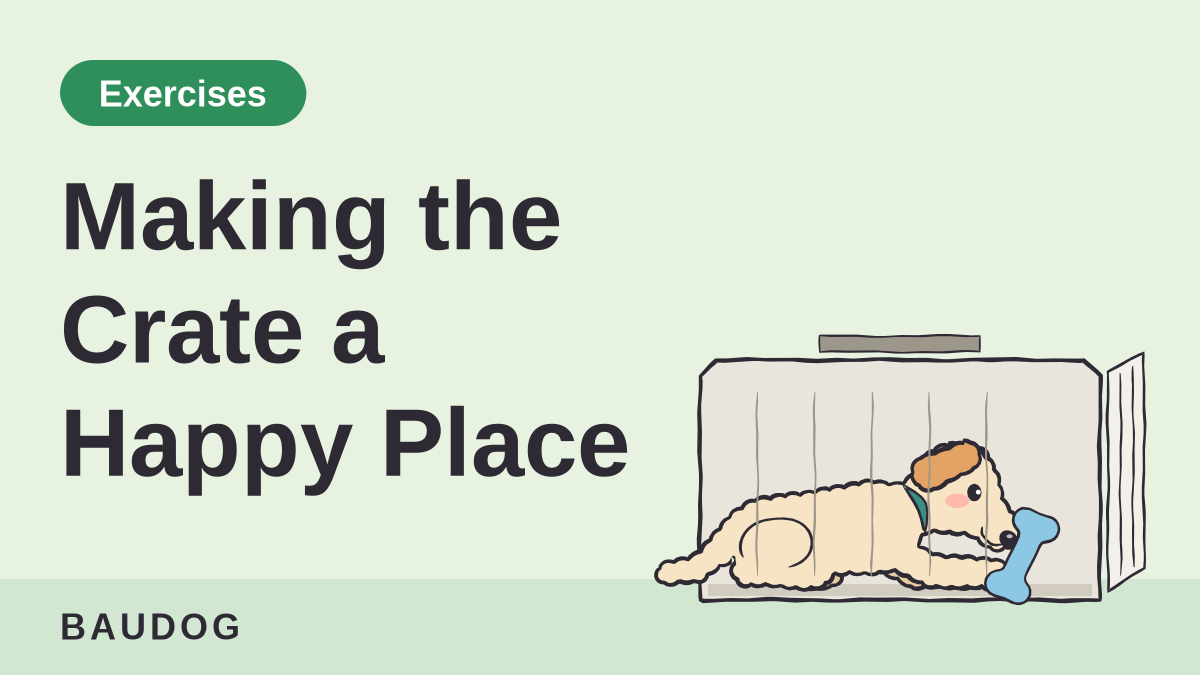
- ExerciseMaking the Crate a Happy Place: Step-by-Step Crate Training Your Dog Will ChooseDoable at home (Steps 1–4 at home)At “Crate,” she walks in on her own, and lies down and rests even with the door closed.Read →
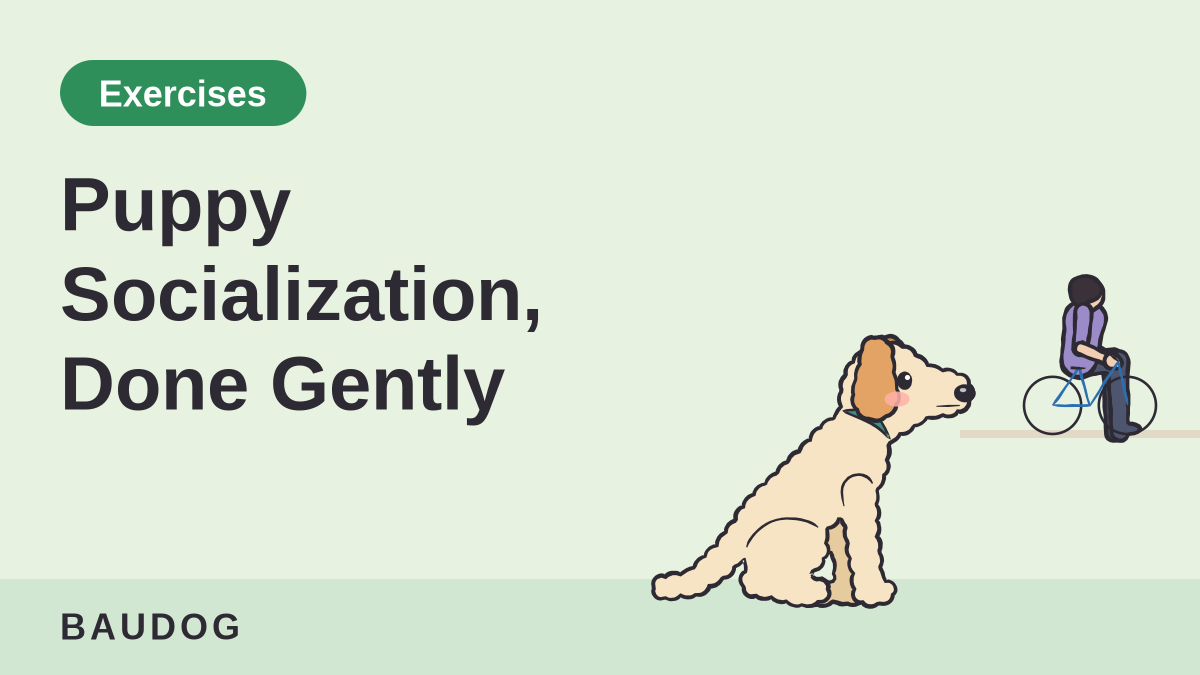
- ExercisePuppy Socialization: How to Make New Things Good ExperiencesStart at home, finish outside (Steps 1–2 at home)When she meets a new person, object or sound, she approaches on her own or watches calmly. When she’s touched, she looks at you expecting a treat.Read →
In the moment: do / don’t
Do
- Close windows and curtains; turn on music or the TV
- If she hides, leave her be. Set up a hiding place — an open crate or a blanket over a table
- If she comes to you, talk calmly and stroke her
- If she can eat, give a treat every time it thunders
- On storm days, walk her early and check doors and windows
Don’t
- Scold her (even for damage or accidents)
- Take a frightened dog outside
- Drag her out of her hiding place or pick her up and hold her
- Shut her in a crate she can’t get out of
- Play loud noises over and over to get her used to them
- Give her medicine meant for people on your own
When to see a professional
- She damages windows or doors trying to escape, injures herself, drools, has accidents or diarrhea. That’s panic — talk to your vet. Medication is often part of the plan
- She hasn’t recovered by the next day, or her fear is getting worse over time
- Her fear is spreading — now rain, wind or a dark sky set her off
- She started fearing storms only as an older dog. Pain may be involved
- You’d like to try medication before storm season. Ask early
Go to the root
Don’t stop at the quick fix. Growing the skill underneath makes other problems lighter too.
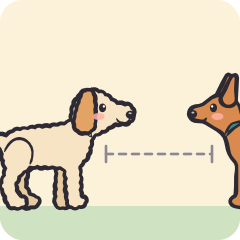 Core skill Confidence
- ExerciseGetting Used to Sounds Step by Step: Sound Desensitization for DogsDoable at home (Steps 1–3 at home)Read →
- ExerciseMaking the Crate a Happy Place: Step-by-Step Crate Training Your Dog Will ChooseDoable at home (Steps 1–4 at home)Read →
- ExercisePuppy Socialization: How to Make New Things Good ExperiencesStart at home, finish outside (Steps 1–2 at home)Read →
Sources
- Dogs Trust — What to do if your dog is scared of loud noises
- Dogs Trust — Fireworks and dogs
- Dogs Trust — How to build a den for your dog (safe space)
- MSD Veterinary Manual (veterinary edition) — Behavioral Problems of Dogs
- MSD Veterinary Manual (pet owner edition) — Behavior Problems in Dogs
- Riemer, S. (2023). Therapy and Prevention of Noise Fears in Dogs—A Review of the Current Evidence for Practitioners. Animals 13(23):3664
- Riemer, S. (2019). Not a one-way road—Severity, progression and prevention of firework fears in dogs. PLoS ONE 14(9):e0218150
- Salonen, M. et al. (2020). Prevalence, comorbidity, and breed differences in canine anxiety in 13,700 Finnish pet dogs. Scientific Reports 10:2962
- Lopes Fagundes, A. L. et al. (2018). Noise Sensitivities in Dogs: An Exploration of Signs in Dogs with and without Musculoskeletal Pain Using Qualitative Content Analysis. Frontiers in Veterinary Science 5:17
- National Weather Service — Understanding Lightning: Thunderstorm Development
- Met Office — Thunder and lightning
- Met Office — Summer: the warmest season
- American College of Veterinary Behaviorists (ACVB)
- Animal Behaviour and Training Council (ABTC)