 BAUDOG The dictionary of dog–human communication
Contents
- The finished behavior
- Assessment: where is your dog now?
- The cue
- How to signal
- Teaching steps
- When to reward
- Crate, kennel, playpen, carrier: what’s the difference?
- Before the cue: make her love the crate
- The release: wait for “Free,” then come out
- How long can a dog stay in a crate?
- When the crate cue pays off
- A good sign to move on
- If it isn’t working
- Prescription: a suggested order
- In the moment: do / don’t
- When to see a professional
- Sources
The finished behavior
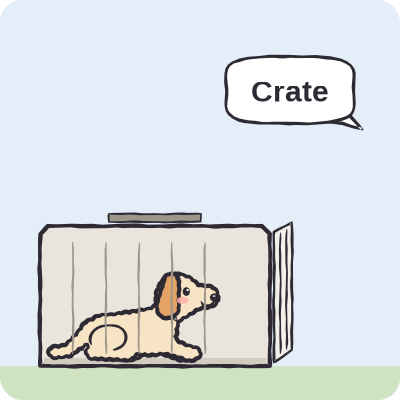
Say “Crate” once, and your dog trots to her crate from anywhere in the room and lies down inside. When the door opens, she waits until you say “Free.” The crate cue isn’t a word for shutting her away. It sends her to a place where good things happen and she can rest. So the order matters: make the crate a place she loves first, then put a word to it.
Assessment: where is your dog now?
Before teaching the word, a visiting trainer would usually check a few things — for example, these four.
Toss a treat into the open crate. Does she walk straight to the back?
→If she won’t go in, or stops at the doorway, don’t add the cue yet. Start with steps 1–2 of Making the Crate a Happy Place (door open, treats at the doorway and then the back, meals inside).
Once inside, can she settle — lie down, eat a treat — or does she shoot straight back out?
→If she bolts, drop a few treats in one after another while she’s inside, so staying in pays before you ask for anything else.
What does the family say? Is it a mix of “crate,” “kennel,” “bed” and “go in”? What do you say to let her out?
→The first homework is agreeing on one word for going in and one word for coming out.
When she’s left alone in the crate, does she drool, howl, or try to break out?
→If so, talk to your vet or a qualified behavior professional before working on the cue. Don’t try to crate her through it.
The cue
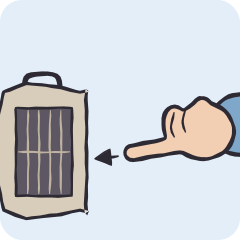
“Crate” is the cue to go into her crate — the box-shaped bed with a roof and a door. Many trainers say “Kennel” or “Kennel up” instead; any word works if the whole family uses the same one. At BAUDOG we give each destination its own word: “Crate” for the crate, “Place” for a mat or bed on the floor. There’s no standard hand signal. We use an index finger pointing at the crate door (the same hand shape as “Place” — what you point at tells her which one). The cue to come out is “Free,” the same release word we use to end “Place” and “Stay.”
How to signal
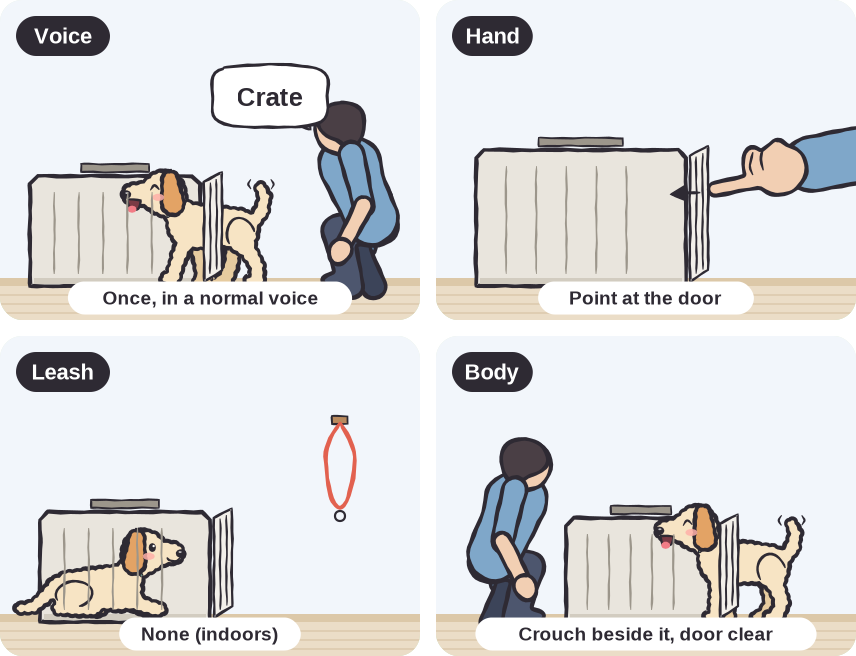
- Voice
Say “Crate” once, in your normal voice. Add the word only once she already goes in on her own. Say “Yes” the moment she’s inside. Let her out with “Free.”
- Hand
Point at the crate door with your index finger. At first, it’s fine to point inside with the hand holding a treat. Once she goes in on the word alone, keep your hand empty — or drop the point altogether.
- Leash
None at home. In the car or somewhere new, keep the leash on up to the door. Our suggestion: unclip it once she’s inside, before you shut the door, so it can’t snag. The American Kennel Club also advises taking her collar off in the crate.
- Body
Stand or crouch beside the crate — never in front of the doorway. As she improves, give the cue from a little farther away.
Teaching steps
- 1
No word yet At home, quiet
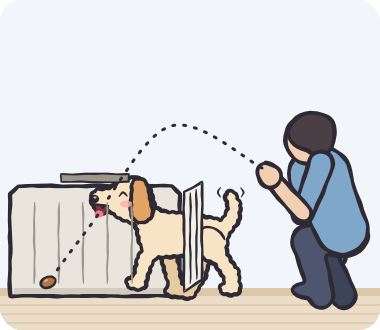
The treat-toss game, no word yet
Crouch beside the crate and toss a treat inside. When your dog’s body is in, say “Yes” and drop 2–3 more treats inside. Finish by tossing one treat outside so she comes out. Don’t say “Crate” yet. Leave the door open.
A good sign to move onShe runs straight to the back of the crate whenever you toss a treat
- 2
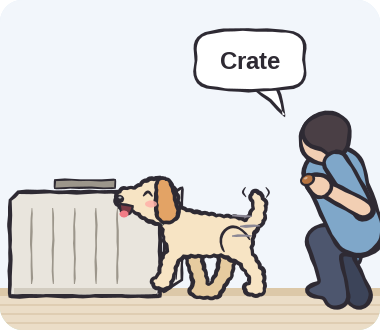
Say the word just as she moves At home, quiet
Say “Crate” as she starts to move
Toss the treat, and the instant your dog heads for the crate, say “Crate” once. When she’s in, “Yes,” then a treat inside. After a few rounds, keep the treat in your hand, say “Crate” first, and toss it once she starts moving.
A good sign to move onShe starts moving on “Crate,” before you toss anything
- 3
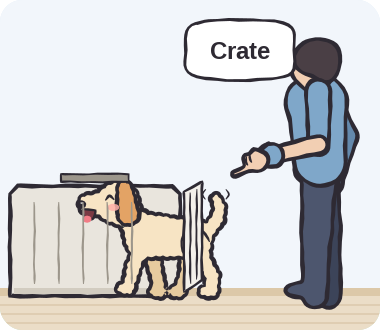
The treat comes after, inside At home, quiet
The word on its own
Say “Crate” once, point at the door, and wait. When she goes in, “Yes,” and give the treat inside the crate — don’t toss one to lure her. If she doesn’t go, don’t repeat yourself; go back a step.
A good sign to move onOne “Crate,” and she goes in by herself within about 3 seconds
- 4
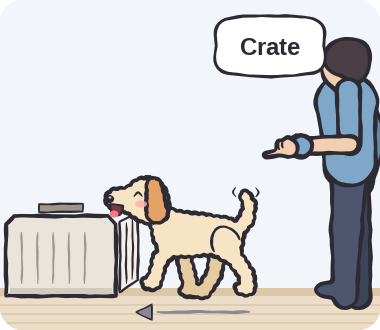
Add distance and people bit by bit At home, small distractions
From anywhere in the room
Give the cue a step or two from the crate, then from the far side of the room, then from the next room. Other family members practice too, with the same word and the same point.
A good sign to move onShe goes in from anywhere in the room, whoever gives the cue
- 5
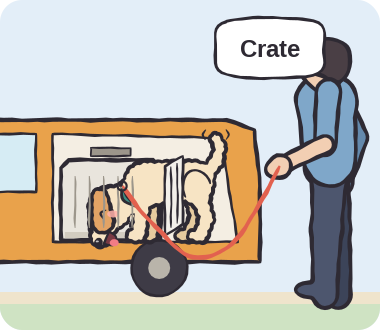
Take her den with you Yard, doorstep, outside the house
In the car and away from home
Practice with the crate set up somewhere new — the car, a relative’s house, a vacation rental. Put her bedding from home inside. When the place changes, it’s fine to run a short round of the treat-toss game again.
A good sign to move onShe goes in on “Crate” in a new place too
When to reward
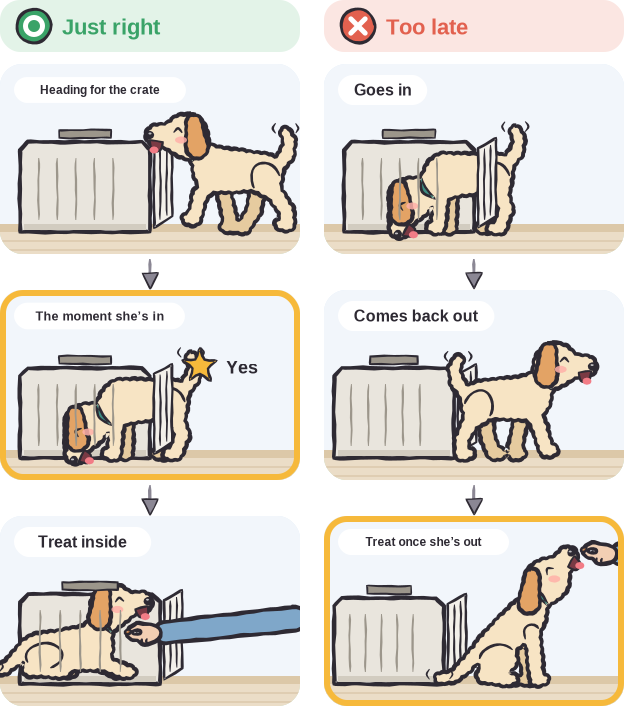
Just right
Say “Yes” the moment your dog’s body is inside the crate. Give the treat inside the crate.
Too late
Handing over the treat after she’s come back out. That rewards being outside.
When you say “Crate” matters too. At first, toss a treat and say the word the instant she starts to run. Say it over and over before she moves, and it becomes background noise. VCA Animal Hospitals (in a handout co-written by a board-certified veterinary behaviorist) describes the same order: once she goes in happily, say the cue as she heads in, then say it before you toss, and finally give the treat only after she goes in on the word. The ASPCA also says the cue as she moves toward the crate and gives the treat once she’s inside.
Crate, kennel, playpen, carrier: what’s the difference?
People use these words loosely — “kennel,” for example, often means the crate itself. What matters is that, in your family, “Crate” always sends her to the same place. Roughly:
- Crate (or kennel, indoor kennel): a box with a roof and a door — wire or plastic, often portable. Used for sleep, the car, the vet and emergencies. This is where the “Crate” cue sends her
- Playpen (puppy pen, exercise pen): a fenced area with no roof, big enough for a bed and a potty spot. Used more as a living space than something she goes into on cue
- Carrier: a bag or small box for carrying a small dog. A place to extend the cue to once she knows it with her crate at home
- Mat or bed: something flat on the floor. A different destination, so it gets its own cue — “Place”
Before the cue: make her love the crate
Add the word “Crate” only once she goes in on her own. Teach the word to a dog who doesn’t like the crate, and it just becomes the signal that she’s being sent somewhere unpleasant. The steps for building that love are in Making the Crate a Happy Place: door open, treats at the doorway and then the back → meals inside → closing the door for a little longer while she eats → you moving away → the car and other places.
You can start the cue (the steps above) once she can do steps 1–2 of that practice — walking all the way in with the door open, and eating her meals inside. It’s fine to work on closing the door at the same time. Our suggestion: in cue sessions, don’t close the door every time — make most rounds ones where she can come out on “Free” straight away. If “Crate” always means being shut in, the word becomes a warning.
Choose a crate she can stand up, turn around, lie down and stretch out in. Put it in a room where the family spends a lot of time, out of direct sunlight and drafts. A blanket over the top and sides (leave the front open) can make it cozier and block out noise and drafts — the PDSA, Dogs Trust and the RSPCA all mention this, and the RSPCA notes a partial cover can help nervous dogs. On warm days, we suggest leaving the cover off or keeping it light, and keeping the room cool: PDSA notes that dogs can overheat simply by sitting somewhere too warm, or in a room without proper ventilation, and the Royal Kennel Club advises keeping the crate away from direct heat. When you’re home, leave the door open so she can come and go.
The release: wait for “Free,” then come out
The cue to come out matters as much as the cue to go in. A dog who bursts out the moment the door opens can crash into people or jump out of the car. Our suggestion is a single release word: “Free.” If several things mean she can go — her name, “come,” the click of the latch — it’s harder for her to know which one counts, and the sound of the door alone can send her flying out.
Teach it once she goes into the crate happily on “Crate” and can settle with the door shut. Before you open the door, wait until your dog is sitting or lying quietly inside, and give her a treat in there. The reward comes before the door opens. Then open it while she’s calm and say “Free.” No treat once she’s out: getting out is its own reward, and a treat outside would make rushing out pay better than waiting (the PDSA says the same — don’t reward her when she chooses to leave — and it’s the same rule we use for “Place”). If she starts to rush out the moment it opens, close the door gently, taking care not to catch her nose or paws, wait a few seconds and try again. Only open it while she’s quiet inside.
We also suggest you don’t follow “Free” with something she dislikes, like a nail trim or a bath — keep it a word that always ends in freedom. “Wait while the door opens” carries over to the front door and the car. For doors that lead outside, the American Kennel Club advises practicing with her on leash.
How long can a dog stay in a crate?
The numbers differ from one organization to the next. The PDSA says never more than three hours at a time (less if she isn’t used to it). The RSPCA says adult dogs who are happy in their crate are normally fine for about three hours, and that shutting a dog in all day while you work is never acceptable. The ASPCA says young puppies shouldn’t be crated for more than an hour or two at a time except at night, and adult dogs for no more than four hours. Humane World for Animals says puppies under six months shouldn’t stay in for more than three or four hours, and adults no more than 4–5 hours during the day.
Our rule of thumb: for a puppy, keep it shorter than she can hold it (your potty log will tell you), and no more than about three hours at most. Night-time sleep is different, and some puppies will still need a potty break in the night. On long days, combine the crate with a playpen holding her bed and a potty spot, or with help from family, a dog walker or a pet sitter. There’s more in the “How long can she stay in?” part of Making the Crate a Happy Place.
When the crate cue pays off
Vet visits, boarding, car trips, rest after surgery, evacuations. Your dog will end up in a crate many times over her life — the American Kennel Club makes the same point. Ready.gov, the US government’s preparedness site, advises getting your dog comfortable with a carrier ahead of time, because you may need to put her in one to evacuate: leave it out and open where she spends time, and put treats and a familiar blanket inside.
It helps with visitors, too. Rather than putting her in after she’s barked or jumped, ask her into her crate before guests arrive and give her something long-lasting to chew in there (Humane World for Animals). For the whole plan for barking at visitors and the doorbell, see our Barking at Visitors page.
A good sign to move on
- Steps 1–3: when one “Crate” gets her in by herself within about 3 seconds, 8 times out of 10 (our rule of thumb), move on to step 4 (from a distance)
- Step 4: once she goes in from across the room or the next room, whoever gives the cue, move on to the car and other places
- “Free”: she waits inside with the door open until you say “Free,” 8 times out of 10 (our rule of thumb)
- Build up door-closed time using the milestones in Making the Crate a Happy Place (about 10 minutes with the door shut after a meal → about 30 minutes with you mostly out of sight)
- If she struggles, go back a step
If it isn’t working
She only goes in if I toss a treat
The treat has become the cue. Keep it in your hand, say “Crate” first, and give it inside once she’s in. If she still doesn’t move, help her by pointing at the door, then make the point smaller over time.
She stops at the door or only puts her front paws in
The crate isn’t her favorite place yet. Drop the cue for now and go back to step 1 of Making the Crate a Happy Place (door open, treats at the doorway and then the back). If the door once swung or banged and startled her, fix it open or take it off. If it’s the sound of the door, a different style of crate can help (American Kennel Club).
She won’t go in when I’m about to leave
“Crate” has become the warning that she’s about to be left alone. Use the cue when you’re home too — for naps and chews — and add lots of rounds where the door stays open, or closes briefly and opens again on “Free.” Humane World for Animals also advises crating her sometimes while you’re home, so the crate isn’t linked only with being left.
She suddenly refuses to go in
Look for the cause before you train. Did it start with hot weather or the heating season, or is she panting inside? It may be too warm. Did it start after a thunderstorm or a door slamming? Something may have frightened her in there. Is she stiff ducking through the door, lying down or getting up? Pain can do this. Cornell’s veterinary college lists signs of pain such as difficulty getting up from lying down, hiding, not wanting to be touched, and panting at rest. If you suspect pain, see your vet. Once you’ve dealt with the cause, restart with the door-open treat toss.
She won’t come out of her crate
If she’s stretched out asleep, leave her. The crate is where she rests, so don’t disturb her in there (PDSA). If you need her out, try sitting a little way from the door, side-on, and saying “Free” once. When she comes out, answer with whatever she came out for — a walk, a meal, play — not a treat (as in the release section, no treat after “Free”). If she doesn’t come, don’t keep repeating it; wait a while and try again. Don’t pull her out by hand or with an object, and don’t tip the crate. If she won’t come out even for meals or walks, or she’s trembling, or flinches when touched, she may be unwell — see your vet.
She whines in the crate
If you open the door while she’s crying, she learns that crying gets her out. Wait for a moment of quiet — even a brief pause — then open it, and shorten the door-closed time next round (RSPCA, ASPCA). Whining right after going in is usually worry about something she isn’t used to yet. Whining after she’s been quiet for a while is more often about the toilet, hunger or boredom. At night, a puppy often needs the toilet: take her out quietly, and bring her back without play.
Should I cover the crate?
You can. A blanket over the top and sides, with the front left open, can make it cozier and cut out noise and drafts (PDSA, Dogs Trust), and a partial cover can help nervous dogs (RSPCA). Add it once she’s comfortable going in, and leave enough of it open for air. On warm days, we suggest leaving the cover off or keeping it light, and keeping the room cool — dogs can overheat simply by sitting somewhere too warm, or in a room without proper ventilation (PDSA).
Where should the crate go at night?
At first, in your bedroom or just outside it, especially for a puppy — you’ll hear her when she needs to go out, and she won’t feel shut away (Humane World for Animals; VCA suggests a second crate in the bedroom if the daytime one lives in the family room). Once she sleeps comfortably through the night, you can move it gradually to where you’d like it.
Is crate training cruel?
Used well, it needn’t be. Introduced gently and never as a punishment, it can become a den where she feels safe — the RSPCA notes that some dogs seem to benefit from having one. What makes it unkind is too much of it: Humane World for Animals points out that a dog crated all day and night doesn’t get enough exercise or company and can become depressed or anxious. Keep crate time within the limits above, and stop and get help if she panics in it.
Will she need a crate forever?
Not for being left alone. The ASPCA says crating when she’s unsupervised or overnight should be the norm only until she’s learned where to toilet and what not to chew, and that most dogs can eventually be left loose at home. Humane World for Animals suggests moving from the crate to a closed-off room like the kitchen before giving her the whole house. Keep the “Crate” cue going anyway — vet visits, travel and emergencies still call for it.
Can an adult dog learn “Crate”?
Yes, the same way as a puppy. The ASPCA says even adult dogs with no crate experience can learn to be comfortable in one. If she’s had a bad experience with a crate, start slowly with the door off. Older dogs with sore joints may find long stretches in a small space uncomfortable, so one trainer quoted by the American Kennel Club suggests a larger area for longer periods.
How long does it take?
We couldn’t find any study measuring how many days it takes. Humane World for Animals says crate training can take days or weeks. Move on by which step she can do, not by the calendar. As a rule of thumb, keep sessions to about 3–5 minutes (3–4 repetitions of going in), a few times a day.
Can I put her in the crate as a punishment for barking?
No. If it becomes the place she’s sent when she’s in trouble, she’ll stop wanting to go in. The RSPCA, PDSA and Humane World for Animals all say never to use the crate as punishment. Instead, ask her in before a likely barking moment and give her a chew inside.
Prescription: a suggested order
Our suggested order. Make the crate a place she loves before you teach the word.
- ExerciseMaking the Crate a Happy Place: Step-by-Step Crate Training Your Dog Will ChooseDoable at home (Steps 1–4 at home)Door open → meals inside → door closed for a little longer → you moving away → the car and other places. The groundwork before the cue, with the milestones for closing the door and the homework.Read →
- ExerciseCharging Your Marker Word: How to Teach Your Dog That “Yes” Means a RewardDoable at home (Steps 1–4 at home)If “Yes” doesn’t yet mean “that’s it” to her, start here, so you can mark the moment she goes in.Read →
In the moment: do / don’t
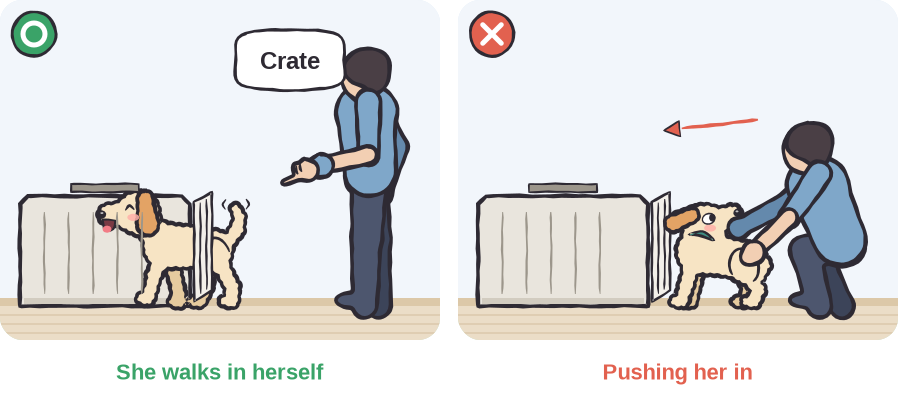
Do
- Leave the door open when you’re home, so she can come and go
- Say “Crate” once. If she doesn’t go, don’t repeat it — go back a step
- “Yes” the moment she’s inside, and the treat inside the crate
- Open the door only when she’s quiet, and let her out with “Free”
- Leave her in peace when she’s resting in there, and ask children and visitors not to poke fingers through the bars or crowd the door
Don’t
- Use the crate as a punishment (after barking or mischief)
- Push her in, carry her in, or drag her out
- Say “Crate” only right before you leave (it becomes a warning)
- Open the door while she’s crying
- Give a treat after “Free”
- Shut her in for long stretches (all through the workday, for example)
When to see a professional
- Left alone in the crate, she paces, trembles, scratches or chews at the door, barks for a long time or drools. These are signs the crate is causing real stress. Stop the confinement practice and talk to your vet or a qualified behavior professional. Dogs with separation anxiety can panic in a crate and hurt themselves trying to escape
- She suddenly won’t go in, is stiff getting up or lying down, flinches when touched, or pants at rest. These can be signs of pain — see your vet. Dogs can hide signs of pain when nervous at the clinic, so take a video of how she is at home
- She won’t come out even for meals or walks, or she’s trembling. She may be unwell — see your vet
- She suddenly starts peeing in the crate, or peeing more often. It can be a bladder infection or another medical problem — see your vet
The skills behind this command
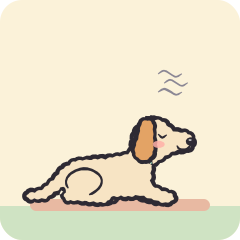 Core skill Settling Down Being able to let go and rest in the crate. “Crate” is a cue to go, by herself, to a place where she can relax.
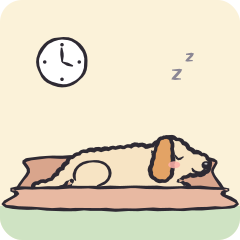 Core skill Being Alone Staying settled inside with the door shut, even when she can’t see you. This is what makes crates at the vet and while you’re out possible.
- ExerciseMaking the Crate a Happy Place: Step-by-Step Crate Training Your Dog Will ChooseDoable at home (Steps 1–4 at home)Read →
- ExerciseCharging Your Marker Word: How to Teach Your Dog That “Yes” Means a RewardDoable at home (Steps 1–4 at home)Read →
Sources
- VCA Animal Hospitals — Crate Training Your Dog (Ellen Lindell, VMD, DACVB; Monique Feyrecilde, LVT, VTS (Behavior))
- ASPCA — Introducing Your Dog to a Crate
- Humane World for Animals (formerly HSUS) — Crate training 101
- RSPCA (UK) — Dog crates: playpen and crate training a puppy
- PDSA — Crate training your dog
- Dogs Trust — Crate training
- Battersea — How to crate train your dog
- American Kennel Club — Everything You Need to Know About Crate Training Your Dog (Stephanie Gibeault)
- American Kennel Club — How to Teach Your Dog to Wait at Doorways
- American Kennel Club — How To Teach Your Dog To Go to Their Place
- Toronto Humane Society — Crate Games (PDF)
- Best Friends Animal Society — How to Crate Train a Puppy or Dog
- Ready.gov (U.S. Department of Homeland Security) — Prepare Your Pets for Disasters
- Cornell Riney Canine Health Center — Recognizing pain in dogs
- Dogs Trust — Stay training
- PDSA — Reward-based training