 BAUDOG The dictionary of dog–human communication
Contents
When to use this exercise
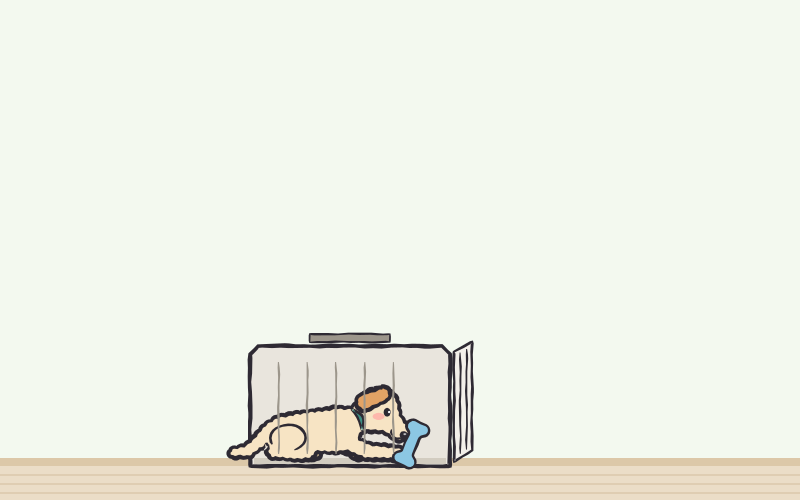
A crate can be your dog’s bed, her safe spot when she’s home alone for a short while, her seat in the car, a familiar den when you travel, and her rest area after surgery. During potty training, it’s also where she stays when you can’t watch her. Dogs prefer not to soil where they sleep, so a crate she can rest in calmly helps her settle into a rhythm of sleep, wake, potty. But a crate is not a cage, and never a punishment. This practice makes it a den she walks into herself and lies down in, even with the door closed. It builds the skills of Calm and Alone Time.
GoalAt “Crate,” she walks in on her own, and lies down and rests even with the door closed.
Assessment: what a trainer might check on the first visit
Before starting, a visiting trainer might check these three things.
What does she do when she sees the crate or goes near it? (Avoids it, trembles, ignores it, walks in by herself)
→If she avoids it or trembles, take the door off or prop it open, and leave the crate in the room like a piece of furniture. Take step 1 slowly.
How big is the crate, and where is it? (Somewhere she can hear and see the family?)
→Move it to a room where the family spends time. If it’s far too big or too small, look at a divider or a different size together.
Has the crate ever been used as a punishment or for very long stretches? When she’s left alone, does she cry hard, drool, or try to break out?
→If it has been used as punishment, stop closing the door for a while and make it a place where only good things happen. If she panics when left alone, don’t try to fix that with the crate — talk to your vet or a qualified behavior professional.
What you need
- A crate that fits: big enough for her to stand up, turn around, and lie down stretched out. For a puppy who is still being potty trained, the ASPCA and the American Kennel Club warn that a crate that’s too big lets her potty at one end and sleep at the other; if that happens, use a divider. PDSA takes the opposite view and says a crate that’s too big is better than one that’s too small.
- Soft bedding (a towel from home is fine)
- Treats, and a long-lasting chew (such as a toy you can stuff with food)
- Where to put it: a room where the family spends a lot of time. Secure the door open at first
How to signal
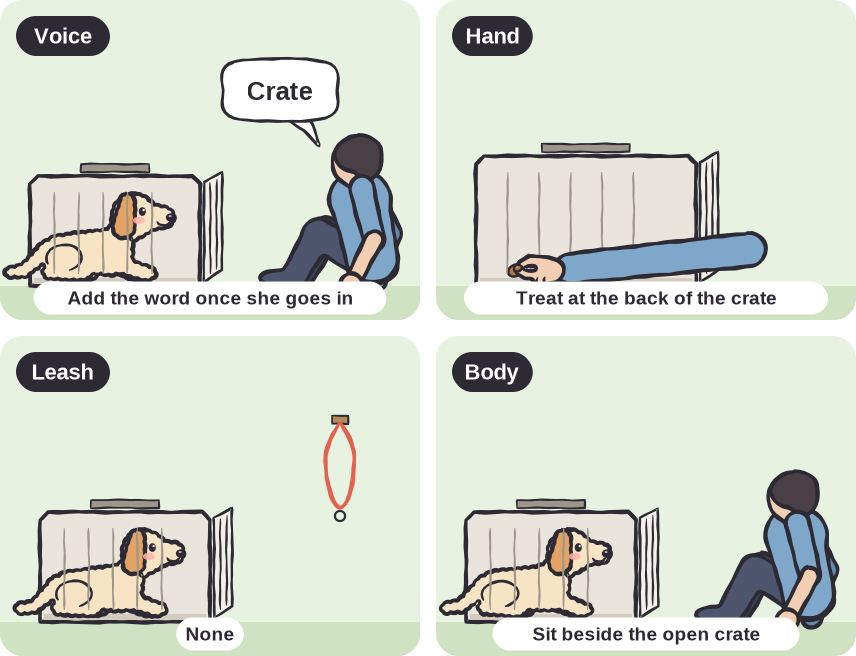
- Voice
Add the cue “Crate” once she’s going in by herself. To let her out, say “Free.”
- Hand
Put treats at the back of the crate. While she’s inside, slip treats in through the gaps.
- Leash
None.
- Body
Secure the door open at first. Sit beside the crate.
Today’s session
With the trainer, you work on step 1.
Step 1Treats at the door(At home, quiet)
With the door secured open, place treats at the entrance, in the middle, and at the back. You and the trainer watch your dog go in on her own. No pushing her in and no closing the door yet. Finish by putting her food bowl at the entrance. About five minutes.
Homework until the next visit
- How often
- A few times a day
- How long
- About 3–5 minutes each
- How much
- Every meal inside the crate (door open)
A good sign she’s readyAt mealtime, she goes all the way to the back of the crate by herself to eat
What the trainer checks next visit
In front of the trainer, put her food bowl at the back of the crate.
If she canIf she walks right to the back and eats, step 3 becomes the next homework: close the door while she eats, and open it as soon as she finishes.
If not yetMove the bowl back to the entrance, look again at the crate’s location and bedding, and do another week of steps 1–2.
Next stages: steps
- 1
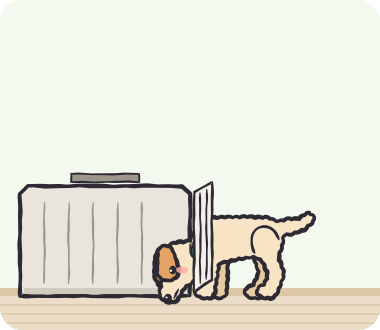
A little further in each time At home, quiet
Treats at the door
With the door secured open, place treats at the entrance → middle → back. She’s free to come and go.
A good sign to move onShe goes all the way to the back by herself
- 2
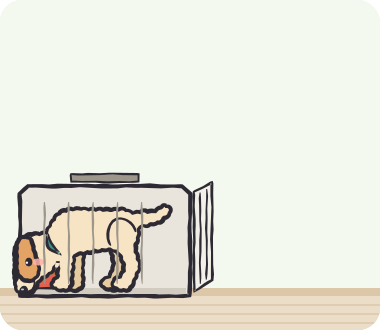
Meals at the back of the crate At home, quiet
Meals inside
Move the food bowl further in a little at a time, until she eats at the back. Door still open.
A good sign to move onAt mealtime, she heads to the crate on her own
- 3
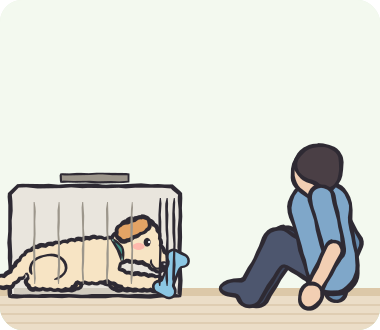
Build closed-door time slowly At home, small distractions
Door closed, a little longer each time
Once she starts eating, close the door, and open it as soon as she finishes. At each meal after that, wait a little longer after she finishes before opening it (seconds → a minute → several minutes). After the meal you can give her a chew.
A good sign to move onAfter a meal, she stays quietly with the door closed for about 10 minutes
- 4
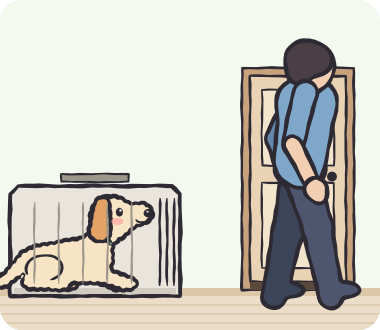
Out of sight, still resting At home, small distractions
You move away
Door closed: sit beside the crate for 5–10 minutes → walk around the room → leave the room and come back within a few minutes. When you come back, open the door at a quiet moment.
A good sign to move onShe rests quietly for about 30 minutes with you mostly out of sight
- 5
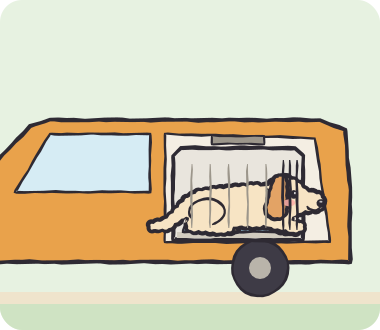
Take her den with you Yard, doorstep, outside the house
In the car and new places
Use the crate somewhere different: in the car, at a relative’s house, on vacation. Bring the same bedding from home.
A good sign to move onEven in a new place, she goes in and rests by herself
Timing
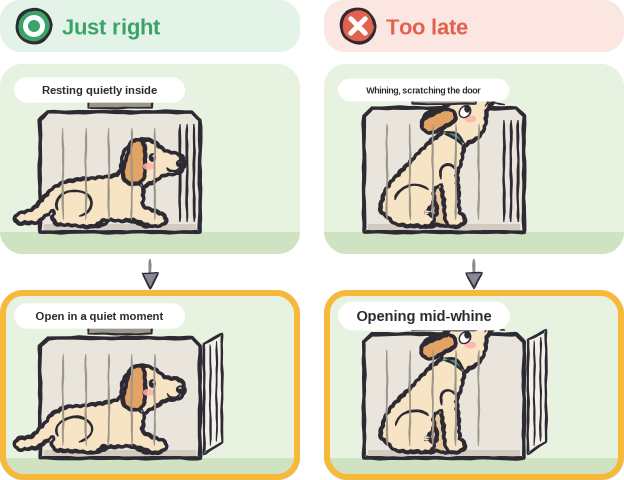
Just right
Slip a treat in through the gaps while she’s settled inside (lying down, chewing). Open the door when she’s quiet.
Too late
Opening the door while she’s whining. She learns that crying gets her out.
Whining or scratching at the door means you’ve built the time up too fast. PDSA and Dogs Trust both advise going back to the previous stage when that happens. If she’s already crying, wait for even the smallest gap in the noise before you let her out (RSPCA) — and next time, keep the door closed for a shorter time. Puppies at night are a different case: crying often means she needs to go out to potty (Humane World for Animals). At night, take her out quietly, and once she’s done, put her straight back in the crate — no play.
How much and how often
About 3–5 minutes, a few times a day (a rule of thumb). Every meal inside the crate. Keep the door closed only for a little less time than she can stay calm.
If it isn’t working
She cries when I close the door
Go back to a closed-door time much shorter than the time she managed calmly. Open it the moment she’s quiet. Give her a chew so there’s something good to do while the door is shut.
Should I just let her cry it out?
No. The American Kennel Club is direct about it: never force your dog inside or leave her to cry it out. Crying means the step was too big — make it smaller. At night, a puppy’s crying often means she needs to potty: take her out quietly, then back to bed.
She runs away when she sees the crate
Take the door off or prop it open and leave the crate in the room like any other piece of furniture. When she isn’t looking, hide treats at the back, so it becomes “the place where good things appear by themselves.”
How long can she stay in the crate?
Organizations give different numbers. PDSA says no longer than three hours at a time (less if she isn’t used to it). The RSPCA says an adult dog who is happy in her crate is normally fine for about three hours, and that it’s never acceptable to shut a dog in a crate all day while you’re at work. The ASPCA says puppies shouldn’t be crated for more than an hour or two at a time except at night, and adults for no more than four hours. Humane World for Animals says puppies under 6 months no more than three or four hours at a time, and adults no more than 4–5 hours during the day. The same Humane World page also gives a “age in months plus one hour” rule — but by that formula a 5-month-old could stay 6 hours, which contradicts its own three-to-four-hour limit. Rather than a formula, our advice is: for a puppy, keep it shorter than the time your potty log shows she can hold it, and about three hours at most. Overnight sleep is different, and some puppies still need a potty trip in the night.
Should I put the crate in my bedroom at night?
At first, it often helps. Humane World for Animals suggests putting the crate in your bedroom or nearby in a hallway, especially with a puppy, so you can hear her when she needs to go out. Once she’s sleeping comfortably through the night, you can move it gradually to where you’d like it to be.
Should I cover the crate?
You can. Dogs Trust and PDSA both suggest a blanket over the top and sides to cut out drafts and noise — PDSA adds leaving the front open. On warm days, leave the cover off or keep it light, and keep the crate out of direct sun: PDSA lists being trapped somewhere hot without proper ventilation as a cause of heatstroke, says very young and flat-faced dogs are among those most at risk, and advises placing the crate out of direct sunlight.
She pees in her crate
The usual causes are a crate that’s too big (she can potty at one end and sleep at the other) or time in the crate that’s too long. Use a divider and shorten the time. If it started suddenly or she’s going very often, see your vet — it can be a bladder infection.
Crate or playpen?
They do different jobs. A playpen (exercise pen) has room for both a bed and a potty pad, so it suits days when she’ll be alone for more than three hours, or a puppy who is still learning where to go. A crate is a portable den for sleep, the car and travel. You can also put the crate inside the playpen and use it as her bed.
She panics in the crate when she’s left alone
If she drools, cries frantically, tries to break out of the crate, or hurts herself, stop using it for this straight away — don’t try to “get her used to it.” It may be separation anxiety, and dogs with separation anxiety can injure themselves trying to escape a crate. Talk to your vet or a qualified behavior professional.
Avoid
- Using the crate as a punishment
- Pushing or dragging her in
- Shutting her in for long stretches (all day while you work, for example)
- Letting her out while she’s crying
- Calling her out or reaching in to pet her while she’s resting inside
A good sign to move on
- Steps 1–2: once she walks to the back of the crate at mealtimes on her own, go on to step 3
- Step 3: once she stays quiet for about 10 minutes with the door closed after a meal, go on to step 4
- Step 4: once she rests for about 30 minutes with you mostly out of sight, start using the crate for short outings and for sleeping at night
- If she shows signs of worry, such as whining or scratching, go back one step
- The goal is a dog who doesn’t need to be shut in: the ASPCA says crating when she’s unsupervised or overnight should only be the norm until she has learned where to potty and what not to chew
Sources
- Humane World for Animals (formerly HSUS) — Crate training 101
- RSPCA (UK) — Crate training
- PDSA — Crate training your dog
- Dogs Trust — Crate training
- Battersea — How to crate train your dog
- ASPCA — Introducing your dog to a crate
- American Kennel Club — How to Crate Train Your Dog
- American Kennel Club — How to Potty Train Your Puppy and Prevent Accidents Indoors
- VCA Animal Hospitals — House Training for Puppies and Dogs