 BAUDOG The dictionary of dog–human communication
Contents
- In short
- When it happens
- How your dog feels
- Assessment: where is your dog now?
- If a trainer came to your home: the first session and the first homework
- First, stop passing people up close
- Don’t let strangers pet her: how to say “please don’t touch”
- Teach “people = something good” from a distance
- When she’s ready to get closer: let her choose
- If she barks because she’s excited
- Why not scold her, yank the leash or use a correction tool?
- If she has bitten or tried to bite someone: make the muzzle a treat dispenser
- If she bites someone
- The missing core skill
- Exercises
- In the moment: do / don’t
- When to see a professional
- Sources
In short
When a dog barks at strangers on a walk, it’s usually fear: “don’t come any closer.” The person walks on, so barking seems to work, and the habit grows. Some dogs bark for the opposite reason — they’re desperate to greet people and the leash holds them back. Either way, start by avoiding close encounters and don’t let strangers touch her. Then, at a distance where she doesn’t bark, teach her that seeing a person means something good is coming. Scolding and leash jerks make people scarier, so leave them out.
When it happens
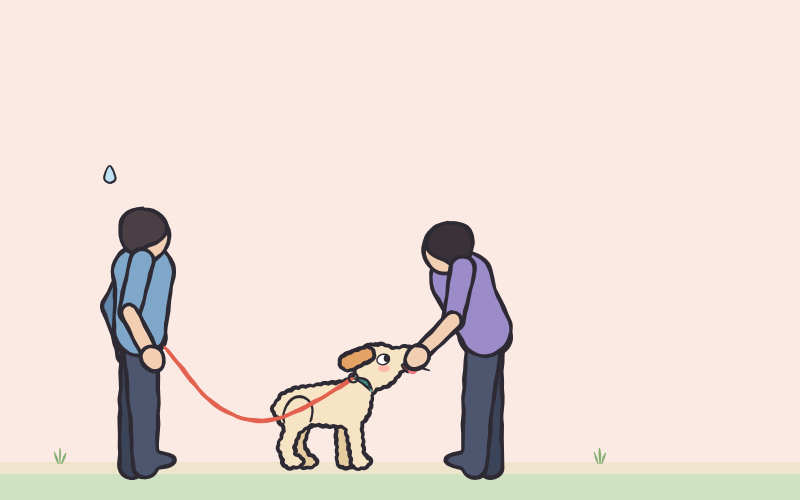
- Your dog barks at people as they pass you on the sidewalk
- She only barks at certain people — men, children, people in hats or carrying umbrellas
- When someone reaches out to pet her, she backs away barking
- She spots someone she knows and barks, tail wagging, pulling toward them
- In the evening or on a dark street, she barks at someone who appears suddenly
How your dog feels
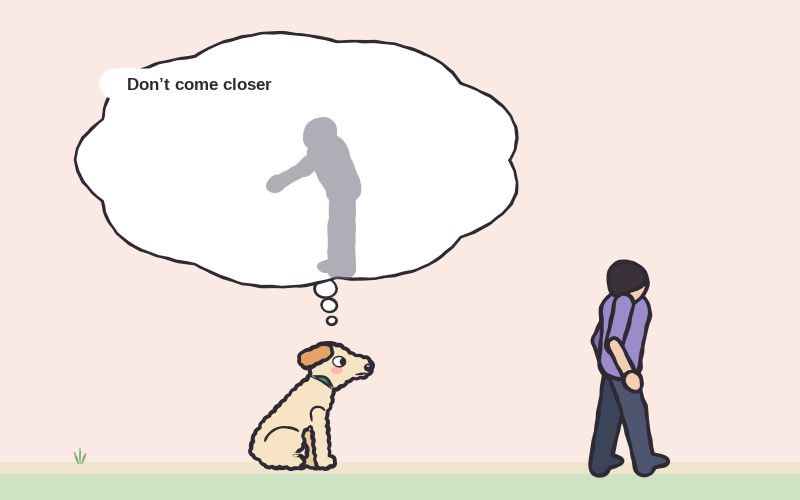
Most often, it’s fear. The MSD Veterinary Manual names fear as the most common motivation for aggression in dogs. When your dog barks, the person usually keeps walking — so from her point of view, barking made the scary person leave. That’s how the habit gets stronger. Battersea, the London rescue charity, puts it simply: barking, lunging and growling are a dog’s way of trying to put more space between herself and the stranger.
The fear can start in different ways. She may not have met many strangers as a puppy, or she was once touched suddenly and it frightened her. Some dogs are wary of particular looks or movements — men, hats, umbrellas, bicycles.
Some dogs bark because they’re excited. Dogs Trust explains that an excited dog held back on leash can get frustrated that she can’t greet a person the way she’d like. If she wags, leans forward and whines while she barks, this may be your dog.
Fear of strangers is common. In a survey of the owners of 13,700 dogs in Finland, 15% of dogs were reported to be afraid of strangers (owners answered online).
Assessment: where is your dog now?
A visiting trainer would usually start by listening, then take a short walk with you and look at things like these. The answers decide where to begin.
What does her body do before she barks? (Crouching, ears back, backing away — or wagging, leaning forward)
→The first set points to fear: start with space and good things when people appear. The second points to excitement: also practice how she greets people (see Four on the Floor).
Who does she bark at? (Men, children, hats, umbrellas, joggers, people walking toward her)
→Knowing her “difficult” people helps you pick practice helpers and situations. Start with the people and places she copes with best.
How far away is the person when she barks? Just outside that distance, can she still eat treats?
→The distance where she can still eat and can look at the person without barking is where practice starts. There’s no set number.
Has she ever bitten, tried to bite, or approached someone growling?
→If so, don’t work through this on your own: talk to your vet or a qualified behavior professional (see “When to get professional help” below).
If a trainer came to your home: the first session and the first homework
Here is one example of how a first in-home session might go — not a fixed script. With a dog who is afraid of people, the trainer is a stranger too. A good trainer will usually start by not approaching her, not making eye contact, and talking with you while she settles in her own time.
- Today: a short walk together to find the distance at which she starts to react to people (the point where she stops taking treats). Back home, 10 reps of step 1 of Look at That: a family member lifts a cushion at the far end of the room, and the moment your dog looks at it — “Yes” → treat. Then step 1 of the Emergency U-Turn in the hallway.
- Homework: walk at quieter times and on quieter routes. When someone comes toward you, U-turn or cross the street before she barks. Practice Look at That and the U-Turn at home twice a day, about 5 minutes each. Tell people who want to pet her, “Please don’t touch her.” Write down who she barked at, and how far away they were.
- Next visit: a family member or friend walks past at a distance where she can eat, and you do 10 reps of Look at That. Our rule of thumb: if she looks and turns back to you without barking 8 times out of 10, keep practicing at that distance and start closing it gradually. If she barks or won’t eat, start again from farther away.
First, stop passing people up close
Before any training, cut down the number of times she barks — every bark makes the habit stronger. The ASPCA calls avoiding the situations that set your dog off a perfectly reasonable way to cope, and notes that its on-leash plan works for dogs who bark at people, too.
- Change when and where you walk. Avoid busy times, and choose wide streets where you can easily move away (Dogs Trust also recommends quiet places and times).
- When someone comes toward you, move away before she barks: U-turn, cross the street, or step between parked cars (options the ASPCA suggests). Crossing also stops people from approaching her head-on (Battersea).
- Stay calm, and try not to tighten the leash suddenly when you see someone. Battersea notes that sudden pressure on the leash can make a dog more anxious, because she may feel she can’t move away.
- Practice the U-turn in your hallway — “this way,” then a quick turn — before you need it outside (see Emergency U-Turn).
- If she barks at visitors coming to your home rather than people outside, see our page on barking at visitors; for the doorbell, see the page on barking at the doorbell.
Don’t let strangers pet her: how to say “please don’t touch”
Getting strangers to pet a fearful dog “so she gets used to people” backfires. Dogs Trust says it’s fine to say no to people who want to stroke your dog if she isn’t relaxed, and not to agree to it if you know she doesn’t like it.
Saying no isn’t rude. It protects your dog — and the other person.
- Say it before they reach her: “Sorry, she’s nervous — please don’t pet her,” or “We’re training — could you just walk past without looking at her?”
- If someone bends down toward her, step between them and your dog and move a few steps away
- If a child heads over, call out early and kindly: “Can you stop there? She gets scared”
- Wait to have strangers hand her treats until she can stay calm around people (our suggestion: some dogs follow the treat in, then notice how close the person is and panic)
Teach “people = something good” from a distance
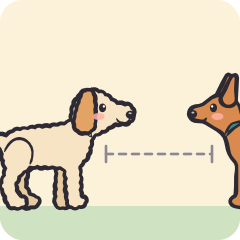
At a distance where she doesn’t bark, play Look at That. The moment she looks at a person — before she barks — say “Yes,” then give a treat. Repeated often enough, strangers stop meaning “don’t come closer” and start meaning “treats are coming.” The professional terms are systematic desensitization and counterconditioning. The MSD Veterinary Manual’s guidelines say the dog must stay calm throughout, the session should stop immediately if she reacts, frequent short sessions work better than occasional long ones, and small changes — the place, the time of day, the kind of treat — can make a big difference.
Battersea adds a useful twist: as you give the treat, move a little farther away from the person. That way she gets two rewards — the treat and more space, which is what she wanted.
You’re too close if she stops eating or snatches treats, stares and can’t look away, doesn’t turn when you call her, or barks. If you see any of these, move away at once and carry on from farther off (Best Friends Animal Society also advises starting where she can see the trigger without reacting). And the distance isn’t fixed: Battersea compares it to a personal-space bubble that grows when a lot of stressful things have happened and shrinks when she’s relaxed — it can change even within a day.
- Your first “strangers” should be family or friends. If she struggles with a particular look (a hat, an umbrella), start without it, with them walking at a distance (this and the next two steps are the order we suggest).
- Once that’s easy, add one feature at a time — a hat, say — and move back out to a bigger distance when you do. Make it harder one thing at a time.
- Build up the movement gradually: the person standing still → walking slowly → walking past.
- Only move closer once she’s looking and turning back without barking most of the time, and only a little at a time. On a bad day, go back a step.
When she’s ready to get closer: let her choose
Once she can watch people calmly, ask a friend to help with a hand-target exercise. Best Friends Animal Society describes using it with shy dogs: the person stands still and holds a hand out to the side, and when the dog comes over on her own and touches it with her nose, she gets praise and a treat. Because she decides whether to approach, she feels more in control — and safer.
The person waits for her to come; they don’t reach toward her. If she doesn’t come, that’s enough for today.
If she barks because she’s excited
A dog who wags and leans forward while she barks wants to say hello so much she can’t hold it in. Practice a simple rule: people come closer and pet her only while all four paws are on the ground (see Four on the Floor). Start at home, with family as the “visitors” (our suggestion).
Why not scold her, yank the leash or use a correction tool?
Scolding her when she barks, jerking the leash, a squirt of spray or a shock collar all teach the same thing: when a person appears, something unpleasant happens. For a dog who barks out of fear, people become even scarier. Dogs Trust warns that telling your dog off can increase stress and make the situation worse.
The American Veterinary Society of Animal Behavior (AVSAB) states in its 2021 position statement that methods and tools that work through pain or fear — choke and prong collars, shock collars, squirt bottles, leash jerking — should not be used in dog training or in treating behavior problems. In a UK survey of about 4,000 dog owners, training methods based on punishment or unpleasant pressure were linked with a higher risk of aggression toward family members and toward strangers outside the home (a link, not proof of cause).
If she has bitten or tried to bite someone: make the muzzle a treat dispenser
If she has bitten or tried to bite a person, get her used to a muzzle as a safety measure alongside the training. Dogs Trust says a muzzle can be essential for dogs known to behave aggressively in certain situations — and a dog who is already comfortable in one can be treated quickly and safely by a vet in an emergency. Battersea also points out that a muzzle signals to people that they should give your dog extra space, and makes strangers less likely to rush up and greet her without asking.
Choose a basket muzzle she can pant, drink and take treats through (Dogs Trust, Battersea, Best Friends Animal Society). Panting is how dogs cool down. Fabric or mesh muzzles that hold the mouth closed don’t allow panting, drinking or treats, so they’re only for very short procedures, like an injection (Best Friends). It should fit without digging into her face or blocking her vision.
A muzzle isn’t a substitute for training. Dogs Trust notes that a muzzle won’t change how your dog feels about a situation, so even with it on, avoid situations that worry her. The Muzzle Up! Project, a US trainer-led muzzle awareness effort, makes the same point: a muzzle isn’t a green light to take your dog into situations that will make her react. Changing how she feels is the job of exercises like Look at That.
Dogs who guard their food or treats, or who dislike having their face or head touched, may not suit the usual treat-based muzzle training — Dogs Trust advises working on that with a professional first. Use a muzzle with guidance from a professional.
- Muzzle appears → treats. Muzzle goes away → treats stop. Repeat until she brightens up and comes over when she sees it (the Muzzle Up! Project’s plan).
- Hold the muzzle still at the height of her nose, with something lickable — squeezy cheese or paste — at the opening. Don’t move the muzzle toward her; she must always be free to pull her face out (Dogs Trust).
- Move the treat gradually deeper. Once she’s putting her nose in by herself, feed through the gaps, and build the time her nose stays in from 1–2 seconds upward (Muzzle Up! Project).
- For the strap: get her comfortable with the sound of the clip → the strap touching her neck → fastening it and undoing it straight away → gradually longer with it fastened (Dogs Trust, Battersea).
- With the muzzle on, do fun things — meals, play, practicing cues she knows. Once she’s relaxed at home, try short walks on quiet streets. If it only goes on when people are around, the muzzle itself can become a bad sign (Best Friends, Muzzle Up! Project).
- If she paws or rubs at it, don’t take it off at that moment: distract her with a cue she knows or a treat, then remove it once she’s calm, and go back to the stage where she was relaxed (Dogs Trust, Best Friends). Taking it off as she paws teaches her that pawing works (Best Friends). If she backs away or stops taking treats, go back to an easier stage and slow down (Dogs Trust, Muzzle Up! Project). Spread training over short sessions across at least a few days (Battersea).
- If she needs to be muzzled for something urgent (a vet visit, say) while you’re still training, use a completely different style of muzzle, so you don’t undo her training with her own (Dogs Trust).
If she bites someone
Stay calm. Keep your voice and body calm — no scolding or hitting — and move her somewhere safe as quickly as you can. That is the first advice in a handout from the American College of Veterinary Behaviorists.
Make sure the person who was bitten washes the wound right away with soap and water and gets medical advice — the CDC advises urgent medical attention after a possible rabies exposure.
Rules after a bite depend on where you live, so find out what applies to you — for example, whether the bite has to be reported to animal control or the local health department. In the US, national public-health guidance is that a healthy dog who bites a person is confined and observed daily for 10 days; questions about a bite should go to your state or local public-health authority.
Then get help — the first time, not the third. The same ACVB handout advises seeking help the first time your dog bites, talking to your vet, and, while you wait, completely avoiding the situation where the bite happened.
The missing core skill
Exercises
This is the order we recommend. The first homework is Look at That (building the rhythm at home) and the Emergency U-Turn (in your hallway). Once she can get closer to people, use the hand target so she can approach on her own terms.
- ExerciseLook at That (LAT): The Game That Helps Reactive Dogs Stay Calm Around Dogs and PeopleStart at home, finish outside (Step 1 at home)The core exercise. At a distance where she doesn’t bark, mark the moment she looks at a person, so seeing people comes to mean something good.Read →
- ExerciseEmergency U-Turn: Teach Your Dog to Turn and Walk Away HappilyStart at home, finish outside (Steps 1–2 at home)Your escape route when someone gets too close. Practice it in the hallway first.Read →
- ExerciseHand Target: How to Teach Your Dog “Touch” — and Use It for Recall and Passing Other DogsDoable at home (Steps 1–3 at home)Get it solid at home, then use it so she can choose to go and touch a friend’s outstretched hand.Read →
- ExerciseCheck-Ins: Teach Your Dog to Look at You Without Being AskedDoable at home (Step 1 at home)Reward her for looking up at you without being asked. It builds the habit of coming back to you after she sees someone.Read →
- ExerciseFour on the Floor: Teaching Your Dog to Greet People PolitelyDoable at home (Steps 1–2 at home)For dogs who bark because they’re excited: people only say hello while all four paws are on the ground.Read →
- ExercisePuppy Socialization: How to Make New Things Good ExperiencesStart at home, finish outside (Steps 1–2 at home)For puppies: all kinds of people seen from a distance → treat.Read →
In the moment: do / don’t
Do
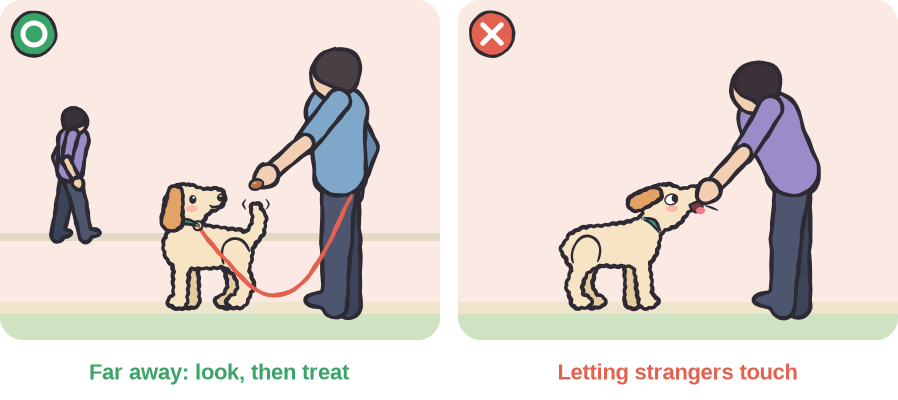
- When you see someone coming, move away before she barks (U-turn, cross the street, step behind parked cars)
- At a distance where she doesn’t bark, say “Yes” the moment she looks at the person, then treat
- Tell people “please don’t pet her” before they reach her
- Let her choose whether to approach people
Don’t
- Scold her or yank the leash when she barks
- Ask strangers to pet her, or carry her up to people, to “get her used to them”
- Try to coax a frightened dog to take treats from a stranger’s hand
- Use spray, shock collars or other tools that startle or hurt
When to see a professional
- She has bitten, tried to bite, or approached someone growling. Talk to your vet, a board-certified veterinary behaviorist or certified applied animal behaviorist (US), or a qualified behaviourist your vet refers you to (UK) — someone who doesn’t use punishment. The American College of Veterinary Behaviorists warns that aggression that is mismanaged, or not addressed early, often gets worse
- She started barking suddenly, minds being touched, or is walking differently. Pain may be behind it — the RSPCA advises a vet check for any behavior problem involving aggression
- She barks or growls at children. Children find it harder to read a dog’s warning signs, so get help early, and keep children and the dog apart until you do
- The barking is happening in more situations, or getting more intense
Go to the root
Don’t stop at the quick fix. Growing the skill underneath makes other problems lighter too.
 Core skill Confidence
- ExerciseLook at That (LAT): The Game That Helps Reactive Dogs Stay Calm Around Dogs and PeopleStart at home, finish outside (Step 1 at home)Read →
- ExerciseEmergency U-Turn: Teach Your Dog to Turn and Walk Away HappilyStart at home, finish outside (Steps 1–2 at home)Read →
- ExerciseHand Target: How to Teach Your Dog “Touch” — and Use It for Recall and Passing Other DogsDoable at home (Steps 1–3 at home)Read →
Sources
- ASPCA — Dogs Who Are Reactive On-Leash (PDF)
- Dogs Trust — Signs your dog is reactive and how to help
- Battersea — How to build your dog’s confidence around strangers
- Best Friends Animal Society — “Look at That” (LAT) Training for Reactive Dogs
- Best Friends Animal Society — Hand Targeting Dog Training
- Best Friends Animal Society — How hand targeting is helping a group of shy dogs gain confidence
- Maddie’s Fund — Teaching Your Dog to Touch
- East Bay SPCA — Dog Reactivity Training: Emergency U-Turns (PDF)
- MSD Veterinary Manual — General Guidelines for Effective Controlled Exposure Behavior Modification in Dogs
- MSD Veterinary Manual — Behavioral Problems of Dogs
- AVSAB — Position Statement on Humane Dog Training (2021)
- AVSAB — Position Statement on Puppy Socialization (2008)
- Casey, Loftus, Bolster, Richards & Blackwell (2014). Human directed aggression in domestic dogs (Canis familiaris): Occurrence in different contexts and risk factors. Applied Animal Behaviour Science 152:52–63
- University of Bristol news (January 2014) — on the Casey et al. study
- Salonen et al. (2020). Prevalence, comorbidity, and breed differences in canine anxiety in 13,700 Finnish pet dogs. Scientific Reports 10:2962
- Whole Dog Journal — 5 Things to Know About a Dog’s Threshold
- RSPCA (UK) — Aggression in dogs
- RSPCA (UK) — Children & dogs
- Dogs Trust — Teach your dog to wear a muzzle
- Battersea — Muzzle training your dog
- Best Friends Animal Society — Dog Muzzles: How and Why to Use Them
- The Muzzle Up! Project — Training Your Dog To Wear a Muzzle (PDF)
- The Muzzle Up! Project — Muzzles are a tool, not a green light to ignore criteria
- American College of Veterinary Behaviorists — What is a veterinary behaviorist?
- Behavior Basics: My dog bit someone! What do I do?! (ACVB handout, hosted by The Ohio State University Veterinary Medical Center)
- NASPHV — Compendium of Animal Rabies Prevention and Control, 2016 (JAVMA)
- CDC — About Rabies
- Merck Veterinary Manual (pet owner version) — Behavior Problems in Dogs
- Mills et al. (2020). Pain and Problem Behavior in Cats and Dogs. Animals 10(2):318