 BAUDOG The dictionary of dog–human communication
Contents
When to use this exercise
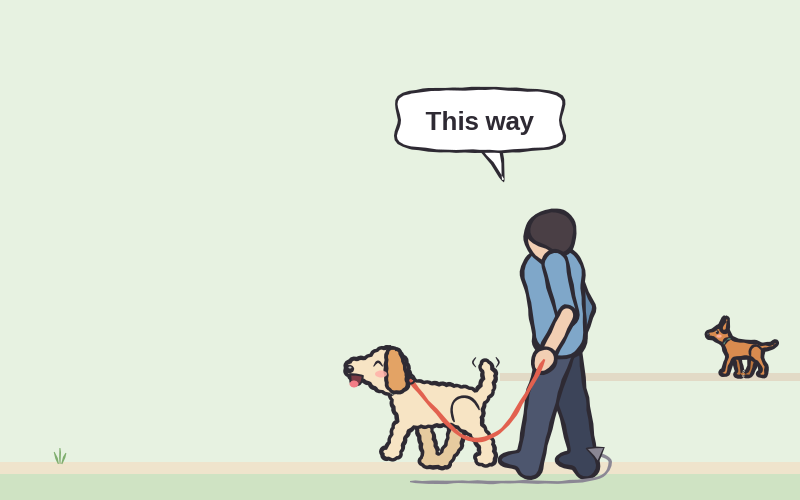
Another dog appears around the corner. There’s food on the ground ahead. You want to get out of there before she barks or lunges. This is your escape route. You don’t haul her around with the leash: you say “This way!” and she turns and follows you on her own. Use it for dogs who bark at other dogs or people, scavenge on walks, or pull. It builds Focus and Confidence. You’ll use it outside, but you teach it in your hallway.
GoalYou say “This way!” once, and your dog turns straight away and follows at your side. The leash stays loose.
Assessment: what a trainer might check on the first visit
A visiting trainer might start by checking these three things.
Indoors, when she’s walking beside you and you suddenly turn around, does she notice and follow?
→If not, start at step 1 (no leash, turning with a treat leading her nose). If she does, keep step 1 short and move on to step 2 with the leash on.
When the leash goes tight, does she brace, resist or bite it?
→If so, agree as a family from the start that in this exercise the leash is never used to turn her. If she bites the leash, read “Leash biting” too.
On walks, how far away is the thing that worries her (another dog, a person, a bike) when she freezes, barks or lunges?
→That tells you when to use the U-turn at the “real life” step. For now, avoid routes where you meet it so close that she barks the moment she notices.
What you need
- Small, soft treats she can eat quickly (for the outdoor steps, something better)
- A well-fitting harness and a standard-length leash (from the second indoor step)
- A marker word she already knows — “Yes” means a treat is coming (see Charging Your Marker Word)
How to signal
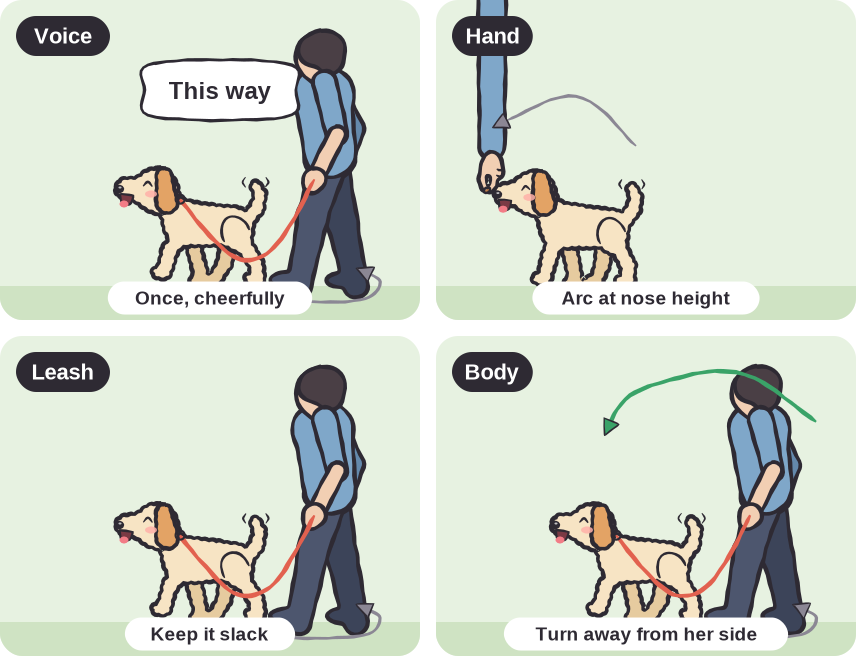
- Voice
“This way!” once, bright and cheerful. Not hurried, not low and tense.
- Hand
As you turn, hold a treat at her nose height and lead her nose around with you (once she’s got it, no lure — the treat comes after she follows).
- Leash
Keep it loose. Never pull her around with it. Move as if she’s going to follow.
- Body
Spin 180 degrees, turning away from her side. Then walk briskly for 2–3 steps.
Today’s session
With the trainer, you work on step 1.
Step 1Hallway, no leash(At home, quiet)
The trainer demonstrates in your hallway, then hands over to you. No leash: walk 3–4 steps side by side, hold a treat at your dog’s nose, spin around away from her side, and when she follows, “Yes” — then the treat 2–3 steps later. Ten times. The trainer corrects on the spot if you’re nudging her with your hand or the leash, or forgetting to walk briskly after the turn. It takes about 5 minutes.
Homework until the next visit
- How often
- Twice a day
- How long
- About 3 minutes each
- How much
- Up to 10 turns per session
A good sign she’s readyIndoors, on leash, she turns straight away on one “This way!”, 9 out of 10 times
What the trainer checks next visit
In front of the trainer: 10 “This way!” turns in the hallway on leash. If that goes well, a few in front of the house.
If she canIf she turns straight away 9 out of 10 times indoors → next stage: step 3 (in front of your house) becomes the new homework.
If not yetBack to step 1 for another week, looking together at how you lead her nose and where you give the treat.
Next stages: steps
- 1
First, lead her nose around At home, quiet
Hallway, no leash
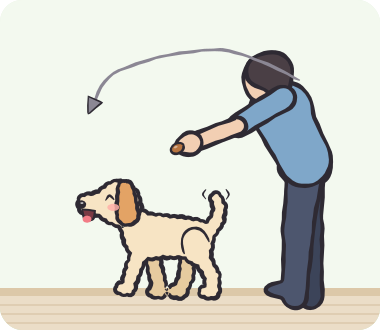
Walk side by side down the hallway, then spin around with a treat leading her nose. When she follows, “Yes,” then the treat 2–3 steps later. No cue word yet.
A good sign to move onShe follows straight away when you turn, without the lure
- 2
Say the word once, just before you turn At home, quiet
Hallway, on leash, “This way!”
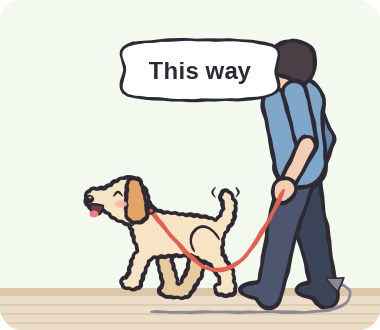
Same thing with harness and leash on. Say “This way!” once, just before you turn. Leash loose.
A good sign to move onShe turns straight away on one “This way!”, 9 out of 10 times
- 3
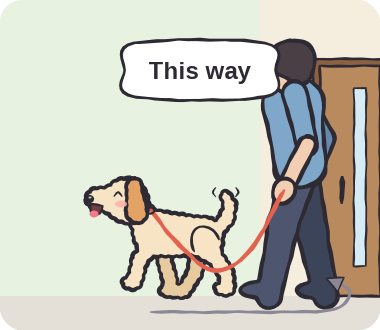
Outside starts in front of your house Yard, doorstep, outside the house
In front of your house
Walking a few yards back and forth in front of your house, say “This way!” now and then, when nothing is going on. Outside, use better treats than indoors.
A good sign to move onIn front of the house, she turns straight away 9 out of 10 times
- 4
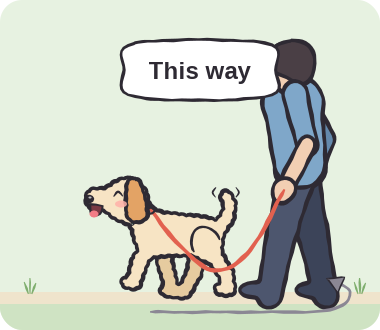
Sprinkle it in when nothing’s happening Quiet street
On a quiet street
On a walk, say “This way!” now and then when nothing is going on. Start while she’s walking, rather than while she’s sniffing.
A good sign to move onOn a quiet street, she turns straight away 9 out of 10 times
- 5
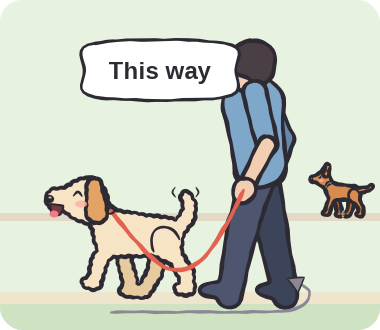
Leave before she barks Around distractions
In real life
When you see something that worries her, say “This way!” before she freezes or barks. Once you’re clear and she’s calm, praise her. If you’ve moved far enough away that she can eat treats, you can follow on with “Look at That” right there.
A good sign to move onShe notices what worries her, but turns and follows before she barks
Timing
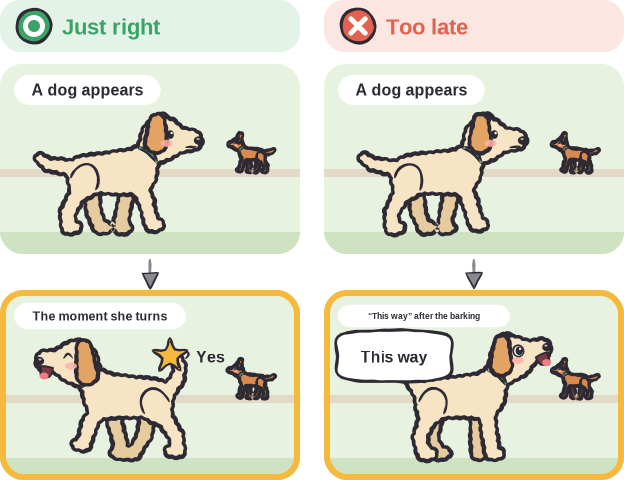
Just right
“Yes” the instant she turns and starts moving toward you. The treat comes after you’ve walked 2–3 steps together, by your leg.
Too late
Saying “This way!” only once she’s already barking at the other dog. Or praising a while after the turn is over and you’ve stopped.
“This way!” works best said before she gets worked up about what she’s seen. US behaviorists Patricia McConnell and Karen London describe the U-turn as the cue for when your dog will be too aroused to respond to “Watch,” or has already barked or lunged. Even so, the earlier you say it, the easier the turn. If she’s already reacting, McConnell’s advice is simply to turn and move away — no treat that time — and once she can listen again, ask for something easy that she can do.
How much and how often
Up to 10 turns per session (about 3 minutes), about twice a day. Once you reach the outdoor steps, sprinkle 5–10 into walks when nothing is going on.
If it isn’t working
She does it at home but not outside
Use better treats outside. Do more practice somewhere quiet like the front of your house, and build up successes when nothing is happening before you use it near what worries her.
What worries her is too close for her to turn
For today, just get away: duck behind a parked car, cross the street, or pick up a small dog. The AKC says getting your dog out of the way by crossing the street or with an emergency turn is always preferable to passing close by. Next time, choose times and routes where you’re less likely to meet it.
She looks unhappy, or has got slower, when I say “This way!”
Check whether you only use it in difficult moments. For a while, practice it more when nothing is happening, so that “This way!” is followed by good things far more often.
She won’t turn unless I pull the leash
Go back to step 1 (no leash, leading her nose). If you pull her around with the leash, she learns to be turned by the leash, not to follow you.
Avoid
- Yanking the leash to turn her
- Using “This way!” only in difficult moments (the cue itself is likely to become a warning that something bad is coming)
- Saying it in a panicked or low, tense voice
- Waiting until she’s close enough to bark before you use it (that close, she can’t learn)
A good sign to move on
- Steps 1–2 (indoors): on leash, she turns straight away on one “This way!”, 9 out of 10 times
- Steps 3–4 (front of the house, quiet street): she turns straight away 9 out of 10 times in that place
- Because it’s an emergency cue, we set the bar higher than for other exercises (our rule of thumb)
- If she struggles, go back one step (our rule of thumb: two misses in a row)
Sources
- American Kennel Club — Cues to Teach Your Dog to Avoid Approaching Dogs (Sassafras Patterdale)
- Battersea — How to deal with lead frustration
- Dogs Trust — Dog walking problems: pulling on lead (“this way”)
- Whole Dog Journal — Using a U-Turn to Leave Trouble Behind (from McConnell & London, Feisty Fido)
- Patricia McConnell — The Other End of the Leash (blog), on the Emergency U Turn
- Best Friends Animal Society — Dealing with Leash Reactivity
- Best Friends Animal Society — How to manage dog leash reactivity
- Vetstreet (Mikkel Becker) — Teach your dog to turn around on cue
- Dogkind Training — Teaching “Let’s go!” for Reactive Dogs (Part 1)
- MSD Veterinary Manual — Behavioral Problems of Dogs
- AVSAB — Position Statement on Humane Dog Training (2021)