 BAUDOG The dictionary of dog–human communication
Contents
- In short
- When it happens
- How your dog feels
- First: dangerous finds, and what to do if she eats one
- Where is she stuck? Three questions
- If a trainer came to your home: the first session and the first homework
- On walks: keep things out of reach
- Build “leave it” at home, then use it on walks
- If it’s already in her mouth
- “Won’t trading teach her to pick things up for treats?”
- Still risky? A muzzle is an option
- Scavenging at home, and in puppies
- The missing core skill
- Exercises
- In the moment: do / don’t
- When to see a professional
- Sources
In short
Most scavenging is simply a dog doing what dogs do: looking for food. Every so often she hits the jackpot — something edible — and that keeps her searching. Telling her off doesn’t stop it, and chasing her to grab the item tends to feel like a game to her; some dogs even gulp their find down before it can be taken. The fix has three parts. 1) On walks, hold the leash short enough that she can’t reach what’s on the ground. 2) At home, start by teaching her to give up a treat in your closed hand, and build from there until she can walk past things on the street. 3) If something does end up in her mouth, don’t chase her — drop a few treats on the floor a little way off so she lets go. If she might have eaten something dangerous, don’t wait and see: call your vet. Don’t try to make her vomit yourself.
When it happens
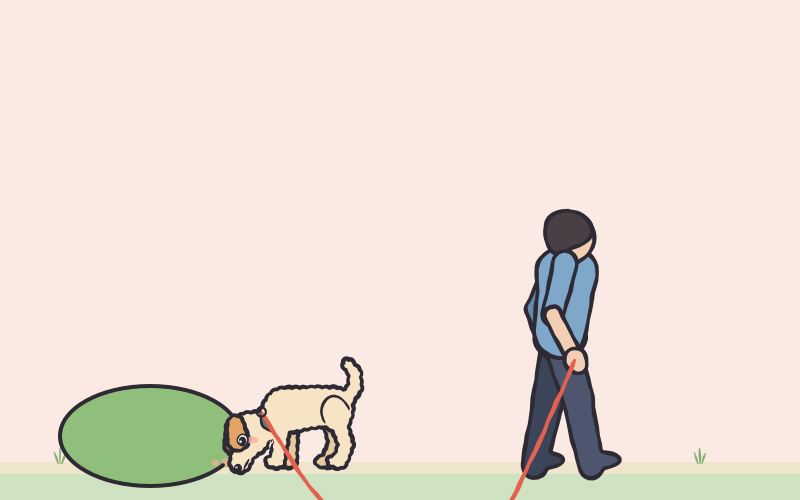
- On walks, your dog’s nose is glued to the ground, hunting for something
- Bread crusts, chip bags, cigarette butts — she snatches them up in a split second
- When you try to take it, she swallows it, runs off, or goes stiff
- At home, too, she eats food or tissues that land on the floor
How your dog feels
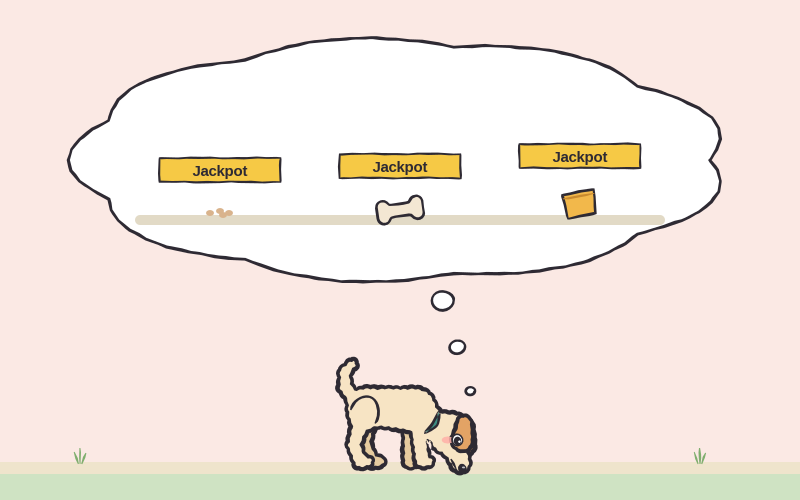
Hunting for dropped food and eating it is, most of the time, just a dog looking for food. The MSD Veterinary Manual describes it the same way: some dogs scavenge as a normal part of getting food, and success keeps them at it. If one walk a day turns up a jackpot somewhere, that’s reason enough to keep searching the ground.
Puppies investigate the world with their mouths. Chewing and swallowing things that aren’t food is part of how they explore.
When she picks something up and you run over, chase her and pull it out of her mouth, it feels to her like a game of chase followed by a game of tug. Next time, she picks things up to play again. Some dogs learn to swallow their find before it can be taken — and a veterinarian writing in Whole Dog Journal notes that yelling often makes a dog swallow its prize as fast as it can.
First: dangerous finds, and what to do if she eats one
Some human foods are poisonous to dogs. According to the ASPCA, they include chocolate (vomiting, diarrhea, tremors, seizures), onions, garlic and chives (red blood cell damage that can lead to anemia), grapes and raisins (kidney damage), and gum, sweets or baked goods containing xylitol (low blood sugar and possible liver damage). Bones — like the chicken bones that turn up in takeout litter — can injure the gut or block it.
If you think she may have eaten something, don’t wait and see. Call your vet or the nearest emergency vet clinic right away. Tell them what she ate, how much, when, and roughly how much she weighs, and bring the wrapper or packet if you have it. If you can’t reach a vet, Cornell University’s veterinary college points US owners to the ASPCA Animal Poison Control Center (888-426-4435) or Pet Poison Helpline (855-764-7661). In the UK, Animal PoisonLine (01202 509 000) is run by the Veterinary Poisons Information Service. All of them charge a fee.
Don’t try to make her vomit on your own. Cornell’s College of Veterinary Medicine explains that for some swallowed objects and poisons, making a dog vomit is the wrong thing to do, and the decision should be made with a vet or a veterinary poison control service. And even if you don’t know what she ate, if she suddenly seems very ill and is getting worse quickly, go to a vet straight away.
Things that aren’t food can get stuck. The PDSA lists the signs of a gut blockage as loss of appetite, not acting like herself, vomiting, diarrhea or constipation, tiredness, and a painful belly. If you see these after she’s swallowed something, call your vet.
Where is she stuck? Three questions
Try these three at home. The answers tell you where to start.
- Does she pick things up off the floor at home, too? If so, tidy up first (no food, small objects or string left on the floor) and start practicing at the indoor steps.
- Hold a treat in a closed fist in front of her nose. How long does she keep sniffing and licking? If she gives up within a few seconds, you can move quickly to the floor step of the Leave It practice. If she keeps at it hard enough to nibble your hand, go slowly from the closed-fist step.
- When you reach for something in her mouth, does she freeze or growl? If so, start with the Trade (Drop It) practice before anything that involves taking things away. If she growls or bites, talk to your vet or a qualified behavior professional.
If a trainer came to your home: the first session and the first homework
Here is how BAUDOG would expect it to go — one example, not a fixed script. A trainer might, for example, check at home how hard your dog works at a treat in a closed hand and how she reacts when someone goes to take something from her mouth, then come along on a walk to look at the leash length and the route.
- Today: hold a treat in a closed fist in front of your dog’s nose; the instant her face moves away, say “Yes” and give her a different treat from your other hand (step 1 of the Leave It practice). The trainer shows you first, then each family member does 10 repetitions. On the walk, you agree together on a leash length that keeps her mouth away from things on the ground.
- Homework: twice a day, 3–5 minutes each, up to 10 repetitions a session — closed fist, then open hand, then a treat on the floor. On walks, hold the leash at the length you agreed and avoid places with lots of dropped food (by trash bins, outside takeout places and convenience stores, the morning after a street party or game day). The whole family agrees: if she gets something in her mouth, nobody chases her.
- Next visit: the trainer puts a treat on the floor. Our rule of thumb: if she looks away on her own and up at you 8 out of 10 times, the next homework is walking past a practice item you’ve set down on a quiet street. If not, it’s back to the open-hand step, and you take another look together at how good the reward treats are.
On walks: keep things out of reach
Until the training works outside, preventing mistakes is the most important training there is — every time she manages to eat something, the habit gets stronger.
- Hold the leash at a length where her mouth can’t reach what’s on the ground. The idea isn’t to jerk her away; it’s to make sure she can’t get there in the first place.
- Avoid the routes and times with the most dropped food: the base of hedges, by trash bins, outside takeout places and fast-food places, after a street party or game day.
- If you spot something before she does, toss a treat up ahead so she goes for that instead of the thing on the ground (a tip from the Ontario SPCA). As The Name Game and the Emergency U-Turn come along, you can also call her name or turn and walk the other way.
- Give her plenty of time to sniff on walks. Sniffing is one of her great pleasures, so don’t take it away. What prevents scavenging is whether her mouth can reach things, not whether her nose is down.
Build “leave it” at home, then use it on walks
The ability to give up something she’s found is built at home, starting with a treat in your hand. Dogs Trust in the UK and Canadian animal welfare groups both advise practicing at home first, and only then using it on walks.
Never give her the thing she just left. Reward her from your other hand, with something better. You’re teaching her that giving something up leads to something even better.
- Hold a treat in a closed fist in front of her nose. Let her sniff and lick, and wait. The instant her face moves away, say “Yes” and reward her from your other hand.
- Next, open your hand. If she moves toward it, close it; when she backs off, praise her.
- Put a treat on the floor and cover it with your hand. Praise her when she moves away. Once that’s easy, take your hand away and stand where you could cover the treat with your foot. Then work up to dropping a treat from a little height while she holds back.
- Only once she reliably looks away straight away, add the cue “Leave it” just before she moves off. (At BAUDOG we use “Leave it” rather than “No,” so the cue doesn’t get mixed up with scolding.) Say it once.
- On walks, start on a quiet street, walking past a practice item you’ve set down yourself, such as treats in a lidded container — and take it home with you afterward. Finally, in front of a real found item: “Leave it,” and when she walks past, a jackpot treat.
If it’s already in her mouth
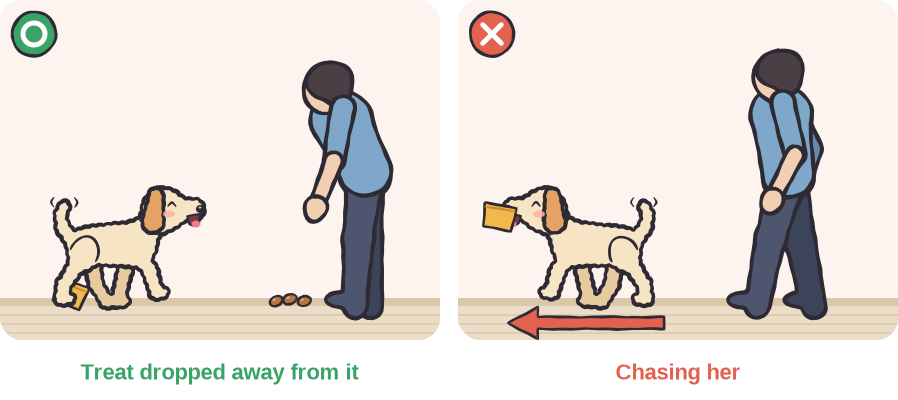
- Don’t chase her, and don’t put your hand in her mouth to pull it out. Chasing turns it into a game; pulling turns it into tug.
- Drop a few treats on the floor a little way away from her. When she lets go of the item to get the treats, calmly pick it up.
- If she has something dangerous, like a pack of tablets, and looks ready to run if you come closer, make a distraction that doesn’t involve talking to her, touching her or looking at her — walk out of the room, or go and open the fridge. Once she drops it, scatter treats in another room and tidy the item away while she’s busy.
- Practice swapping toys for treats as a game in everyday life, and she’ll be much more likely to let go when it really matters (see the Trade (Drop It) practice).
“Won’t trading teach her to pick things up for treats?”
It’s a fair worry: she might learn that grabbing something earns a treat, and start picking up more. In BAUDOG’s view, trading is a way to get a dangerous item out of her mouth quickly and safely — it isn’t the main way to reduce scavenging. The main tools are leaving things before they reach her mouth (Leave It) and holding the leash so she can’t reach. On walks, make the reward for walking past something better than the reward for a trade, so walking past always pays more.
Still risky? A muzzle is an option
For dogs on strict diets, or dogs who try to eat everything, Dogs Trust says a muzzle could be a life saver. The PDSA likewise suggests a leash and a muzzle on walks for dogs who don’t yet know “leave” or “drop.” It’s a safety tool, not a punishment.
If you choose one, pick a basket-type muzzle she can drink and pant through. Don’t just put it on her. Get her used to it bit by bit: a treat when she sees the muzzle, then eating a treat from inside it, then praise for putting her nose in. If she paws at it or rubs her face on things, go back a stage.
Scavenging at home, and in puppies
At home, the best fix is a clear floor. Keep food, medicines, small toys, string and tissues out of reach.
Boredom can also be a reason dogs pick things up. Put part of her meal in a food puzzle toy, or scatter it on the floor for her to find (see Sniffing Games). Time spent finding her food by nose satisfies her urge to use her mouth and nose.
If she’s a puppy, there’s good news: the PDSA says most puppies chew and swallow non-food items as a normal part of puppyhood and grow out of it, usually with the help of reward-based training. Until then, a clear floor and the steps above keep her safe.
The missing core skill
Exercises
BAUDOG’s suggested order: the practices she can learn at home come first, and the ones you finish off on walks come last.
- ExerciseLeave It Practice: From a Closed Fist to Food on the SidewalkDoable at home (Steps 1–3 at home)Moving her face away from a treat in your hand, all on her own. The core practice for ending scavenging.Read →
- ExerciseThe Trade Game: Teach Your Dog to Drop It by Swapping, Not GrabbingDoable at home (Steps 1–4 at home)Letting go of what’s in her mouth in exchange for a treat. Your insurance against dangerous finds.Read →
- ExerciseThe Name GameDoable at home (Steps 1–2 at home)Turning when she hears her name, so you can bring her attention back before she heads for the ground.Read →
- ExerciseBuilding a Stay: Duration, Distance, Distraction — One at a Time, Up to the Front Door and GuestsDoable at home (Steps 1–3 at home)Building her ability to wait until you say “OK,” even with food right in front of her.Read →
- ExerciseScent Games for Dogs: Easy Treat Hunts With a Towel and Paper CupsDoable at home (Steps 1–3 at home)Satisfying her love of finding food by nose, at home.Read →
- ExerciseLoose Leash Walking: Stop When It’s Tight, Reward at Your Side (Starting Indoors)Start at home, finish outside (Steps 1–2 at home)Walking with a slack leash — the basis for walks on a leash length that keeps things out of reach.Read →
- ExerciseEmergency U-Turn: Teach Your Dog to Turn and Walk Away HappilyStart at home, finish outside (Steps 1–2 at home)When you spot something on the ground, turn smartly and walk away from it.Read →
In the moment: do / don’t
Do
- Hold the leash short enough that she can’t reach things on the ground
- If you spot something first, get her attention before she reaches it — a “watch me” cue or a treat tossed ahead — and reward her
- If something is in her mouth, drop treats on the floor a little way off so she lets go
- If she might have eaten something dangerous, call your vet right away
Don’t
- Chase her, or put your hand in her mouth to take things
- Shout “No!”
- Try to make her vomit yourself
- Hand back the thing she gave up
When to see a professional
- She has eaten, or may have eaten, something dangerous (human food, medicine, bones). Don’t wait and see — call your vet right away
- Even if you don’t know what she ate, she suddenly seems very ill or is getting worse fast. Go to a vet now
- After swallowing something, she goes off her food, vomits, has diarrhea or constipation, seems tired or not herself, or her belly seems painful. These can be signs of a gut blockage
- She repeatedly swallows things that aren’t food — stones, fabric, plastic (pica). Digestive and other medical problems can be involved, so have your vet check her first
- She growls or bites when you try to take something from her mouth. Someone could get hurt, so talk to your vet or a qualified behavior professional early
Go to the root
Don’t stop at the quick fix. Growing the skill underneath makes other problems lighter too.
 Core skill Impulse Control
- ExerciseLeave It Practice: From a Closed Fist to Food on the SidewalkDoable at home (Steps 1–3 at home)Read →
- ExerciseThe Trade Game: Teach Your Dog to Drop It by Swapping, Not GrabbingDoable at home (Steps 1–4 at home)Read →
- ExerciseThe Name GameDoable at home (Steps 1–2 at home)Read →
Sources
- MSD Veterinary Manual (veterinary edition) — Behavior Problems of Dogs
- MSD Veterinary Manual (pet owner edition) — Behavior Problems in Dogs
- Cornell University College of Veterinary Medicine (Riney Canine Health Center) — First-aid for poisonous substances
- ASPCA Animal Poison Control — People Foods to Avoid Feeding Your Pets
- ASPCA Animal Poison Control Center
- Animal PoisonLine (UK, run by the Veterinary Poisons Information Service)
- PDSA — Why do dogs eat everything?
- Dogs Trust — Teach your dog to leave it
- Dogs Trust — How to stop your dog stealing
- Dogs Trust — Teach your dog to wear a muzzle
- Dogs Trust — Enrichment activities to keep your dog entertained
- Dogs Trust — Top ten dog training tips
- RSPCA (UK) — Train your dog to leave alone
- Ontario SPCA and Humane Society — Tips to deter your dog from scavenging during walks
- Ontario SPCA and Humane Society — How to teach “leave it”
- Toronto Humane Society — How to Teach “Leave It” (PDF)
- San Francisco SPCA — Leave It (PDF)
- Karen B. London, PhD, CAAB, CPDT-KA — 7 Ways to Stop Your Dog from Scavenging on Walks (Adopt a Pet)
- Eileen Fatcheric, DVM — How to Keep a Dog From Eating Everything He Sees (Whole Dog Journal)
- AVSAB — Position Statement on Humane Dog Training (2021)