 BAUDOG The dictionary of dog–human communication
Contents
- In short
- When it happens
- How your dog feels
- Assessment: where is your dog now?
- If a trainer came to your home: the first session and the first homework
- First, stop meeting dogs up close
- Find the distance where she doesn’t bark — and watch your dog, not a number
- Teach “another dog = something good” from a distance
- She doesn’t need to say hello to other dogs
- Why not scold her, yank the leash or use a correction tool?
- She never used to bark at dogs — why now?
- If you have a puppy or a newly adopted dog
- If you’re worried she might bite: make the muzzle a treat dispenser
- The missing core skill
- Exercises
- In the moment: do / don’t
- When to see a professional
- Sources
In short
A dog who barks at other dogs isn’t badly trained, and she isn’t trying to be the boss. Most of the time it’s one of two things: fear (“go away”) or frustration (“I want to go over there and I can’t”). Either way, the other dog is closer than your dog can cope with. First, cut down on close encounters — change when and where you walk, and turn away early. Then, at a distance where she doesn’t bark, teach her that seeing a dog means something good is coming. Don’t scold her or yank the leash: that only makes other dogs more unpleasant.
When it happens
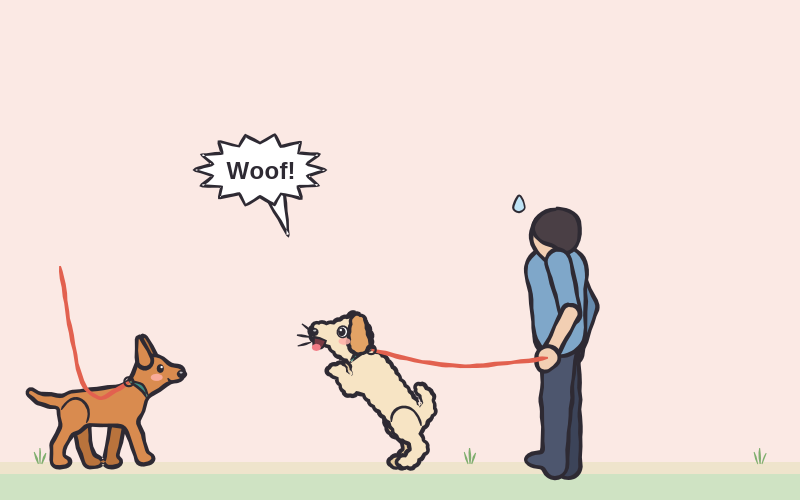
- A dog comes toward you on the sidewalk and your dog barks and lunges at the end of the leash
- She spots a dog far away, freezes and stares — then bursts into barking as it gets closer
- She wags, whines and barks at the same time, dragging you toward the other dog
- She’s fine with other dogs off leash at the dog park, but barks at them when she’s on leash
- She only barks at certain dogs — big dogs, for example
How your dog feels
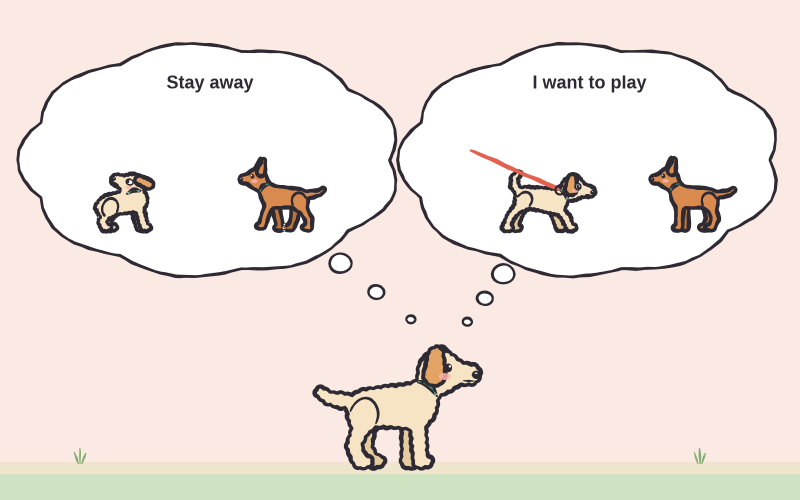
The most common reason is fear. Your dog barks “go away,” and the other dog almost always keeps walking past. From her point of view, barking worked: the scary thing left. The ASPCA explains that for these dogs, barking and lunging on leash serves a purpose — it keeps approaching dogs away.
The other reason is frustration. She likes other dogs and wants to go and greet them, but the leash stops her, and that bottled-up wanting comes out as barking and pulling. Dogs Trust, the UK dog welfare charity, describes both kinds of dog the same way: they badly want to get closer, or to get away, and they can’t.
That’s why the leash matters so much. A frightened dog on leash can’t escape, and a frustrated one can’t go and say hello — which is why many dogs who are fine at the dog park bark on leash. On a sidewalk, dogs also tend to meet head-on, which makes direct eye contact more likely.
Whichever it is, every bark is practice. Dogs Trust notes that the more a dog practices reactive behavior, the more likely it is to become her default response.
If this is your dog, you have plenty of company. In a survey of the owners of 13,700 dogs in Finland, 17% of dogs were reported to be afraid of other dogs (owners answered online).
Assessment: where is your dog now?
A visiting trainer would usually start by listening, then take a short walk with you and look at things like these. The answers decide where to begin.
What does her body do before she barks? (Ears back, tail low, backing away — or tail high and wagging, leaning forward, whining)
→The first set points to fear; the second to frustration. Many dogs are a mix, and the way to start is the same for both: space, and good things when a dog appears.
How far away is the other dog when she freezes or barks? Just outside that distance, can she still eat treats?
→The distance where she can still eat and can look at the other dog without barking is where practice starts. There’s no set number — it varies from dog to dog, and from day to day.
How many times a week do you run into dogs close enough for her to bark?
→If it’s often, start by cutting those encounters down (different times, different routes, early U-turns) before you start practicing.
Has she ever bitten or tried to bite another dog? Is she ever too strong for you to hold?
→If so, don’t work through this on your own: talk to your vet or a qualified behavior professional (see “When to get professional help” below).
If a trainer came to your home: the first session and the first homework
Here is one example of how a first in-home session might go — not a fixed script. Barking at other dogs only really gets fixed outside. Even so, after a short walk to see what happens, a trainer will often spend the first day at home and right outside it, building the tools you’ll need.
- Today: a short walk together to find the distance at which she starts to react (the point where she stops taking treats). Back home, 10 reps of step 1 of Look at That: a family member lifts a cushion at the far end of the room, and the moment your dog looks at it — “Yes” → treat. Then step 1 of the Emergency U-Turn in the hallway.
- Homework: walk at quieter times and on quieter routes. When a dog comes toward you, U-turn or cross the street before she barks. Practice Look at That and the U-Turn at home twice a day, about 5 minutes each. On walks, write down how far away a dog was when she could still eat without barking.
- Next visit: you go together to a spot where a dog is visible at a distance she can eat at, and do 10 reps of Look at That. Our rule of thumb: if she looks and turns back to you without barking 8 times out of 10, keep practicing at that distance and start closing it gradually. If she barks or won’t eat, you look together for a place and time where you can get farther away.
First, stop meeting dogs up close
Before any training, cut down the number of times she barks — every bark makes the habit stronger. The ASPCA calls avoiding the situations that set your dog off a perfectly reasonable way to cope. It isn’t giving up; it’s what makes the training possible.
- Change when and where you walk. Skip the busy dog-walking hours, and choose routes with good sight lines and room to move away (Dogs Trust also recommends quiet places and times).
- When a dog comes toward you, move away before she barks: U-turn, cross the street, or step between parked cars (all options the ASPCA suggests).
- A U-turn tried for the first time in a real emergency usually turns into a tug-of-war. Practice it in your hallway first — “this way,” then a quick turn (see Emergency U-Turn).
- If she barks at dogs walking past your window or gate, block the view for a while — window film or a screen works (our suggestion; it also cuts down barking at home).
Find the distance where she doesn’t bark — and watch your dog, not a number
Practice happens at a distance where she can see the other dog and still not bark. Trainers call this staying “under threshold.” There is no rule in feet or meters. The ASPCA’s handout gives one example: if a dog starts to notice other dogs at about 40 feet (12 m), start with the other dog about 50 feet (15 m) away. Best Friends Animal Society advises starting farther away than you think you need.
That distance isn’t fixed, either. Battersea, the London rescue charity, describes the same idea for dogs who react to strangers: a personal-space bubble that shrinks when your dog is relaxed and grows when a lot of stressful things have happened — it can change even within a day. We expect the same with other dogs: a distance that worked yesterday may be too close today.
If you see any of these, you’re too close. Move away straight away and carry on from farther off.
- She stops taking treats — or snatches them roughly
- She can’t take her eyes off the other dog (a fixed stare)
- She doesn’t turn when you say her name
- Her body stiffens slightly (the RSPCA notes this may be the first or only clue)
- She barks or lunges
Teach “another dog = something good” from a distance
Once you know her comfortable distance, play Look at That there. The moment she looks at the other dog — before she barks — say “Yes,” then give a treat. Repeated often enough, other dogs stop meaning “go away” and start meaning “treats are coming.” The professional terms are systematic desensitization and counterconditioning (gradual exposure, paired with something good). The MSD Veterinary Manual’s guidelines say the dog must stay calm throughout, the session should stop immediately if she reacts, and frequent short sessions work better than occasional long ones.
The order matters: the treats start when the other dog appears and stop when it’s gone. Humane World for Animals (formerly the Humane Society of the United States) describes it exactly that way — start feeding as the other dog comes into view, stop as soon as it disappears — and warns that it may take days or weeks before your dog can pay attention to you without barking.
One small study looked at 16 shelter dogs who showed moderate aggression toward other dogs. Most of the 9 dogs given this kind of training for 30 minutes a day over 10 days scored lower on aggression in a test straight afterwards. But in a later re-test with fewer dogs, about a week on, the difference from the 7 dogs who had simply spent 30 minutes a day in an outdoor pen was no longer clear. It is one study, in shelter dogs.
- Use better treats than you use at home — small pieces of chicken or cheese, and plenty of them.
- The best first “other dog” is a calm one. If a friend can walk their steady dog back and forth in the distance for you, practice gets much easier (the ASPCA and Best Friends both suggest this).
- Only move closer once she’s looking and turning back without barking most of the time, and only a little at a time (Best Friends suggests about a foot, 30 cm, at a time).
- Make it harder one thing at a time. On a day you close the distance, don’t also change the place or the number of dogs.
- On a bad day, go back to the last distance that worked. No scolding.
She doesn’t need to say hello to other dogs
Walking a barking dog up to other dogs “to get her used to them” isn’t a shortcut. Dogs Trust is clear that forcing a frightened dog to meet other dogs won’t make her feel better. The goal isn’t friendship — it’s being able to pass another dog calmly.
If an off-leash dog is heading your way, it’s fine to ask the owner to call it back (Dogs Trust recommends this too). Speak up early: “Sorry — could you call your dog? Mine isn’t good with dogs.”
For a frustrated, sociable dog, whether to let her meet other dogs once she can watch them calmly is something to decide with your trainer, choosing the dog and owner carefully (our suggestion).
Why not scold her, yank the leash or use a correction tool?
Telling her off when she barks, jerking the leash, a squirt of spray or a shock collar all teach the same thing: when another dog appears, something unpleasant happens. For a dog who barks out of fear, other dogs become even scarier. Dogs Trust warns that telling your dog off can increase stress and make the situation worse.
The American Veterinary Society of Animal Behavior (AVSAB) states in its 2021 position statement that methods and tools that work through pain or fear — choke and prong collars, shock collars, squirt bottles, leash jerking — should not be used in dog training or in treating behavior problems.
In a survey of 140 owners whose dogs had been brought to a US university veterinary behavior service, hitting or kicking the dog led to an aggressive response in 43% of the dogs it had been tried on, and growling at the dog in 41%. Reward-based methods led to aggression in very few dogs. The survey relied on owners’ memories, so it can’t prove cause and effect.
She never used to bark at dogs — why now?
If a dog who used to be fine with other dogs suddenly starts barking or lunging — especially if she also minds being touched, or is moving differently — have her checked by your vet first. Pain is an important risk factor for behavior problems, and it can make a change seem to come out of nowhere. The RSPCA advises a vet check for any behavior problem involving aggression.
If you have a puppy or a newly adopted dog
AVSAB says the most important time for puppy socialization is the first three months of life, and that missing out then raises the risk of fear and aggression problems later. With a puppy, start with calm adult dogs seen from a distance → treat (see Puppy Socialization), and keep going after three months — that’s what AVSAB recommends. With an adult dog, the idea is the same.
If you’re worried she might bite: make the muzzle a treat dispenser
If she has ever tried to bite another dog, think about a muzzle for safety, alongside the training. Battersea recommends a basket muzzle, which lets you feed treats while it’s on, and says your dog should come to see it as a treat dispenser. Dogs Trust also suggests muzzle training as an extra safety measure. If a muzzle only goes on at scary moments, it tends to become something scary itself (Best Friends), so let her wear it for fun things too. Use a muzzle with guidance from a professional.
The missing core skill

Exercises
This is the order we recommend. The first homework is Look at That (building the rhythm at home) and the Emergency U-Turn (in your hallway). If you also build the hand target and her name at home, you’ll have more tools ready when a dog appears on a walk.
- ExerciseLook at That (LAT): The Game That Helps Reactive Dogs Stay Calm Around Dogs and PeopleStart at home, finish outside (Step 1 at home)The core exercise. At a distance where she doesn’t bark, mark the moment she looks at the other dog, so seeing a dog comes to mean something good.Read →
- ExerciseEmergency U-Turn: Teach Your Dog to Turn and Walk Away HappilyStart at home, finish outside (Steps 1–2 at home)Your escape route when a dog gets too close. Practice it in the hallway first.Read →
- ExerciseHand Target: How to Teach Your Dog “Touch” — and Use It for Recall and Passing Other DogsDoable at home (Steps 1–3 at home)When you pass another dog, it lets you guide your dog to your other side. Get it solid at home first.Read →
- ExerciseThe Name GameDoable at home (Steps 1–2 at home)So she can turn to her name after spotting a dog. Build it indoors first.Read →
- ExerciseCheck-Ins: Teach Your Dog to Look at You Without Being AskedDoable at home (Step 1 at home)Reward her for looking up at you without being asked. It leads into the stage of Look at That where she turns back on her own.Read →
- ExerciseLoose Leash Walking: Stop When It’s Tight, Reward at Your Side (Starting Indoors)Start at home, finish outside (Steps 1–2 at home)If she can walk on a loose leash, passing another dog is less likely to turn into a tug-of-war.Read →
- ExercisePuppy Socialization: How to Make New Things Good ExperiencesStart at home, finish outside (Steps 1–2 at home)For puppies: calm dogs seen from a distance → treat.Read →
In the moment: do / don’t
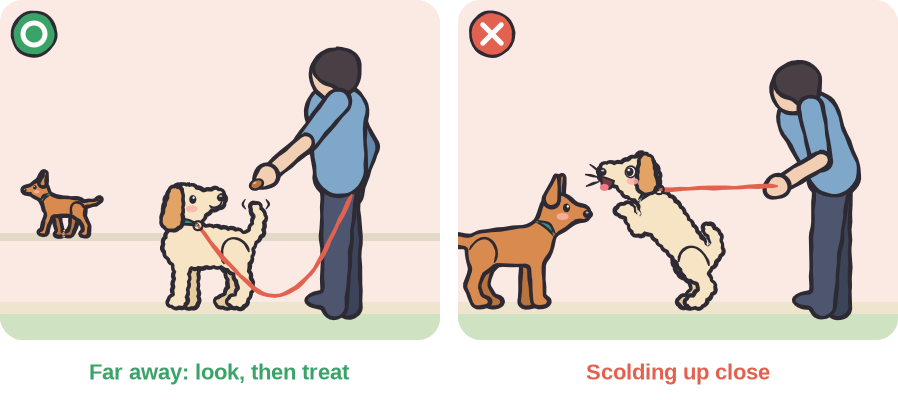
Do
- When you see a dog, move away before she barks (U-turn, cross the street, step behind parked cars)
- At a distance where she doesn’t bark, say “Yes” the moment she looks at the dog, then treat
- Walk at times and on routes with fewer dogs
- Ask owners of off-leash dogs to call them back
Don’t
- Scold her or yank the leash when she barks
- Walk her up to other dogs to “get her used to them”
- Stand still in a spot where she keeps barking
- Use spray, shock collars or other tools that startle or hurt
When to see a professional
- She has bitten or tried to bite another dog or a person. Talk to your vet, a board-certified veterinary behaviorist or certified applied animal behaviorist (US), or a qualified behaviourist your vet refers you to (UK) — someone who doesn’t use punishment. The American College of Veterinary Behaviorists warns that aggression that is mismanaged, or not addressed early, often gets worse
- She started barking suddenly, minds being touched, or is walking differently. Pain may be behind it — the RSPCA advises a vet check for any behavior problem involving aggression
- The barking is happening in more situations, or getting more intense
- She pulls free and charges at dogs, you can’t hold her, or you’ve started dreading walks (our rule of thumb: get help early, for your safety and hers)
Go to the root
Don’t stop at the quick fix. Growing the skill underneath makes other problems lighter too.
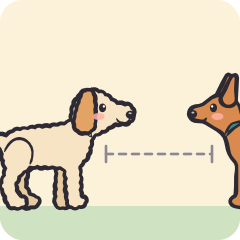 Core skill Confidence
- ExerciseLook at That (LAT): The Game That Helps Reactive Dogs Stay Calm Around Dogs and PeopleStart at home, finish outside (Step 1 at home)Read →
- ExerciseEmergency U-Turn: Teach Your Dog to Turn and Walk Away HappilyStart at home, finish outside (Steps 1–2 at home)Read →
- ExerciseHand Target: How to Teach Your Dog “Touch” — and Use It for Recall and Passing Other DogsDoable at home (Steps 1–3 at home)Read →
Sources
- ASPCA — Dogs Who Are Reactive On-Leash (PDF)
- Dogs Trust — Signs your dog is reactive and how to help
- Best Friends Animal Society — Dealing with Leash Reactivity
- Best Friends Animal Society — “Look at That” (LAT) Training for Reactive Dogs
- Humane World for Animals — How to get your dog to stop barking
- Battersea — How to build your dog’s confidence around strangers
- East Bay SPCA — Dog Reactivity Training: Emergency U-Turns (PDF)
- East Bay SPCA — LAT (“Look at That”): A Training Exercise for Reactive Behavior (PDF)
- MSD Veterinary Manual — General Guidelines for Effective Controlled Exposure Behavior Modification in Dogs
- MSD Veterinary Manual — Behavioral Problems of Dogs
- AVSAB — Position Statement on Humane Dog Training (2021)
- AVSAB — Position Statement on Puppy Socialization (2008)
- Herron, Shofer & Reisner (2009). Survey of the use and outcome of confrontational and non-confrontational training methods in client-owned dogs showing undesired behaviors. Applied Animal Behaviour Science 117:47–54
- Salonen et al. (2020). Prevalence, comorbidity, and breed differences in canine anxiety in 13,700 Finnish pet dogs. Scientific Reports 10:2962
- Orihel & Fraser (2008). A note on the effectiveness of behavioural rehabilitation for reducing inter-dog aggression in shelter dogs. Applied Animal Behaviour Science 112:400–405
- Whole Dog Journal — 5 Things to Know About a Dog’s Threshold
- RSPCA (UK) — Aggression in dogs
- Battersea — Muzzle training your dog
- Best Friends Animal Society — Muzzle training dog training plan
- American College of Veterinary Behaviorists — What is a veterinary behaviorist?
- Merck Veterinary Manual (pet owner version) — Behavior Problems in Dogs
- Mills et al. (2020). Pain and Problem Behavior in Cats and Dogs. Animals 10(2):318