 BAUDOG The dictionary of dog–human communication
Contents
When to use this exercise
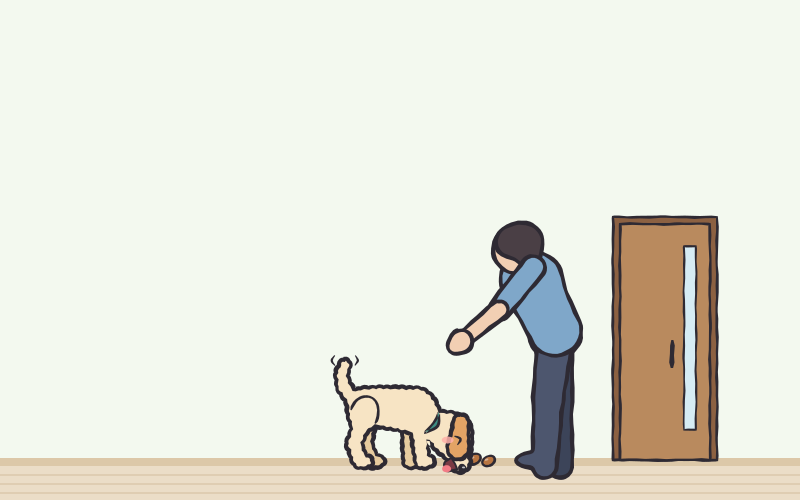
Use this for homecomings, guests at the door and people you meet on walks. While all four of your dog’s paws are on the floor, people come closer and treats land on the floor. The moment her front paws lift, the person steps back. Repeat it enough and she learns that keeping her feet down is what brings people to her. She doesn’t have to sit. What grows is impulse control and the ability to settle. Start with family, then the front door, then friends on walks, then real visitors. (If you want to know why dogs jump up and what to do about it today, start with our jumping-up page — this one is the step-by-step practice plan.)
GoalWhen someone comes up to her, your dog greets them with all four paws on the floor (she doesn’t need to sit).
Assessment: what a trainer might check on the first visit
Before starting, a visiting trainer might check something like these three things.
When you come home or someone walks up, how many seconds before her front paws leave the floor?
→If it’s almost instant, start the approach from farther away. If a single step toward her is enough, begin before step 1: toss treats onto the floor from a distance.
Is anyone in the family petting her or picking her up when she jumps?
→If so, part of the homework is getting everyone to agree: while she’s jumping, no looking, no talking, no touching.
When strangers come, does her body go stiff, her ears go back or her tail tuck between her legs?
→Then there’s worry or fear mixed into the jumping. Before this practice, work on making people less scary (for example, Look at That) and talk to a qualified behavior professional.
What you need
- Small treats that roll along the floor — kept in a pouch or pocket, out of sight
- A family member or friend who’ll help
- A leash (a standard 6 ft / 1.8 m one is fine) — even for indoor practice, and always at the door and outside
How to signal
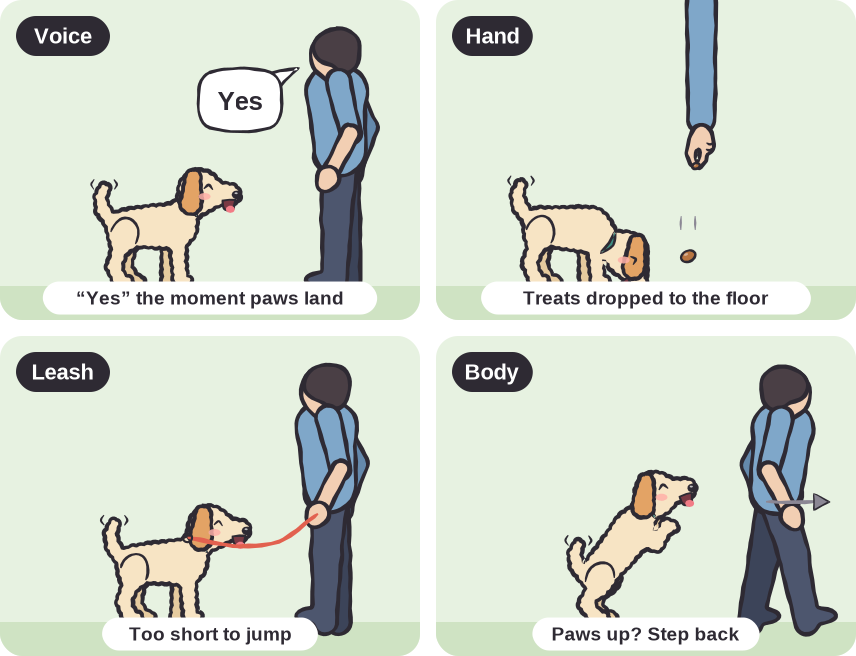
- Voice
Say “Yes” the moment all four paws are on the floor. While she’s jumping, say nothing — not “No,” not “Off,” not “Down.”
- Hand
Drop treats on the floor (a treat held at face height invites a jump). If you hand one over, bring it quickly all the way down to her mouth. Stroke her shoulder or chest; don’t reach over her head.
- Leash
For visitor and front-door practice, keep her on leash, held short enough that she can’t reach anyone with a jump. Never use it to haul her down.
- Body
When her front paws lift, take a step back, or fold your arms and turn sideways. When all four are down again, turn back and come closer.
Today’s session
With the trainer, you work on step 1.
Step 1Approach and retreat(At home, quiet)
Your dog is on leash and the trainer walks toward her. If she stays on all four paws, the trainer keeps coming, drops a treat on the floor and strokes her shoulder. If her front paws lift, the trainer steps back and waits; when they’re down again, the trainer comes closer again. After that demonstration, each family member takes a turn — 10 approaches each. The trainer fixes things on the spot, especially stepping back too late and offering treats at face height.
Homework until the next visit
- How often
- Every homecoming, plus one practice a day
- How long
- About 5 minutes per practice
- How much
- 10 approach-and-retreats
A good sign she’s readyFive days in a row with no jumping when someone comes home (our rule of thumb)
What the trainer checks next visit
The trainer walks in through the front door without ringing the bell.
If she canIf your dog greets the trainer on four paws, it’s on to the next stage: step 3 (a family member plays the visitor, rings the bell and comes in) becomes the new homework.
If not yetGo back to approach-and-retreat (step 1) for another week, and look together at when you step back and how quickly the treats hit the floor.
Next stages: steps
- 1
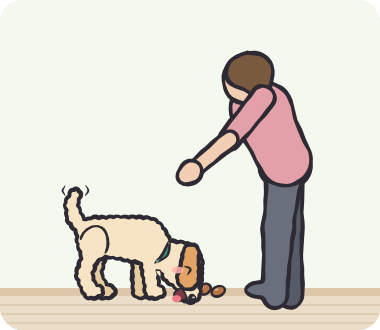
Paws up, step back. Paws down, come closer At home, quiet
Approach and retreat
Your dog is on leash. A family member walks toward her. If she stays on four paws, they keep coming, drop a treat on the floor and stroke her shoulder. If her front paws lift, they take a step back. Paws down again, and they come closer.
A good sign to move onShe stays on four paws until she’s stroked, 8 out of 10 approaches
- 2
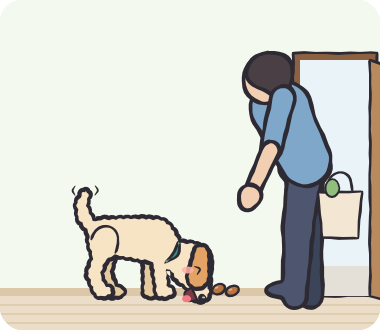
Treats on the floor before you step in At home, small distractions
When family come home
Open the door, roll a few treats onto the floor a little way inside, then step in. Say a quiet hello while she sniffs them up. You can also practice homecomings on purpose: step back outside, wait a few minutes, come in again, and repeat.
A good sign to move onFive days in a row with no jumping at homecomings (our rule of thumb)
- 3
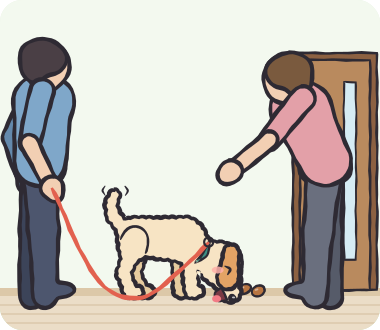
Four paws down, even after the doorbell Yard, doorstep, outside the house
At the door (family plays the visitor)
Clip her leash on first. A family member rings the bell from outside and comes in. The “visitor” strokes her only while all four paws are down, and steps back if they lift. If the bell alone sets her off, practice the bell by itself first: ring it, and give her a treat if she stays calm — or as soon as she settles.
A good sign to move onShe greets at the door on four paws, 8 out of 10 times
- 4
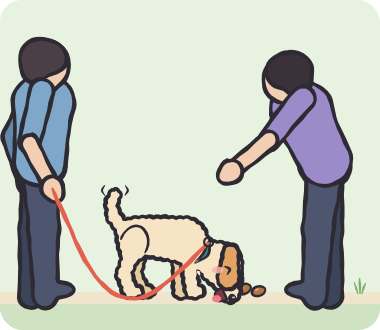
Same rule outside Quiet street
Friends on a walk
Ask a friend to help and do the same thing on a quiet street. Tell them first: “Only say hello while all four of her paws are down.” Have them start walking toward you from a distance where your dog can still eat treats. Until she’s passing this step, don’t let strangers greet her on walks — keep her attention on you with treats and let them walk by.
A good sign to move onShe greets on four paws outside too, 8 out of 10 times
- 5
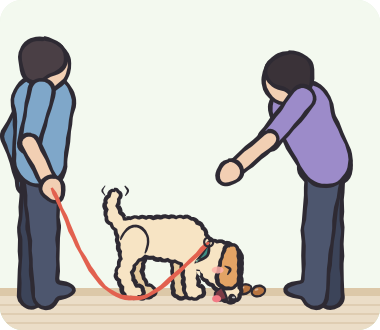
Keep the leash handy for the real thing Around distractions
Real visitors
Clip her leash on before guests arrive. Ask them: “Please only pet her while all four paws are on the floor,” and give them a treat to drop on the floor as she comes up. Keep the hello brief and calm; once they move away, toss her a treat away from them so she doesn’t follow. On very excitable days, let her settle first — on her mat or in another room — then bring her in.
A good sign to move onShe greets visitors on four paws, 8 out of 10 times
Timing
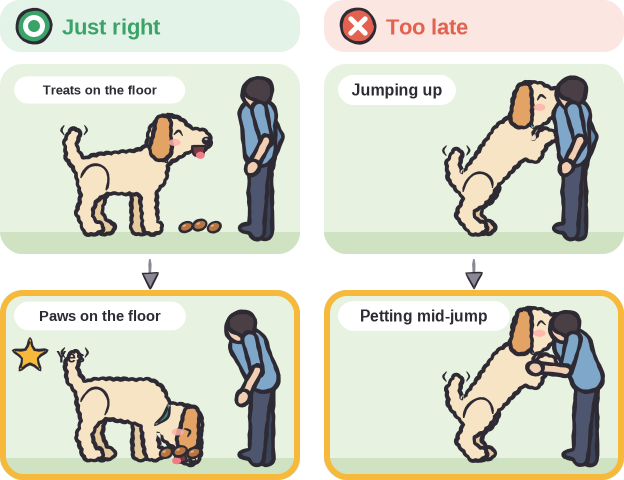
Just right
The instant her front paws touch the floor: “Yes,” then a treat on the floor. People come closer and pet her only while she’s on four paws.
Too late
Petting or talking to her mid-jump. Even “No, Luna, down!” is attention to a dog.
Drop the treats before the person arrives, and you reward her before she ever leaves the ground. That’s how the American Kennel Club’s “four on the floor” method works: toss several treats on the floor before the person reaches your dog, and if she jumps anyway, the person turns and walks away. As she gets the idea, use fewer treats, little by little, until the greeting itself is the reward.
How much and how often
Every time someone comes home, plus about 5 minutes a day (10 approach-and-retreats). On days a visitor is coming, run one practice with the family beforehand.
If it isn’t working
Visitors love it when she jumps and pet her anyway
While guests are over, set things up so she can’t reach them in the first place — her mat (see Relaxing on a Mat), a baby gate or another room. Tell visitors the plan before they arrive. If someone on the street says “Oh, it’s fine, I love dogs!”, it’s still your call: politely say no, and if they keep coming, turn and walk away with her.
She’s too wound up to even look at the treats on the floor
Give her some time to calm down before the greeting. The person is also too close — have them start walking toward you from much farther away.
Since we started, she jumps even harder
That’s common. When jumping that used to get a reaction stops working, dogs often try harder for a while. If you pet her now, you teach her that harder jumps pay off. Keep going and it will fade.
She’s a big dog — waiting it out isn’t safe
With large dogs, or when children or anyone unsteady on their feet is around, ignoring her and waiting isn’t the right approach. Use a leash or a baby gate so she can’t reach anyone from the start. (For readers in England and Wales: GOV.UK says a dog counts as “dangerously out of control” if it makes someone worried it might injure them — and that applies in your own home too.)
I’d rather she sat to say hello
Sitting is fine too (see Say Please by Sitting). For dogs who find sitting uncomfortable, or who are too excited to sit, four paws on the floor is plenty.
Can I leave the leash on in the house?
Clipping it on before visitors arrive stops her from learning that the leash means guests are coming. Leave it on only while someone is watching her; take it off when no one is (it can catch on furniture or tangle around her legs).
She goes wild over the treats themselves
Switch to lower-value treats — her everyday kibble rather than chicken. Food that’s too exciting can wind her up instead of settling her.
She’s a puppy, or a small dog
Puppies aren’t too young to learn calm greetings, and it’s easier before the habit sets in. With small dogs and puppies, once she’s settled with her paws down, the person can crouch to say hello at her level — from down there, a face is a long way up.
We have more than one dog
Train one dog at a time. A new arrival can wind up even well-behaved dogs, so keep the others in a crate or another room while you practice.
Does she have to greet everyone?
No. She doesn’t have to say hello to everybody, especially people who worry her, and passing people calmly without greeting is a great skill too. Let her move away if she wants to, and let people interact only if she approaches them confidently and stays relaxed.
Someone in the family loves it when she jumps up
Ideally nobody invites it — being allowed to jump sometimes but not other times is confusing for a dog. If someone really wants hugs, some trainers teach jumping up only on a distinctive cue (touching both shoulders, for example) and reward it only when cued. If you try this, our rule of thumb is to wait until four-on-the-floor greetings are solid.
Avoid
- Kneeing her in the chest, stepping on her back feet or grabbing her front paws
- Shouting, scolding or pushing her off
- Yanking her down by the leash or collar
- Petting her or picking her up when she jumps — or letting it slide “just this once”
A good sign to move on
- Steps 1, 3, 4 and 5: she greets on four paws 8 out of 10 times at that step → move on (our rule of thumb)
- Step 2 (homecomings): five days in a row with no jumping (our rule of thumb)
- When you switch to a new person, she may slip back a little at first. If so, have them start walking toward her from farther away
- If it isn’t working, go back one step — our rule of thumb is two misses in a row
Sources
- American Kennel Club — How to Stop Your Dog From Jumping Up on People
- Dogs Trust — How to stop your dog jumping up at people
- Battersea Dogs & Cats Home — How to train your dog not to jump up
- Battersea Dogs & Cats Home — How to teach your dog to greet people
- Ontario SPCA and Humane Society — How to teach “four-on-the-floor”
- Animal Welfare League of Arlington — Polite Greetings
- ASPCA — Jumping Up on Walks
- Woodgreen Pets Charity — How to train a dog not to jump up
- Peninsula Humane Society & SPCA — Jumping-Up (PDF)
- Whole Dog Journal (Pat Miller, CBCC-KA, CPDT-KA) — How to Teach Your Dog to Greet Nicely – or Not Greet at All
- ASPCA — Mounting and Masturbation
- GOV.UK — Controlling your dog in public
- legislation.gov.uk — Dangerous Dogs Act 1991, section 3 (England and Wales)
- AVSAB — Position Statement on Humane Dog Training (2021)