 BAUDOG The dictionary of dog–human communication
Contents
- The finished behavior
- Assessment: where is your dog now?
- The cue
- How to signal
- Teaching steps
- When to reward
- Should dogs be allowed on the couch? Set the house rules first
- “Off” or “Down”?
- If she gets on the couch while you’re out
- If she growls on the couch
- Is jumping down dangerous? Dachshunds and dogs with bad backs
- A good sign to move on
- If it isn’t working
- Prescription: a suggested order
- In the moment: do / don’t
- When to see a professional
- Sources
The finished behavior
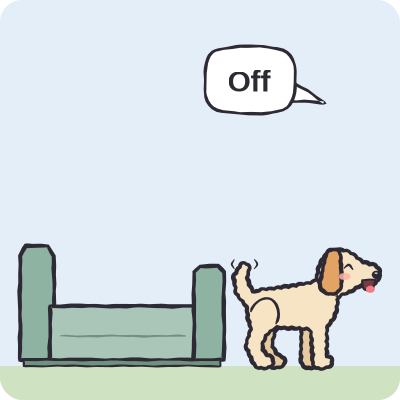
One “Off,” and she puts all four paws back on the floor — off the couch, the bed or a person — without you pulling her collar or lifting her down. And once she’s down, she has her own bed or mat to relax on.
Assessment: where is your dog now?
A visiting trainer might check something like this before starting.
Has the family decided whether she’s allowed on the couch and bed?
→Either answer is fine. If it isn’t settled, agree on the rules as a family first. If the rules change from person to person, she’ll be confused.
If she’s on the couch and you toss a treat to the floor, does she get off?
→If yes, start at step 1. If not, switch to a treat she likes more.
When you go to move her, does she growl, freeze or show her teeth?
→If so, don’t try to move her with your hands. Before practicing anything on this page, read “If she growls on the couch” below.
Does she get on the furniture when you’re out, or when nobody’s watching?
→When you can’t supervise, set things up so she can’t get on (management). Practice only when you’re there to see it.
Does she have a bed of her own that’s more comfortable than the couch?
→If not, get her a soft bed or mat. Getting off is easier when there’s somewhere comfy to go.
The cue
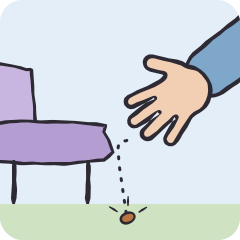
“Down” means lie down; “Off” means get off. Keep the words separate so one word never has two meanings. At first, the hand movement of tossing a treat to the floor becomes the basis of the hand signal.
How to signal
- Voice
Say “Off” once, in a normal voice — not a scolding one. Don’t mix it with other words like “No” or “Get down.”
- Hand
At first, say “Off,” then toss a treat to the floor. Or show her a treat at her nose and lure her down to the floor. Later, just pretend to toss; eventually, the word alone.
- Leash
Don’t pull her off by the collar, leash or harness.
- Body
Don’t lift her down. Don’t suddenly touch a sleeping dog to move her (a dog woken with a start may bite).
Teaching steps
- 1
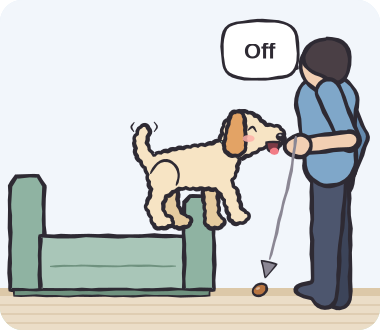
Getting off means good things on the floor At home, quiet
“Off” → treat on the floor
While your dog is on the couch, say “Off” once and toss a treat to the floor. The instant all four paws touch the floor, “Yes” — and she eats the treat on the floor.
A good sign to move onShe gets off when you toss a treat, 8 out of 10 times (our rule of thumb)
- 2
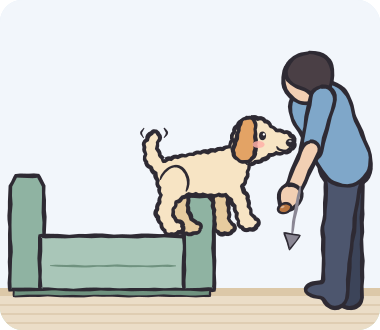
From her nose to the floor At home, quiet
Lure from her nose
Instead of tossing, show her a treat at her nose and lower it to the floor. When all four paws are on the floor, “Yes” → treat.
A good sign to move onShe gets off for the lure 8 out of 10 times
- 3
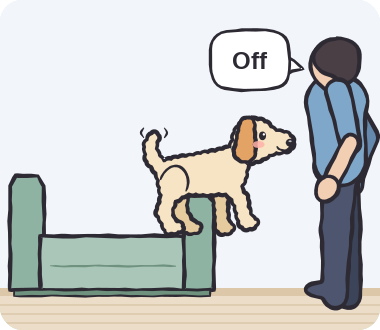
Give her a few seconds At home, quiet
The word alone
Say “Off” and wait a few seconds. If she doesn’t get off, help by pretending to toss or just pointing at the floor. When she gets off, “Yes” → treat. Reduce the hand movement bit by bit.
A good sign to move onShe gets off to the word alone 8 out of 10 times
- 4
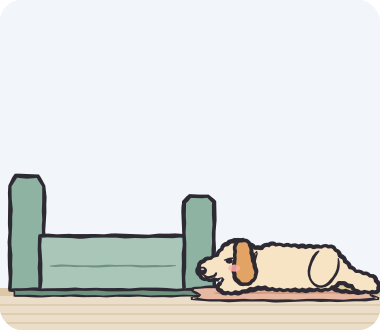
Give her somewhere to go At home, small distractions
Once off, to her own mat
After she gets off, invite her to a nearby mat or bed and treat her for relaxing there (the Relaxing on a Mat practice).
A good sign to move onAfter getting off, she relaxes on her mat for a minute
- 5
New place? Start from the beginning At home, small distractions
Change places and who asks
The bed, the other end of the couch, someone’s lap — each new place, start again from step 1. She should get off whoever in the family asks.
A good sign to move onShe gets off anywhere, for anyone, 8 out of 10 times
When to reward
Just right
“Yes” the instant all four paws touch the floor. The treat goes on the floor.
Too late
Giving the treat on the couch, or before she gets off — then being on the couch is what gets paid.
Should dogs be allowed on the couch? Set the house rules first
There’s no right answer. The UK charity Dogs Trust and US trainer Pat Miller (Whole Dog Journal) both say it’s up to each household. What matters is that everyone agrees. If one person always lets her up, another only when invited, and another never — that’s confusing for a dog.
Dogs don’t get on the couch to be naughty. It’s soft and comfortable, and it’s where you are. If you’d rather she stayed off, give her a bed or mat of her own that’s even more comfortable than the couch.
If you want “only when invited,” Dogs Trust suggests putting a special blanket on the couch only when she’s allowed up. The blanket becomes her signal that it’s OK to get on.
“Off” or “Down”?
It’s easy to say “Down!” when a dog jumps up or climbs on the furniture. But if “Down” also means lie down, she can’t know which one you want. Cornell University’s College of Veterinary Medicine advises using different words for different behaviors, because dogs don’t generalize as easily as we do. Keep “Down” for lying down and “Off” for four paws on the floor.
If she gets on the couch while you’re out
“She never gets on when I’m watching, but there’s dog hair on the couch when I get home.” She isn’t being sneaky. She has simply learned that getting on when people are around leads to something unpleasant, and when nobody’s there, nothing happens.
When you can’t supervise, make the couch unavailable (management): stand the cushions up, put boxes on it, or put a gate across the doorway. Dogs Trust also recommends not letting her practice getting on the furniture when you can’t see her, while you’re training.
If she growls on the couch
A dog who growls or shows her teeth when you come to move her is worried about losing her spot, or about being approached. Don’t scold her or force her off. Punishing growling is understood to raise stress and tends to make things worse.
In the moment, stop moving and let her settle a little. Then ask her to get off with “Off” (or, if you haven’t taught it yet, by tossing a treat to the floor). After that, manage access to the furniture, and plan training with a behavior professional so that being approached becomes a good thing. If the growling is intense, she has bitten before, or you feel afraid, don’t practice alone — get professional help.
Is jumping down dangerous? Dachshunds and dogs with bad backs
A disc rupture can happen after a small fall or an ordinary jump (VCA Animal Hospitals). But we couldn’t find solid research showing that banning couch access prevents disc disease. In a web survey of owners of 2,031 Dachshunds, simple comparisons found higher odds of a disc disease diagnosis in dogs exercised less than 30 minutes a day and in dogs not allowed to jump on and off furniture. Both results could run in reverse — dogs who’d had disc disease may have been given less exercise and kept off furniture afterwards — and the authors present them as leads for further research.
If your dog has hurt her back before, or your vet has told you to stop the jumping, follow your vet’s advice. If she’s allowed on the furniture, a ramp or steps is one option.
A good sign to move on
- Once she gets off to the word alone 8 out of 10 times, change places and who asks (our rule of thumb)
- In a new place (the bed, a car seat, someone’s lap), start again from step 1 — tossing a treat to the floor
- If she struggles, go back one step (our rule of thumb: she doesn’t get off twice in a row)
- Once she can relax on her mat after getting off, she’ll climb up less often in the first place
If it isn’t working
She won’t get off even when I toss a treat
Switch to a treat she likes more. Once getting off pays better than staying on, she’ll get off. If that still doesn’t work, calling her with her recall word and rewarding her when she comes is fine, too.
She gets off, then jumps straight back up
That’s because there’s nothing to do once she’s down. Invite her to her mat or bed and treat her for relaxing there; a chew toy helps too. Keep up the management for a while so she can’t get back on.
Can I use “Down” for getting off?
Keep them separate. “Down” means lie down; “Off” means get off. If one word has two meanings, she can’t tell which one you want.
She climbs onto laps or jumps up on people
You can teach “Off” for laps and people the same way — practice again with each person. For jumping up on people itself, see the jumping-up problem page and the Four on the Floor Greetings practice, which teach what to do before she jumps.
Isn’t it OK to just tell her off and make her get down?
Scolding makes dogs anxious, and it can teach her to stay off only when people are around (and climb up when you’re out). Asking her off with a treat teaches it faster.
Prescription: a suggested order
BAUDOG’s recommended order. Teach “Off” itself with the steps above; these two practices then grow a dog who can settle without climbing up — and doesn’t jump on people.
- ExerciseRelaxing on a Mat: How to Teach Your Dog to SettleDoable at home (Steps 1–4 at home)Gives her a place of her own to go once she’s off. When she can relax on a mat, she has less reason to get on the couch at all.Read →
- ExerciseFour on the Floor: Teaching Your Dog to Greet People PolitelyDoable at home (Steps 1–2 at home)Greeting people with all four paws on the floor, even when they come close. Jumping up on people is taught here.Read →
In the moment: do / don’t
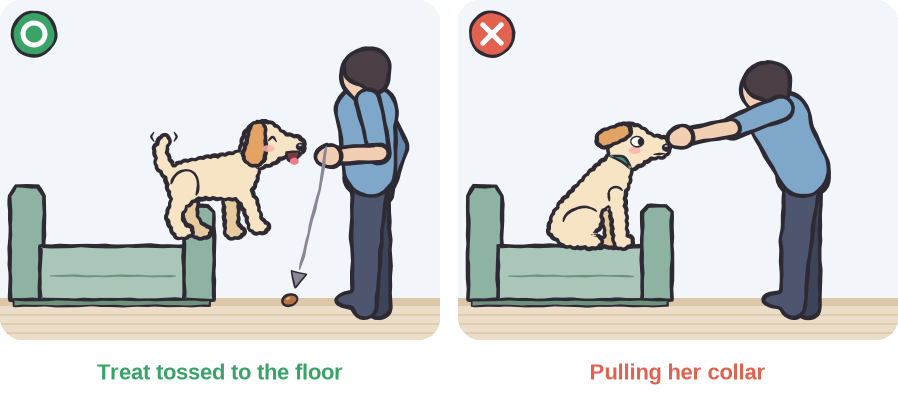
Do
- Agree as a family whether she’s allowed up
- After “Off,” a treat on the floor
- Give her a comfortable bed or mat to go to
- When you can’t watch, manage access so she can’t get on
Don’t
- Pulling her off by the collar or leash, or lifting her down
- Scolding her off
- Suddenly touching a sleeping dog to wake her
- Punishing her for growling
When to see a professional
- On the couch or bed, she growls, shows her teeth or tries to bite when you go to move her. Don’t scold; talk to a behavior professional (a veterinary behaviorist or certified trainer)
- She seems to have back or neck pain, doesn’t want to move (won’t even walk around the house), hunches her back, or her back legs are wobbly. This can be spinal (disc) disease — see a vet right away. Some dogs get worse fast and can’t walk within an hour
The skills behind this command
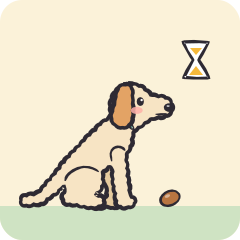 Core skill Impulse Control Putting four paws back on the floor on cue, even when she’d rather climb up or be close to you.
- ExerciseRelaxing on a Mat: How to Teach Your Dog to SettleDoable at home (Steps 1–4 at home)Read →
- ExerciseFour on the Floor: Teaching Your Dog to Greet People PolitelyDoable at home (Steps 1–2 at home)Read →
Sources
- Best Friends Animal Society — How to Teach a Dog ‘Off’
- Dogs Trust — How to stop your dog getting on the furniture
- Whole Dog Journal (Pat Miller, CBCC-KA, CPDT-KA) — How to Keep Dogs Off Furniture – If You Want To
- Cornell University College of Veterinary Medicine (Riney Canine Health Center) — Training ‘stay’ vs. ‘wait’
- AVSAB — Position Statement on Humane Dog Training (2021)
- AVSAB — Position Statement on the Use of Dominance Theory in Behavior Modification of Animals
- VCA Animal Hospitals — Disc Disease in Dogs
- American College of Veterinary Surgeons — Intervertebral Disc Disease
- MSD Veterinary Manual (Pet Owner Version) — Disorders of the Spinal Column and Cord in Dogs
- Packer, Seath, O’Neill, De Decker, Volk (2016). DachsLife 2015: an investigation of lifestyle associations with the risk of intervertebral disc disease in Dachshunds. Canine Genetics and Epidemiology 3:8