 BAUDOG The dictionary of dog–human communication
Contents
- The finished behavior
- Assessment: where is your dog now?
- The cue
- How to signal
- Teaching steps
- When to reward
- The goal: all the way to you, collar in hand
- After she comes, let her go back to playing
- How long do I need treats? Will she ever come without them?
- Using a whistle
- When can I start, and how long does it take?
- A good recall doesn’t mean off leash in public
- A good sign to move on
- If it isn’t working
- Prescription: a suggested order
- In the moment: do / don’t
- When to see a professional
- Sources
The finished behavior
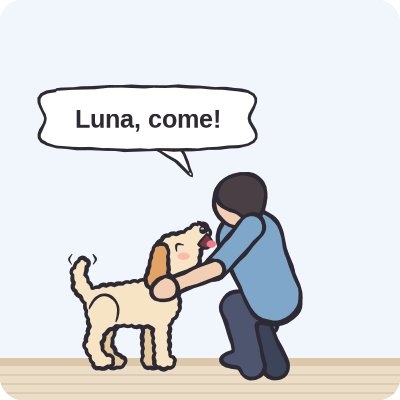
You say (if her name is Luna) “Luna, come” once, and whatever she’s doing, she runs to you, stops at your feet and lets you take hold of her collar. That’s a finished recall. The order to teach it: turning to her name → “come” from close up indoors → recall games with the family → your yard or just outside your door (on leash) → a quiet open space (on a long line). Every time she arrives, something good happens. That’s the whole method, repeated.
Assessment: where is your dog now?
Before you start, a trainer would usually check three things. If one of them is a problem, start there. If your dog already ignores “come” outside, the reasons and the rebuild are on Won’t Come When Called.
In a quiet room at home, does she turn to you straight away when you say her name once?
→If not, start with The Name Game before “come.” Move on to “come” once her name reliably gets a head turn.
When you reach for her collar or harness, does she duck away?
→If so, teach “a hand on the collar means a treat” first (see “The goal” below). A dog who comes but can’t be caught isn’t safe yet.
Have you used “come” to scold her, or right before leaving the park, a bath or a nail trim?
→If so, the word may already mean “something bad is coming.” Pick a new word (“here,” for example) and teach it from scratch.
The cue
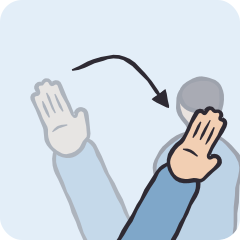
The word can be anything short — “come,” “here,” “close.” What matters is choosing one and having everyone in the family use the same word, said the same way. Say her name first, then the cue, once: “Luna, come.” Her name means “look at me”; “come” means “run all the way to me.” A whistle works as a recall cue too. For the hand signal, hold your open hand out in front of you and pull it in toward your chest — the same movement as “Come” in the hand-signal list for deaf dogs from Louisiana State University’s veterinary school. Show it together with your voice, and it will help when she can’t hear you well.
How to signal
- Voice
“Luna, come” once, bright and happy. While she’s on her way, keep encouraging her (“good, good!”). Don’t repeat the cue.
- Hand
Pull your open hand in toward your chest as you call. When she arrives, gently touch her collar or harness, then give the treat. If she has started coming only when she can see food, keep the treat out of sight until she reaches you.
- Leash
Indoors, no leash. In the yard or outside your door, a regular leash stays on. In open spaces, clip a long line to a harness and hold the end. Use a long line only where local rules allow it — some places limit leash length in public. Never use the leash to reel her in.
- Body
As you call, crouch down or back away a few steps — dogs love to follow something moving away. If she stops partway, don’t walk up to her and hand over the treat.
Teaching steps
- 1
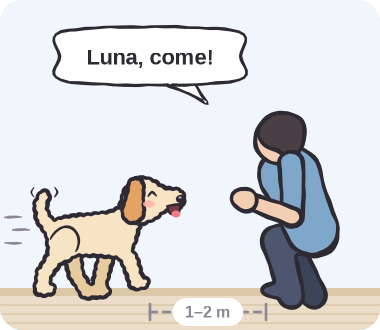
Start close enough that she can’t fail At home, quiet
Indoors, close up
Once she turns to her name, call “Luna, come” once from so close she’s sure to come — about 3–6 ft (1–2 m). As she starts toward you, “Yes.” When she reaches your feet, touch her collar gently, then treat.
A good sign to move onShe comes straight away when called (our rule of thumb: 8 out of 10 times)
- 2
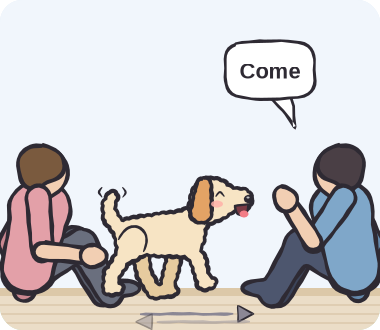
Make being called a game At home, small distractions
Family ping-pong and hide-and-seek
Two people at opposite ends of a room take turns calling her (“ping-pong”), or one hides in another room and calls. Being called becomes a game.
A good sign to move onCalled once from another room, she comes straight away (8 out of 10 times)
- 3
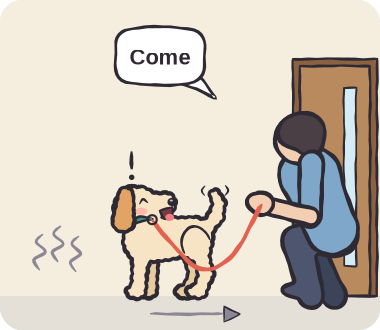
After she comes, let her go back to sniffing Yard, doorstep, outside the house
Yard or front door (on leash)
With the leash on, call her in the pauses between sniffs. When she comes, treat, then say “Free” and let her go back to sniffing. Outside, use better treats than indoors.
A good sign to move onOutside your door, she comes straight away when called (8 out of 10 times)
- 4
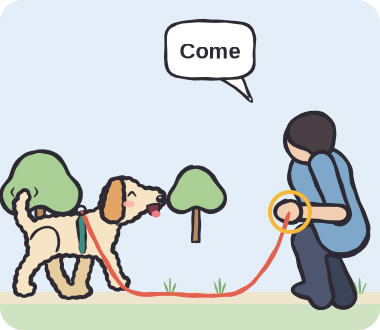
Keep hold of the end of the long line Quiet street
Open space (long line)
In a wide space with few people and no traffic, clip a long line to her harness and hold the end. Once that goes well, practice a little at a time near things she finds interesting — a dog in the distance, a toy.
A good sign to move onOutside, she comes straight away when called (8 out of 10 times). Distractions come after that
When to reward
Just right
The moment your dog starts running toward you, “Yes.” When she reaches your feet, a gentle touch on the collar, then her very best treat straight away.
Too late
Praising her a while after she has arrived — the running to you never got rewarded. Worst of all is scolding her for taking so long.
The goal: all the way to you, collar in hand
A recall isn’t finished when she heads your way. It’s finished when she’s at your feet and you can take hold of her collar or harness — only then can you keep her safe. If she stops short and you walk up to her or stretch out a treat, she can easily learn that halfway is good enough. Our advice: practice from distances where she’s sure to come all the way in.
A dog who spins away just out of reach has learned that a hand on the collar means the fun is over. The American Kennel Club (AKC) suggests teaching her, before you work on “come,” that a collar grab means something delicious. One way to do it: gently touch her collar → treat, a few times. Then, little by little, take a firmer hold before the treat. Practice in different places, and always finish with a treat.
After she comes, let her go back to playing
If you only call her at the park when it’s time to go home, “come” becomes the signal that fun is ending. Call her a few times during play: praise, treat, then “Free” and let her go back to playing. When it really is time to leave, don’t call — walk over quietly and clip the leash on.
How long do I need treats? Will she ever come without them?
At first, give a great treat every single time she comes. Once coming is a habit, it doesn’t have to be every time — Dogs Trust in the UK says that as your dog improves you won’t need to give a treat every time. Praise, though, is every time. A pat, a ball throw, a game of tug, or being let go again with “Free” can all be rewards.
For dogs who aren’t very interested in food, make a favorite toy the reward and keep it special — RSPCA Australia suggests putting it away and bringing it out only for training. When she pulls away from something exciting outside to come to you, give her a bigger-than-usual reward — a jackpot.
If she only comes when she sees food, keep the treats hidden until she arrives, then bring one out.
Using a whistle
Dogs Trust and Battersea both say a whistle can be your recall cue instead of a word. You teach it exactly the same way: blow it from close by, and treat the moment she arrives. Agree on one pattern as a family (three short blasts, for example), and don’t use it for anything else.
When can I start, and how long does it take?
There’s no set age. Our advice: once your puppy comes home, start the name game and close-up “come” indoors — up close in the house, even a young puppy can succeed. Adult and rescue dogs can start in exactly the same order.
There’s no honest number of days, either. Judge by the stage she has passed, not the calendar: when she comes straight away 8 out of 10 times where you are now, move on (our rule of thumb). Each new place counts as a new stage, so expect to slow down again whenever you move somewhere harder.
A good recall doesn’t mean off leash in public
No recall is 100% reliable. Leash rules differ from place to place, so check yours. For example, New York City requires dogs in public places to be restrained on a leash no more than six feet long. In Great Britain (England, Scotland and Wales), the Highway Code says to keep a dog on a short lead on the pavement, the road and paths shared with cyclists or horse riders, and on roads designated by the local council a dog must be held on a lead by law. Practice off leash only in fenced or enclosed areas. Think of “come” as insurance for the day the leash slips or the collar comes off. Long lines, leash lengths and when to go off leash are covered in more detail on Won’t Come When Called.
A good sign to move on
- Move to the next stage (indoors → family games → yard or front door → open space → distractions) when she comes straight away where you are now. Our rule of thumb: 8 out of 10 times
- Make it harder one thing at a time (distance, place or distraction — just one)
- If it isn’t working, go back one stage (our rule of thumb: two misses in a row)
- Homework for each stage (how many times a day, for how long) and the details of when to move on are on The Recall Game
If it isn’t working
She won’t come, or runs off when I call
First, don’t chase her and don’t scold her. Then work out why she isn’t coming (something unpleasant has followed “come,” it hasn’t been taught outside yet, she used to come and stopped as she grew up, and so on). How to tell and how to rebuild are on Won’t Come When Called.
She stops halfway or hovers just out of reach
Go back to a distance where she’s sure to come all the way. Call, crouch or back away a few steps, and treat the moment she reaches your feet. Don’t walk up to a dog who has stopped and hand her the treat. If she still doesn’t come, walk over calmly to get her, and call from closer next time.
She spins away just as I reach for her
Build “hand on collar = something delicious” first (see “The goal” above). And keep letting her go back to playing with “Free” after she comes.
She comes at home but not outside
The “come” she learned at home doesn’t work outside yet. Start again at the yard or front-door stage (on leash), with better treats than you use indoors.
I’ve said “come” far too many times
Repeating it teaches her the first call is optional. If the word feels worn out, choose a new one and teach it again from close up indoors.
Prescription: a suggested order
The order we recommend: once she turns to her name, move on to “come.” Keep the name game going alongside.
- ExerciseThe Name GameDoable at home (Steps 1–2 at home)Before “come,” one call of her name should get a head turn. Every recall starts with turning to you.Read →
- ExerciseRecall GamesDoable at home (Steps 1–3 at home)The core of teaching “come”: indoor ping-pong and hide-and-seek, then the yard or front door, then open spaces. Homework for each stage and when to move on are here.Read →
- ExerciseHand Target: How to Teach Your Dog “Touch” — and Use It for Recall and Passing Other DogsDoable at home (Steps 1–3 at home)She comes to touch your outstretched hand with her nose. It works as a second recall and helps bring a dog who is nearby all the way in.Read →
In the moment: do / don’t
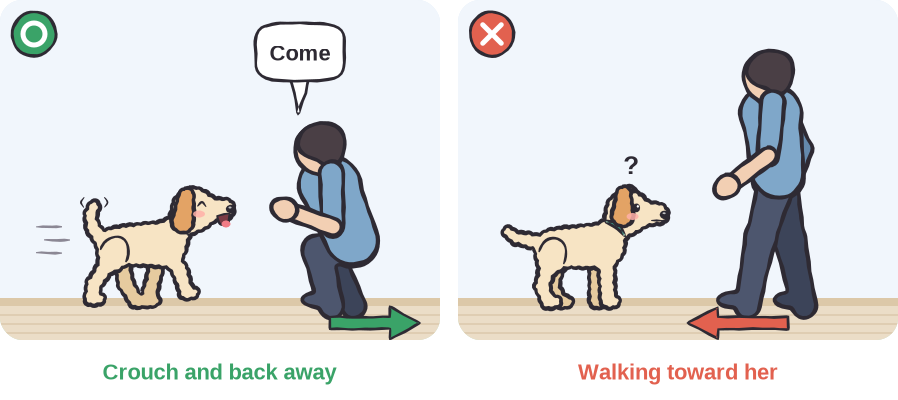
Do
- Say “Luna, come” once — bright and happy
- Crouch down or back away a few steps as you call
- When she arrives, touch her collar gently, then give her best treat
- Praise her, then say “Free” and let her go back to playing
- If she probably won’t come, don’t call — walk over quietly and clip the leash on
Don’t
- Call her with “come” and then scold her
- Call her only for things she dislikes, like leaving, a bath or a nail trim
- Chase her when she doesn’t come (it starts a game of chase)
- Say “come, come, come” over and over
- Hit, shout or use a shock collar
When to see a professional
- She doesn’t react to sounds other than her name or “come” either (the doorbell, the treat bag rustling). Her hearing may be going — gradual hearing loss in older dogs can show up as not coming when called. See your vet
- When you call, she stiffens, tucks her tail or growls. Those are signs of fear. Talk to your vet or a qualified behavior professional
The skills behind this command
 Core skill Focus Choosing you over the world. “Come” starts with turning to her name.
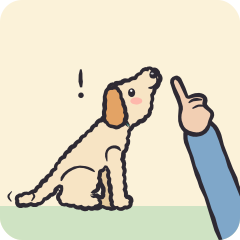 Core skill Understanding Cues Knowing that “come” means the same thing outside the house, and whoever in the family says it.
- ExerciseThe Name GameDoable at home (Steps 1–2 at home)Read →
- ExerciseRecall GamesDoable at home (Steps 1–3 at home)Read →
- ExerciseHand Target: How to Teach Your Dog “Touch” — and Use It for Recall and Passing Other DogsDoable at home (Steps 1–3 at home)Read →
Sources
- American Kennel Club — How to Train Your Dog to Come When Called: Step-by-Step Recall
- American Kennel Club — How to Train a Reliable Recall for Your Dog
- RSPCA (UK) — Train your dog to come when called
- Dogs Trust — Recall training
- Battersea — How to teach your dog a recall
- RSPCA Australia — How can I teach my dog recall (to come when called)?
- Toronto Humane Society — How to Teach Recall (PDF)
- Maxwell, M. E. (2017). Teaching Name Recognition (AVSAB blog)
- LSU School of Veterinary Medicine — Hand Commands for Communicating with Deaf Animals
- Oregon Humane Society — Hand target (touch)
- AVSAB — Position Statement on Humane Dog Training (2021)
- Battersea — How to use a long line lead
- New York City Health Code Article 161, §161.05
- The Highway Code (Great Britain) — Rules about animals (47 to 58)
- Road Traffic Act 1988 (Great Britain), section 27
- Merck Veterinary Manual — Deafness in Dogs
- Cornell Riney Canine Health Center — Dog Bite Prevention