 BAUDOG The dictionary of dog–human communication
Contents
- In short
- When it happens
- How your dog feels
- Where and why does she get out? Four situations
- Start today: block the exits
- Training: waiting at doors, then recall
- If she gets out: what to do
- If a trainer came to your home: the first session and the first homework
- The missing core skill
- Exercises
- In the moment: do / don’t
- When to see a professional
- Sources
In short
An escaped dog can be hit by a car or lost for good, so prevention comes before training. Put a gate inside the front door, settle your dog in another room or clip the leash on before you open it, and check your fence, collar and harness. Then teach her to wait at doors, say please by sitting, turn to her name, and come when called. If she gets out, don’t chase her and don’t scold her when she comes back. If she doesn’t come straight back, call your local animal control and shelters right away (US) or the council dog warden (UK), and search outward from home. An ID tag with your phone number and a registered, up-to-date microchip are what get a found dog back to you.
When it happens
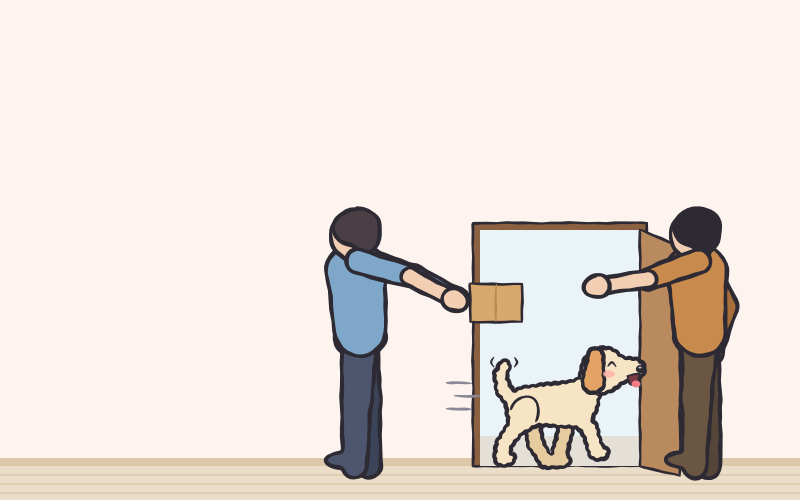
- You open the door for a delivery and your dog slips past your legs and out
- She jumps the backyard fence, or digs her way underneath
- On a walk, something startles her, she backs up, and her collar slides right off
- Thunder or fireworks send her running in a panic
- You come home to find she’s pushed through a window screen and got out
How your dog feels
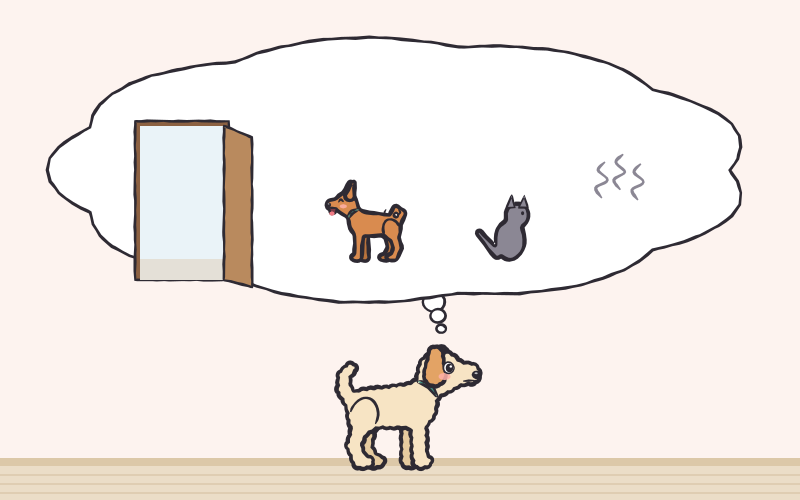
Beyond the door are smells, moving things and other dogs. The UK charity Dogs Trust notes that many dogs slip out through doors and gates when they’re excited, frightened, or want to follow family members.
There are other reasons too. Thunder, fireworks or building work can frighten a dog into running. A bored dog goes looking for something to do. Some want to chase cats or birds. Some are anxious about being left alone and try to get out through doors or windows. And an unneutered male may go to great lengths to find a mate.
If you chase an escaped dog, she may think it’s a game — or get scared and run farther. If you scold her when she comes back, she’ll be slower to come back next time.
Where and why does she get out? Four situations
What helps depends on how she gets out. Pick the one that fits your dog.
- Through the front door or gate: she bolts the moment it opens. → A gate inside the door, and practice waiting at doors.
- From the yard: over the fence, under it, or through a gap. → Check the fence, and don’t leave her out there alone.
- On walks: her collar or harness slips off, or the leash slips out of your hand. → Check the gear, and practice the name game and recall.
- When she’s home alone: she damages doors, windows or screens trying to get out. → This can be separation-related distress. See “When to see a vet” below.
Start today: block the exits
Training takes time. Until it’s solid, set up your home and gear so she can’t get out in the meantime.
- Put a gate across the hallway inside the front door. Before you open the door, settle your dog in another room or behind the gate
- On days with lots of visitors or deliveries, let her trail a lightweight house line indoors so you can grab it the moment the door opens. Always take it off before you leave her alone
- Before opening any door to the outside, clip on her leash
- Every time before you let her out, check the yard fence, walls and gate: high enough, no gaps, no damage. Move bins, boxes and anything she could climb on away from the fence
- Stay with her in the yard. If there’s any chance she could get out, keep her on a leash or long line there too
- Check that her collar, harness and leash fit and aren’t worn. A three-strap harness is harder to wriggle out of. For extra security, use both a collar and a harness and connect them with a safety strap or a double-ended leash, so if one comes off she’s still attached
- On days with thunder or fireworks forecast, or building work nearby, keep windows and doors shut and keep her behind a gate away from the doors. Use a leash even in the yard
- Make sure she always wears a collar with an ID tag showing your phone number. In the UK this is the law: in a public place, a dog must wear a collar and tag with your name and address
- Have her microchipped and keep the registration up to date — if you move or change your number, update it. In the UK every dog must be microchipped and registered by 8 weeks old, and keeping the details current is your responsibility. In the US, a chip is only as good as the contact details behind it: in a study of about 7,700 microchipped dogs and cats arriving at 53 US shelters (2007–08), the most common reason an owner couldn’t be found was a wrong or disconnected phone number, and only 58% of the chips that shelters looked up were registered at all
Training: waiting at doors, then recall
With the exits blocked, teach her not to bolt when a door opens. Start with an inside door that doesn’t lead outside — a bathroom or bedroom — so if she gets past you, she’s still safe.
Make it harder one thing at a time: how far the door opens, then an inside door, then the front door, then people coming and going. Our rule of thumb: move on when she gets the current step right 8 out of 10 times. If she struggles, go back a step.
- At an inside door, open it just a crack. If your dog moves toward it, close it straight away. If she stays put as it opens, say “Yes” at that moment and give her a treat
- Gradually open the door wider. When she hesitates and holds still, say “Free” and let her through — going through is the reward. On the reps where you don’t let her through, still reward her for waiting
- When you move to the front door, keep her leash on. A door to the outside is a whole new challenge, so go back to the easiest step and build up again
- If sitting comes easily to her, use Say Please by Sitting: when she sits, start opening the door; if she stands up, it closes. When she can stay sitting with the door wide open, say “Free”
- Everyone in the family uses the same rule at every door, every time — including the back door to the yard and the car door
- Alongside this, practice The Name Game and Recall Games, starting indoors, so she can come back to you if she ever does get out
If she gets out: what to do
Time matters. In the UK, a council must legally hold a stray dog for only seven days (five in Northern Ireland); after that it can be rehomed, passed to a rescue, or put to sleep. In the US, over thirty states have “holding period” laws. The minimum hold is often only about three to seven days — as little as 48–72 hours in some states — before an unclaimed dog can be adopted out or euthanized, and some states hold a dog with an ID tag or microchip longer (based on a 2017 table of state laws). An ID tag or a registered microchip lets a shelter contact you right away.
The good news: most lost dogs do get home. In a US telephone survey of 817 dog-owning households, about 14% of dogs had been lost in the previous five years, and 93% of those were found. About half of the found dogs (49%) were found by their owners searching the neighborhood, and 15% came home because of an ID tag or microchip. It’s one survey, but it shows why a neighborhood search and visible ID come first.
- Don’t chase her and don’t shout. Running at her can scare her into going farther. Follow as quickly and calmly as you can, keeping her in sight
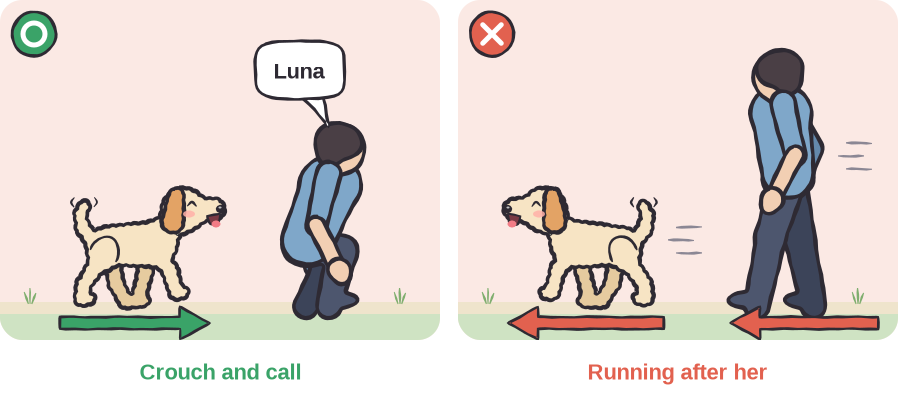
- If she has noticed you, crouch down, or run the other way, and call her name brightly. Dogs love to chase something moving away from them
- When she comes back, don’t scold her. However upset you are, praise her and give her a treat. A telling-off makes her slower to come back next time
- Search your neighborhood thoroughly first — yards (with permission), green spaces, under porches and in sheds — then widen the search. Tell everyone you meet, and ask them to call you rather than chase her. Hand flyers with a recent photo and your phone number to dog walkers and mail carriers
- In the US: call your local animal control, the municipal and private shelters, vets and rescue groups — one of them may already have her. Check the shelters every day, in person, with photos; if there’s no shelter near you, contact the police
- In the UK: report her missing to your council’s dog warden, who is responsible for stray dogs — and to the neighboring councils too, as dogs can travel quite far. Call local kennels, rehoming centers and vets, and tell your microchip database she’s lost
- When she’s found, tell everyone you reported her to — including the microchip database
If a trainer came to your home: the first session and the first homework
Here is how we’d expect the first in-home session to go — one example, not a fixed script. With escaping, the trainer starts by checking the house, before any training.
- Assessment: where has she got out, or might she (front door, yard, walks, when alone)? You look at the front door, the yard fence and the fit of her collar and harness together. If she damages things to get out when alone, the trainer refers you for help with separation-related problems
- Today: you decide where the gate goes and what everyone does before opening the door (another room, or the leash), and share it with the whole family. Training starts at an inside door: open a crack → close if she moves → treat if she holds still
- Homework: waiting at an inside door about twice a day, about 3–5 minutes each. For everyday comings and goings, always use the gate or the leash. Check her ID tag and the contact details on her microchip registration
- Next visit: can she wait at an inside door, without being asked, while it opens all the way? Our rule of thumb: if she manages 8 out of 10, the next homework is “at the front door, on leash”
The missing core skill

Exercises
- ExerciseBuilding a Stay: Duration, Distance, Distraction — One at a Time, Up to the Front Door and GuestsDoable at home (Steps 1–3 at home)Your dog holds a sit or down from “Stay” until “Free” — with duration, distance and distraction each built up one at a time.Read →
- ExerciseSay Please by SittingDoable at home (Steps 1–3 at home)When she wants something, she sits and waits — on her own, without being asked.Read →
- ExerciseThe Name GameDoable at home (Steps 1–2 at home)You say (if her name is Luna) “Luna” once, and within 2 seconds she turns toward you.Read →
- ExerciseRecall GamesDoable at home (Steps 1–3 at home)You say (if her name is Luna) “Luna, come” once, and whatever she’s doing, she runs straight to your feet.Read →
In the moment: do / don’t
Do
- Put her behind a gate or clip on the leash before you open the door
- Check her collar, harness and your fence regularly
- If she gets out, crouch down or run the other way and call her brightly
- Praise her when she comes back
Don’t
- Run after an escaped dog
- Scold her when she comes back
- Open the front door without a leash because “she never runs off”
- Leave her out in the yard alone for long stretches
When to see a professional
- When she’s home alone, she damages doors, windows or screens trying to get out. This can be separation-related distress. Talk to your vet or a qualified behavior professional
- She has suddenly started trying to escape, is afraid of things she used to be fine with, or has become worried about wearing her collar or harness. A health problem can be behind changes like these — see your vet first
- He is an unneutered male who often tries to get out. Neutered males are less likely to roam away from home. Talk to your vet about the benefits and drawbacks of neutering for your dog
Go to the root
Don’t stop at the quick fix. Growing the skill underneath makes other problems lighter too.
 Core skill Impulse Control
- ExerciseBuilding a Stay: Duration, Distance, Distraction — One at a Time, Up to the Front Door and GuestsDoable at home (Steps 1–3 at home)Read →
- ExerciseSay Please by SittingDoable at home (Steps 1–3 at home)Read →
- ExerciseThe Name GameDoable at home (Steps 1–2 at home)Read →
Sources
- Dogs Trust — How to stop your dog escaping or running away
- Oregon Humane Society — Wait
- American Kennel Club — How to Teach Your Dog to Wait at Doorways
- Peninsula Humane Society & SPCA — Teaching a dog not to dart out the open door
- Peninsula Humane Society & SPCA — Door dashing dog
- ASPCA — Finding a Lost Pet
- Humane World for Animals — How to find a lost dog
- Dogs Trust — What to do if you’ve lost your dog
- Washoe County Regional Animal Services (Nevada) — Lost Your Pet?
- GOV.UK — Get your dog or cat microchipped
- Environmental Protection Act 1990, section 149 (legislation.gov.uk)
- The Dogs (Northern Ireland) Order 1983, article 23 (legislation.gov.uk)
- Wisch & Dillingham (2017). Table of State Holding Laws. Michigan State University College of Law, Animal Legal & Historical Center
- Lord, Ingwersen, Gray & Wintz (2009). Characterization of animals with microchips entering animal shelters. JAVMA 235(2):160–167
- Weiss, Slater & Lord (2012). Frequency of Lost Dogs and Cats in the United States and the Methods Used to Locate Them. Animals 2(2):301–315
- ASPCA — Spay/Neuter Your Pet
- RSPCA Australia — How can I teach my dog recall (to come when called)?
- RSPCA (UK) — Train your dog to come when called
- MSD Veterinary Manual (for veterinarians) — Behavior Problems of Dogs