 BAUDOG The dictionary of dog–human communication
Contents
- In short
- When it happens
- How your dog feels
- Is it separation anxiety? Four things to check
- If a trainer came to your home: the first session and the first homework
- How to treat it: start with absences so short she never panics
- Veterinary behaviorists and medication
- Common questions
- The missing core skill
- Exercises
- In the moment: do / don’t
- When to see a professional
- Sources
In short
Separation anxiety is intense distress at being apart from the people a dog is attached to. It isn’t spite or a lack of discipline. It usually shows as you get ready to leave or within 15–30 minutes of you going: non-stop barking or howling, damage around doors and windows, accidents, drooling, refusing food. The heart of treatment is very short absences — short enough that you’re back before she starts to panic — built up a little at a time. While you train, avoid leaving her alone long enough to get upset (use day care, a sitter or family). In moderate to severe cases, a vet may combine medication with the training. It can take months.
When it happens
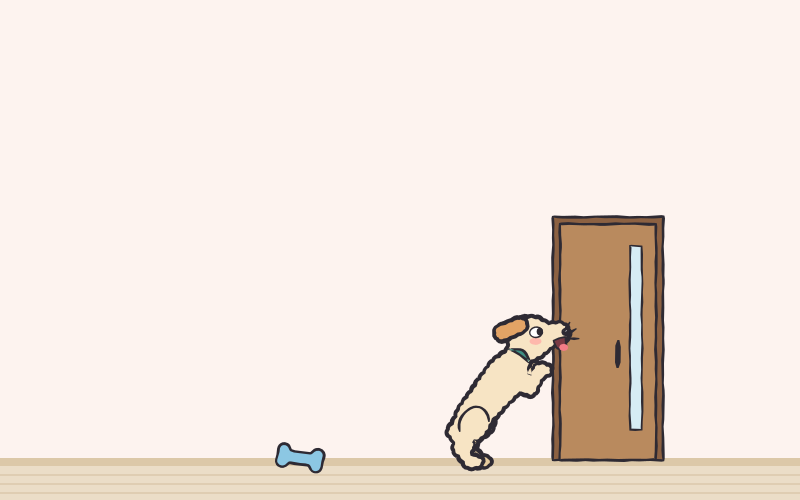
- Minutes after you leave, the howling starts — and a neighbor has complained
- The front door and window frames are chewed and covered in scratch marks
- Her favorite treat is still sitting there, untouched, when you get home
- Picking up your keys or putting on your shoes makes her tremble or shadow you
How your dog feels
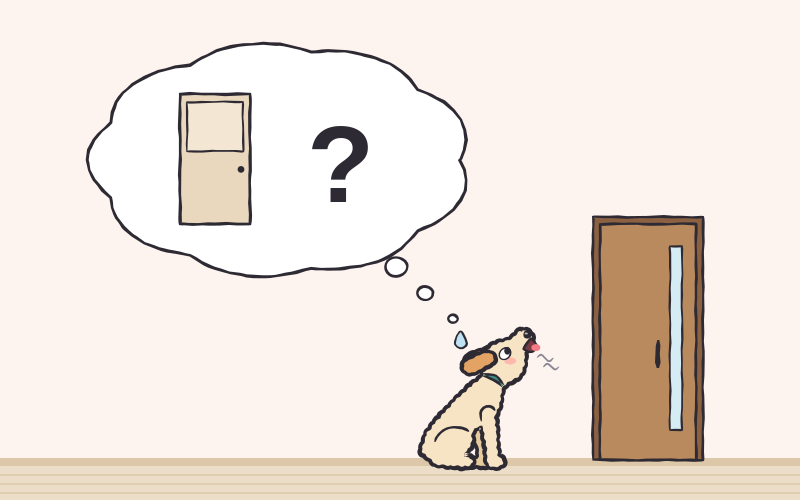
What your dog feels when she’s left is intense anxiety — for some dogs, close to panic. The chewing, the howling, the accidents aren’t meant to make a point. They’re what a frightened dog does when she can’t cope. That’s why punishment doesn’t help.
It isn’t simply “spoiling” or a clingy personality. The MSD Veterinary Manual notes that dogs who follow their family around the house are at no greater risk of separation anxiety than other dogs.
Dogs who are afraid of loud noises like thunder or fireworks often have separation anxiety too. For some, it starts after a scary experience — hearing a storm, say — while they were home alone.
It’s not rare. In a survey of about 13,700 pet dogs in Finland, 5% showed separation-related behavior often. The authors note that they only counted dogs who did it frequently, and that earlier studies put the figure two to three times higher.
Every absence that tips her into panic makes her more sensitive to being left, and the problem harder to treat. That’s why, during treatment, the goal is to avoid any absence long enough to set it off.
Is it separation anxiety? Four things to check
Start by filming her after you leave, with your phone or a pet camera. The MSD Veterinary Manual calls video an invaluable diagnostic tool. Then look at four things:
- When does it start? If it begins while you get ready (shoes on, keys in hand, heading for the door) or within 15–30 minutes of you leaving, think separation anxiety.
- Does it only happen when she’s alone? Doing it when she’s alone but never when someone is home is a key feature.
- What is she doing? Damage around exits (doors, windows) or to your belongings, non-stop barking or howling, accidents, drooling, pacing and unable to settle, not eating, licking her paws over and over.
- Could it be something else? Unfinished house-training, a bored dog exploring, noises outside, fear of loud sounds, or hating being shut in can all look similar. So can illness or pain. Vets rule these out before diagnosing separation anxiety.
If a trainer came to your home: the first session and the first homework
With separation anxiety, a trainer shouldn’t work alone — the usual approach is to combine training with a check-up from your vet. The ASPCA also says this kind of training is complex and needs the guidance of a trained, experienced professional.
Here is how we’d expect a first in-home session to go — one example, not a fixed script.
- Today: watch the recording together to see how many seconds (or minutes) pass before she shows signs of anxiety. Choose a spot where your dog relaxes, and a “marker” that only appears for practice absences — for example, a towel in a color you never use, or a sign you hang on the door handle. Put the marker out, step one pace beyond a baby gate, and come straight back (step 1 of Building Alone Time Step by Step).
- Homework: a few times a day, a practice absence much shorter than the time it takes her to get anxious. Film every one. Outside of practice, don’t leave her alone (family at home, day care, a pet sitter).
- Next visit: on the videos, did she stay relaxed for the whole practice absence? Could it be a little longer? If the intense anxiety isn’t changing, see a veterinary behaviorist.
How to treat it: start with absences so short she never panics
The ASPCA and the MSD Veterinary Manual agree: start with absences shorter than the time it takes her anxiety to begin, practice every day, and build up slowly over weeks. The ASPCA notes that most anxious responses happen in the first 40 minutes, so up to that point you add only a few seconds per session (or every few sessions). MSD warns the whole process can take months.
There’s no set amount to add each time. Our rule of thumb: once she has stayed relaxed on video for several sessions in a row, add just a little. If she gets restless, make the next one shorter.
- While you’re in treatment, don’t leave her alone outside of practice. On workdays, use doggy day care, a pet sitter, a family member at home, or take her to work. A single absence that tips her into panic can set the training back.
- Put the marker out only for practice absences. This is what MSD calls a “safety signal”: a new object or sound that has never been linked to your real departures. She learns that when the marker is out, you’ll be back before she gets worried.
- Keep each absence well below the point where she shows anxiety — very short at first. Film every session to make sure she stayed relaxed.
- For dogs who get upset at your departure routine (keys, shoes, coat), the ASPCA suggests going through the routine without leaving, many times a day. MSD, on the other hand, recommends the safety-signal approach for moderate to severe cases, and notes it differs from older advice about breaking the link with departure cues. Decide with your vet or trainer which route to take.
- For mild cases: before you leave, give her a special treat or long-lasting chew in a set spot, one she only gets when she’s alone, and put it away when you come home. Being alone becomes the time good things happen.
- Walks and play suited to her age and breed, on a predictable daily routine. Keep up reward-based training in everyday life too. It makes her day easier to predict.
Veterinary behaviorists and medication
Separation anxiety is also a behavioral condition that vets diagnose and treat. Start with your own vet to rule out illness or pain, and bring the videos of her alone.
Medication: in the US, two medicines are FDA-approved for canine separation anxiety, to be used together with a behavior modification plan — fluoxetine (an SSRI; brand name Reconcile) and clomipramine (a tricyclic antidepressant; brand name Clomicalm). The MSD Veterinary Manual says both have been shown to reduce signs, especially when combined with behavior modification. The ASPCA notes that some dogs are so distressed that treatment can’t begin without medication, and that most dogs need medication and behavior modification together, not medication alone. Whether to use medication, and which one, is always your vet’s decision. Outside the US, ask your vet what is available where you live.
Finding a specialist. In the US and Canada, board-certified veterinary behaviorists are Diplomates of the American College of Veterinary Behaviorists (ACVB). They are vets with specialist training in behavior who can prescribe medication, and the ACVB website has a “Find a Diplomate” search by location. In the UK, the Animal Behaviour and Training Council (ABTC) keeps a national register: a Clinical Animal Behaviourist works with you and your dog on veterinary referral, and a Veterinary Behaviourist is a Clinical Animal Behaviourist who is also a vet. The register of Certificated Clinical Animal Behaviourists (CCAB) is another place to look. If no one is near you, ask your own vet for a referral.
Common questions
- How long does it take? It depends on the dog. The MSD Veterinary Manual says the gradual departure program can take months to complete. Skipping steps usually makes it take longer.
- Can separation anxiety be cured? It can be treated. The ASPCA says that in mild cases, counterconditioning might reduce or resolve the problem. For moderate to severe cases, the gradual program — with medication if your vet recommends it — is the route, and MSD notes that both FDA-approved medicines reduce signs, especially alongside training. Expect progress measured in weeks and months, not a quick fix.
- Is it cruel to leave a dog with separation anxiety? During treatment, the advice is to avoid it: the ASPCA says a dog in treatment can’t be left alone except during practice sessions. Line up day care, a sitter or family while you work on it.
- Would a second dog help? It depends on the dog. MSD describes some dogs who are distressed when separated from one particular person and can’t be comforted by anyone else, and others who are only distressed when there’s no human around at all. Our view: a dog who is attached to one particular person is unlikely to be helped by another dog. Before you get one, look at the videos and ask your vet.
- Will a crate stop the damage? A crate won’t treat separation anxiety, and she can hurt herself trying to get out. If she pants heavily, drools, tries frantically to escape or howls non-stop in the crate, a crate isn’t right for her. Use a single room closed off with a baby gate instead.
- Do calming sprays, collars or diffusers work? The evidence is thin. A 2010 systematic review of pheromone studies found only 1 of 7 dog studies gave good evidence of an effect (on fear during training); the rest — noise phobia, car travel, vet visits, shelter dogs, crying in newly adopted puppies — didn’t show enough evidence either way. None of them looked at separation anxiety itself. If you want to try one, use it alongside the training, not instead of it.
- Can it be prevented in puppies? MSD says that letting a puppy spend time alone regularly and comfortably during the day lowers the risk of fear and anxiety when left. In a UK and Irish study that followed 145 puppies to six months of age, based on what owners reported, puppies who by 16 weeks slept nine hours or more at night and spent the night in a crate or room had fewer separation-related problems. Puppies in homes that used more punishment had more. It found links, not proof of cause and effect.
The missing core skill
Exercises
Our suggested order. The first one is the core. In severe cases, work on it alongside your vet.
- ExerciseBuilding Alone Time Step by Step: Training Your Dog to Stay Home AloneDoable at home (Steps 1–3 at home)Absences that end before she gets anxious, lengthened little by little while you watch the videos. The center of separation anxiety training.Read →
- ExerciseScent Games for Dogs: Easy Treat Hunts With a Towel and Paper CupsDoable at home (Steps 1–3 at home)A good sniff leaves her satisfied and ready to rest. It won’t fix separation anxiety on its own; it supports the training.Read →
In the moment: do / don’t
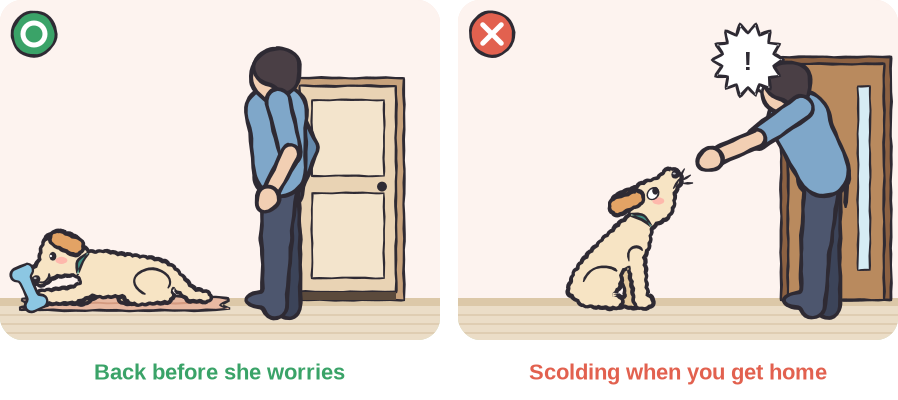
Do
- Film her to find out how long she copes before anxiety starts
- While training, use day care, a sitter or family so she isn’t left alone
- Keep goodbyes and hellos low-key
- Talk to your vet early
Don’t
- Scold her when you get home — it makes the anxiety worse
- Leave her to “cry it out” — she learns that being alone is terrifying
- Shut her in a crate to stop the damage
- Use bark collars, shock collars or other punishment devices
When to see a professional
- She injures herself (constant paw-licking, tail-biting), or gets hurt trying to break out through doors or windows
- She won’t eat anything, not even treats, when she’s alone
- Drooling, trembling or pacing that goes on the whole time she’s alone
- You keep training, but the time before her anxiety starts isn’t getting longer
- It started suddenly in an older dog. Illness, pain or changes in brain function (cognitive decline) can be behind it
Go to the root
Don’t stop at the quick fix. Growing the skill underneath makes other problems lighter too.
Sources
- MSD Veterinary Manual (veterinary edition) — Behavioral Problems of Dogs (Borns-Weil, 2025)
- ASPCA — Separation Anxiety
- RSPCA (UK) — Recognising separation-related behaviour and anxiety in dogs
- RSPCA (UK) — How to train your dog to stay home alone
- Humane World for Animals (formerly the Humane Society of the United States) — How to crate train your dog or puppy
- Best Friends Animal Society — How to crate train a puppy or dog
- AVSAB — Position Statement on Humane Dog Training (2021)
- Dale, Burn, Murray & Casey (2024). Canine separation-related behaviour at six months of age: dog, owner and early-life risk factors identified using the “Generation Pup” longitudinal study. Animal Welfare 33
- Salonen et al. (2020). Prevalence, comorbidity, and breed differences in canine anxiety in 13,700 Finnish pet dogs. Scientific Reports 10
- Frank, Beauchamp & Palestrini (2010). Systematic review of the use of pheromones for treatment of undesirable behavior in cats and dogs. JAVMA 236(12):1308–1316
- American College of Veterinary Behaviorists (ACVB)
- ACVB — Find a Diplomate near you
- Animal Behaviour and Training Council (ABTC, UK) — Types of practitioners
- ASAB — CCAB accreditation (Register of CCAB Certification practitioners)