 BAUDOG The dictionary of dog–human communication
Contents
- In short
- When it happens
- How your dog feels
- When does she bite? Four questions that tell you where to start
- If a trainer came to your home: the first session and the first homework
- How to stop puppy biting
- Should you yelp “ouch!” when your puppy bites?
- Why we don’t recommend holding her mouth shut, tapping her nose or loud noises
- When do puppies stop biting?
- Puppy biting in a home with children
- The missing core skill
- Exercises
- In the moment: do / don’t
- When to see a professional
- Sources
In short
Puppy biting is normal — it comes from play, exploring with the mouth, and teething. You don’t stop it by telling her off. You stop the fun the moment teeth touch skin, redirect her to a toy she’s allowed to chew, and protect her sleep, because puppies tend to bite more when they’re tired or overexcited. There’s no set month when it ends, but it should be steadily easing off. If the biting gets harder, more frequent, or comes with growling, talk to a professional.
When it happens
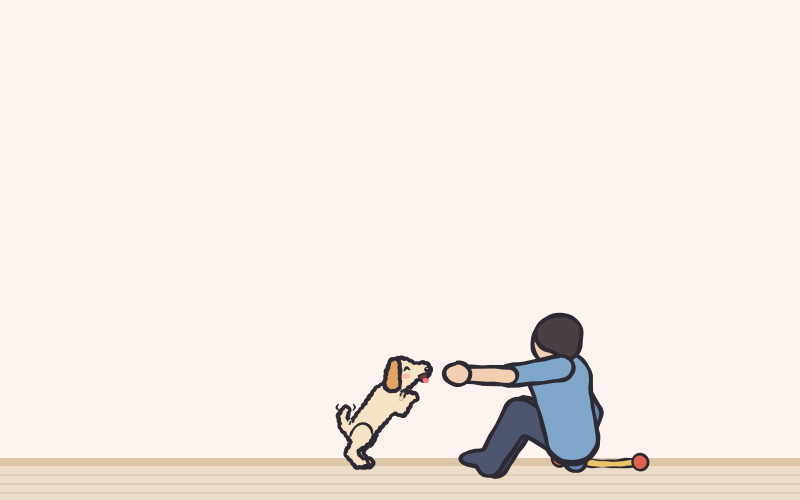
- During play, your dog grabs your hands and fingers with her needle-sharp teeth
- She ambushes your ankles, pant legs and slippers as you walk past
- In the evening, or after a big play session, she races around and the biting ramps up
- She bites when you stroke her, pick her up or brush her (if so, read the fourth question below first)
How your dog feels
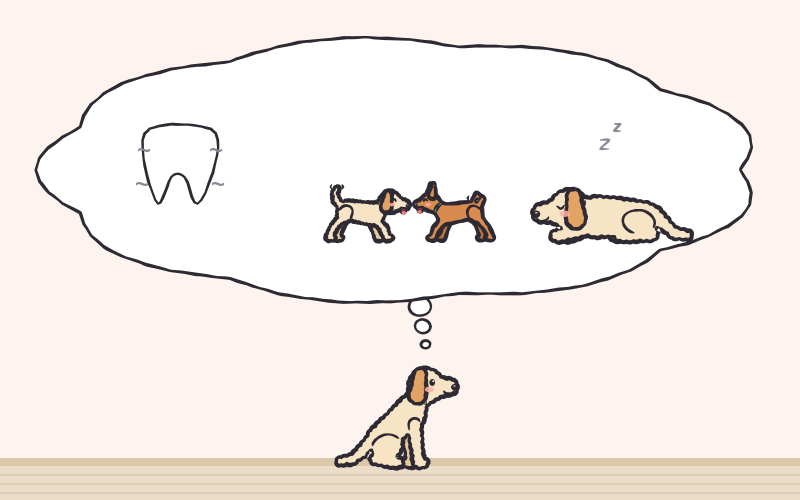
Puppies explore the world with their mouths. With their littermates, play meant mouthing and wrestling, so they try the same game with human hands. The ASPCA and the UK’s RSPCA both describe mouthing as normal puppy behavior, and the San Francisco SPCA adds that it is not a sign your puppy will grow up aggressive.
Teething adds to it. According to the Merck Veterinary Manual, puppies have 28 baby teeth, which start coming in at 3–5 weeks. The 42 adult teeth usually begin to appear at around 4–5 months, and all of them are in by 7 months. During this stretch, having things to chew helps ease the discomfort.
Puppies are also still learning how hard is too hard. Animal welfare groups such as the ASPCA and RSPCA NSW in Australia describe the ability to control the force of a bite — bite inhibition — as something rehearsed during puppy play.
And sleep matters more than most people expect. Dogs Trust in the UK writes that puppies who don’t get enough sleep often look like they have too much energy: zoomies, wanting to play, and mouthing. If the biting suddenly ramps up in the evening, she may not need more play — she may need a nap.
When does she bite? Four questions that tell you where to start
Not every puppy bites for the same reason. The UK charity Blue Cross suggests writing down when the biting happens and what came just before it. Keep notes for a few days, then look at these four questions — the ones BAUDOG uses to work out where to start.
- Do her teeth land on you once play gets exciting? Excitement often makes her lose control of how hard she bites. Start with the practice Play and Pause (Settling Down).
- Does it get worse in the evening, after play, or when she’s been awake a long time? She may be overtired. Before adding more play, add more rest (see “How to stop puppy biting” below).
- Does she go for moving feet, pant legs and hands? She may be chasing movement. Stand still and move a toy to draw her onto it instead. Letting go of whatever she’s grabbed is taught with the practice Trade (Impulse Control).
- When you stroke her, pick her up, trim her nails or take something from her mouth, does she go stiff, growl or bare her teeth and bite? That isn’t play mouthing — it can be fear or pain. For this puppy, read “When to talk to a vet or behavior professional” below before trying the practices on this page. Our pages on biting and growling may also help.
If a trainer came to your home: the first session and the first homework
Here’s how a first in-home session might go — one example put together by BAUDOG, not a fixed script. Puppy biting happens at home, so the whole plan starts at home, with the family.
- Today: talk through her day (sleep, meals, play) and find the times the biting peaks. Decide where chew toys will live in each room she spends time in, and where the baby gates or playpen go. The trainer demonstrates “freeze when teeth touch, then offer a toy” and step 1 of Play and Pause, and each family member has a turn.
- Homework: every day, note when she bit and what came just before. Set nap times and let her rest in her playpen or crate. Play and Pause twice a day, 3–5 minutes each. Nobody plays with hands or feet. The whole family responds the same way when teeth touch skin. An adult is always nearby when children play with her.
- Next visit: the trainer looks at your notes — has the bitey part of the day got shorter? In Play and Pause, is she settling faster after you stop? (Our rule of thumb: she settles within 10 seconds, 8 times out of 10.) If so, the next homework adds the Trade practice while you keep up Play and Pause. If the biting is getting harder or she has started growling, talk to your vet or a behavior professional.
How to stop puppy biting
Three things do most of the work: give her things she’s allowed to bite, make the fun stop when teeth touch skin, and keep her from getting overtired or overexcited. Preventing the biting is generally easier and safer than interrupting it.
- Keep chew toys within reach at all times, and offer her a toy before you start playing or handling her. While she’s teething, give her things to chew too. Avoid anything so hard it won’t bend — it can break teeth — and ask your vet which chews are safest for her.
- Don’t play with your hands or feet. Use toys for every game — tug, fetch. For tug, choose a long toy that keeps her mouth far from your hand, or a big soft one.
- When her teeth touch your hand, first go still. Don’t snatch your hand away — movement makes her want to chase it more. If she keeps going, turn away and fold your arms. If she still keeps going, step behind a baby gate or a door for a moment.
- Keep the break short — a few seconds up to about 30 — then come back once she’s calm and play gently again. If you stay away much longer, she won’t connect the break with what she did.
- If she ambushes your ankles or pant legs, stop your feet completely. Once you’re still, wiggle a toy to draw her onto that instead.
- Until the biting settles, put away the things that move and beg to be grabbed: dangling bathrobe ties, fluffy slippers.
- Let her sleep — a lot. Dogs Trust says puppies need around 18–20 hours of sleep a day. If she fights naps, schedule quiet time and let her rest in her playpen or crate.
- After exciting play, give her something calming to do: sniffing, licking or chewing (the practice Sniffing Games).
- When she chooses to chew a toy on her own, praise her quietly. You’re rewarding good choices.
- Don’t use the playpen or crate she rests in as a punishment for biting. For breaks, step behind a gate or into another room instead.
Should you yelp “ouch!” when your puppy bites?
Opinions differ. The ASPCA describes giving a high-pitched yelp, as if you’re hurt, and letting your hand go limp when a puppy bites hard. Blue Cross in the UK advises against high-pitched squeals because they tend to excite puppies and often lead to more biting, and The Royal Kennel Club says the more you yelp, the more likely your puppy is to think the game is on. The ASPCA itself warns against yelping like you’re hurt if a puppy throws a temper tantrum while you’re holding or handling her.
BAUDOG’s advice: skip the yelp and just go still. The routines from Dogs Trust and the UK rescue charity Battersea don’t use your voice either — only “freeze, turn away, step away.” If you do say something, keep it to one calm, ordinary word that won’t startle her. If using your voice makes the biting worse, it isn’t right for your puppy.
Why we don’t recommend holding her mouth shut, tapping her nose or loud noises
Holding her mouth shut, grabbing her muzzle, flicking or tapping her nose, sticking fingers down her throat, scruff-shaking — the ASPCA and the San Francisco SPCA, among others, list all of these as things not to do. The ASPCA notes that slapping or hitting a puppy for playful mouthing can make her bite harder. Startling her with shouting or a can of coins is no better: frightening a puppy can make her start to lose trust in you (Blue Cross).
There’s research, too. A survey at a US veterinary school asked the owners of 140 dogs brought in for behavior problems which methods they had tried before coming in. Aggressive responses were reported in 43% of dogs who had been hit or kicked, 39% of dogs who’d had items physically forced out of their mouths, and 26% of dogs who’d been grabbed by the jowls and shaken. Few owners reported aggressive responses to reward-based or non-aversive methods. These were dogs already seen for behavior problems, not mouthy puppies, and the survey relied on owners’ recall, so it can’t show cause and effect — only that confrontational methods were often followed by aggressive responses. The American Veterinary Society of Animal Behavior (AVSAB) recommends using only reward-based methods for all dog training, including fixing behavior problems.
When do puppies stop biting?
There’s no fixed month. Dogs Trust says plainly that there’s no magic age when puppies stop, but that once teething is finished, at around seven months, most are mouthing a lot less. Blue Cross puts the typical end at three to five months, and Battersea says most puppies start to grow out of it by around five to six months — so the estimates vary. In larger breeds, which take longer to mature, it can continue into the first year and sometimes up to 18–24 months (Battersea).
More important than her age is whether it’s easing off. Battersea writes that mouthing should be steadily reducing over time — not becoming more frequent or more intense. The American Kennel Club’s advice is that if you haven’t been able to moderate the behavior by six months, it’s a good idea to consult an experienced trainer or animal behavior specialist.
Small dogs may teethe a little later. A study that followed the teeth of 61 Yorkshire Terriers from 12 to 28 weeks found that dogs weighing 3 kg (about 6.6 lb) or less tended to change teeth later than dogs over 5 kg (about 11 lb). That was one breed, studied at a pet food company’s research center.
You’re not alone. In a UK study that followed 985 puppies brought home in 2020 until they were 21 months old, 262 of the 900 owners who answered (about 3 in 10) listed mouthing as a problem behavior.
Puppy biting in a home with children
Puppy teeth are sharp, and it isn’t reasonable to expect children to deal with play biting on their own (Blue Cross). The adults set things up.
- Whenever children and the puppy are together, an adult supervises. When you can’t, separate them with a baby gate or playpen (Blue Cross, Battersea).
- Ask children not to run and shout near the puppy. Running, squealing and rough play overexcite puppies and set off mouthing.
- No tug, wrestling or chase games between children and the puppy (Dogs Trust, Battersea). Teach children to offer a toy instead of their hands.
- While she’s going through an ankle-biting phase, rain boots protect children’s feet while an adult redirects her to a toy (Dogs Trust).
- Make it a family rule: let a sleeping puppy sleep (Blue Cross). Short sleep often means more biting.
The missing core skill
Exercises
BAUDOG’s suggested order. Start with Play and Pause, to practice coming back down from excitement. If you build a marker word (“Yes”) alongside it, every other practice gets easier.
- ExercisePlay and Pause: Teach Your Dog an “Off Switch” With TugDoable at home (Steps 1–3 at home)Short bursts of play, a pause, and play again once she’s calm. “Teeth on skin means the game stops” is taught inside the same practice.Read →
- ExerciseThe Trade Game: Teach Your Dog to Drop It by Swapping, Not GrabbingDoable at home (Steps 1–4 at home)Gets her to let go of your hand, your slipper or something she picked up — without chasing her.Read →
- ExerciseScent Games for Dogs: Easy Treat Hunts With a Towel and Paper CupsDoable at home (Steps 1–3 at home)After exciting play or on rainy days. Using her nose satisfies the urge to chew and play.Read →
- ExerciseCharging Your Marker Word: How to Teach Your Dog That “Yes” Means a RewardDoable at home (Steps 1–4 at home)A word that marks the instant she chooses the toy. It underpins the other practices.Read →
In the moment: do / don’t
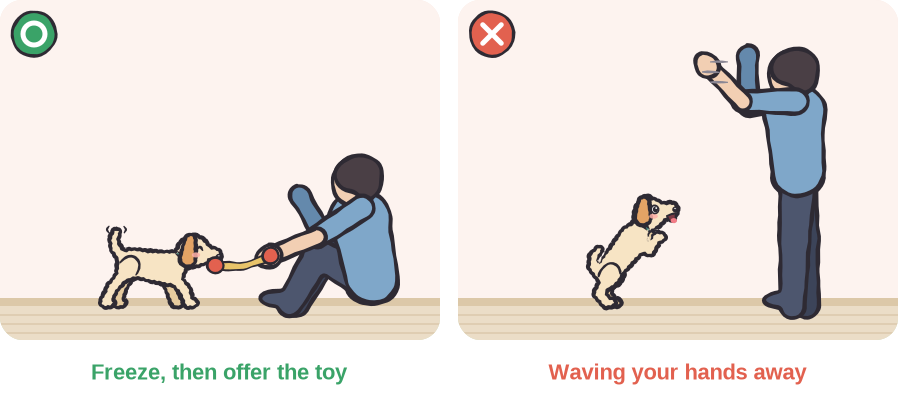
Do
- Go still when teeth touch skin
- Wiggle a toy and redirect her onto it
- When she’s sleepy, end the game and let her rest
- Quietly praise her when she chews a toy
Don’t
- Play with your hands or feet
- Tap her nose, hold her mouth shut or hit her
- Squeal, shout or scold
- Snatch your hand away or run off — it turns into a chase
When to see a professional
- She goes stiff, pulls back her lips to show her teeth, or growls while biting — this may not be play. Talk to your vet or a behavior professional
- She growls or freezes and bites when you stroke her, pick her up, trim her nails or take something from her mouth — this can be a sign of fear or pain. See our pages on growling and biting too
- The biting has suddenly increased, or it eased off and came back — pain or illness can be behind it. Have your vet check her first
- It isn’t easing off as she gets older, or it’s becoming more frequent or harder — talk to a trainer or behavior professional
Go to the root
Don’t stop at the quick fix. Growing the skill underneath makes other problems lighter too.
Sources
- ASPCA — Mouthing, Nipping and Biting in Puppies
- Dogs Trust — Mouthing, nipping and puppy biting
- Blue Cross — Puppy biting and mouthing
- Battersea — How to stop a puppy mouthing or biting
- Merck Veterinary Manual — Dental Development of Dogs
- VCA Animal Hospitals — Teeth, Teething and Chewing in Puppies
- RSPCA — Understanding mouthing and play-biting behaviour (PDF)
- RSPCA NSW — Prevent-a-Bite: Puppy biting (PDF)
- San Francisco SPCA — Puppy Play Biting and Mouthing (PDF)
- The Royal Kennel Club — How do I stop my puppy mouthing?
- The Ohio State University Indoor Pet Initiative — Mouthing / Warning Signs
- Blue Cross — Puppies and children
- Dogs Trust Ireland — Tug of fun
- Herron, Shofer & Reisner (2009). Survey of the use and outcome of confrontational and non-confrontational training methods in client-owned dogs showing undesired behaviors. Applied Animal Behaviour Science 117:47–54
- AVSAB — Position Statement on Humane Dog Training (2021)
- Wallis et al. (2023). Development of Yorkshire Terrier Dentition. Veterinary Sciences 10(7):406
- Brand et al. (2024). Owner-reported problem behaviours in a UK Pandemic Puppies cohort at 21 months of age. Animals 14:336
- American Kennel Club — How to Stop Puppy Biting
- American Kennel Club — How Much Do Puppies Sleep?