 BAUDOG The dictionary of dog–human communication
Contents
- The finished behavior
- Assessment: where is your dog now?
- The cue
- How to signal
- Teaching steps
- When to reward
- “Drop it” vs “All done”
- “Drop it” vs “Leave it”
- Is tug-of-war OK?
- Can you teach “Drop it” without treats?
- A good sign to move on
- If it isn’t working
- Prescription: a suggested order
- In the moment: do / don’t
- When to see a professional
- Sources
The finished behavior
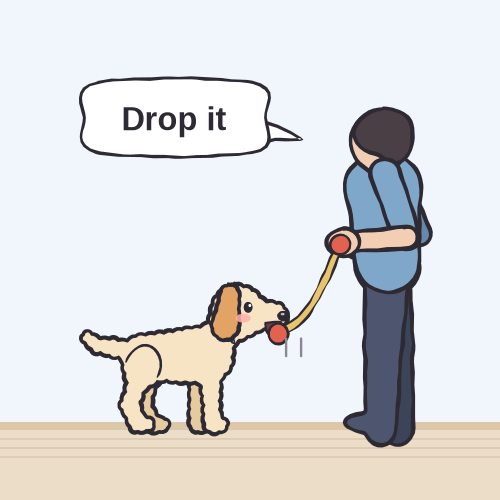
In the middle of tug or fetch, you say “Drop it” and your dog lets go of the toy. She knows that letting go means the game starts again, so she has no reason to hang on.
Assessment: where is your dog now?
Before teaching anything, a visiting trainer might check something like these three things.
When someone comes near something in her mouth or her toys, does she freeze, growl, gulp it down fast or hunch over it?
→If so, this may be resource guarding. Don’t work through this page on your own — do it with your vet or a behavior professional.
Treats or toys: which does she get more excited about?
→If it’s toys, this page’s approach suits her. If it’s treats, you can start with trading for a treat instead (the Give page).
During tug, do her teeth land on your hands, or does she stay wound up even after you stop?
→Start with the practice Play and Pause, so she learns to settle when the game stops. Use a long toy that keeps her mouth well away from your hands.
The cue
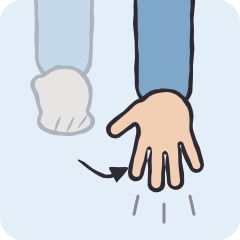
On BAUDOG, “Drop it” and “Give” are the same cue: let go of what’s in your mouth. “Out” works too — pick one word for the whole family. The Give page teaches it by trading for treats; this page teaches it inside play. The hand signal is a loosely closed hand, palm down, that springs open. Your hands are full during tug, so teach the word first, and add the hand signal during fetch, when a hand is free.
How to signal
- Voice
Say nothing at first. Once she lets go as soon as you freeze, say “Drop it” the instant her mouth opens. When she lets go, “Yes.”
- Hand
To freeze, pull the toy in against your body and hold it still. Don’t pull back. During fetch, when a hand is free, show the hand signal as you say the word: a loosely closed hand, palm down, that springs open.
- Leash
None indoors. Don’t play fetch in unfenced areas. In public, keep her on a leash and hold it. Leash rules vary — New York City, for example, requires a leash in public. Check your local rules.
- Body
When you freeze, stop moving altogether and wait quietly. Don’t chase her.
Teaching steps
- 1
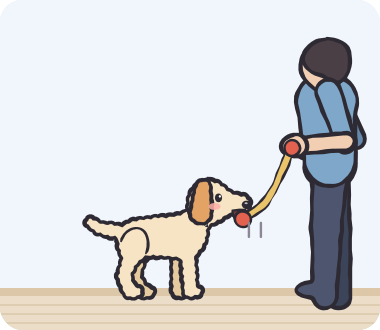
Freeze, and wait without a word At home, quiet
Freeze the game
Play tug gently with a long rope toy. After about 30 seconds, suddenly stop moving: pull the toy in against your body and wait, without saying anything.
A good sign to move onWhen you freeze, she lets go by herself
- 2
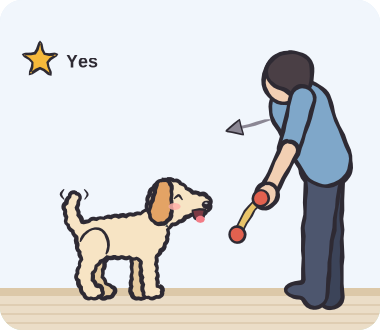
The reward for letting go is the next round of play At home, quiet
Let go, and the game goes on
The instant her mouth comes off the toy, “Yes.” Straight away, “Let’s play” — and the tug game starts again. Letting go means more play.
A good sign to move onLets go as soon as you freeze, 8 times out of 10
- 3
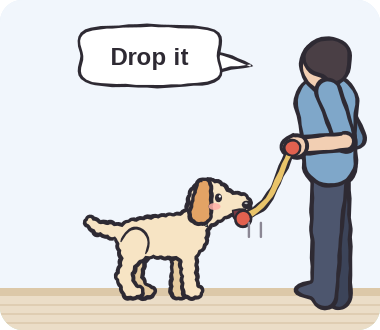
The cue comes the instant her mouth opens At home, quiet
Add the cue
Once she lets go as soon as you freeze, say “Drop it” the instant her mouth opens. When she’s used to that, say “Drop it” at the same moment you freeze.
A good sign to move onLets go on “Drop it,” 8 times out of 10
- 4
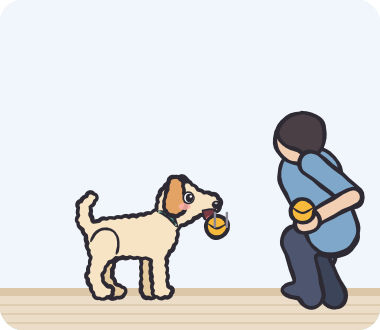
Trade one toy for the other At home, small distractions
Two toys (fetch)
Get two toys she likes about the same. Roll one; when she brings it back, show her the second and wiggle it as if it’s the best thing ever. When she lets go of the first, “Yes” → throw the second. Pick up the first while she’s chasing.
A good sign to move onWhen she sees the second toy, she lets go of the first
- 5
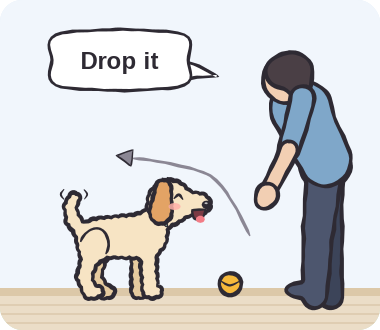
Let go, and the same toy flies again At home, small distractions
One toy
Say “Drop it” before you show the second toy. When she lets go, “Yes” → throw the same toy again (or start a game of tug).
A good sign to move onLets go on “Drop it” without seeing a second toy, 8 times out of 10
When to reward
Just right
“Yes” the instant the toy leaves her mouth. Then start the game again right away.
Too late
Saying “Yes” or restarting the game while she’s still holding on and pulling. That teaches her that pulling keeps the game going.
“Drop it” vs “All done”
- Drop it: let go with your mouth. Once she lets go, the game starts again straight away, so letting go never costs her anything.
- All done: stop the game itself (the practice Play and Pause). Wait until she has settled — sitting, lying down or relaxing — before you start again. Use it when her teeth touch your hands or clothes, or when the game gets too wild.
- You can use both in the same game of tug: “Drop it” to let go, “All done” to bring the excitement down.
“Drop it” vs “Leave it”
- Drop it: let go of something that’s already in her mouth.
- Leave it: ignore something she hasn’t picked up yet — food on the floor, something on the sidewalk (the Leave It page).
- Teach both. The American Kennel Club (AKC) points out that you won’t always spot things before your dog does — so you need a way to get back what she has already picked up.
Is tug-of-war OK?
Some people worry that tug makes dogs “dominant.” The UK charity Blue Cross says that tug is great fun for most dogs and a good outlet for natural behavior. Let her win now and then and keep the toy — otherwise she may lose interest in playing with you. The research on winning and losing, and why children shouldn’t play wild games with dogs, is on the practice Play and Pause.
Can you teach “Drop it” without treats?
Yes — for a dog who loves toys, the game itself is the reward: she lets go, and the play starts again. That’s what steps 1–5 above do. The San Francisco SPCA suggests that once she drops things reliably, the reward for a dropped toy can simply be another throw or a game of tug. Keep food ready for the big moments, though: if she drops something really valuable to her, like a chicken bone she found on the street, the SPCA says to have a food treat to give her.
A good sign to move on
- Steps 2–3: freeze → lets go, then lets go on “Drop it.” Move on once she manages that step 8 times out of 10 (our rule of thumb)
- Steps 4–5 (fetch) come once “Drop it” works in tug. If she doesn’t play tug, you can start at step 4
- Use it outdoors only once it’s reliable indoors — and start in a fenced yard
- If she struggles, go back a step (our rule of thumb: two misses in a row)
If it isn’t working
She keeps pulling even when I freeze
She may be too wound up. Move the toy slowly at first and keep games short (Blue Cross). Start with a toy she’s less crazy about. If she still can’t settle when you freeze, work on the practice Play and Pause first.
She won’t let go even for a treat
For a dog who prefers toys to food, trade toy for toy (step 4). Make the second toy look really exciting (AKC, Battersea).
She runs off with the toy
Don’t chase her. Being chased is a fun game to her, and she learns to run away. Keep playing the two-toy trade: she’ll learn that toys are boring without you, and start bringing them back (Battersea).
She tries to grab the toy back as soon as she lets go
With two toys, pick up the first while she’s busy with the second. You can also toss a treat a few feet away and pick the toy up while she goes for it (AKC).
How long should practice sessions be?
Short. The San Francisco SPCA suggests about 5 minutes, two or three times a day.
She’s got something dangerous (a battery, medication, a wooden skewer, chocolate)
Don’t chase her, don’t pry her mouth open, and don’t shout in a panic. Throw a handful of treats away from the item; when she goes for them, throw more even further away, and pick the item up meanwhile (Dogs Trust). If she may have swallowed it, or it could be toxic or cause a blockage, go to your vet straight away.
She growls or freezes when she has something
Don’t approach, don’t take the item, and move away. A growl is a warning. Punishing it only stops the growl, and she may learn to bite without warning (Dogs Trust). Talk to your vet or a behavior professional.
Prescription: a suggested order
The homework version — how many times a day, for how long, and what a visiting trainer checks next time — is on the practice pages.
- ExerciseThe Trade Game: Teach Your Dog to Drop It by Swapping, Not GrabbingDoable at home (Steps 1–4 at home)The full step-by-step for “Drop it” by trading for treats, from toys at home to things she picks up on walks.Read →
- ExercisePlay and Pause: Teach Your Dog an “Off Switch” With TugDoable at home (Steps 1–3 at home)Stopping and settling even when play gets exciting. If she can’t settle when the game stops, start here.Read →
In the moment: do / don’t
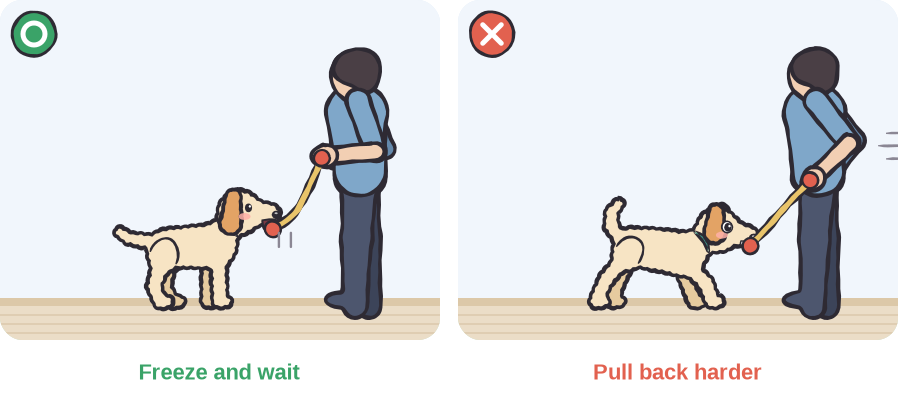
Do
- To freeze, pull the toy in against your body and hold it still
- “Yes” the instant she lets go → start the game again
- Let her win now and then and keep the toy
- If she has something dangerous, toss treats away from it and pick it up meanwhile
Don’t
- Pull back and take the toy by force
- Pry her mouth open
- Chase her when she runs off with a toy
- Scold her for growling
When to see a professional
- She freezes, growls or tries to bite over things in her mouth or her toys (resource guarding). Don’t take things from her yourself — talk to your vet or a behavior professional
- She may have swallowed something dangerous. If it could be toxic or cause a blockage, go to your vet straight away
The skills behind this command
 Core skill Impulse Control Letting go of a toy she’s wrapped up in, by her own choice — pausing for a breath in the middle of a game.
- ExerciseThe Trade Game: Teach Your Dog to Drop It by Swapping, Not GrabbingDoable at home (Steps 1–4 at home)Read →
- ExercisePlay and Pause: Teach Your Dog an “Off Switch” With TugDoable at home (Steps 1–3 at home)Read →
Sources
- Blue Cross — How to play with your dog
- Battersea Dogs & Cats Home — Teaching your dog to “drop it”
- American Kennel Club — Teaching Your Dog to Drop It
- American Kennel Club — Teach Your Dog to Trade Items With You
- San Francisco SPCA — Drop It Command
- Dogs Trust — How to train your dog to leave it
- Dogs Trust — Resource guarding in dogs
- ASPCA — Food Guarding
- New York City Health Code Article 161, §161.05