 BAUDOG The dictionary of dog–human communication
Contents
- The finished behavior
- Assessment: where is your dog now?
- The cue
- How to signal
- Teaching steps
- When to reward
- Choosing a toy: no sticks
- Her body, and hot days
- What’s the reward: a treat, or the next throw?
- How long does it take a dog to learn fetch?
- A good sign to move on
- If it isn’t working
- Prescription: a suggested order
- In the moment: do / don’t
- When to see a professional
- Sources
The finished behavior
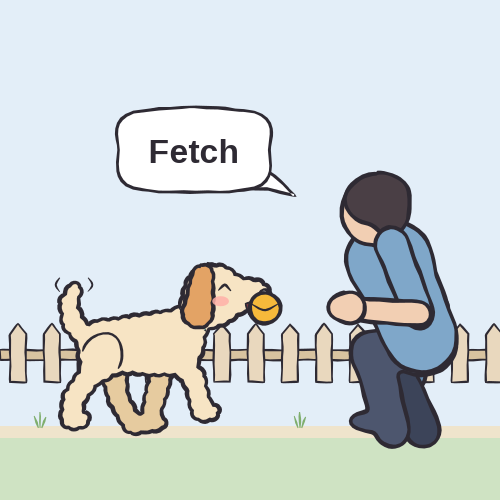
On “Fetch,” your dog chases the ball, brings it back and lets go of it on “Drop it.” She knows that bringing it back means another throw, so she doesn’t run off with it.
Assessment: where is your dog now?
Before teaching anything, a visiting trainer might check something like these three things.
When you roll a toy, does she chase it? Does she pick it up?
→Fetch doesn’t come naturally to every dog: retrievers often take to it, while some dogs never learned to play with toys as puppies. If she chases but doesn’t pick it up, start at step 1 (hold). If balls leave her cold, try different toys — plush, rope and so on.
Does she run off with the toy, or refuse to let go?
→She may have been chased for things before, and had them taken away. Make “no chasing” a family rule, and practice the handing-over part (“Drop it”) first.
When someone comes near a toy in her mouth, does she freeze or growl?
→If so, this may be resource guarding. Don’t take things from her yourself — talk to your vet or a behavior professional.
The cue
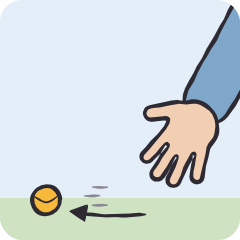
The voice cue is “Fetch” (or “Get it” — pick one for the whole family). For handing it over, use the “Drop it” cue. BAUDOG hasn’t set a hand signal for fetch yet: the throw or roll itself becomes the signal for your dog.
How to signal
- Voice
Say “Fetch” once, then roll the toy low. When she starts back with it, call her in a happy voice. When she reaches you, “Drop it.”
- Hand
Start by placing the toy on the floor or rolling it just a short way. Even later, roll or toss it low — don’t throw it high.
- Leash
Indoors or in a securely fenced yard. In public places, keep her on a leash and follow local leash laws — a long line is fine where allowed, but keep hold of the end. Let her off leash only in a securely fenced area.
- Body
When she picks it up, back away and clap softly to call her. Don’t chase her.
Teaching steps
- 1
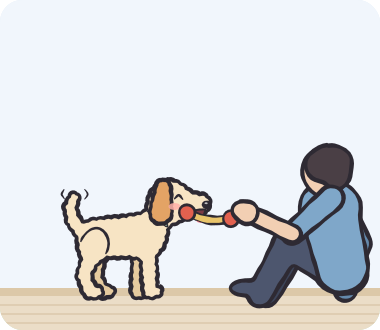
Start with holding At home, quiet
Hold
Sit on the floor and show her the toy. When she sniffs it, “Yes” → treat. Next, “Yes” when her teeth touch it. Then “Yes” when she holds it in her mouth for a moment — building the time up little by little.
A good sign to move onTakes the toy you offer and holds it for about 2 seconds
- 2
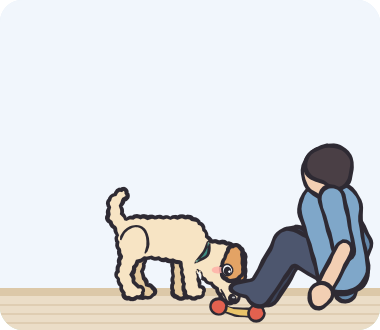
Picking it up from the floor is the right answer At home, quiet
Pick it up from the floor
Put the toy on the floor. When she picks it up, “Yes” → treat. If she doesn’t, start by saying “Yes” when she just goes over and sniffs it.
A good sign to move onPicks up a toy from the floor straight away
- 3
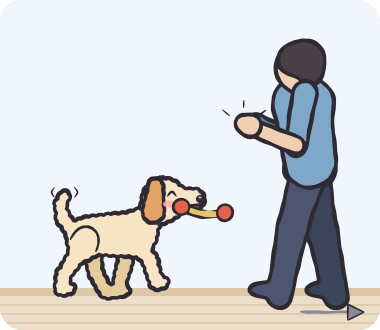
Back away and call, and she follows At home, quiet
Bring it back
Place the toy right beside you, then a little farther each time. When she picks it up, back away and clap softly to call her. When she reaches you, “Drop it.” When she lets go, “Yes” → treat.
A good sign to move onBrings back a toy from 3–6 ft (1–2 m) away and lets go of it for you
- 4
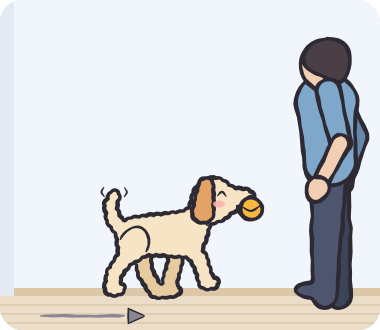
She lets go, and the next roll comes right away At home, small distractions
Roll it: “Fetch”
Say “Fetch” once, then roll the toy low. When she brings it back and lets go on “Drop it,” say “Yes” and roll it again straight away.
A good sign to move onBrings back a toy rolled 10–16 ft (3–5 m) and lets go of it, 8 times out of 10
- 5
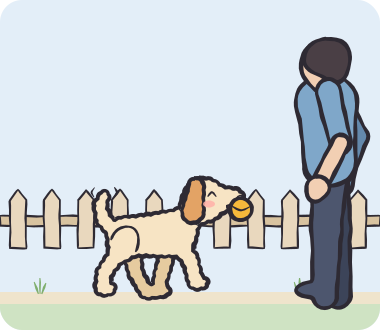
Outdoors, start with short distances Yard, doorstep, outside the house
In a fenced yard
Do the same in a fenced yard. Dogs get more excited outdoors, so go back to short distances to start with.
A good sign to move onBrings it back and lets go in the yard, too
When to reward
Just right
When she picks up the toy and starts back toward you, call her in a happy voice and clap softly. The instant she lets go on “Drop it,” “Yes” → a treat or the next throw straight away. We suggest not saying “Yes” while she’s still on her way back — she may drop the toy to come and collect her treat.
Too late
Praising her a while after she has let go — or throwing the next one before she has handed the toy over. The handing over never got rewarded.
Choosing a toy: no sticks
- Don’t throw sticks. The UK charity Blue Cross warns that sticks fly and bounce unpredictably, and can cause injuries to the gums or throat or a blockage in the gut — some of them life-threatening.
- Pick a ball too big for her to swallow. A ball on a rope is safer. Tennis balls can get stuck in a small dog’s throat, and pieces chewed off can block the stomach (Blue Cross).
- Replace damaged toys so she doesn’t swallow the pieces.
Her body, and hot days
Don’t throw the ball high. Leaping for it can injure her when she lands. Repeated fetch also puts strain on her body through sudden turns and stops, and dogs tend to keep going past their limits because they’re having so much fun (Blue Cross). Asking her to sit and wait while you throw, and letting her go once the ball has stopped, is far kinder on her body. On slippery floors, we suggest playing on a rug or on grass.
Take extra care on hot days. A study of UK veterinary records (more than 900,000 dogs seen in 2016) found that among heatstroke cases where the trigger was recorded (879 cases), 74% were triggered by exercise — far more than being left in a hot car (5%). Young male dogs were more likely to get heatstroke from exercise, and flat-faced breeds (such as pugs and French bulldogs) were more likely to get heatstroke from any of the three triggers: exercise, hot weather and cars. Avoid the hottest part of the day, and keep games short.
What’s the reward: a treat, or the next throw?
Teach it with treats at first. Blue Cross says that once your dog learns that bringing the toy back means another throw, you can gradually cut down the treats. The American Kennel Club (AKC), on the other hand, says that for dogs the game itself isn’t the reward, and recommends continuing to reward with treats. Which works depends on the dog. If she starts slowing down on the way back, bring the treats back.
How long does it take a dog to learn fetch?
We can’t give you a fixed number of days — it depends on whether she already loves toys and already picks things up. Count successes instead of days: at each step, move on once she gets it 8 times out of 10 (our rule of thumb). If she needs longer on one step than another, that’s fine — go at her pace.
A good sign to move on
- Step 4: once she brings back a rolled toy and lets go of it 8 times out of 10, move outdoors (our rule of thumb)
- Outdoors (step 5) only once it’s reliable indoors — start in a fenced yard
- If she struggles, go back a step (our rule of thumb: two misses in a row)
If it isn’t working
She chases it but won’t bring it back
Don’t chase her — that makes keep-away the better game. Backing away, crouching down or clapping softly makes her more likely to follow you (Blue Cross). Go back to shorter distances and repeat step 3 (bring it back).
She brings it back but won’t let go
Practice “Drop it” first. Another way: get two toys she likes about the same; when she comes back, show her the second, and throw it once she lets go of the first (Battersea). More on the Drop It page.
She isn’t interested in toys at all
Try different toys: some dogs love balls, others love plush toys. You can also use a toy you can put food inside (AKC).
She’s obsessed with the ball and can’t stop or rest
Ask her to sit and wait while you throw, and set a limit on the number of throws. After play, a sniffing game — scattering some of her food for her to find — is a good way to help her calm down (Dogs Trust Ireland). If she gets too wound up to stop, work on the practice Play and Pause first.
When can a puppy start, and how long should sessions be?
Once she can play with toys, she can start at step 1. With puppies, we suggest not throwing high and playing on flat ground that isn’t slippery. Keep each session to a few minutes — about 3 to 5 is a common rule of thumb — and stop while she still wants more.
Prescription: a suggested order
The handing-over part and the stopping part are on the practice pages, set out as homework.
- ExerciseThe Trade Game: Teach Your Dog to Drop It by Swapping, Not GrabbingDoable at home (Steps 1–4 at home)Letting go of the toy she brought back on “Drop it.” The finishing touch for fetch.Read →
- ExercisePlay and Pause: Teach Your Dog an “Off Switch” With TugDoable at home (Steps 1–3 at home)Stopping and settling even when ball games get exciting. For dogs who get carried away.Read →
In the moment: do / don’t
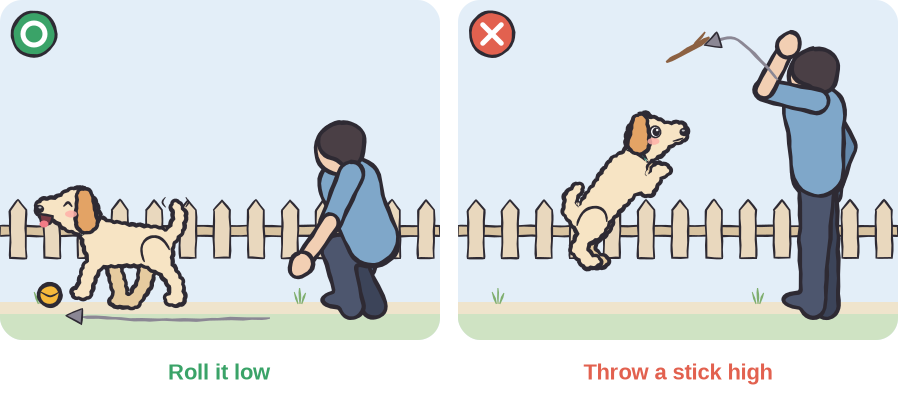
Do
- Start by placing the toy on the floor or rolling it low
- When she picks it up, back away and call her
- Once she lets go, throw again straight away
- Use toys too big to swallow, like a ball on a rope
Don’t
- Throw sticks
- Throw the ball high so she leaps for it
- Chase her when she runs off with the toy
- Keep throwing over and over in the heat of the day
When to see a professional
- After play, she limps, walks oddly or doesn’t want to be touched. Have her checked by your vet
- On a hot day, her heavy panting doesn’t settle with rest, or she staggers, vomits or goes limp. This could be heatstroke: stop exercising, cool her down in the shade, and go to your vet straight away
- She freezes, growls or tries to bite over a toy in her mouth (resource guarding). Talk to your vet or a behavior professional
The skills behind this command
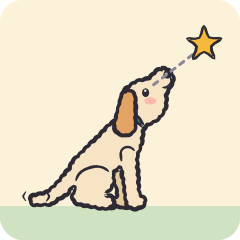 Core skill Focus Even after grabbing a toy far away, turning her attention back to you and coming home.
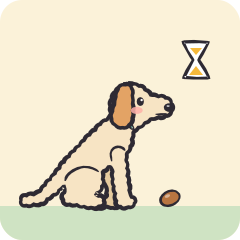 Core skill Impulse Control Letting go of the toy, and waiting until you throw — pausing for a breath in the middle of an exciting game.
- ExerciseThe Trade Game: Teach Your Dog to Drop It by Swapping, Not GrabbingDoable at home (Steps 1–4 at home)Read →
- ExercisePlay and Pause: Teach Your Dog an “Off Switch” With TugDoable at home (Steps 1–3 at home)Read →
Sources
- Blue Cross — How to play with your dog
- Blue Cross — Are sticks safe for dogs?
- American Kennel Club — How to Teach Your Dog to Fetch
- Battersea Dogs & Cats Home — Teaching your dog to “drop it”
- Hall, Carter & O’Neill (2020). Dogs Don’t Die Just in Hot Cars — Exertional Heat-Related Illness (Heatstroke) Is a Greater Threat to UK Dogs. Animals 10(8):1324
- RSPCA — Heatstroke in dogs
- Dogs Trust Ireland — Scatter Feeding
- Dogs Trust — Top ten dog training tips
- RSPCA Australia — How can I teach my dog recall (to come when called)?
- American Kennel Club — Teaching Your Dog to Drop It
- New York City Health Code Article 161, §161.05