 BAUDOG The dictionary of dog–human communication
Contents
- The finished behavior
- Assessment: where is your dog now?
- The cue
- How to signal
- Teaching steps
- When to reward
- If a trainer came to your home: today’s session and the homework
- What age can a puppy learn shake?
- Which paw should my dog shake with?
- Am I doing it right? (Combos and changing the cue)
- A good sign to move on
- If it isn’t working
- Prescription: a suggested order
- In the moment: do / don’t
- When to see a professional
- Sources
The finished behavior
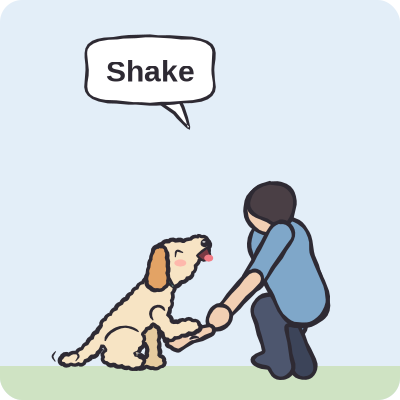
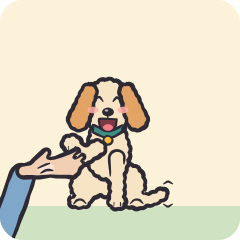
Shake is your dog putting a front paw into your open hand on her own. Rather than picking up her paw and shaping it for her, hold out a fist with a treat inside, wait, and say “Yes” the instant her paw touches it — that way she learns that lifting the paw herself is what pays. Add the word “Shake” only once the paw comes up every time. A puppy can start soon after coming home, as a game that lasts a few minutes.
Assessment: where is your dog now?
A visiting trainer might check something like these four things before teaching shake.
Is she relaxed about having her front paws touched? (Stroke gently from the shoulder down to the toes.)
→If she pulls her paw away or mouths you, start with “Touch Then Treat” so being handled on the paws becomes easy, before you teach shake.
What does she do when you hold a closed fist with a treat in it near her nose? (Sniff, lick, paw at it, or chew hard?)
→If a paw comes up, go straight to step 1. If she chews hard, lower your fist close to the floor so a paw is easier than a mouth.
Does she lift and use both front legs evenly when she reaches or walks?
→If she now uses one front leg less than before, or favors it when she walks, see your vet before practicing.
How does your family teach shake now? (Word, how the hand is held, which paw.)
→Agreeing on one word, one way of holding out the hand, and one paw for “Shake” becomes part of the homework.
The cue
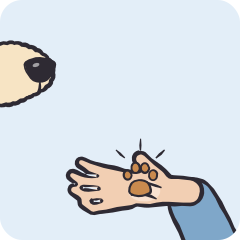
The voice cue is “Shake” (“Paw” is common too — pick one). The hand signal is your palm facing up, held out in front of her chest at about elbow height. That looks a lot like the chin rest signal (palm up, just under the chin), so BAUDOG separates them by height — low for shake, right under the face for chin rest — and uses the voice cue alongside.
How to signal
- Voice
At first, say nothing and wait. Once the paw comes up every time, say “Shake” once, just before you hold out your hand.
- Hand
Start with a closed fist holding a treat, a little below your dog’s nose, and keep it still. Then an empty fist, then an open palm. Hand over the treat from your other hand. Don’t grab her paw and lift it.
- Leash
No leash indoors. When you show the trick outside, keep the leash looped over your wrist and held in your hand — don’t stand on it.
- Body
Crouch or sit on the floor in front of her, on a surface that isn’t slippery. She can be sitting or standing.
Teaching steps
- 1
At home, quiet
Paw touches your closed fist
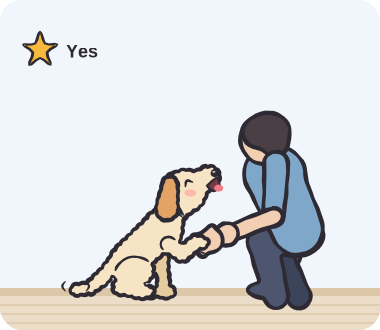
Hold a closed fist with a treat in it a little below her nose, and wait without a word. If she sniffs or licks, keep your hand still. The instant her paw touches your hand: “Yes” → open your hand and let her have the treat.
A good sign to move onA paw comes up when you offer your fist, 8 out of 10 times
- 2
At home, quiet
Empty fist, then open palm
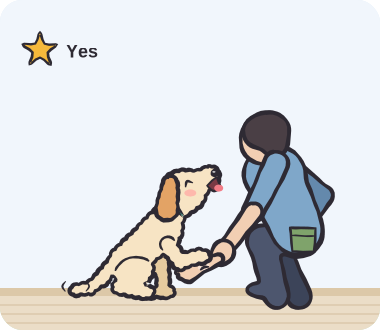
Offer a fist with no treat in it. When her paw touches it: “Yes” → treat from your other hand. Then open your hand a little more each time, until her paw rests on your open palm.
A good sign to move onHer paw lands on your open palm, 8 out of 10 times
- 3
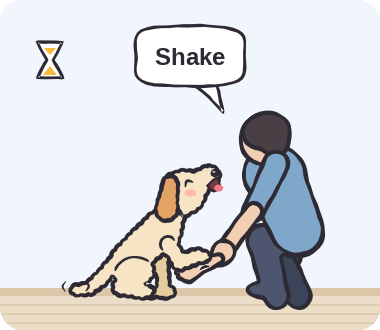
At home, quiet
Add “Shake”
Say “Shake” once, just before you hold out your hand. Paw lands: “Yes” → treat. Stretch the time her paw stays there a little — 1 second, then 2.
A good sign to move onYou say “Shake,” hold out your hand, and her paw lands, 8 out of 10 times
- 4
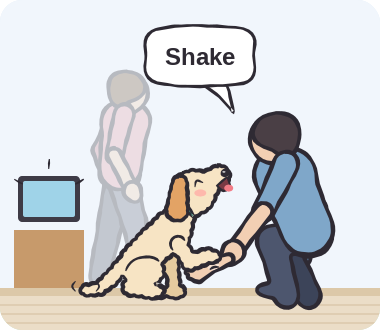
At home, small distractions
With mild distractions — and with the family
TV on, someone walking past. Whoever asks uses the same word and the same hand.
A good sign to move on8 out of 10 times in that setting
- 5
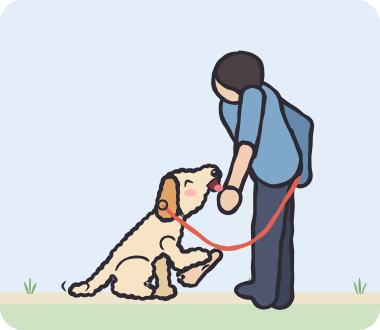
Yard, doorstep, outside the house
Yard, front step, partway through a walk
Outside, use a better treat than indoors. Standing is fine. Keep the leash in your hand.
A good sign to move on8 out of 10 times in that place
When to reward
Just right
“Yes” the instant her paw touches your hand — the treat comes after. Word first, food second.
Too late
“Yes” after she has put her paw down again, or after she has pawed at you several times — you end up rewarding the scraping or the putting-down.
If a trainer came to your home: today’s session and the homework
Here is how a first in-home session might go — one example BAUDOG has put together, not a fixed script.
- Today: the trainer shows you how to hold out a fist with a treat and wait, then hands over for 10 repetitions. The two things they watch and fix on the spot: saying “Yes” at the moment the paw touches, and keeping your hand still while you wait.
- Homework: twice a day, about 3 minutes (5–10 reps). Steps 1–2 only — no “Shake” word yet. If she paws at you without being asked, don’t give a treat; take your hand back and wait.
- Next visit: hold out an empty, open palm — does her paw land on it? Our rule of thumb: at 8 out of 10, adding the word “Shake” (step 3) becomes the next homework. If not, back to the closed fist for another week.
What age can a puppy learn shake?
You can start soon after your puppy comes home. Dogs Trust says puppy training starts as soon as you bring your dog home, and the American Veterinary Society of Animal Behavior (AVSAB) says puppies can start socialization classes as early as 7–8 weeks, with training — in class and at home — based on positive reinforcement.
But shake isn’t an everyday essential. BAUDOG’s suggested order: in the first few weeks, put the marker word, her name, toilet training and getting used to being handled first, and play shake in between as a game of a few minutes.
Which paw should my dog shake with?
Either paw is fine. The American Kennel Club’s Trick Dog program lists “Shake hands” as a Novice-level trick, and its evaluator guide simply says the dog raises her paw chest high so the handler can shake hands — on the cue “Shake,” “Paw” or “Shake hands.” It doesn’t say which paw.
Dogs do seem to have a favorite paw. A meta-analysis of studies on paw preference in cats and dogs found that about two-thirds of dogs (68%) consistently preferred one paw — but, unlike people, dogs as a whole weren’t biased toward the right. So our suggestion: make whichever paw she offers most easily “Shake,” and teach the other one as “Other paw.” Once you’ve chosen, keep it the same across the whole family.
Am I doing it right? (Combos and changing the cue)
We looked at ways owners have come up with on their own, through a trainer’s eyes.
- We always go “Shake → Other paw → Shake…” in turn → She may learn the order and start offering a paw before you ask. Our suggestion: mix up the order now and then — ask for “Shake” twice in a row, or put a “Sit” in between — and reward only when the paw matches the cue.
- I want to show “Shake → Other paw → High five → Wave” as one routine → That works. Make each one solid on its own first (our rule of thumb: 8 out of 10 each), then link them. Once they’re linked, the next cue itself can stand in for a treat after each trick — that’s how Karen Pryor Clicker Training describes behavior chains. If the routine falls apart, go back and practice just the trick that broke on its own, and always reward at the end.
- I want to change the word — from “Paw” to “Shake,” say → Say the new word, pause briefly, then give the old cue and hand as usual, and reward when the paw lands. If you say the new word and the old cue at the same moment, she responds to the old one and never learns the new one. Repeat, and she’ll start lifting her paw to the new word alone.
- I only hold out my hand and never say anything → Dogs often watch hand movements more closely than they listen to words. If the hand alone works for you, you’re done. If you want the word alone to work, say “Shake,” wait about a second before holding out your hand, and praise big if the paw comes up before your hand does.
- She won’t do it unless she sees a treat → Change it step by step: fist with a treat → empty fist → open palm (steps 1–2). Hand over the treat from your other hand. Not showing the treat isn’t the same as not rewarding.
- I ask for a shake before trimming her nails → A good idea. Veterinary Partner, a veterinarian-run site, describes using an offered paw as her “go ahead” signal: if she pulls her paw back, you stop, and you carry on when she offers it again. But a dog who can shake isn’t necessarily fine with nail trims. Practice holding her toes and touching the clippers to her paw separately (“Touch Then Treat,” “Chin Rest”).
- CommandsHow to Teach Your Dog to Shake With the Other Paw — and Tell the Two Apart→
- TricksHow to Teach a Dog to High Five: Three Steps From Shake→
- TricksHow to Teach a Dog to Wave: From High Five to a Paw Wave in the Air→
- ExercisesTouch Then Treat: Help a Dog Who Hates Being Handled Learn to Enjoy It→
- TricksChin Rest Dog Training: Teach It as a Trick or as a Grooming “Start Button”→
A good sign to move on
- Steps 1–2 (indoors): when her paw lands on your fist or open palm 8 out of 10 times, add the word “Shake” (our rule of thumb)
- Steps 3–5: when “Shake” gets her paw on your hand 8 out of 10 times in that place, move to the next place (our rule of thumb)
- If she struggles, go back one step — our rule of thumb is two misses in a row
If it isn’t working
She won’t lift a paw — she just nudges with her nose
Keep your hand still and wait a little longer. Lowering your fist close to the floor makes a paw easier. If it still doesn’t come, praise the tiniest lift of the paw, then gradually wait for it to reach your hand. A dog who finds it hard from a sit can do it standing.
She scrapes my hand hard and her nails hurt
Reward the moment the paw rests on your hand, not the scraping. Wait for the paw to stay on your hand for 1 second, then “Yes.” Don’t mark while she’s scraping.
She chews or licks my hand
Lower your fist toward the floor, where a paw comes more easily than a mouth. If she takes your hand in her mouth, pull it back, wait a moment, and try again.
She offers her paw before I ask
Our suggestion: don’t scold — just take your hand back and wait. When all four feet are on the floor and she’s settled, say “Shake” once, and reward only the paw that comes after the cue.
Since learning shake, she paws at me for attention
First check that she’s getting enough walks, play and food, and that nothing hurts — advice from veterinary behaviorist Dr. Denenberg. Then stop answering paws that weren’t asked for. Start by ignoring her for about 30 seconds and build from there. Meanwhile reward “Say Please by Sitting,” so she has a way to ask without using her paws.
Can I lift her paw to show her?
We don’t recommend it. The American Kennel Club says there’s no need to pick up your dog’s paw and force the shake, and Dogs Trust advises showing your dog what you want rather than physically forcing it. When you lift the paw for her, it’s harder for her to work out what she should do herself, and some dogs come to dislike having their paws handled.
What if she gives the wrong paw?
Don’t scold. Say nothing, wait a moment, and reward when the paw you want comes up. A wrong paw is just her looking for the answer.
Prescription: a suggested order
Practices to do before teaching shake — and for problems afterward.
- ExerciseCharging Your Marker Word: How to Teach Your Dog That “Yes” Means a RewardDoable at home (Steps 1–4 at home)So “Yes” can tell her the exact moment her paw touched your hand. It’s the main foundation of shake.Read →
- ExerciseTouch Then Treat: Help a Dog Who Hates Being Handled Learn to Enjoy ItDoable at home (Steps 1–5 at home)For dogs who don’t like their paws touched. Nail trims and paw wiping are practiced here, separately from shake.Read →
- ExerciseSay Please by SittingDoable at home (Steps 1–3 at home)A different way to ask, for a dog who has started pawing at you to demand things.Read →
In the moment: do / don’t
Do
- Hold out a fist with a treat in it, and wait
- “Yes” the instant her paw touches
- Add the word only once the paw comes every time
- Keep each session to a few minutes
Don’t
- Grab her paw and lift it
- Say “Shake, shake, shake”
- Scold her for the wrong paw
- Answer pawing she wasn’t asked for with a treat
When to see a professional
- She used to shake but now won’t lift one front paw, favors a leg when walking, or keeps licking her paw — these can be signs of pain. Stop practicing and see your vet
- She cries out, growls or mouths when you touch her front paws. Besides pain, she may be afraid. Don’t push on; talk to your vet or a behavior professional
The skills behind this command
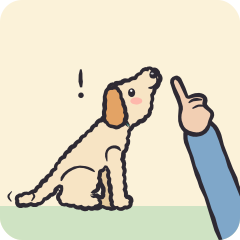 Core skill Understanding Cues Knowing that the word “Shake” and the shape of your hand mean “put your paw here.”
 Core skill Comfort with Handling Being relaxed when her front paws are touched — useful for shake and for nail-trim practice alike.
- ExerciseCharging Your Marker Word: How to Teach Your Dog That “Yes” Means a RewardDoable at home (Steps 1–4 at home)Read →
- ExerciseTouch Then Treat: Help a Dog Who Hates Being Handled Learn to Enjoy ItDoable at home (Steps 1–5 at home)Read →
- ExerciseSay Please by SittingDoable at home (Steps 1–3 at home)Read →
Sources
- American Kennel Club — How to Teach Your Dog to Shake Hands (Sassafras Patterdale, CPDT-KA)
- American Kennel Club — AKC Trick Dog Participant and Evaluator Guide (PDF)
- Dogs Trust — How to teach your dog to give a high five (paw and high five)
- Dogs for Good — Advanced training: Shake hands (PDF)
- Veterinary Partner (VIN) — Shake a Paw for Nail Trims
- Veterinary Partner (VIN) — How To Fade the Lure in Training
- Dogs Trust — Top ten dog training tips
- Dogs Trust — Puppy 101: Training
- AVSAB — Position Statement on Puppy Socialization
- PDSA — Reward-based training
- Whole Dog Journal — How to Teach a Dog to Shake (Paw) (Pat Miller, CBCC-KA, CPDT-KA)
- Ocklenburg et al. (2019). Paw preferences in cats and dogs: Meta-analysis. Laterality 24(6)
- D’Aniello et al. (2016). The importance of gestural communication: a study of human–dog communication using incongruent information. Animal Cognition 19
- Dogmantics (Emily Larlham) — Adding a verbal cue or changing a cue
- Smart Dog University — How to Clean Up Cues and Transfer Cues
- Karen Pryor Clicker Training — Making the Connection: Behavior Chains
- American Kennel Club — How to Identify and Stop Attention-Seeking Behavior in Dogs
- Cornell Riney Canine Health Center — Recognizing pain in dogs