 BAUDOG The dictionary of dog–human communication
Contents
- The finished behavior
- Assessment: where is your dog now?
- The cue
- How to signal
- Teaching steps
- When to reward
- How is this different from turning to her name, or checking in?
- Does eye contact build your bond?
- Dogs who avoid eye contact
- On walks, don’t ask her to keep looking up
- When should I start?
- A good sign to move on
- If it isn’t working
- Prescription: a suggested order
- In the moment: do / don’t
- Sources
The finished behavior
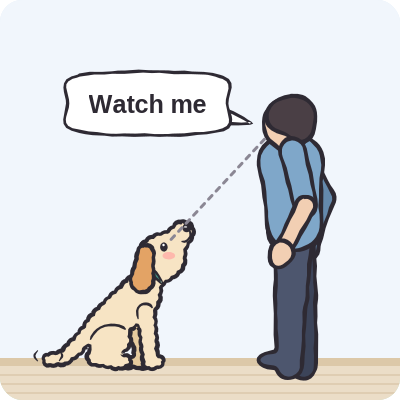
You say “Watch me,” and your dog looks up at your face and holds it there for a few seconds, waiting for what comes next. That’s eye contact on cue. The point isn’t a long stare. It’s getting her attention on you, ready to hear the next cue, with a single word.
Assessment: where is your dog now?
Before you start, a trainer might check three things.
Does she turn to you straight away when you say her name once?
→If not, start with The Name Game. Once her name gets a head turn, “watch me” is much easier to teach.
Without being asked, does she sometimes look up at you on her own?
→If she hardly ever does, start Check-Ins alongside — a no-cue practice where you simply reward the moment she looks up.
When you lean in to look at her face, does she look away, stiffen or back off?
→If so, eye contact is hard for her. Don’t loom over her; crouch side-on and reward the briefest glance toward your face (see “Dogs who avoid eye contact” below).
The cue
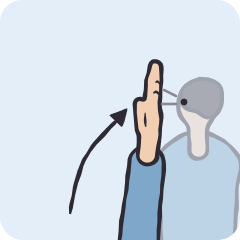
The verbal cue is “Watch me.” Any short word that doesn’t sound like your other cues is fine, but we don’t use “Look” — that’s the cue for the Look at That practice, and two cues shouldn’t share a word. Agree on it as a family. Her name (turn toward me) and “Watch me” (look at my face and wait) do different jobs: you can use her name to get the turn, then “Watch me” to hold her attention. If you want a hand signal, raise your open hand to the side of your eye — the “Look at me” sign in the hand-signal list for deaf dogs from Louisiana State University’s veterinary school. It’s the same movement as the first lure, carrying a treat up to your eye.
How to signal
- Voice
Say “Watch me” once. “Yes” the instant her eyes meet yours. Don’t keep saying “watch me, watch me” while she’s looking elsewhere.
- Hand
At first, slowly carry a treat from her nose to the side of your eye. Soon, make the same movement with an empty hand, and give the treat from your other hand or a pouch.
- Leash
Indoors, no leash. Outside, hold the leash long and loose. Never pull on it to make her look up.
- Body
Stand, or crouch side-on. Don’t lean over her face from above. With a small dog, sitting down at first brings your eyes closer to hers.
Teaching steps
- 1
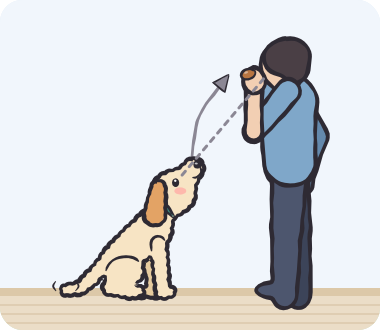
Carry the treat up to your eye At home, quiet
Treat hand to your eye
Show your dog a treat at her nose, then slowly carry it up to the side of your eye. The instant her eyes meet yours, “Yes” → treat.
A good sign to move onWhen you bring your hand to your eye, she looks at your face straight away (our rule of thumb: 8 out of 10 times)
- 2
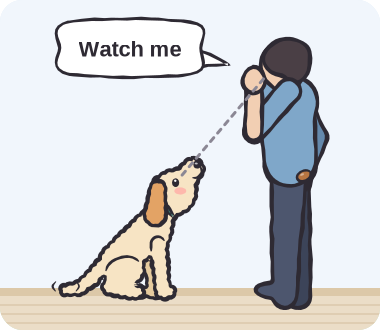
Eye contact, even with an empty hand At home, quiet
Empty hand, then add “Watch me”
Make the same movement with no treat in that hand. When your eyes meet, “Yes” → a treat from your other hand. Once the empty hand reliably gets eye contact, say “Watch me” just before you move your hand.
A good sign to move onWhen you say “Watch me,” she looks at your face (8 out of 10 times)
- 3
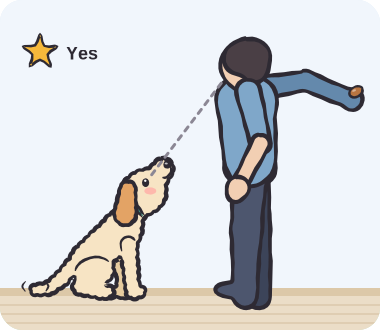
Your face, not the treat At home, small distractions
A second at a time
When your eyes meet, don’t say “Yes” straight away — wait one second. Once she manages one second, try two, adding a second at a time. If she looks away, go back to the length she could manage and try again. Battersea’s version is a good extra exercise: hold the treat out to the side at arm’s length, and say “Yes” the moment she stops looking at the treat and looks at your face.
A good sign to move onShe holds eye contact for about 3–5 seconds
- 4
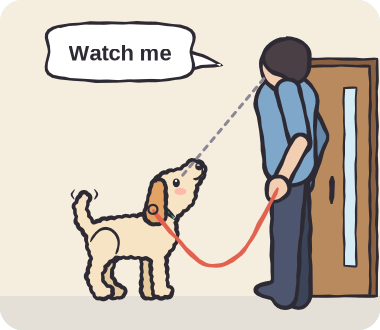
Outside: short holds, better treats Yard, doorstep, outside the house
Outside your door, then on walks
On leash in front of your house, stop and say “Watch me.” Outside, use better treats than indoors, and go back to one second. Once that goes well, try a quiet street, then your usual walk.
A good sign to move onIn that place, “Watch me” gets a look at your face straight away (8 out of 10 times)
When to reward
Just right
The instant your dog’s eyes meet yours, “Yes.” Then the treat.
Too late
Saying “Yes” after her eyes have already moved to your treat hand or the floor. What you rewarded was looking away.
How is this different from turning to her name, or checking in?
All three are “looking at you,” but they happen in different moments and do different jobs. Here’s how we split them.
- Turning to her name (The Name Game): your dog is looking at something else, and one call of her name turns her head toward you. It’s where the recall starts.
- “Watch me” (this page): your dog is already facing you, and she holds her gaze on your face for a few seconds. She’s ready for the next cue.
- Checking in (Check-Ins): with no cue at all, your dog chooses to look up at you. On walks and at cafés, this is the one that pays off longest.
Does eye contact build your bond?
A team of researchers in Japan (Azabu University and colleagues, published in Science in 2015) reported that when dogs gazed at their owners, the owners’ urinary oxytocin (a hormone linked to bonding between people and animals) rose; the owners then interacted with their dogs more, and the dogs’ oxytocin rose too. With wolves, gazing didn’t raise the owners’ oxytocin. In a second experiment, giving dogs oxytocin through the nose increased their gazing, which in turn raised their owners’ oxytocin. (The study summary doesn’t give the number of animals or other conditions, so we only report the direction of the results.)
But this was a study of everyday gazing that dogs start themselves. It didn’t test whether teaching a “watch me” cue deepens your relationship. The length of eye contact alone doesn’t decide how good your relationship is. Teach “watch me” as a cue for attention.
Dogs who avoid eye contact
Being stared at is uncomfortable for some dogs. Turning the head away, avoiding eye contact, creeping backward and a stiff body are listed by Cornell University’s Riney Canine Health Center as signs of fear and tension. If you see them, don’t ask for eye contact. The AKC also notes that some dogs are uncomfortable with eye contact and take longer to learn this, and that a dog deliberately looking away is probably not ignoring you — it’s more like “please calm down.” Take a break and try again when you can be relaxed and upbeat. Our advice: don’t lean over her; turn side-on, crouch, and reward the brief moment she turns her face toward you on her own. Longer holds come later.
Why dogs stare at their owners (asking for something, checking what you’re doing, and so on) is covered on Why Does My Dog Stare at Me?
On walks, don’t ask her to keep looking up
Use eye contact in short moments: when you stop, before passing someone, waiting at a crossing. The goal isn’t a dog who stares up at you the whole way. She needs time to watch her feet and her surroundings too. Once “Watch me” is solid, the AKC suggests it can make it easier to walk past another dog, because she’s looking at you instead.
But if another dog is coming and your dog is scared, barking or trying to lunge, don’t stay put trying to get her to look at you — move away first. Dogs Trust in the UK puts it this way: if your dog can’t pull their gaze away from the distraction, you’re too close; move away before they lose their ability to focus. How to manage distance from things she finds hard is covered on Barking at Other Dogs.
When should I start?
There’s no set age. Our advice: start once she has settled in a little and turns to her name. A puppy who has just arrived and isn’t used to people or the house yet should start with the name game and quiet time near you.
A good sign to move on
- When she looks at your face on cue 8 out of 10 times at the current step, move on (our rule of thumb)
- Build the hold one second at a time. If she looks away partway, go back to the length she managed before
- When you change places, drop back to one second (make it harder one thing at a time)
If it isn’t working
She stares at the treat hand, not my face
The treat has stayed in your hand too long. Make the same movement with an empty hand and give the treat from your other hand or a pouch. Holding the treat out to the side and rewarding only when she looks at your face, not the treat, helps too.
She looks away almost immediately
You’re asking her to hold it too long. Go back to rewarding the instant your eyes meet, then add a second at a time. Check your body too — are you leaning over her?
She does it at home but not outside
Outside, smells and sounds are more interesting than your face. Start again somewhere quiet, like right outside your door, back at one second, with better treats than you use at home.
Now she keeps looking up and won’t walk
After you praise her, toss the treat a little ahead or say “Let’s go” and set off. On walks, use it only for short moments.
Suddenly she won’t meet my eyes, or she bumps into things
Her eyesight or hearing may be changing. See your vet before you add more practice.
Prescription: a suggested order
The order we recommend. Once she turns to her name, you can work on “Watch me” and Check-Ins side by side.
- ExerciseThe Name GameDoable at home (Steps 1–2 at home)When one call of her name gets a turn, the first step of “watch me” becomes much easier.Read →
- ExerciseCheck-Ins: Teach Your Dog to Look at You Without Being AskedDoable at home (Step 1 at home)Builds the habit of looking up at you with no cue. It carries the attention “watch me” creates into everyday walks.Read →
In the moment: do / don’t
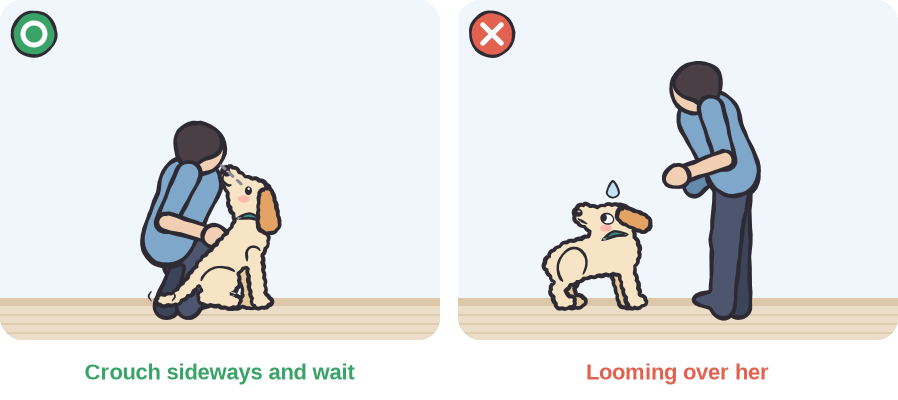
Do
- “Yes” the instant your eyes meet
- Switch from the treat hand to an empty hand early
- Build the hold one second at a time
- For a dog who looks away, crouch side-on and reward a brief glance
Don’t
- Say “watch me” again and again
- Lean over her face, or turn her head toward you with your hands
- Pull on the leash to make her look up
- Try to make a frightened dog look at you on the spot
The skills behind this command
 Core skill Focus Bringing her attention back to you, even when something else is interesting. “Watch me” creates that attention with one cue and holds it for a few seconds.
- ExerciseThe Name GameDoable at home (Steps 1–2 at home)Read →
- ExerciseCheck-Ins: Teach Your Dog to Look at You Without Being AskedDoable at home (Step 1 at home)Read →
Sources
- Battersea — How to teach your dog the watch me command
- American Kennel Club — Grab and Hold Your Dog’s Attention With the ‘Watch Me’ Cue
- San Francisco SPCA — Name Recognition and Attention
- Whole Dog Journal (Pat Miller) — Teach Your Dog to Make Eye Contact
- American Kennel Club — How to Reduce Your Dog’s Treat Dependence
- Nagasawa, M., Mitsui, S., En, S., et al. (2015). Oxytocin-gaze positive loop and the coevolution of human-dog bonds. Science 348(6232):333–336
- LSU School of Veterinary Medicine — Hand Commands for Communicating with Deaf Animals
- Maxwell, M. E. (2017). Teaching Name Recognition (AVSAB blog)
- American Kennel Club — Dog Training Duration, Distance, Distraction (the 3 Ds)
- San Francisco SPCA — Sit Command
- Battersea — How to teach your dog to sit
- AVSAB — Position Statement on Humane Dog Training (2021)
- Cornell Riney Canine Health Center — Dog Bite Prevention
- Dogs Trust — Pulling on lead