 BAUDOG The dictionary of dog–human communication
Contents
- The finished behavior
- Assessment: where is your dog now?
- The cue
- How to signal
- Teaching steps
- When to reward
- Turning her own stretch into a trick (capturing)
- Is my own way right? Common questions
- What a play bow means between dogs
- The look-alike “praying position” can be a sign of belly pain
- A good sign to move on
- If it isn’t working
- Prescription: a suggested order
- In the moment: do / don’t
- When to see a professional
- Sources
The finished behavior
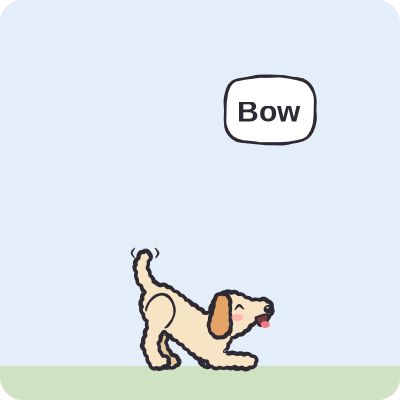
On “Bow,” your dog lowers her chest and puts her front elbows on the floor while her rear end stays up.
Assessment: where is your dog now?
A visiting trainer might check something like this before starting.
Does she stretch into a bow on her own — after waking up, or when inviting play?
→If she does it often, rewarding that moment (capturing) is the fastest way.
Standing, if you lower a treat from her nose, does she drop straight into a down?
→The better a dog is at “Down,” the more her bows turn into downs. With the lure method, mark the moment her elbows touch the floor and get her moving again right away (see the steps).
Is the floor non-slip?
→Dogs sometimes slide their front paws out as they stretch, so BAUDOG suggests a non-slip mat.
How is her body?
→A bow doubles as a back stretch. But if she has a sore back or hips, check with your vet first. If she keeps taking a similar position when she isn’t playing, it can mean belly pain (see below).
The cue
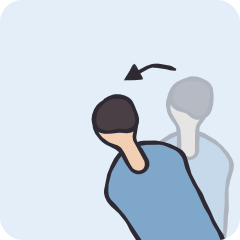
The word is “Bow.” For the hand signal, many families use a smaller version of the teaching lure (a hand moving from her nose down toward her chest), or a little bow of their own. Add either one only once she can do the movement.
How to signal
- Voice
Say “Bow” once — and only once the movement is reliable. At first: “Bow” → short pause → the usual hand lure.
- Hand
At first, the lure: a treat at her nose, lowered between her front legs toward her chest. Switch to an empty hand and shrink the motion. You can also transfer the cue to a little bow of your own.
- Leash
Practice indoors, off leash.
- Body
Crouch in front of her. For a dog who keeps lying down, just rest a palm or a finger lightly under her belly, a little in front of her hips — don’t lift.
Teaching steps
- 1
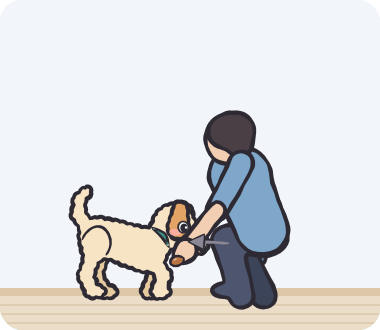
From her nose toward her chest, slowly From a stand, lure toward her chest
With your dog standing, lower a treat slowly from her nose to between her front legs, toward her chest (the lure the American Kennel Club describes). When she bends her front legs a little, “Yes” → treat.
A good sign to move onBAUDOG’s rule of thumb: she bends her front legs 8 times out of 10
- 2
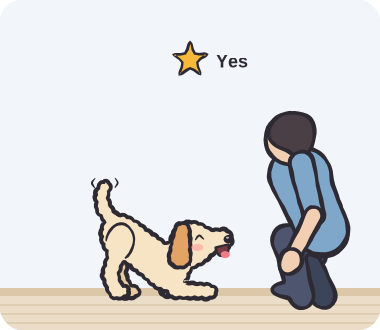
Rear up, elbows down Until her elbows touch the floor
Lure a little deeper each time. The moment her elbows touch the floor with her rear still up, say “Yes.” Toss the treat a short distance so she stands right up — waiting in position tends to turn into a down (this is what an AKC trainer recommends).
A good sign to move onBAUDOG’s rule of thumb: elbows on the floor with her rear up, 8 times out of 10
- 3
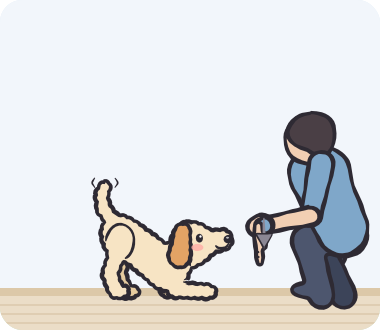
Lure with an empty hand With an empty hand
Make the same hand motion without a treat. When she bows, reward from your other hand. Make the motion a little smaller each time.
A good sign to move onBAUDOG’s rule of thumb: 8 out of 10 with an empty hand
- 4
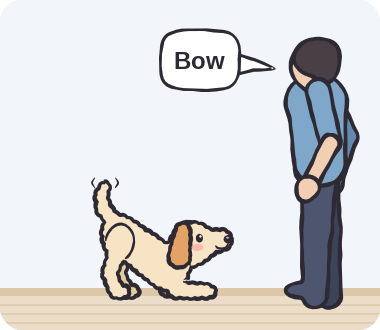
Word → short pause → hand Add the word
“Bow” once → short pause → small hand lure → “Yes” when she bows. With repetition, she starts to bow on the word alone.
A good sign to move onBAUDOG’s rule of thumb: 8 out of 10 on the word alone
- 5
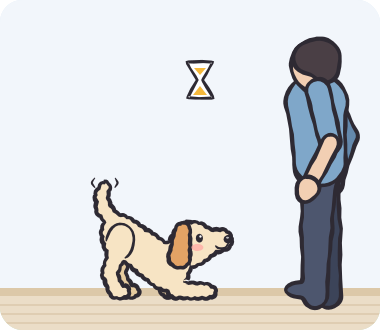
A little longer each time Hold it a little longer
Have her stay in the bow a little longer before you mark — 1 second, then 2, and so on.
A good sign to move onBAUDOG’s rule of thumb: 8 out of 10 at that length
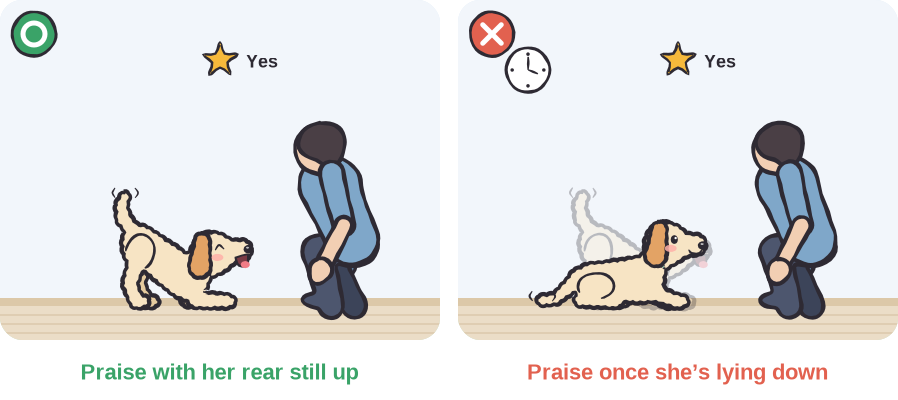
When to reward
Just right
“Yes” the moment her elbows touch the floor with her rear still up. With the capturing method, the moment she reaches the stretch.
Too late
“Yes” after her rear has dropped and she’s lying down — the reward goes to the down.
Turning her own stretch into a trick (capturing)
Many dogs stretch into a bow on their own — after waking up, or when inviting play. If you mark that moment with “Yes” and give a treat, again and again, she will start offering the bow more often. The American Kennel Club recommends this method too.
It suits dogs who keep lying down when lured. Add the word once you can tell a stretch is coming (once you can predict it): say “Bow” just as she starts to stretch, and repeat.
In the AKC Trick Dog program, a lured bow is one of the Novice-level options, and a bow with no lure is an Advanced trick. A captured stretch with a cue on it is already a bow without a lure.
Is my own way right? Common questions
Answers to the questions owners most often have about methods they worked out themselves.
“Every time she stretches, I say ‘Bow’ and praise her. Will she learn it that way?” — Yes. Rewarding a movement she offers and turning it into a trick is a proper training method. Two things to fine-tune: say the word just as the stretch begins, not after it’s over, and mark the moment she reaches the stretch.
“She keeps lying down, so I lift her belly to make the shape.” — Stop lifting. The American Kennel Club says to stretch your dog by hand only if a veterinary physical therapist has told you to, because otherwise you could accidentally injure her. The AKC trainer’s tip is a light touch under the belly, just in front of the hips, to tell her you’re not asking for a down. With the lure method, mark the moment her elbows touch the floor and toss the treat so she stands right up.
“I want to finish a routine like a show — Spin, then Bow.” — BAUDOG suggests linking them only once Spin and Bow each work reliably on the word alone. Give the cues one at a time at first; once the flow is steady, give the whole routine a new single word. To add it: new word → short pause → the usual first cue.
“I want her to bow when I bow.” — A great cue. Your bow → short pause → the usual cue (word or hand lure) → reward when she does it; repeat until your bow alone works. The AKC notes too that the physical cue can evolve into you bowing or curtsying.
“Can she bow when I say ‘Thank you’?” — It’s just a change of word, so the same transfer works. But words you say all the time in everyday talk will reach her when you don’t mean the trick. BAUDOG suggests a phrase you rarely use otherwise — “Take a bow,” for example.
What a play bow means between dogs
The front-down, rear-up posture dogs use in play is called a play bow, and has long been seen as an invitation to play. A study of 414 play bows by 16 pet dogs at play found that bows most often came right after a brief pause in play, and were often followed by both dogs moving in the same way or by a chase. The researchers concluded that play bows work to restart play after a pause. It was a small study.
The bow trick is this posture put on cue. If your dog play-bows at you, she may be inviting you to play.
The look-alike “praying position” can be a sign of belly pain
If your dog keeps taking a rear-up, front-legs-and-head-on-the-floor position when she isn’t playing or doing the trick — and is also lethargic, vomiting or off her food — it can mean belly pain. Dogs with pancreatitis may take this “praying position” during an attack (VCA). See your vet right away.
A good sign to move on
- Bend the front legs → elbows on the floor → empty hand → word → hold a little longer. BAUDOG’s rule of thumb: move on when the current step works 8 times out of 10
- Add the word only once the movement is reliable (with capturing: once you can predict the stretch)
- If she’s struggling, go back one step — our rule of thumb is two misses in a row
- Keep sessions to a few minutes, and stop while she still wants more
If it isn’t working
Her rear drops and she lies down
The most common snag. Mark the moment her elbows touch the floor — before her rear drops — and toss the treat so she stands right up. Moving your hand too far forward can also lead to a down. A light hand under her belly can help (don’t lift). If she still lies down, switch to capturing her stretch.
She backs up instead
Your hand may be moving too far back, deep under her chest. Try lowering it straight down between her front legs, for example.
She won’t bend her front legs
You’re asking for too much at once. Start by rewarding a slight bend, then deepen it little by little.
She won’t bow on the word alone
Go back to word → short pause → small hand lure. Don’t drop the hand suddenly — shrink it little by little.
Prescription: a suggested order
Bow rests on one skill: linking a cue to a movement.
In the moment: do / don’t
Do
- Mark the moment she stretches into a bow on her own
- Mark when her elbows touch the floor, then toss the treat so she stands up
- Switch to an empty hand early and shrink the motion
- Add the word once the movement is reliable
Don’t
- Lift her belly or pull her front legs to make the shape
- Praise after she has lain down
- Keep practicing tricks with a dog who repeatedly takes the praying position when she isn’t playing
When to see a professional
- She keeps taking a rear-up, front-legs-and-head-down position when she isn’t playing, and is lethargic, vomiting or off her food. It can mean belly pain, such as pancreatitis — see your vet right away
- She struggles to sit or get up from lying down, hesitates to play actively, or suddenly stops stretching or bowing. These can be signs of pain
The skills behind this command
Sources
- American Kennel Club — Advanced Dog Tricks (How to Teach Your Dog to Bow)
- American Kennel Club — Why Dog Core Strength Matters (Bowing)
- American Kennel Club — Lure-and-Reward Training
- AKC Trick Dog Participant and Evaluator Guide (PDF)
- Whole Dog Journal — Clean Up Your Cues
- Battersea Dogs & Cats Home — How to teach your dog to lie down
- Susan Garrett — When Do I Add a Cue?
- Byosiere, Espinosa & Smuts (2016). Investigating the function of play bows in adult pet dogs. Behavioural Processes 125:106–113
- AVSAB — Position Statement on the Use of Dominance Theory in Behavior Modification of Animals
- AVSAB — Position Statement on Humane Dog Training (2021)
- VCA Animal Hospitals — Pancreatitis in Dogs
- Cornell University Riney Canine Health Center — Recognizing pain in dogs
- Dogs Trust — Top ten dog training tips