 BAUDOG The dictionary of dog–human communication
Contents
- In short
- When it happens
- How your dog feels
- Where does it go wrong? Four patterns
- If a trainer came to your home: the first session and the first homework
- Step by step: teaching her to accept nail trims
- Treat after the touch, not during it
- Let her say “go ahead”
- How not to cut the quick (especially on black nails)
- If a nail bleeds
- How often to trim — and signs the nails are too long
- Grinders and scratch boards: other ways to keep nails short
- Older dogs and dogs with sore joints
- When to stop and get help
- What the research says
- The missing core skill
- Exercises
- In the moment: do / don’t
- When to see a professional
- Sources
In short
Most dogs who hate nail trims have had several unpleasant things happen at once: a paw grabbed, a body held down, maybe a nail cut too short. Every dog is different, but feet are a sensitive area to begin with, and holding a dog down to do all the nails in one go tends to make the next trim harder. The fix is to break the trim into small steps — shoulder, elbow, paw, seeing the clippers, hearing them, then one nail — and pair each step with something good. One nail per session is fine. One nail a day still gets every nail done. If your dog growls or tries to bite, don’t push on alone: talk to your vet.
When it happens
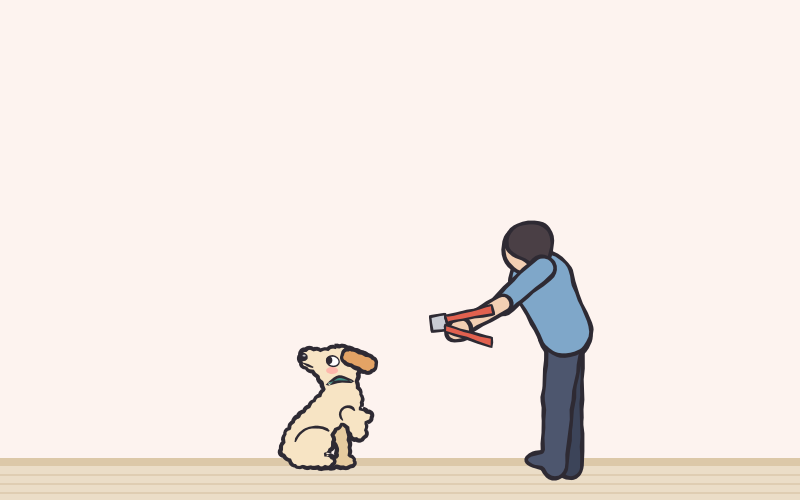
- Your dog runs and hides the moment the clippers come out
- She pulls her paw away or thrashes as soon as you reach for her foot
- She jumps and bolts at the “snip”
- She’ll let you do the front feet, but never the back — or never the black nails
- She’s been much worse since the time a nail bled
- Nail trims are the only time she growls or tries to bite
How your dog feels
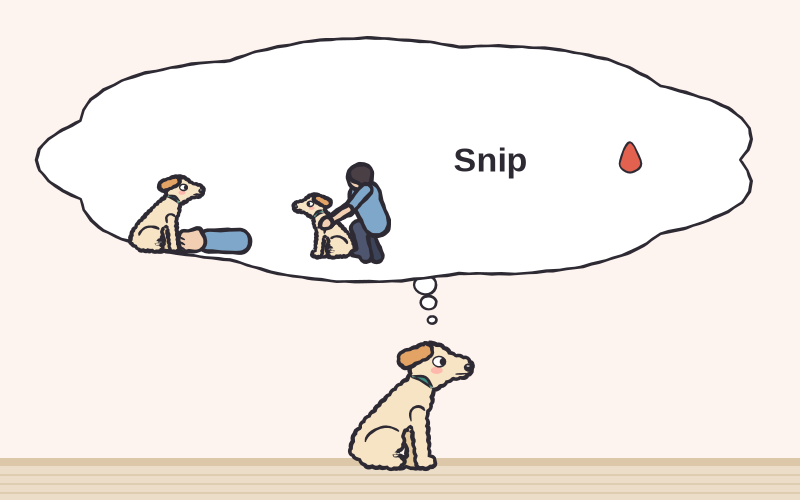
Paws are one of the most sensitive parts of a dog’s body — VCA notes that dogs have more nerve endings in their feet and toes than elsewhere. In a typical nail trim, that sensitive foot is grabbed, the dog is held so she can’t leave, there’s a sharp snip, and sometimes it hurts. For a dog, that is several unpleasant things stacked on top of each other.
One painful trim can be enough. After a nail is cut into the quick, some dogs brace the moment they see the clippers: here comes the painful thing again. Forcing the trim through makes it more likely she’ll fight sooner and harder next time.
Not knowing what is coming, and not being able to get away, is stressful in itself. So the aim is a routine where she can predict each step and can say “wait” — that makes nail care much easier to accept.
Where does it go wrong? Four patterns
Watch which part of the trim she objects to. That tells you where to start practicing. (These four patterns are BAUDOG’s way of sorting it, one example rather than a rule.)
- She objects as soon as you touch her paw → being handled is the problem. Put the clippers away and start with Touch Then Treat on her shoulder or back.
- Touching is fine, but she runs from the clippers → the tool is linked to past bad experiences. Start with “see the clippers → treat” (step 4 below).
- She lets you hold her paw but jumps at the snip → add sound practice (step 5).
- She allows one or two nails, then starts to struggle → you’re doing too many at once. Cut back to the number she can manage before she objects: one.
If a trainer came to your home: the first session and the first homework
Here is how we’d expect a first in-home session with a visiting trainer to go — one example from BAUDOG, not a fixed script. Even for a dog who hates nail trims, no nails get cut on day one.
- What the trainer looks at first: where she’s happy to be touched and where she starts to object (a light touch moving shoulder → elbow → wrist → paw). Her “I don’t like this” signals — freezing, a quick lick of the lips, yawning, turning her head away. How she reacts when she sees the clippers. Whether a nail has ever been cut too short.
- Today: touch her shoulder or back for one second → take your hand away → treat, 10 times (step 1 of Touch Then Treat). The trainer shows you how to read her stress signals and stops just before the spot she dislikes. Don’t grab her foot from above; glide your hand down from her shoulder instead.
- Homework (BAUDOG’s rule of thumb): a few times a day, 2–3 minutes each. Up to 10 rounds of touch-then-treat on a spot she’s happy with. Once that’s easy, move one step closer each time: elbow, then wrist, then paw. If she objects, go back a step. Keep the order — touch first, then treat (don’t touch her while she’s eating the treat).
- At the next visit, the trainer checks: when you touch her paw for one second, does her body stay loose? Our rule of thumb: if she stays relaxed 8 times out of 10, the next homework is holding her paw for longer and “see the clippers → treat.”
Step by step: teaching her to accept nail trims
Break the trim into tiny steps (desensitization) and pair each one with something delicious (counterconditioning). This is the approach recommended in VCA handouts written by veterinary behavior specialists, and in an owner handout on Veterinary Partner, the Veterinary Information Network’s site for pet owners. Only move on when she stays relaxed and is happily waiting for the next treat. Rushing can backfire: she may start to see the treats themselves as a warning that something bad is coming. For a dog who is already afraid, VCA notes this can take weeks, months, or longer — that’s normal.
- 1. Touch her shoulder → treat. Touch her elbow → treat.
- 2. Touch her paw → treat. Don’t grab from above — glide your hand down from her shoulder to her paw.
- 3. Hold her paw → press gently on a nail → treat. Build up how long you hold, for example 1 second → 3 seconds → 5 seconds (BAUDOG’s rule of thumb).
- 4. Put the clippers down nearby → treat. Show her the clippers → treat.
- 5. The snip sound → treat. A little way away from her, snip a piece of dry spaghetti with the clippers, then treat.
- 6. Bring the clippers up to a nail and touch it (no cutting) → treat.
- 7. Cut the very tip of one nail → an especially good treat → done for today. Stop at one, even if she looks like she’d let you do more.
- 8. One nail a day — or one nail at a time, a few times a day. As she relaxes, go up to two nails, then three.
Treat after the touch, not during it
Touch or trim first, then the treat straight away — in the same order every time. The VIN handout says the treat goes right after each step whatever her reaction, and she doesn’t need to offer a paw or do anything to earn it.
If you trim while she’s busy eating, she gets clipped before she notices, and the food can start to mean “something is about to happen to me.” VCA’s behavior specialists put it plainly: for dogs who fear nail care, avoid tricks and distractions — don’t hand over a spoonful of peanut butter and quickly try to trim. It may work once or twice, but it damages her trust and often makes the fear worse. So while you’re building up, keep it trim first, treat second. (Purdue University’s handout also describes letting a dog lick treats from a lick mat stuck to the wall while you handle her paws. We treat that as a separate option for dogs who are already comfortable with trims.)
If there are two of you, one person can do the touching and trimming while the other hands out the treats. It makes the timing much easier.
Let her say “go ahead”
You don’t have to hold her down — you can teach her to take part. The VIN handout describes teaching a dog to sit, lift a front paw, place it in your hand and keep it still: no restraint needed, because the dog chooses to join in. A chin rest works too: you only touch her nails while her chin rests on your hand or a towel, and you stop the moment she lifts it (see Chin Rest: Your Dog’s Start Button). Once she can say “hang on,” she no longer needs to fight to get away.
How not to cut the quick (especially on black nails)
Inside each nail runs a blood vessel and nerve, called the quick. Cutting into it bleeds and hurts — and a single painful trim can be where nail-trim fear begins.
- Take only a tiny bit off the tip at a time. Many small cuts are better than one big one.
- On white or clear nails you can see the pink quick inside. Stop well before it.
- On black nails you can’t see in, so look at the cut surface after each small trim. When the center changes from dry and flaky-looking to slightly moist and shiny — VCA compares it to the inside of a jellybean — stop. You’re close to the quick.
- If you can’t tell where to stop on dark nails, ask your vet or a groomer to show you once.
- Choose scissor- or plier-style clippers, where two sharp blades cross. Guillotine clippers have only one sharp blade and can crush the nail instead of cutting it. Keep the blades sharp.
- If you’re new to clippers, practice first on cocktail straws or dry spaghetti to get a feel for how to hold them and how hard to squeeze.
If a nail bleeds
Stay calm and press a little styptic powder onto the end of the nail — cornstarch works if you don’t have any. Bleeding usually stops within a few minutes, and the pain is usually brief. If it doesn’t stop, call your vet.
Don’t trim any more that day. End with something tasty, and next time start again gently from an earlier step (seeing the clippers, or touching them to the nail).
How often to trim — and signs the nails are too long
VCA says most dogs need their nails trimmed every 3–4 weeks, and some need it weekly. Purdue University’s handout says most dogs do well with a monthly trim, give or take. How fast nails wear down depends on how much and where your dog walks.
If you can hear her nails clicking on the floor when she trots, they’re probably too long.
Overlong nails can change the way a dog stands and walks, which can be painful, and they can split or catch on things. Don’t forget the dewclaws on the inner side of the paw (not every dog has them).
When a nail has grown long, the quick grows with it, so you can’t shorten it all at once. Trim a little at a time over several sessions.
Grinders and scratch boards: other ways to keep nails short
If the snip or the squeeze of the blades is the problem, there are other tools.
- Nail grinder (such as a Dremel): it files a little at a time, so you’re less likely to hit the quick. It is noisy and vibrates, so start by switching it on a distance away → treat. Touch each nail for just 1–2 seconds; longer, and the nail heats up. Keep clippers handy for spots the grinder can’t reach.
- Scratch board (a board covered in sandpaper): your dog files her own nails by scratching at it with her front paws. A VIN handout by a board-certified veterinary behaviorist explains how to teach it in small steps — approach the board, touch it, scratch it — rewarding each one. It’s especially useful for dogs who hate having their feet held.
Older dogs and dogs with sore joints
VCA points out that hard floors can be painful for bony or arthritic dogs, so trim on something soft. Rather than making her stand, let her lie on a bed or mat in whatever position is comfortable. Avoid lifting or bending her legs high — that can hurt stiff joints (BAUDOG’s advice). If she used to be fine and has suddenly started hating nail trims, have your vet check for pain.
When to stop and get help
If she freezes, tries to escape or tries to bite, stop and ask your vet for help — Purdue University’s handout says the same. If she might be frightened enough to bite, talk to your vet first and protect yourself with a muzzle (teach her to like the muzzle with treats beforehand).
Holding her down — by hand, or in a grooming hammock or sling — carries a high risk of making the fear worse, VCA warns. If her nails are too long to wait until training is done, your vet can trim them under sedation, and may prescribe medication to reduce her anxiety before trims. That protects all the work you’ve put in far better than a frightening forced trim.
Please don’t punish her for growling. A dog who learns that growling gets her in trouble may stop warning and bite instead.
What the research says
There isn’t much research on nail trims specifically. One small study took 37 dogs that were afraid of the vet: 15 had four weeks of exam-style handling practice at home (desensitization and counterconditioning) plus weekly trips to the clinic, and 22 had no training. The trained dogs showed slightly less fear at the vet — the authors called the program “mildly effective” — and 44% of these motivated owners didn’t keep up with the training. A review of how to reduce fear and stress at the vet adds that forceful restraint and a sharp “no” raise the risk of aggressive responses such as biting.
So: short sessions, at an amount you can actually keep up. That really is the fastest way.
The missing core skill
Exercises
- ExerciseTouch Then Treat: Help a Dog Who Hates Being Handled Learn to Enjoy ItDoable at home (Steps 1–5 at home)Even when a sensitive spot is touched, her body stays relaxed and she looks to you for the next treat.Read →
- ExerciseChin Rest Training: Teach Your Dog a “Start Button” for Grooming and Vet CareDoable at home (Steps 1–5 at home)She offers her chin to your palm or a towel on her own, and keeps it there for a few seconds up to about 10. While her chin is down, she’s comfortable being touched.Read →
In the moment: do / don’t
Do
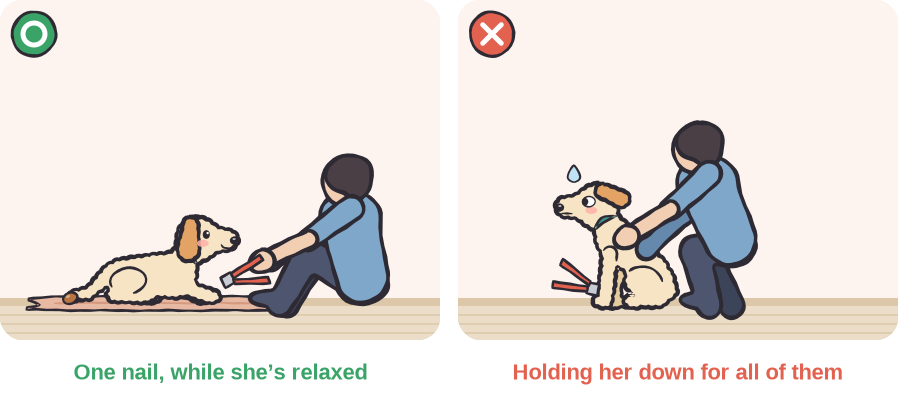
- Glide your hand down from her shoulder to her paw
- Touch or trim first, then treat straight away
- One nail per session — stop while she’s still relaxed
- On black nails, check the cut surface after every small trim
- Have styptic powder ready before you start
Don’t
- Grab her foot from above
- Hold her down and do every nail at once
- Distract her with peanut butter and sneak a trim (while you’re still building up)
- Punish her for growling
- Carry on trimming the same day after cutting the quick
- Use blunt guillotine clippers that crush the nail
When to see a professional
- She growls, tries to bite or freezes. Talk to your vet — a muzzle, sedation or anti-anxiety medication may be part of the plan
- She started refusing strongly after a nail was cut too short. Work with your vet or groomer on the next steps
- Her nails are so overgrown they’re splitting, or she walks oddly
- She used to be fine but suddenly doesn’t want her feet touched — this can be a sign of pain
- Bleeding hasn’t stopped after a few minutes
Go to the root
Don’t stop at the quick fix. Growing the skill underneath makes other problems lighter too.
Sources
- VCA Animal Hospitals — Handling Exercises for Trimming Nails and Brushing Teeth (Lindell, Feyrecilde, Horwitz, Landsberg)
- VCA Animal Hospitals — Taking the Stress out of Nail Trimming for Dogs (Lindell, Feyrecilde, Llera, Buzhardt)
- VCA Animal Hospitals — Best tips to de-stress your pet’s pedicures
- Veterinary Partner (VIN) — Conditioning Your Dog to Nail Trims (Sherrie Yuschak, RVT, VTS (Behavior))
- Veterinary Partner (VIN) — Nail Boards: An Alternative to Clipping Nails (Christine D. Calder, DVM, DACVB)
- Veterinary Partner (VIN) — Top 10 Myths About Canine Behavior (Christine D. Calder, DVM, DACVB)
- Purdue University Canine Welfare Science — Nail trimming for dogs (PDF)
- Ontario SPCA — How to trim your dog’s dark nails safely and efficiently
- American Kennel Club — How to Trim Dog Nails Safely
- American Kennel Club — Dog Hates Being Groomed: How Husbandry Training Can Help
- Riemer et al. (2021). A Review on Mitigating Fear and Aggression in Dogs and Cats in a Veterinary Setting. Animals 11(1):158
- Stellato et al. (2019). Effect of a Standardized Four-Week Desensitization and Counter-Conditioning Training Program on Pre-Existing Veterinary Fear in Companion Dogs. Animals 9(10):767
- MSD Veterinary Manual (veterinary edition) — Behavioral Problems of Dogs (cooperative care)
- PDSA — Muzzle training your dog