 BAUDOG The dictionary of dog–human communication
Contents
When to use this exercise
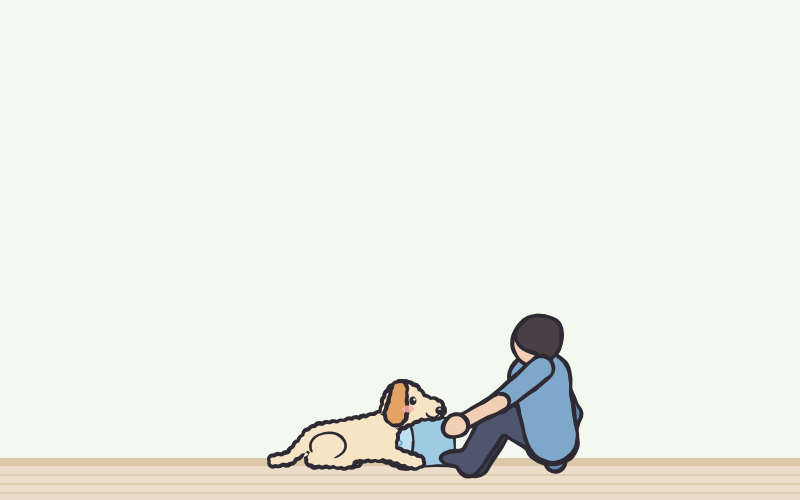
For nail trims, toothbrushing, eye drops and vet exams. Do the care only while your dog rests her chin on a towel or your palm, and stop the moment she lifts it. Chin down means “go ahead”; chin up means “wait a moment.” Once she knows she can stop things herself, accepting care gets easier. The key point: you don’t ask for the chin rest with a cue — you wait for your dog to offer it on her own (that’s different from showing off a “chin” trick). The MSD (Merck) Veterinary Manual also says handling for care is best approached with cooperative care training, which is built on positive reinforcement. This practice goes hand in hand with Touch Then Treat, and it builds Comfort with Handling and Calm.
GoalShe offers her chin to your palm or a towel on her own, and keeps it there for a few seconds up to about 10. While her chin is down, she’s comfortable being touched.
Assessment: what a trainer might check on the first visit
A visiting trainer might check these before starting.
Can you bring your palm or a towel under her chin without her minding?
→If she minds, first use Touch Then Treat to get her used to hands near her face.
How far along is Touch Then Treat?
→If touching her comfortable spots is going well, you can start. Run it alongside the work on her sensitive spots.
Which part of her care does she find hardest? (Paws, mouth, ears, eyes)
→In steps 4–5, start touching her comfortable spots while her chin is down, and leave the hardest spot until last.
How big is she, and what position will you do her care in?
→Small dogs: your palm, on your lap or a table. Large dogs: you sit on the floor and use a towel or cushion. Decide where her chin will go.
What you need
- A rolled-up towel or a small cushion (whatever you have at home)
- Small treats
- You’ve already started Touch Then Treat (to about step 2)
How to signal
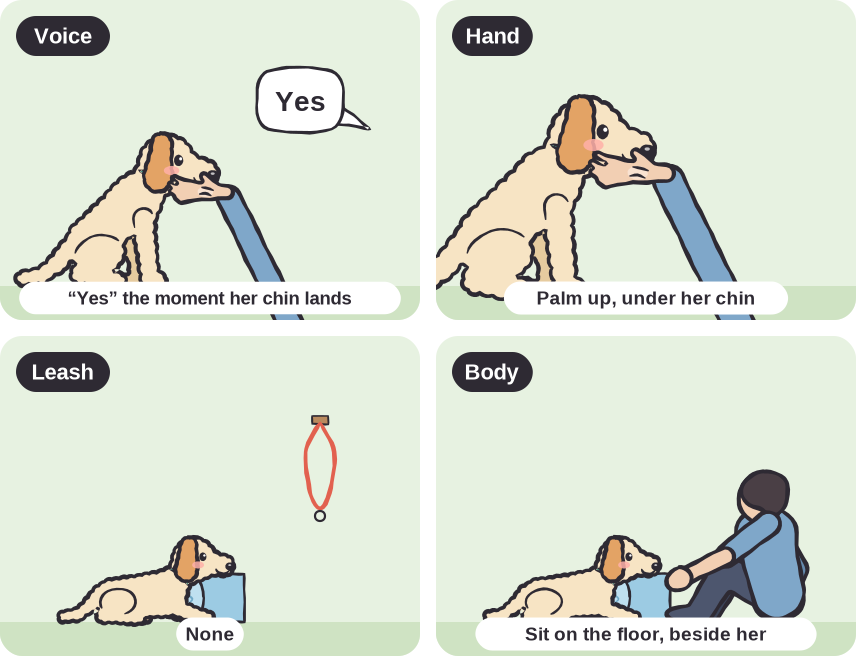
- Voice
No cue word. Offer your palm or the towel, then wait quietly; the instant she rests her chin on it, say “Yes.” Save the word “chin” for when you show it off as a trick.
- Hand
Palm up, held just under her chin. When her chin lands, bring the treat to her mouth with your other hand. Never hold her chin in place.
- Leash
None.
- Body
Sit on the floor, or crouch beside her. Don’t lean in and stare into her face.
Today’s session
With the trainer, you work on step 1.
Step 1Chin touches your palm(At home (quiet room))
The trainer shows you once, then hands over. Hold your palm under her chin and use a treat in your other hand to draw her nose down a little. The moment her chin touches your palm, “Yes” → treat. Ten repetitions. The trainer fixes on the spot the two common slips: holding her chin down, and offering your hand too high.
Homework until the next visit
- How often
- Once or twice a day
- How long
- 2–3 minutes each
- How much
- Up to 10 per session
A good sign she’s readyWhen you offer your hand, she rests her chin on her own and keeps it there for about 5 seconds
What the trainer checks next visit
In front of the trainer, see how long she keeps her chin on your palm or the towel.
If she canIf she offers it herself and stays still for about 5 seconds, step 3 (moving to a towel or cushion) and step 4 (touching comfortable spots while her chin is down) become the next homework.
If not yetShorten the time again and do another week. If she lifts her chin straight away, check together how you deliver the treat (to her mouth, with her chin still down).
Next stages: steps
- 1
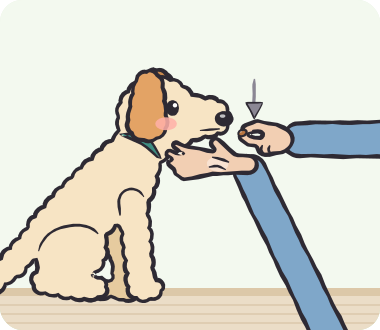
At home (quiet room)
Chin touches your palm
Hold your palm under her chin and use a treat to draw her nose down a little. The moment her chin touches it, “Yes” → treat.
A good sign to move onWhen you offer your hand, she rests her chin on her own, 8 out of 10 times
- 2
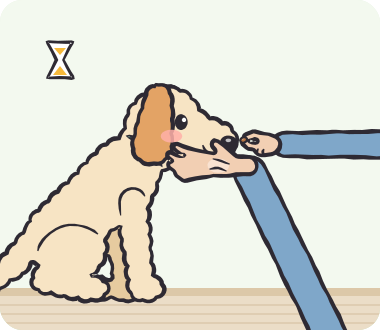
At home (quiet room)
How long it stays
1 second → 3 → 5 → 10, a little at a time. Bring treats to her mouth while her chin is down. When she lifts it, that’s the end of that rep.
A good sign to move onHer chin stays down for about 10 seconds (the number of seconds is a guide)
- 3
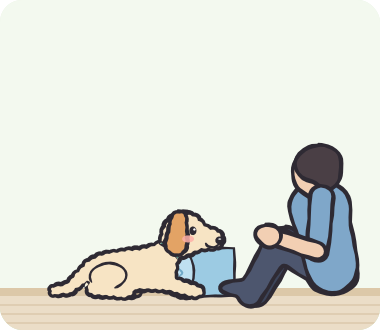
At home (quiet room)
Onto a towel or cushion
Do the same with a rolled towel or cushion instead of your palm. Both your hands are now free, which makes care easier. No cue: put the towel down and wait quietly.
A good sign to move onWhen you put the towel down and wait, she comes and rests her chin on it without a cue
- 4
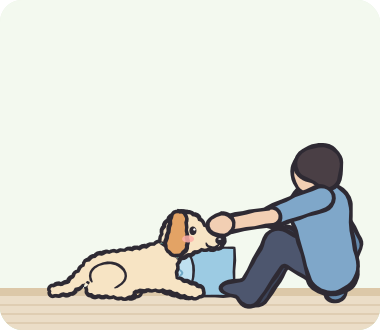
At home (quiet room)
Touching while her chin is down
While her chin is down, lightly touch a comfortable spot (shoulder, back) → treat. Once that’s easy, move on to her paws and mouth. If she lifts her chin, take your hand away at once.
A good sign to move onShe keeps her chin down while you touch her, 8 out of 10 times
- 5
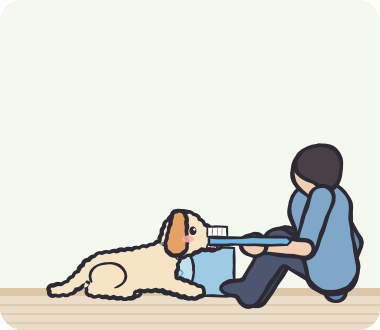
At home (quiet room)
Using tools while her chin is down
While her chin is down, touch her with the nail clippers or toothbrush → take it away → treat. Once that’s easy, one nail or one tooth. If she lifts her chin, stop and wait.
A good sign to move onDay after day of doing one nail or one tooth with her chin down
- 6
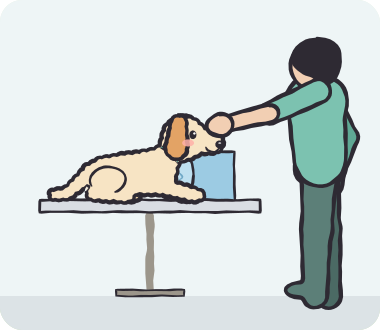
At the vet’s or the groomer’s
At the vet’s or groomer’s
Bring her usual towel, put it on the exam table or in the waiting room, and wait for your dog to rest her chin on it herself. Ask the vet or groomer ahead of time to stop if she lifts her chin.
A good sign to move onShe offers her chin on her own, even away from home
Timing
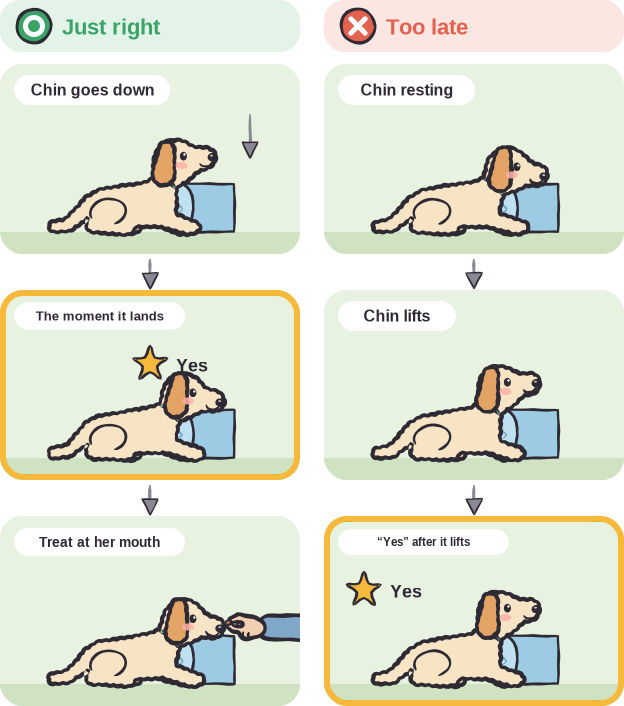
Just right
“Yes” the instant her chin lands on your palm. Then the treat, to her mouth, while her chin is still down.
Too late
Praising or treating after she lifts her chin. That rewards lifting it.
Deliver the treat close to where her chin is resting — right at her mouth. If you hand it over further away, she reaches for it and her chin comes up.
How much and how often
2–3 minutes per session, up to 10 reps. About once or twice a day.
If it isn’t working
She lifts her chin straight away
That’s her “wait a moment.” Stop at once. Go back one step in how long, how firmly or where you touch. Once she learns that lifting her chin really does stop things, she feels safe and is more likely to offer her chin again.
She doesn’t get what the chin rest is for
Use a towel on the floor and praise the moment her chin dips even slightly. It’s fine to draw her nose down a little with a treat.
She licks or nibbles your hand when you offer it
Check that she can’t see the treat hand. Keep the treat behind your back and bring it out only after her chin touches.
She keeps her chin down but doesn’t move at all (she’s frozen)
If her body is stiff, she may not be accepting it so much as putting up with it. Go back one step and keep it short.
Many guides teach a “chin” cue. Should I?
For a trick, yes — add a “chin” cue once she offers it reliably; the Chin Rest trick page explains how. As a start button for care, we don’t cue it. Veterinary Partner’s guide puts it plainly: this behavior is never cued — your dog should offer it voluntarily. If you ask for it, it’s no longer her way of saying “I’m ready.” How long she can hold it matters less than you stopping when she lifts it.
Avoid
- Carrying on with care after she has lifted her chin (she learns that signaling is pointless)
- Holding her chin down with your hand
- Scolding her for not resting her chin
A good sign to move on
- Step 1: when you offer your hand she rests her chin on her own, 8 out of 10 times → move on (our rule of thumb)
- Steps 2–5: day after day of keeping her chin down through that step → move on
- If she keeps lifting her chin, go back one step
- To use it for toothbrushing, follow the order on the “Hates Teeth Brushing” page (face → lips → finger → toothbrush) with her chin down
Sources
- Klebba, K. (AVSAB handout) — Cooperative Care: When to touch and poke?
- Veterinary Partner (VIN) — How to Teach a Chin Rest as a Start Button (Hannah Brehaut, CDBC)
- Seeing Eye Dogs (Vision Australia) — Cooperative care: Puppy Development (2023, PDF)
- MSD Veterinary Manual — Behavior Problems of Dogs
- AAHA (2015) Canine and Feline Behavior Management Guidelines
- MSD Veterinary Manual — General Guidelines for Effective Controlled Exposure Behavior Modification in Dogs (table)
- Dogs Trust — Dog aggression: causes, warning signs and how to help