 BAUDOG The dictionary of dog–human communication
Contents
- In short
- When you see it
- What it may mean
- Assessment: where is your dog now?
- Does wagging to the left or right mean something different?
- Breed differences
- When she chases or chews her tail
- When her tail suddenly hangs limp or stays down
- Skills to build
- Exercises
- When you see it: do / don’t
- When to see a professional
- Sources
In short
Dogs don’t only wag when they’re happy. A 2024 research review says tail wagging often goes with arousal of both kinds — good and bad. So read the tail together with three other things: how high it is (high, level, low or tucked), how it’s moving (loose and sweeping, fast and stiff, or suddenly still), how stiff the body is, and what’s going on. A loose, sweeping wag with a relaxed body usually means friendly. A tail held high and stiff with a fast, narrow wag points to excitement or tension. A low wag or a tucked tail points to worry or fear. Tail shape and resting position vary a lot between breeds, so the most useful thing is to know your own dog’s normal and notice changes from it.
When you see it
- She came over wagging, then growled when you reached to pet her
- On a walk, she spots another dog and her tail goes straight up, the tip flicking fast
- At the vet’s, her tail is tucked between her back legs
- When you come home, she wags so hard her whole back end swings
- Your Shiba Inu’s curled tail is hanging lower than usual
- After a long swim, her tail suddenly hangs limp and she won’t wag
What it may mean
A review of research on dog communication describes the tail like this. Held high: confidence, arousal, or wanting to approach — to greet or play. Held stiff: a threat, or anxiety. Held low or tucked between the back legs: fear, anxiety, or appeasement (“I don’t want trouble”). Wagging loosely from side to side: friendliness or excitement. With fast movements, height changes the meaning — a high tail suggests confidence, while a low wag is generally linked to anxiety, nervousness or inner conflict.
A 2024 review of tail-wagging research says wagging often comes with both positive and negative arousal. People tend to read every wag as happiness, but one small study found the opposite of what you might expect: in 16 small tests of aggressive reactions, police dogs with a history of aggression during training (11 dogs) wagged their tails more than a group of herding and other dogs (13 dogs). The same review also points out that, for all the meaning people read into it, tail wagging has rarely been measured carefully. Tail charts online are rough guides, not a dictionary.
So don’t judge by the tail alone. Look at the whole dog — how stiff her body is, her ears, eyes and mouth — and the situation. If the wagging stops or her body freezes the moment you touch her, it may mean “I’m not so sure about this.”
Assessment: where is your dog now?
Look at these four things together. Here is one way BAUDOG suggests reading a tail.
How high is it, compared with her usual position?
→Higher than usual points to arousal, confidence or interest; lower than usual or tucked points to worry or fear. Resting position varies by breed, so compare with your dog’s normal.
How is it moving?
→A loose, sweeping wag (often with the whole back end swinging) is usually friendly; PDSA describes a medium-high, “half-mast” wag as a relaxed, comfortable dog and a circular “helicopter” wag as the clearest sign of joy. A fast, narrow, stiff wag held high points to excitement or tension. A low, fast wag points to worry — PDSA notes that the lower and faster the wag, the more anxious a dog may feel. If the wag suddenly stops, she may be weighing things up or getting tense.
Is her body loose or stiff?
→Even if she’s wagging, a stiff body leaning forward with a fixed stare means it’s better not to approach.
What’s happening?
→A homecoming, play or a greeting — or a strange dog, the vet’s, or something she doesn’t want to give up? The same wag can mean different things in different situations.
Does wagging to the left or right mean something different?
In a 2007 experiment, 30 pet dogs were shown their owner, an unfamiliar person, a cat and a dominant unfamiliar dog. Their tails swung more to the right when they saw something positive, like their owner, and more to the left when they saw the dominant unfamiliar dog. The researchers link this to the different jobs of the left and right sides of the brain.
In a 2013 study, 43 dogs watched videos of a dog wagging more to one side (most were turned into silhouettes). When the dog on screen wagged more to the left, the watching dogs’ heart rates went up and they showed more anxious behavior than when it wagged more to the right. Dogs may be able to pick up this difference in each other.
But these studies measured the swing of the tail on video. Nobody has shown that owners can tell left from right by eye in everyday life. BAUDOG’s suggestion: pay more attention to height, movement and the whole body than to left and right.
Breed differences
Tail shape and resting position vary by breed. For example, dogs with curled tails, like Shiba Inus, Akitas and Pugs, normally carry the tail up over the back, while Greyhounds and Whippets normally carry it low. Dogs with very short tails, or docked tails, have fewer ways to show how they feel with their tail, which makes them harder to read. A long or dense coat can hide tail and body signals, too.
Whatever your dog’s breed, look at how her tail has changed from its usual position, and read it alongside her ears, eyes, mouth and how stiff her body is.
When she chases or chews her tail
A puppy playing with her own tail is usually just exploring her body. In adult dogs, tail chasing can come from boredom, wanting attention, a sore or injured tail, or a compulsive disorder she can’t stop.
If it happens only now and then, or only in certain situations, and she stops easily when you call her, it’s usually nothing to worry about. If she injures her tail, starts with little or no trigger, or it gets in the way of normal life, it needs checking as a possible compulsive disorder. Pain and neurological problems can cause the same thing, so start with your vet. Some breeds, such as German Shepherds and Bull Terriers, are more prone to it.
Scolding adds fear and frustration, which makes it harder to treat. Instead, distract her with a food puzzle or a game, and teach her a calm behavior such as settling on a mat.
When her tail suddenly hangs limp or stays down
A tail held in an unusual position is one of the signs of pain. If she suddenly holds her tail down and won’t lift it, doesn’t like the base of her tail being touched, or doesn’t want to sit, have her checked by your vet.
One cause to know about is limber tail (also called acute caudal myopathy, swimmer’s tail or cold tail), a strain of the tail muscles. According to Cornell’s vet school, it’s seen most often in young, athletic, large-breed working and hunting dogs such as Labrador Retrievers and Pointers. It often follows long swims (especially in cold water), hard exercise, long periods in a crate or car, or cold, wet weather, and the signs usually appear within a few hours to a day. The tail hangs limp, or is stiff at the base with a floppy tip, and it may hurt to touch; she may not want to wag, may have trouble sitting or lying down, or may lick or chew her tail.
Other problems can look similar — a broken tail, spine trouble, anal gland or (in male dogs) prostate problems — so let your vet examine her rather than guessing. With rest and any pain relief your vet prescribes, most dogs recover fully within a few days to two weeks.
Skills to build
Exercises
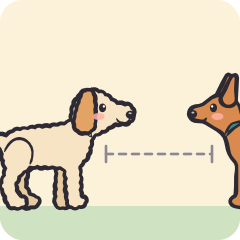
If her tail goes stiff and high, or tucks, around strange dogs or people, help her get comfortable from a distance. Here is one plan BAUDOG suggests.
When you see it: do / don’t
Do
- Read tail height and movement together with body stiffness and the situation
- Learn where your own dog’s tail usually sits
- If the wagging stops when you touch her, stop petting
Don’t
- Assume a wagging tail means she’s happy to be petted
- Walk up to a dog whose tail is high and stiff while she stares
- Laugh at, or scold, a dog who chases and bites her tail
When to see a professional
- She suddenly holds her tail down and won’t lift it, doesn’t like the base being touched, or doesn’t want to sit (this can be pain)
- Her tail suddenly hangs limp or she can’t wag, especially after swimming, hard exercise or a long time in a crate (possible limber tail — your vet will rule out a fracture or spine problem)
- She chases her tail until she injures it, starts with no trigger, or can’t be stopped
- She keeps growling or snapping when you try to pet her, even while wagging (talk to your vet or a qualified behavior professional)
Grow the skill underneath
Sources
- Siniscalchi et al. (2018). Communication in Dogs. Animals 8(8):131
- Leonetti, Cimarelli, Hersh & Ravignani (2024). Why do dogs wag their tails? Biology Letters 20:20230407
- Quaranta, Siniscalchi & Vallortigara (2007). Asymmetric tail-wagging responses by dogs to different emotive stimuli. Current Biology 17:R199–R201
- Siniscalchi, Lusito, Vallortigara & Quaranta (2013). Seeing left- or right-asymmetric tail wagging produces different emotional responses in dogs. Current Biology 23:2279–2282
- Gobbo & Zupan Šemrov (2021). Neuroendocrine and Cardiovascular Activation During Aggressive Reactivity in Dogs. Frontiers in Veterinary Science 8:683858
- PDSA — Tail meaning: What your pet’s tail is trying to tell you
- VCA Animal Hospitals — Canine Communication: Interpreting Dog Language (Horwitz & Landsberg, DACVB)
- RSPCA — Understanding your dog’s body language
- VCA Animal Hospitals — Compulsive Disorders in Dogs (Lindell, Horwitz & Landsberg, DACVB)
- VCA Animal Hospitals — Why do dogs chase their tails?
- Cornell University College of Veterinary Medicine — Limber tail in dogs (acute caudal myopathy)
- Cornell University College of Veterinary Medicine — Recognizing pain in dogs
- PDSA — Dogs and phobias
- Cornell Richard P. Riney Canine Health Center — Dog Bite Prevention (April 2025)