 BAUDOG The dictionary of dog–human communication
Contents
- In short
- When to use it
- From your dog’s side
- Assessment: where is your dog now?
- What is luring? Lure vs. bribe
- How to lure a sit and a down
- How to fade the lure: turn your hand motion into a hand signal
- A way to fade without the empty hand
- If a trainer came to your home: the first session and the first homework
- Troubleshooting
- A good sign to move on
- Skills to build first
- Exercises that use it
- Using it: do / don’t
- When to see a professional
- Sources
In short
Luring (lure-reward training) means holding a treat — or a toy — at your dog’s nose and moving it so her body follows into the position you want. It’s a quick way to teach sit, down and many tricks. The part that matters most is fading the food out of your hand early. Once she follows the treat easily, reward from your other hand → use the same motion with an empty hand → add the cue word → make the hand motion smaller. That motion becomes her hand signal. Fade early so she doesn’t learn to move only when she can see food — the point where a lure starts turning into a bribe.
When to use it
- Your dog sits when she sees a treat, but not when your hand is empty
- You want to teach a sit but aren’t sure how to move your hand
- When you try to lure a down, she stands up to follow the treat
- You’ve heard that “luring with food is bribery” and aren’t sure whether to use it
From your dog’s side
Dogs follow their noses. Hold a treat close to her nose and move it, and her head follows — and her body comes along. When her head goes up, her rear goes down, and she sits.
But dogs pay close attention to what they can see. If you guide her with a food-filled hand every time, she can learn “I do it when I see the treat” — and stop doing it when she can’t.
While her attention is on the food in your hand, she’s watching your hand more than noticing what her own body is doing. Giving the treat from your other hand helps shift her attention from the food to the action.
Assessment: where is your dog now?
A visiting trainer would usually start by checking whether luring suits your dog. Check these four things.
When you hold a treat at her nose, does she follow your hand?
→If so, luring is a good fit. If not, try a tastier treat, or a quiet room with fewer distractions.
Does she jump up at the treat?
→Keep the treat close to her nose and move slowly. For a sit, lifting your hand too high makes her jump instead of sit.
Does she flinch or back away when a hand comes over her head?
→Luring isn’t the right tool. Reward her the moment she sits on her own (capturing), or use shaping.
Do sitting or lying down look uncomfortable for her (an older dog, sore joints, a long-backed breed)?
→Go slowly and reward small steps. If it looks painful, don’t push it — talk to your vet. It’s fine to teach a different position instead, such as standing still or lying down.
What is luring? Lure vs. bribe
Luring uses a reward the dog wants to follow — usually a treat — to guide her body into a position or movement. The American Veterinary Society of Animal Behavior (AVSAB) lists luring, alongside capturing and shaping, as a way to teach behaviors with rewards. It works for positions like sit and down, and for many tricks too.
A toy can be a lure as well, for a dog who will follow it. The American Kennel Club suggests not always giving that same toy as the reward — surprise her with something else, so she learns the lure and the reward are two different things.
Isn’t luring with food just bribery? Trainers such as Dr. Ian Dunbar and Suzanne Clothier draw the line like this: a lure helps a dog who doesn’t yet understand what you’re asking, while a bribe is waved or promised before the behavior to talk a dog into something she knows but doesn’t want to do. Dunbar adds a warning: if the same food is used as both lure and reward for long, lure-reward training slides toward bribery — the dog does it only when there’s food in your hand. That’s why the lure should leave your hand early, and the food should move from what starts the behavior to what comes after it (trainer Dr. Deb Jones). Then the treat is a reward, not a bribe.
The catch is that both dogs and people can easily become dependent on the lure. Fade it early so she doesn’t only work when food is in view (see “How to fade the lure” below).
One more caution: don’t use food to coax a dog closer to a person or thing she’s afraid of. Trainer Pat Miller describes a dog who is afraid of strangers taking a treat from a stranger’s hand, then realizing he’s far too close to the scary person — and biting. Our advice: never lure a fearful dog toward what frightens her.
How to lure a sit and a down
Start in a quiet room at home. Keep sessions short.
- Use a tiny treat (smaller than your fingernail), pinched between thumb and index finger, held right at her nose.
- Sit: with her standing, move the treat slowly from her nose up over her head and slightly back, in a gentle arc. As her head follows it up, her rear goes down. The instant it touches the floor, “Yes” → that treat.
- Down: with her sitting, move the treat from her nose toward her chest, then straight down to the floor. As soon as she lies down, treat.
- If her down doesn’t reach the floor, mark and reward when she gets partway, then a little lower next time — combining luring with shaping.
- Our suggestion: if she loses the treat, bring your hand back to her nose and start again. Don’t make her chase it or speed up suddenly; she follows better when you move slowly.
- Spins, weaving through your legs and other tricks can be taught the same way, by leading her with a treat at her nose.
How to fade the lure: turn your hand motion into a hand signal
Start fading as soon as she follows the treat easily (our rule of thumb: five smooth reps in a row). Most dogs only need a few repetitions with food in your hand, says the American Kennel Club. We’ve laid out the UK charity Battersea’s method as four steps.
- Step 1 — switch hands: lure with the treat hand, then give the treat from your other hand.
- Step 2 — empty hand: make the same motion with an empty hand. When she does it, reward from your other hand (or a treat pouch, so she can’t tell where the food is coming from).
- Step 3 — cue word: say “Sit” while making the same motion. Once she responds right away, say the word once first and wait a few seconds. If she doesn’t move, help her with the hand motion.
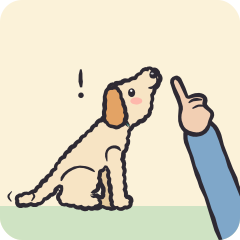
- Step 4 — smaller signal: gradually make the hand motion smaller, until a small hand signal or the word alone is enough. On BAUDOG’s cue cards, the hand signal for sit is a raised index finger; shrinking the upward lure motion leads naturally into it.
- Removing everything at once makes dogs lose motivation. If she stops responding, go back a step (our rule of thumb: two misses in a row).
- The food leaves your hand, but the reward stays. When she does it, praise her and give her a treat.
A way to fade without the empty hand
Some trainers feel that moving an empty hand as if it held a treat (step 2) is tricking the dog. Their alternative: hold the treat hand behind your back and say the cue. If she does it, mark and treat. If she doesn’t, bring the treat out and lure her. Gradually wait a little longer after the cue before helping, and lure less and less each time. Either way, you end up in the same place.
If a trainer came to your home: the first session and the first homework
Here’s one example of how a visiting dog trainer might run it.
- Today: an assessment (does she follow a treat at her nose, is she hand-shy, does sitting look uncomfortable). In a quiet room, the trainer demonstrates luring a sit, then you take over for about five reps. If it goes smoothly, you move on to step 1 (switching hands).
- Homework until next time: for example 2–3 sessions a day, 2–3 minutes each, working through step 1 then step 2. Film one session on your phone to check that your “Yes” lands the moment her rear touches the floor.
- What the trainer checks next visit: can she sit to an empty-hand motion? By our rule of thumb, 8 out of 10 → step 3 (cue word) becomes the next homework. If not, another week on step 1.
Troubleshooting
- She won’t do it unless she sees the treat: the fading came too late. Test it — give the cue word or hand signal with no food in your hand. If she doesn’t respond, she’s still relying on the lure. Start again from step 1 (switching hands).
- She won’t follow an empty hand at all: the American Kennel Club suggests rubbing the fingers of your lure hand with a smelly treat, then rewarding from your other hand. Use it as a short bridge for a few reps, then go back to a plain empty hand (our suggestion).
- She only does it with the hand signal: make the hand motion smaller and reward when she starts to respond to the word. Fade the hand bit by bit.
- She jumps at the treat: your hand is too high. Keep it close to her nose and move slowly.
- She stands up during a down: check whether your hand is drifting forward (pulling it forward makes it easy for her to stand up to follow the treat). Go toward her chest, then straight down. Reward partway and build up.
- She does it at home but not outside: go back a step and practice somewhere quiet outdoors, rewarding often. Expect to start from scratch in each new place; after the first couple of places, she’ll usually progress faster.
A good sign to move on
- She follows the treat hand easily (our rule of thumb: five in a row) → step 1 (switch hands)
- She sits to an empty-hand motion 8 out of 10 times (our rule of thumb) → step 3 (cue word)
- She sits within a few seconds of one cue word, 8 out of 10 times (our rule of thumb) → step 4 (smaller signal)
Skills to build first
Exercises that use it
Our suggested order.
- ExerciseCharging Your Marker Word: How to Teach Your Dog That “Yes” Means a RewardDoable at home (Steps 1–4 at home)If you can say “Yes” the moment she gets it right, she still knows what earned the treat after the food leaves your hand.Read →
- ExerciseHand Target: How to Teach Your Dog “Touch” — and Use It for Recall and Passing Other DogsDoable at home (Steps 1–3 at home)Once she touches your palm with her nose, you can guide her with a hand that holds no food.Read →
- ExerciseSay Please by SittingDoable at home (Steps 1–3 at home)Turns the sit she learned through luring into something she offers on her own before she gets what she wants.Read →
Using it: do / don’t
Do
- Keep the treat close to her nose and move slowly
- Switch hands as soon as she follows easily
- “Yes” the moment she does it → treat
- Keep rewarding even when she does it to an empty hand
Don’t
- Keep showing the treat before every rep, forever (that’s where luring turns into bribing)
- Lift your hand too high for a sit
- Push on her rear or back to put her into position
- Take away the hand and the food all at once
- Use food to coax her toward a person or thing she’s afraid of
When to see a professional
- She’s reluctant to sit or lie down, or moves slowly and stiffly. It may be joint or other pain. Have her checked by your vet
- When a hand comes near, she tucks her tail and crouches, backs away or growls. These are signs of fear. Talk to your vet or a qualified behavior professional
Grow the skill underneath
 Core skill Understanding Cues
- ExerciseCharging Your Marker Word: How to Teach Your Dog That “Yes” Means a RewardDoable at home (Steps 1–4 at home)Read →
- ExerciseHand Target: How to Teach Your Dog “Touch” — and Use It for Recall and Passing Other DogsDoable at home (Steps 1–3 at home)Read →
- ExerciseSay Please by SittingDoable at home (Steps 1–3 at home)Read →
Sources
- AVSAB — Position Statement on Humane Dog Training (2021)
- Battersea Dogs & Cats Home — How to teach your dog to sit
- RSPCA (UK) — How to train your dog to sit
- RSPCA (UK) — How to train your dog to lie down
- American Kennel Club — Lure-and-Reward Training for Dogs: Top Tips to Keep in Mind (Stephanie Gibeault, MSc, CPDT)
- American Kennel Club — How to Successfully Fade the Lure in Dog Training (Sassafras Patterdale)
- American Kennel Club — Dog Training Terms and Lingo
- Whole Dog Journal — How to Get a Dog to Behave (Pat Miller): luring, shaping and capturing
- Dog Star Daily — Lure-Reward Training (Dr. Ian Dunbar)
- Dog Star Daily — More Lure/Reward Training (Dr. Ian Dunbar)
- Dog Star Daily — Lures, Rewards and Bribes (Dr. Ian Dunbar)
- Suzanne Clothier — Rewards, Lures & Bribes
- Deb Jones Dog Training — Shaping: It’s Not What You Think It Is! (Deborah Jones, PhD)
- Karen Pryor Clicker Training — Shaping Success (Sarah Dixon)
- Dogs Trust — Train your dog to touch a target
- Cornell Riney Canine Health Center — Recognizing pain in dogs
- Cornell Riney Canine Health Center — Dog Bite Prevention (April 2025)