 BAUDOG The dictionary of dog–human communication
Contents
- The finished behavior
- Assessment: where is your dog now?
- The cue
- How to signal
- Teaching steps
- When to reward
- What counts as a spin? The AKC Trick Dog standard
- Is my own way right? Common questions
- Looking after her body, and signs of illness
- A good sign to move on
- If it isn’t working
- Prescription: a suggested order
- In the moment: do / don’t
- When to see a professional
- Sources
The finished behavior
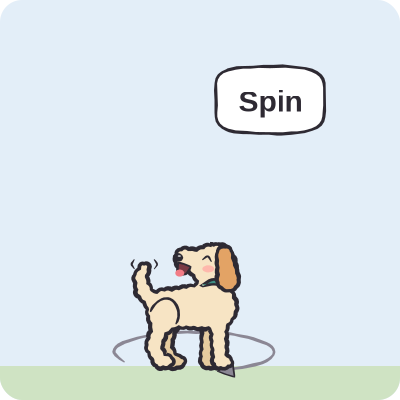
On “Spin,” your dog turns one full circle on the spot and ends up facing you again.
Assessment: where is your dog now?
A visiting trainer might check something like this before starting.
Does she follow a treat at her nose as your hand moves?
→If not, use a treat she likes more, or start with “Touch” (hand targeting) so she learns to follow your hand.
Which way does she turn more easily?
→Many dogs spin more readily one way than the other, as trainer Pat Miller notes in Whole Dog Journal. BAUDOG suggests drawing her a little to each side with a treat and starting with the direction she turns into more easily.
Does she already whirl around when excited, or chase her tail?
→If so, BAUDOG suggests rewarding spins only after the cue, never the excited ones she does on her own. If she circles a lot, check with your vet first (see below).
Is the floor non-slip? Is it close to a meal?
→Spinning means pushing off the floor with her feet, so BAUDOG suggests a non-slip mat or carpet. Large, deep-chested dogs should avoid exercise before and after meals.
The cue
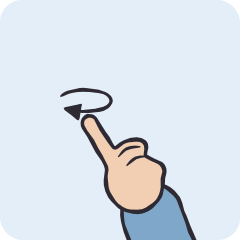
The word on this page is “Spin.” Plenty of families say “Spin around” or “Turn” instead — any word works. BAUDOG suggests picking one that doesn’t sound like another cue she knows: if she mixes up “Spin” and “Sit,” for example, try “Twirl.” In the AKC Trick Dog program, “Circle” is a different trick (going around a person or an object), so it’s worth keeping that word free. If you teach both directions, BAUDOG suggests giving each its own word that starts with a different sound.
How to signal
- Voice
Say “Spin” once — and only once she can follow your hand all the way around. At first: “Spin” → short pause → hand signal.
- Hand
At first, move a treat from her nose in a slow, large circle just above her head. Switch to an empty hand, shrink the motion, and end with a small circle drawn with your index finger (everyone in the family uses the same shape and the same direction).
- Leash
Practice indoors, off leash.
- Body
Stand or crouch facing her. With a small dog, crouch so your hand is at her nose height.
Teaching steps
- 1
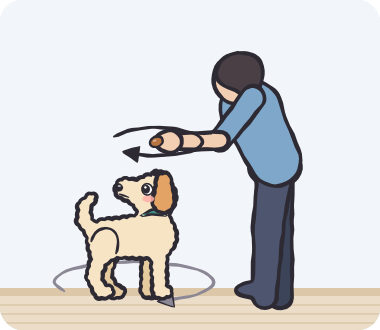
From her nose, a slow, large circle Lure one full circle with a treat
Hold a treat at your dog’s nose and move it slowly in a large circle just above her head. The moment she completes the circle and faces you again, “Yes” → treat. You can add an in-between step of rewarding a half turn.
A good sign to move onBAUDOG’s rule of thumb: one full lured circle, 8 times out of 10
- 2
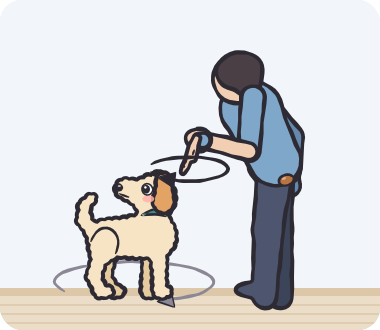
Lure with an empty hand, reward from the other With an empty hand
Make the same hand motion without a treat in it. When she completes a circle, reward from your other hand.
A good sign to move onBAUDOG’s rule of thumb: one full circle for an empty hand, 8 times out of 10
- 3
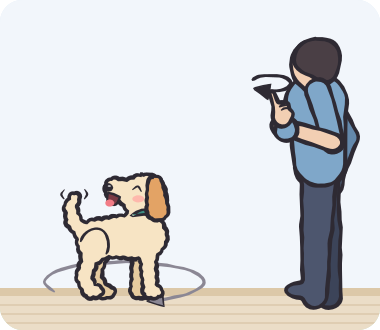
Down to a small finger circle Shrink the hand motion
Make the circle smaller and raise your hand a little at a time, until you’re drawing a small circle with your index finger.
A good sign to move onBAUDOG’s rule of thumb: one full circle for a small finger circle, 8 times out of 10
- 4
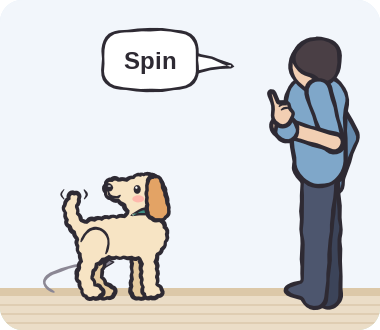
Word → short pause → finger circle Add the word
“Spin” once → short pause → finger circle → “Yes” when she turns. With repetition, she starts to spin on the word alone.
A good sign to move onBAUDOG’s rule of thumb: 8 out of 10 on the word alone
- 5
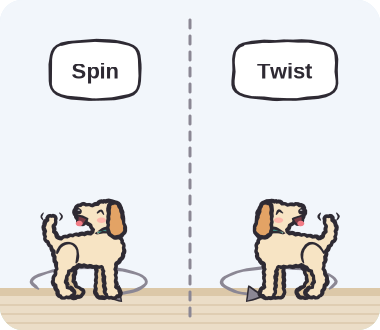
A different word for the other direction Two spins, and the other direction (finishing)
In the American Kennel Club’s method, once she’s good at one full spin, you add more circles before the treat — 2 to 3 spins. For the other direction, BAUDOG suggests finishing her easier direction first, then teaching the other one from the first step with a different word.
A good sign to move onBAUDOG’s rule of thumb: 8 out of 10 at that number of spins, in that direction
When to reward
Just right
“Yes” the moment she completes the circle and faces you again. Then the treat.
Too late
“Yes” once she has finished and stood still for a while — or handing over a treat at the half-way point every time, so she stops waiting for the full circle.
For the first few tries, it’s fine to reward a half turn. Once she can do a full circle, reward only the full circle.
What counts as a spin? The AKC Trick Dog standard
“Spin,” “Spin around” and “Turn” all name the same trick: one circle on the spot. In the AKC Trick Dog program, Spin is a Novice-level trick: on “Spin,” the dog turns a full, tight circle as if chasing her tail. She may spin to the right or the left, and should spin at least twice; at Novice level the handler may use a lure. More advanced trick dogs can learn to answer “spin right” and “spin left.”
AKC also separates “Circle” from Spin: in a circle, the dog goes around a person or an object.
Is my own way right? Common questions
Answers to the questions owners most often have about methods they worked out themselves.
“I want ‘Spin’ for clockwise and ‘Spinny’ for counterclockwise.” — Using a different word for each direction is right. Whole Dog Journal’s Pat Miller uses “Spin” for a right turn and “Twirl” for a left turn, Fenzi Dog Sports Academy’s Nicole Wiebusch uses the same pair, and the AKC mentions “spin right” and “spin left” for advanced trick dogs. But “Spin” and “Spinny” begin with the same sound, which makes them hard to tell apart. Words that differ from the very first sound — “Spin” and “Twirl,” for example — are easier to hear. And don’t teach both at once: once one direction works on its word alone, teach the other from the first step.
“I want Spin → Bow to end with a ‘Ta-da!’ (a chained trick).” — BAUDOG suggests linking them only once Spin and Bow each work reliably on the word alone. Give “Spin” and “Bow” one at a time at first; once the flow is steady, add a new single word for the whole thing (“Ta-da!”). To add it: new word → short pause → the usual first cue (“Spin”).
“I want her to spin several times in a row.” — In the American Kennel Club’s method, once she’s good at one full spin, you add more circles before the treat — 2 to 3 spins. BAUDOG suggests adding one circle at a time, once a single spin works on the word alone. Jumping to many spins at once can make her stall partway.
“Her tail-chasing is adorable. Can I put a cue on it and make it a trick?” — We don’t recommend it. Tail-chasing can be puppy play, but it can also be a displacement behavior that shows up when a dog is excited or frustrated, or a sign of a physical problem such as skin trouble, anal glands or pain. German Shepherds and Bull Terriers are at higher risk of spinning and tail-chasing. Reward only spins that follow your cue and your hand, and see your vet if tail-chasing is increasing.
“When she’s excited, she spins before I even give the cue.” — That shows spinning has become a “good things happen” move for her. BAUDOG suggests not rewarding spins that come before the cue — just wait a moment — and saying “Yes” only for spins after the cue.
Looking after her body, and signs of illness
We found no veterinary source saying the spin trick itself is bad for a dog’s body. What to watch is the floor and the number of spins. Spinning fast on a slippery floor makes it easy to slip, so BAUDOG suggests a non-slip mat and adding spins little by little. Large, deep-chested breeds such as Great Danes, German Shepherds and Standard Poodles are at higher risk of bloat (gastric dilatation-volvulus, GDV), and restricting exercise before and after meals is recommended (Merck Veterinary Manual). Keep spin practice away from mealtimes, too.
Puppies can learn it. VCA Animal Hospitals lists Spin — bonus points for both directions — among the tricks to teach a puppy.
Separate from the trick: suddenly circling or falling to one side, a head tilt, or eyes darting back and forth can be signs of vestibular disease (a balance disorder). The form with no known cause is more common in older dogs (VCA). See your vet right away.
A good sign to move on
- Treat lure for one circle → empty hand → small finger circle → word, in that order. BAUDOG’s rule of thumb: move on when the current step works 8 times out of 10
- Add the word only once she can follow your hand all the way around
- Teach the other direction only after finishing her easier one, with a different word (BAUDOG’s suggestion)
- If she’s struggling, go back one step — our rule of thumb is two misses in a row
- Keep sessions to a few minutes, and stop while she still wants more
If it isn’t working
She stops halfway
Usually your hand is moving too fast. Keep the treat at her nose and go slowly. If she still stops, try a bigger circle. Add a step of rewarding the half turn, then move on to the full circle.
She jumps at your hand instead of turning
Usually your hand is too high. Circle at her nose height, passing just over her head, for example. If she jumps, freeze your hand and start again once all four feet are on the floor.
She only turns one way
Many dogs spin more readily one way than the other (Whole Dog Journal). BAUDOG suggests finishing her easier direction first, then teaching the other one from the first step.
She won’t spin on the word alone
Usually the switch from hand signal to word was too sudden. Go back to word → short pause → small finger circle. Also check that your word doesn’t sound like another cue she knows.
She keeps spinning or gets wound up
Mark the moment she completes one circle and faces you, for example, then bring the treat to her nose to stop her. For excitable dogs, BAUDOG suggests fewer reps per session and resuming once she has calmed down.
Prescription: a suggested order
Spin rests on two skills: linking a cue to a movement, and paying attention to your hand.
- ExerciseCharging Your Marker Word: How to Teach Your Dog That “Yes” Means a RewardDoable at home (Steps 1–4 at home)A word that marks the moment she completes the circle. Spinning is fast, so without a marker your timing will slip.Read →
- ExerciseHand Target: How to Teach Your Dog “Touch” — and Use It for Recall and Passing Other DogsDoable at home (Steps 1–3 at home)Following your hand with her nose. Once she can do that, luring with an empty hand and a finger circle becomes much easier.Read →
In the moment: do / don’t
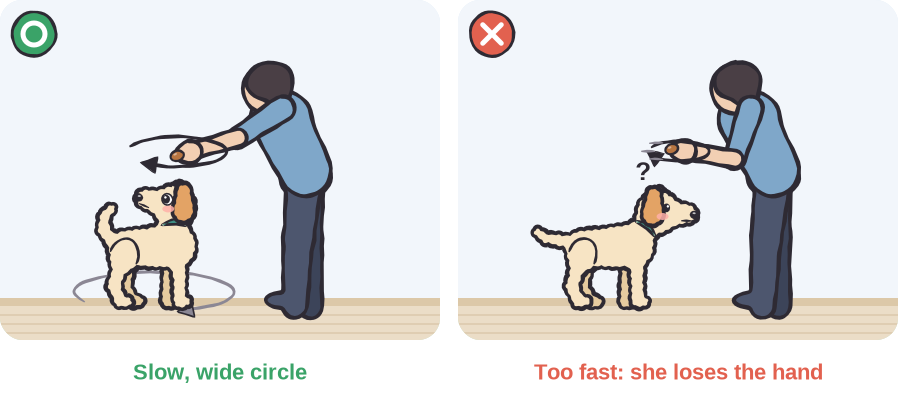
Do
- Lure from her nose in a slow, large circle
- Mark the moment she completes the circle
- Switch to an empty hand early, then shrink it to a finger circle
- Teach right and left with different words, one at a time
Don’t
- Whip your hand around quickly (she can’t keep up)
- Reward tail-chasing or excited spins she does on her own
- Choose a word that sounds like another cue
- Practice on a slippery floor, or right before or after a meal
When to see a professional
- She suddenly circles or falls to one side, tilts her head, or her eyes dart back and forth. It may be vestibular disease or another problem — see your vet right away
- Tail-chasing or spinning is increasing, hard to interrupt, or getting in the way of daily life. It may be a physical problem (pain, skin, nerves) or a compulsive disorder — talk to your vet
- She struggles to sit or get up from lying down, hesitates to play actively, or suddenly stops spinning. These can be signs of pain
The skills behind this command
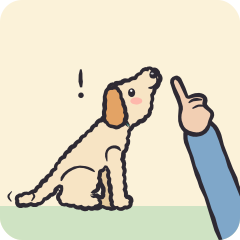 Core skill Understanding Cues Telling “Spin” from “Sit,” and the words for each direction, apart.
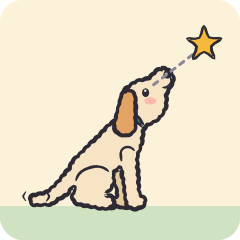 Core skill Focus Keeping her mind on your hand and voice even while she’s turning.
- ExerciseCharging Your Marker Word: How to Teach Your Dog That “Yes” Means a RewardDoable at home (Steps 1–4 at home)Read →
- ExerciseHand Target: How to Teach Your Dog “Touch” — and Use It for Recall and Passing Other DogsDoable at home (Steps 1–3 at home)Read →
Sources
- American Kennel Club — Teach Your Dog to Spin Around
- American Kennel Club — Lure-and-Reward Training
- AKC Trick Dog Participant and Evaluator Guide (PDF)
- Whole Dog Journal — How to Teach Your Dog to Spin (Pat Miller, CBCC-KA, CPDT-KA)
- Fenzi Dog Sports Academy — Spins in Heel Position (Nicole Wiebusch)
- Whole Dog Journal — Clean Up Your Cues
- Battersea Dogs & Cats Home — How to teach your dog to lie down
- Merck Veterinary Manual — Behavior Problems of Dogs (abnormal repetitive behaviors)
- American Kennel Club — Why Do Dogs Chase Their Tails?
- Merck Veterinary Manual — Gastric Dilation and Volvulus in Small Animals
- VCA Animal Hospitals — Vestibular Disease in Dogs
- VCA Animal Hospitals — Tricks To Teach Your Puppy
- Cornell University Riney Canine Health Center — Recognizing pain in dogs
- Dogs Trust — Top ten dog training tips