 BAUDOG The dictionary of dog–human communication
Contents
- In short
- When you see it
- What it may mean
- Assessment: where is your dog now?
- The behaviors most often called calming signals
- What research has found — and what it hasn’t
- Can you use calming signals on your dog?
- Putting it to use every day
- Calming signals vs. body language vs. stress signals
- Skills to build
- Exercises
- When you see it: do / don’t
- When to see a professional
- Sources
In short
“Calming signals” is a term made popular by Norwegian dog trainer Turid Rugaas. It describes behaviors such as yawning, turning away, licking the nose, sniffing the ground and moving slowly as signals dogs use to calm others or themselves and avoid conflict. These behaviors can appear in tense or uncertain situations, and researchers have studied them as behaviors linked to conflicting motivations. But whether they actually calm the other dog or person hasn’t been clearly confirmed yet. The practical way to read them: “she may be a little uncomfortable or unsure right now.” Check her whole body and the situation, and be the one who backs off.
When you see it
- Just before passing another dog, your dog suddenly starts sniffing the ground
- You walked straight up to pat her head, and she turned her face away and licked her nose
- You said “No!” sharply and she yawned. It looked as if she wasn’t taking you seriously
- When a training session runs long, she looks away and wanders off to sniff
What it may mean
Turid Rugaas, who made the term popular in her book On Talking Terms with Dogs: Calming Signals (first published in the US in 1996), writes that dogs have “about 30 calming signals, perhaps even more.” In her account, when someone does something a dog finds threatening — walking straight at her, reaching for her, bending over her, using an angry voice — the dog uses these signals to calm that person down. In her view, a dog who yawns while being scolded isn’t being cheeky; the yawn can happen because the moment is tense for her.
Researchers, on the other hand, usually call many of these behaviors “displacement behaviors” — behaviors that appear without an obvious connection to what’s going on — and study them as signs of conflicting motivations and as a possible by-product of the body’s stress response. Whether they work as signals that calm another dog or person is still being studied.
So what we can say is that these behaviors can appear in tense or uncertain situations. Reading them in line with current research means not deciding “this signal = this feeling,” and instead reading them from her whole body and the situation.
Assessment: where is your dog now?
When you see one of the behaviors called calming signals, check these in order. This is BAUDOG’s suggested way of looking — one example.
What happened just before?
→If someone had just come straight at her, leaned over her, raised their voice, or a strange dog had appeared, read it as a sign she may be uncomfortable. A yawn as she wakes up, or sniffing at the start of a walk, is usually just a yawn or a sniff.
Are other signals showing too?
→The more you also see a stiff body, ears pulled back, a lowered tail or the whites of her eyes, the more it points toward tension.
What happens when you back off?
→If the behavior stops and her body loosens when you stop approaching, turn sideways or soften your voice, that was probably the cause.
The behaviors most often called calming signals
These are behaviors that researchers have studied as possible appeasement signals, plus some of those Rugaas describes. Every one of them also happens in other situations.
- Turning the head away, turning the body sideways, turning her back
- Looking away, blinking
- A quick lick of the nose or lips
- Yawning
- Sniffing the ground
- Moving slowly; approaching in a curve instead of straight on
- Freezing (going completely still), making herself smaller
- Sitting or lying down — sometimes sitting with her back turned
- Lifting one front paw
- The play bow (rear end up, front legs down — also an invitation to play)
- A low wag of the tail, lowering the body
What research has found — and what it hasn’t
Dogs with dogs: In a small pilot study, 24 dogs were each watched in four five-minute, off-leash meetings: with a familiar and an unfamiliar dog of the same sex, and with a familiar and an unfamiliar dog of the other sex. The behaviors Rugaas lists showed up more while the two dogs were interacting than when they weren’t, and head turning, nose licking, freezing, making themselves smaller and paw lifting were more common with unfamiliar dogs. None of the 109 aggressive episodes (growling, trying to bite and so on) was preceded by one of these behaviors. When the dog showed one after the other dog’s aggression, the aggression eased off in about four out of five cases. The researchers suggested the behaviors may help prevent further aggression. But the study grouped many different behaviors together, so it can’t tell us what each one does on its own.
Dogs with people: In a study of 53 pet dogs approached by unfamiliar people in either a mildly threatening or a neutral way, nose licking, blinking and similar behaviors were more common in dogs who didn’t bark or growl at the experimenter. But they didn’t increase when the person approached in the more threatening way. The researchers concluded that an appeasement function “cannot be confirmed yet.”
A third study of 64 pet dogs, looking at behaviors usually called stress signals, also found that these behaviors don’t necessarily carry a fixed emotional meaning — what they mean depends on the situation. The researchers recommend not labeling them as “appeasement signals” or “stress signals” in advance.
- Rugaas: dogs have “about 30” calming signals, “perhaps even more.” Research: no study has fixed a number or an agreed list. Researchers suggest studying each behavior one at a time, in its context.
- Rugaas: threatening behavior “will always” make a dog use a calming signal. Research: in the 53-dog study, the behaviors didn’t increase when the approach was more threatening.
- Rugaas: the signals are “international and universal,” understood by every dog. Research: we haven’t found a study that tests this directly. What is known is that body shape matters — flat-faced breeds have less flexible facial expressions, and dogs with permanently upright ears or very short tails lose part of their signaling.
- Rugaas: turning away will usually calm the other dog. Research: the 24-dog pilot study fits that idea, but it was small, grouped many behaviors together, and hasn’t settled the question.
Can you use calming signals on your dog?
Rugaas suggests that people can use them too: if you want a dog to feel safer, move more slowly, and walk up to a dog in a curve rather than straight at her. We haven’t found research that tests whether people yawning, licking their lips or turning away actually calms dogs, so we don’t recommend copying the signals as a technique.
What is well supported is simply not doing the things that make dogs uneasy. Cornell University’s vet school advises asking visitors to sit down instead of leaning over a nervous dog, and ideally to let her come to them. Battersea suggests letting a dog come and sniff you without reaching out, approaching a larger dog side-on with your hands by your sides, and never going over her head first.
Putting it to use every day
Even though their function hasn’t been confirmed, these behaviors are a useful clue that she may be uncomfortable. When you notice them, you’re the one who adjusts. Here are BAUDOG’s suggested ways to adjust.
- When you approach her, don’t walk straight up head-on; come in a little from the side. Don’t lean over her, and turn your body sideways.
- If she starts sniffing the ground before passing another dog, don’t pull her along. Give a little more room and pass in a curve.
- If she starts looking away or wandering off to sniff more during training, the session may be too long or too hard. Go back to an easier step and finish soon.
- Don’t take a yawn in the middle of a scolding as cheek and scold her more.
- Teach children that when a dog turns her face away, it means “please stop.” Young children may not always notice, so an adult should watch and step in when needed.
Calming signals vs. body language vs. stress signals
Body language is every signal a dog gives with her body. “Calming signals” is a name given to some of the small behaviors within it that can also appear in tense or uncertain situations. Some books call the same behaviors “stress signals,” and researchers call them “displacement behaviors.” Whatever the name, you read them the same way: from the whole body and the situation. For more, see our pages on dog body language and dog stress signals.
Skills to build
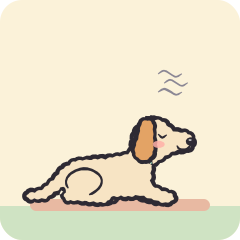
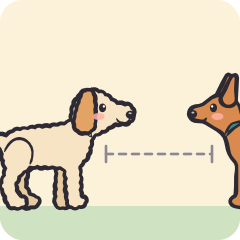
Exercises
If she always shows these behaviors in the same situation — passing other dogs, visitors arriving — make that situation easier for her, little by little.
When you see it: do / don’t
Do
- If you think “she might be uncomfortable,” back off (stop approaching, turn sideways, soften your voice)
- Approach her a little from the side, not head-on
- When passing other dogs, give room and pass in a curve
- If the behaviors increase during training, make it shorter and easier and stop
Don’t
- Treat a yawn or a look away during a scolding as defiance and scold her more
- Use a list to decide “this behavior = this feeling”
- Turn her face back toward you with your hand when she’s looking away
- Keep petting or approaching while she’s showing these behaviors
When to see a professional
- Yawning, nose-licking or turning away happens all day long, not just in particular situations. Have your vet check for a physical problem (pain, nausea and so on)
- After the small signals, she has started growling, snapping or biting. Talk to your vet or a behavior professional
- She’s afraid of more and more situations. Talk to your vet early and ask for a referral to a behavior specialist
Grow the skill underneath
Sources
- Turid Rugaas (official site) — Calming Signals: The Art of Survival
- Turid Rugaas (official site) — Publications (On Talking Terms with Dogs: Calming Signals)
- Mariti, Falaschi, Zilocchi, Fatjó, Sighieri, Ogi & Gazzano (2017). Analysis of the intraspecific visual communication in the domestic dog (Canis familiaris): A pilot study on the case of calming signals. Journal of Veterinary Behavior 18:49–55
- Pedretti, Canori, Biffi, Marshall-Pescini & Valsecchi (2023). Appeasement function of displacement behaviours? Dogs’ behavioural displays exhibited towards threatening and neutral humans. Animal Cognition
- Riggio, Borrelli, Atilgan, Russo, Diverio & Mariti (2026). Rethinking dog stress behaviours: contextual and physiological insights from the attachment framework. Veterinary Quarterly
- Siniscalchi, d’Ingeo, Minunno & Quaranta (2018). Communication in Dogs. Animals 8(8):131
- VCA Animal Hospitals — Canine Communication: Interpreting Dog Language (Horwitz, DVM, DACVB; Landsberg, DVM, DACVB)
- Cornell Richard P. Riney Canine Health Center — Dog Bite Prevention (April 2025)
- Cornell University College of Veterinary Medicine — Fearful dogs
- Battersea Dogs & Cats Home — How to approach a dog
- Kuhne, Hößler & Struwe (2012). Affective behavioural responses by dogs to tactile human-dog interactions. Berl Munch Tierarztl Wochenschr 125:371–378
- Horowitz (2009). Disambiguating the “guilty look”. Behavioural Processes 81:447–452
- VCA Animal Hospitals — Why do dogs yawn?
- VCA Animal Hospitals — Why do dogs lick humans?
- PDSA (UK) — Dogs and phobias
- RSPCA (UK) — Understanding your dog’s body language