 BAUDOG The dictionary of dog–human communication
Contents
- The finished behavior
- Assessment: where is your dog now?
- The cue
- How to signal
- Teaching steps
- When to reward
- What age can a puppy start? How high is high enough?
- Dogs who should skip the jump: breeds, joints and seniors
- Is my own way right? Common questions
- A good sign to move on
- If it isn’t working
- Prescription: a suggested order
- In the moment: do / don’t
- When to see a professional
- Sources
The finished behavior
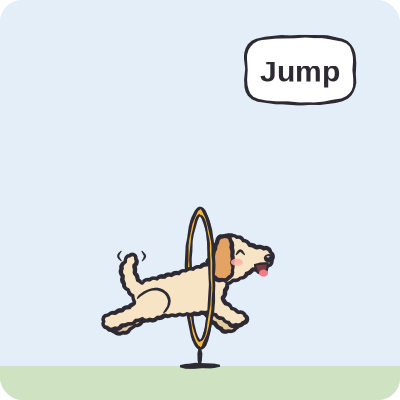
On “Jump,” your dog jumps through a hoop you hold, or over a low bar.
Assessment: where is your dog now?
Jumping puts load on a dog’s body. A visiting trainer might check something like this before starting.
How old is she? Has she finished growing?
→In a growing puppy, the growth plates at the ends of the bones are soft and can be injured by repeated jumping. BAUDOG suggests staying with walking through a hoop that stands on the floor until she has finished growing (see below).
What breed is she, and how is her body?
→For breeds prone to disc disease such as Dachshunds and French Bulldogs, small dogs whose kneecaps slip easily, dogs with hip concerns, and seniors, BAUDOG suggests skipping the jump and sticking with walking through a hoop on the floor. If you’re unsure, ask your vet.
Is the landing surface non-slip?
→On a hardwood or laminate floor her feet can slide on landing. BAUDOG suggests practicing on a non-slip mat or carpet.
Does she jump up on people?
→If so, BAUDOG suggests rewarding jumping only when you’ve given the cue and she jumps through the hoop or over the bar. Jumping up on people is a separate problem, fixed on its own page.
The cue
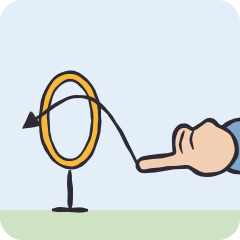
The word on this page is “Jump.” The AKC Trick Dog guide uses “Jump!” for the hoop and suggests “Through” or “Hup” for jumping through your arms; any word works as long as everyone in the family uses the same one. For a hand signal, most families point at or gesture toward the hoop or bar. Add the cue only once she is already going through the hoop.
How to signal
- Voice
Say “Jump” once — and only once she is already going through the hoop. At first: “Jump” → short pause → your usual hand lure.
- Hand
At first, show her a treat on the far side of the hoop. Then switch to a hand with no treat in it, and shrink the gesture to a point or an open palm toward the hoop.
- Leash
Indoors, practice with the leash off. Outside, if she hops over a curb or a step, keep the leash in your hand.
- Body
Use a hoop big enough for her whole body to pass through easily. At first, stand it upright with the bottom touching the floor and hold it firmly so it doesn’t wobble.
Teaching steps
- 1
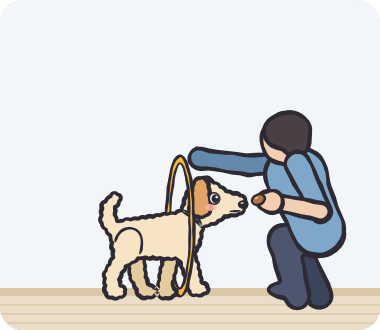
Bottom on the floor: she just walks through Walk through a hoop standing on the floor
Stand a hoop (a hula hoop works) upright with its bottom edge on the floor, and lure your dog through from the other side with a treat. The moment her body passes through, “Yes” → treat. No jumping needed. If the hoop worries her, lay it flat on the floor and start with stepping over it.
A good sign to move onBAUDOG’s rule of thumb: she goes through on her own 8 times out of 10
- 2
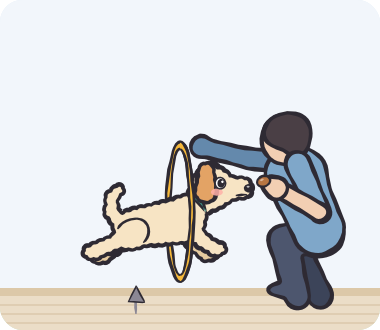
An inch or two at a time A little higher
Lift the bottom of the hoop an inch or two (a few cm) off the floor. When she goes through, raise it another inch or two. Raise the height only a little at a time.
A good sign to move onBAUDOG’s rule of thumb: 8 out of 10 at that height
- 3
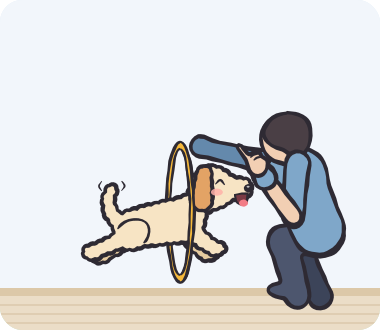
Your hand just shows the way With an empty hand
Point or gesture beyond the hoop with a hand that has no treat in it. When she goes through, reward from your other hand (or toss the treat beyond the hoop).
A good sign to move onBAUDOG’s rule of thumb: 8 out of 10 with an empty hand
- 4
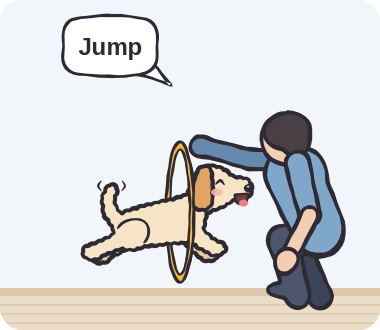
Word → short pause → hand Add the word
“Jump” once → short pause → your usual hand signal → “Yes” when she goes through. With repetition, she starts going through on the word alone.
A good sign to move onBAUDOG’s rule of thumb: 8 out of 10 on the word alone
- 5
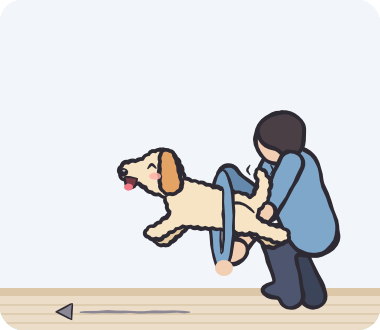
Start by stepping over one arm Arm hoop (small and medium dogs)
Instead of a hula hoop, make a circle with your arms. Start with one arm resting on the floor so she just steps over it, then make the circle smaller over time. The American Kennel Club’s hoop article suggests another route: hold your arms around the hoop for a few reps, then try without the hoop.
A good sign to move onBAUDOG’s rule of thumb: 8 out of 10 through your arms
When to reward
Just right
“Yes” the moment her body passes through the hoop (as she lands). Give the treat on the far side of the hoop.
Too late
“Yes” after she has come back to you through the hoop. What you rewarded was “coming back.”
What age can a puppy start? How high is high enough?
In a growing puppy, the ends of the bones have soft growth plates, and strenuous exercise can injure them, leading to abnormal development and pain. VCA Animal Hospitals recommends waiting until a puppy has finished growing before having them jump hurdles or compete in agility, and notes that this depends on size: a little over 6 months for small dogs, closer to 1½ years for giant breeds. The American Kennel Club says puppies shouldn’t be asked to jump in extreme or competitive situations until they are at least 12–15 months old (or older for giant and slow-maturing breeds), and suggests limiting everyday jumping too — onto beds, over baby gates and out of the car. Dogs can enter AKC agility trials from 15 months of age.
The two figures don’t line up, so if you’re not sure whether she has finished growing, ask your vet. BAUDOG suggests that until you know she has, you stop at walking through a hoop standing on the floor or stepping over a bar lying on the floor, and add height only once she’s fully grown. The same AKC article notes that a young dog can be introduced to agility with the jumps set very low, or even with the bars on the ground.
As for height, a family trick can stay low. In the AKC Trick Dog program, the Novice-level “Jump” is over a low bar a few inches from the floor (roughly 2–4 in, 5–10 cm) or through a low hula hoop, and at Novice level a lure may be used. AKC’s own hoop article says to keep the height in proportion to your dog’s size. Our rule of thumb: there’s no need to go higher than her shoulder height (withers).
Dogs who should skip the jump: breeds, joints and seniors
Breeds whose cartilage makes the spinal discs wear early — the “chondrodystrophic” breeds such as Dachshunds, Pekingese and Beagles — account for the vast majority of disc ruptures, according to the American College of Veterinary Surgeons. To reduce the odds of a back injury, Cornell University’s College of Veterinary Medicine recommends minimizing stairs and jumping on and off a deck, bed or sofa, and says leaping for a thrown toy isn’t a good idea either. (The surgeons’ college also lists minimizing jumping off furniture as part of life after disc surgery.) Still, no study has yet shown that banning jumping on and off furniture prevents disc disease (more on the “Off” page). In a US Dog Aging Project study of about 43,500 dogs, owners reported that 1.2% of all the dogs had ever had intervertebral disc disease (IVDD), compared with 15.3% of Dachshunds; among purebreds, French Bulldogs had the highest odds. These are owner reports from a single survey, so they show which dogs are affected more often, not what causes it. The same study found that dogs with more daily activity, and dogs who regularly used stairs, had lower odds — an association, not proof that either protects the back.
A kneecap that slips out of place (patellar luxation) mainly affects small dogs. In a UK study of the records of 210,824 dogs seen at primary-care vet practices in England, 1.3% had been diagnosed with it; compared with crossbreds, the odds were about 6.5 times higher in Pomeranians, 5.9 in Chihuahuas, 5.5 in Yorkshire Terriers and 5.4 in French Bulldogs. For dogs with hip dysplasia, moderate daily exercise and avoiding high-impact activities such as jumping may help keep them mobile (VCA Animal Hospitals).
For dogs like these, and for seniors, BAUDOG suggests skipping the jump and sticking with walking through a hoop standing on the floor. Walking through is still plenty of fun.
Large, deep-chested breeds such as Great Danes, German Shepherds and Standard Poodles are at higher risk of bloat (gastric dilatation-volvulus, GDV), and restricting exercise before and after meals is recommended (Merck Veterinary Manual). Keep jump practice away from just before and just after meals, too.
Is my own way right? Common questions
Answers to the questions owners most often have about methods they worked out themselves.
“I hold a treat above her head and say ‘Jump’ when she leaps for it.” — We don’t recommend it. Leaping straight up means landing on her hind legs, which tends to put more load on her body, and it easily turns into jumping up on people (BAUDOG’s judgment). If she jumps, teach it forward, over a low hoop or bar.
“I said ‘Jump’ whenever she hopped over a ditch or curb on walks, and she learned it.” — Putting a cue on something she already does on her own is a perfectly sound method. But jumping down from height is the kind of move veterinary sources recommend minimizing, so keep the drops low. Near roads, keep the leash in your hand; your local leash laws may require it in public anyway — New York City, for example, requires a leash no longer than six feet.
“She’s got the arm hoop. Can I have her jump through my leg or over my back?” — In the AKC Trick Dog program, jumping through your circled arms is an Intermediate trick for small and medium-sized dogs: you may bend over or kneel, the suggested cue is “Through” or “Hup,” and large dogs who don’t fit through your arms may jump over your leg instead. Jumping over your back is an Advanced trick. Only for a healthy, fully grown dog, starting low, on a non-slip surface. Jumping over your back can be risky for both dog and owner, so BAUDOG doesn’t recommend it.
“I want jumping off the sofa to be her ‘Jump’ cue.” — Don’t. Jumping off furniture is a move Cornell University’s vet school recommends minimizing to reduce the odds of a back injury, and putting a cue on it only makes it happen more often. (No study has shown that banning it prevents injury, but there’s no reason to encourage it either.) To get her off the sofa, use the “Off” cue.
“I want her to jump into my arms.” — The AKC Trick Dog program lists “Jump into handler’s arms” as an Advanced trick, but BAUDOG doesn’t recommend it. It’s an upward leap with a landing you can’t control: if the catch goes wrong, she drops from your chest height. If she’s small and you want her up in your arms, it’s safer to crouch and lift her.
“I want her to jump several times in a row.” — Make each single jump reliable first, then add reps a little at a time. BAUDOG suggests no more than a few jumps per practice session.
A good sign to move on
- Hoop on the floor → a little higher → empty hand → word, in that order. BAUDOG’s rule of thumb: move on when the current step works 8 times out of 10
- Raise the height an inch or two at a time. Until she’s fully grown, stay at floor level
- When it isn’t working, go back one step (a lower height). Our rule of thumb: after two misses in a row
- Keep each session to a few minutes, with no more than a few jumps
If it isn’t working
She’s scared of the hoop and won’t go near it
Lay the hoop flat on the floor and start by putting treats around it and inside it. A hoop that rattles or falls over is scary, so hold it firmly.
She goes around the hoop instead of through it
One thing to try: put one side of the hoop against a wall to block the way around, and lower it so going through is the easy option.
She catches her feet on the hoop
Usually the height went up too fast. Go back to the previous height and use a slightly bigger hoop.
She slips when she lands
The floor is slippery. BAUDOG suggests laying a non-slip mat or carpet on the landing side too.
She suddenly stopped jumping, or hesitates before she jumps
It may be pain. Stop practicing and see your vet.
Prescription: a suggested order
Jumping rests on two skills: linking a cue to a movement, and getting comfortable with something new like a hoop.
- ExerciseCharging Your Marker Word: How to Teach Your Dog That “Yes” Means a RewardDoable at home (Steps 1–4 at home)A word that marks the moment she passes through the hoop. Praise right as she goes through makes heading for the hoop clear to her.Read →
- ExerciseHand Target: How to Teach Your Dog “Touch” — and Use It for Recall and Passing Other DogsDoable at home (Steps 1–3 at home)Following your hand with her nose. It makes guiding her beyond the hoop with your hand or a point easier, and dogs who can’t jump can still play and move with “Touch.”Read →
In the moment: do / don’t
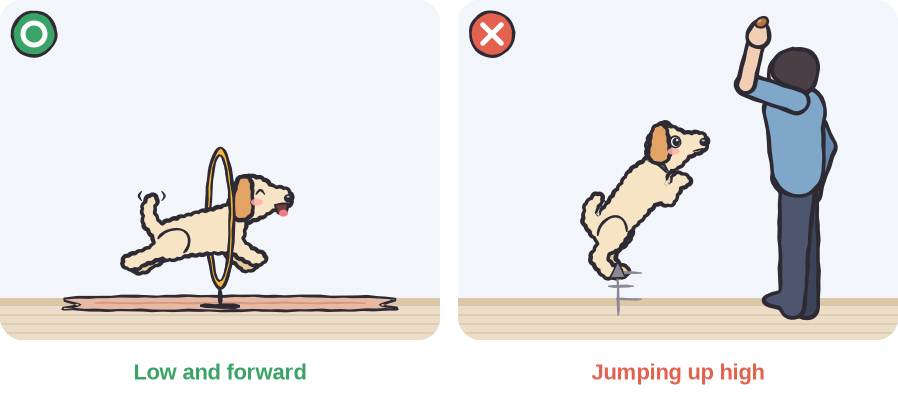
Do
- Start with walking through a hoop standing on the floor
- Raise the height an inch or two at a time, no higher than her shoulders
- Use a non-slip mat, on the landing side too
- Keep it to a few jumps per session
Don’t
- Have a growing puppy do repeated jumps with height
- Ask a dog with back, knee or hip concerns to jump
- Put a cue on jumping off the sofa or other high places
- Hold a treat above her head so she leaps straight up
When to see a professional
- She hesitates before jumping or has suddenly stopped jumping, dislikes stairs or getting on and off furniture, or is reluctant to get up. It may be pain
- She suddenly skips for a few steps with a hind leg held up, or runs on three legs and then is fine again. It can be a sign of a slipping kneecap
- She avoids turning her head to one side, walks to her bowl but only looks at it, or is wobbly. It may be a spinal disc problem — see your vet right away
The skills behind this command
 Core skill Understanding Cues Jumping only on the “Jump” cue — keeping it separate from jumping up on people.
 Core skill Confidence Approaching unfamiliar things like a hoop or a bar without fear.
- ExerciseCharging Your Marker Word: How to Teach Your Dog That “Yes” Means a RewardDoable at home (Steps 1–4 at home)Read →
- ExerciseHand Target: How to Teach Your Dog “Touch” — and Use It for Recall and Passing Other DogsDoable at home (Steps 1–3 at home)Read →
Sources
- American Kennel Club — How to Teach Your Dog to Jump Through a Hoop
- AKC Trick Dog Participant and Evaluator Guide (PDF)
- American Kennel Club — How to Help Puppies and Dogs Jump Safely
- AKC — Regulations for Agility Trials and Agility Course Test (PDF)
- VCA Animal Hospitals — How Exercise Can Damage Puppy Growth Plates
- American College of Veterinary Surgeons — Intervertebral Disc Disease
- Cornell University Riney Canine Health Center — Intervertebral disc disease
- Wee C, Nin DZ (2025). Demographic and lifestyle characteristics impact lifetime prevalence of owner-reported intervertebral disc disease: 43,517 companion dogs in the United States. J Am Vet Med Assoc 263(5):1–9
- American College of Veterinary Surgeons — Patellar Luxations
- VCA Animal Hospitals — Luxating Patella in Dogs
- O’Neill DG et al. (2016). The epidemiology of patellar luxation in dogs attending primary-care veterinary practices in England. Canine Genet Epidemiol 3:4
- VCA Animal Hospitals — Hip Dysplasia in Dogs
- Merck Veterinary Manual — Gastric Dilation and Volvulus in Small Animals
- American Kennel Club — Lure-and-Reward Training
- Whole Dog Journal — Clean Up Your Cues
- Battersea Dogs & Cats Home — How to teach your dog to lie down
- Karen Pryor Clicker Training — The Ten Laws of Shaping
- New York City Health Code, Article 161 (§161.05) (PDF)
- Cornell University Riney Canine Health Center — Recognizing pain in dogs
- Dogs Trust — Top ten dog training tips