 BAUDOG The dictionary of dog–human communication
Contents
- The finished behavior
- Assessment: where is your dog now?
- The cue
- How to signal
- Teaching steps
- When to reward
- Figure eight or walking weave: the AKC Trick Dog standard
- Is my own way right? Common questions
- Looking after her body
- A good sign to move on
- If it isn’t working
- Prescription: a suggested order
- In the moment: do / don’t
- When to see a professional
- Sources
The finished behavior
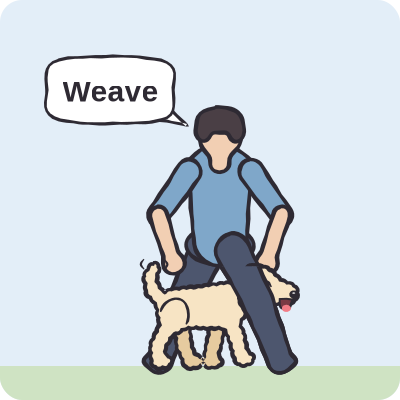
On “Weave,” your dog threads through your legs in a figure eight (or, as you walk, passes under each leg in turn).
Assessment: where is your dog now?
A visiting trainer might check something like this before starting.
Does she follow your hand with her nose (can she do “Touch”)?
→A leg weave means guiding her nose between your legs with your hand. In BAUDOG’s view, it’s easier to guide a dog who already knows hand targeting (some trainers wait until the dog follows a palm before starting this trick). If she doesn’t yet, starting with a treat lure is fine.
Is she happy going underneath your legs (something just above her head)?
→Some dogs feel tense going under something close above their head. If she hesitates, stand with your legs wide and just reward going through.
Do her size and your leg length fit?
→If a big dog struggles to fit between your legs, stick to the figure eight with your legs wide apart. With a small dog, raise your hand a little at a time so you don’t have to bend over too far.
Can she do “Heel” (sit and walk at your left side)?
→It gives you a clear starting position and makes teaching easier — especially for the walking version.
The cue
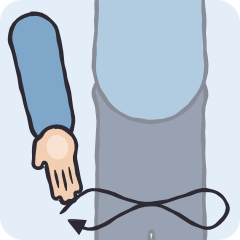
The word is “Weave.” Some families say “Through” or “Figure eight” instead. If you teach both the standing figure eight and the walking version, BAUDOG suggests giving them different words — for example “Weave” for the figure eight and “Walk-through” for the walking one. Add the word once she can follow your hand through.
How to signal
- Voice
Say “Weave” once, at the start. Add it only once she can follow your hand through. At first: “Weave” → short pause → hand guide.
- Hand
At first, bring a treat (or your “Touch” hand) around from behind your leg to between your legs, and guide her nose around that leg. Right hand for the right leg, left hand for the left. Gradually make the motion smaller.
- Leash
Practice indoors, off leash (a leash will tangle around your legs). If you practice outside, choose an enclosed area.
- Body
Stand with your feet a little wider than shoulder width. Don’t move your legs suddenly over her. For the walking version, take slow, big steps, one at a time.
Teaching steps
- 1
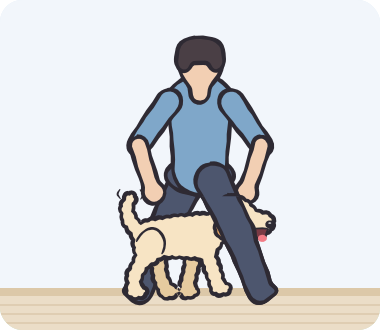
First, just go through Through your legs
Stand with your legs apart and your dog in front of you. Bring the treat (your Touch hand) in from behind, between your legs, and when she passes through and out the other side, “Yes” → treat.
A good sign to move onBAUDOG’s rule of thumb: she goes through 8 times out of 10
- 2
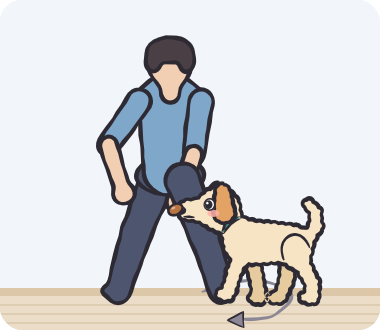
One leg at a time Around one leg
From there, use your right hand to guide her around the outside of your right leg; when she’s back in front, “Yes” → treat. Don’t ask for the whole figure eight yet — one leg at a time.
A good sign to move onBAUDOG’s rule of thumb: around one leg and back to the front, 8 times out of 10
- 3
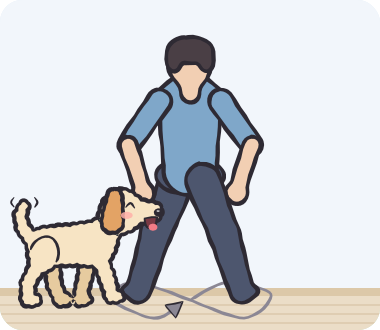
Right, then left: a figure eight The other leg too → a figure eight
Do the left leg the same way with your left hand. When right then left flows together, reward the whole figure eight.
A good sign to move onBAUDOG’s rule of thumb: one figure eight, 8 times out of 10
- 4
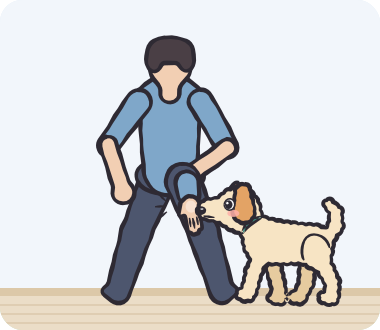
Guide with a “Touch” hand With an empty hand (Touch)
Guide her with an empty hand held out as a “Touch” target. When she touches it, reward from your other hand. Make the motion smaller and higher, little by little.
A good sign to move onBAUDOG’s rule of thumb: a figure eight with an empty hand, 8 times out of 10
- 5
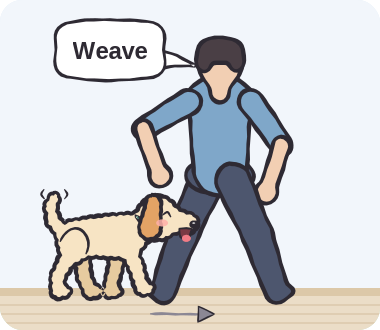
Word → short pause → hand Add the word
“Weave” once → short pause → hand guide → “Yes” when she completes the figure eight. With repetition, she starts on the word alone.
A good sign to move onBAUDOG’s rule of thumb: one “Weave,” a figure eight, 8 times out of 10
- 6
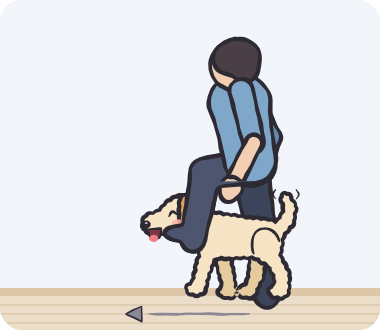
One slow step at a time Weaving as you walk (finishing)
Take one slow, big step forward and guide her under the forward leg from the inside to the outside. At first reward every step, then gradually add steps.
A good sign to move onBAUDOG’s rule of thumb: 3–4 steps in a row, 8 times out of 10
When to reward
Just right
“Yes” the moment she comes out between your legs, or the moment she has circled a leg and is back in front. Then the treat.
Too late
Rewarding once, after several laps of the figure eight (she can’t tell which part was right). At first, reward in short chunks.
Figure eight or walking weave: the AKC Trick Dog standard
In the AKC Trick Dog program, Leg weave is an Intermediate-level trick: the dog weaves around the handler’s legs, going around each leg at least twice. “Leg weave moving” — the handler walks while the dog weaves between the legs — is listed among the ideas for Advanced tricks.
At home, either is plenty. Start with the standing figure eight, and add the walking version once that is steady.
Is my own way right? Common questions
Answers to the questions owners most often have about methods they worked out themselves.
“When we walk, I say ‘Weave’ at every step.” — That’s fine while she’s learning. BAUDOG suggests moving toward a single word at the start: once she can weave a few steps in a row, keep her going with small hand movements and “Yes” alone.
“I want to finish the figure eight with a jump over my leg or a spin (a chained trick).” — BAUDOG suggests linking them only once the weave and the finishing move (Spin, Jump, etc.) each work reliably on the word alone. Give the cues one at a time at first; once the flow is steady, give the whole routine a new single word. To add it: new word → short pause → the usual first cue (“Weave”). For a jump over your leg, read the body-care notes on the Jump page first.
“She weaves when she can see the treat, but not when I take my hand away.” — Switch early from the treat lure to an empty hand (a Touch hand), and reward from your other hand. Don’t make the hand vanish suddenly — make it smaller and higher little by little.
“I taught both the figure eight and the walking weave with the same ‘Weave.’” — Some dogs tell them apart by whether you’re standing still or walking, but BAUDOG suggests one cue for one behavior. If she seems unsure, transfer one of them to a new word (for example “Walk-through”).
“I’d like to do walking weaves on the sidewalk during walks.” — BAUDOG suggests keeping it indoors or in an enclosed area: feet and leash can get tangled, and both of you could trip. On public streets, hold the leash and walk normally.
Looking after her body
A leg weave has no landing impact like a jumping trick, so in BAUDOG’s view it’s on the gentler side (we found no veterinary source on the effects of weaving on a dog’s body). The things to watch: don’t move your legs suddenly over her, so you don’t step on or knock into her, and don’t have her circle over and over on a slippery floor (BAUDOG’s suggestion). Battersea advises choosing a different trick if your dog has joint pain or another condition that makes weaving uncomfortable. If she is reluctant to get up or favors a back leg, see your vet first.
A good sign to move on
- Through → around one leg → figure eight → empty hand (Touch) → word → walking, in that order. BAUDOG’s rule of thumb: move on when the current step works 8 times out of 10
- Add the word only once she can follow your hand through. Say it once, at the start
- If she’s struggling, go back one step — our rule of thumb is two misses in a row
- Keep sessions to a few minutes, and stop while she still wants more
If it isn’t working
She won’t go between your legs
Stand with your legs wide and go back to rewarding just going through. You can also put a treat on the floor between your legs and reward her for walking in on her own.
She comes back to the front instead of going around the outside of your leg
Usually you’re asking for too long a movement at once. Add a step of rewarding her after one leg. Bring your hand slowly around from behind your leg.
She stops partway or loses track of the direction
Your hands may be flapping. Rehearse the hand and leg movements once without her, then try again.
When you walk, she walks beside you instead of weaving
Your steps may be too short or too fast, for example. Take one slow, big step and go back to rewarding each step.
Prescription: a suggested order
Leg weave rests on two skills: moving while paying attention to your hand, and linking a cue to a movement.
- ExerciseHand Target: How to Teach Your Dog “Touch” — and Use It for Recall and Passing Other DogsDoable at home (Steps 1–3 at home)Following your hand with her nose. Since the weave is guided with a “Touch” hand, in BAUDOG’s view a dog who follows hands well tends to learn it faster.Read →
- ExerciseCharging Your Marker Word: How to Teach Your Dog That “Yes” Means a RewardDoable at home (Steps 1–4 at home)A word that marks the moment she comes through or circles a leg. Use it to reward in short chunks.Read →
In the moment: do / don’t
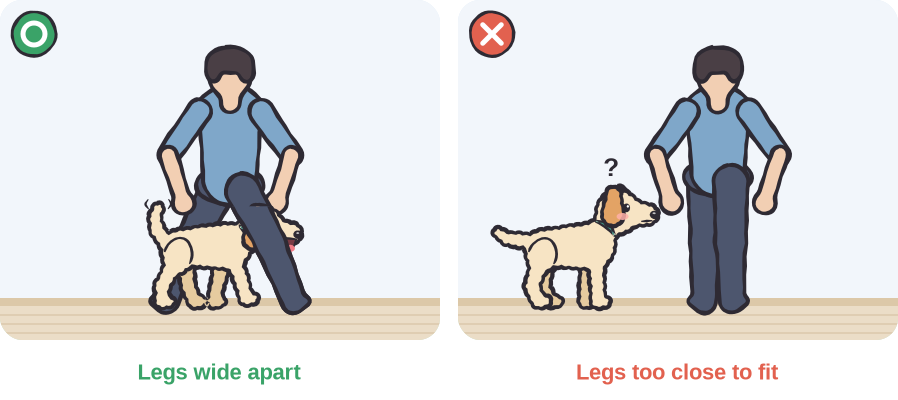
Do
- If she knows “Touch,” guiding is easier (if not, start with a treat lure)
- Stand with your legs wide, and teach one leg at a time
- Mark the moment she comes through, or is back in front
- Give the cue once, at the start
Don’t
- Move your legs suddenly over her
- Ask for the whole figure eight or a long walking weave all at once
- Do walking weaves on busy sidewalks
- Practice indoors with her leash on (it tangles around your legs)
When to see a professional
- She’s reluctant to get up, favors a back leg, or hesitates to play actively. These can be signs of pain
- She suddenly carries a back leg up for a few steps (“skips”). It may be a sign that her kneecap is slipping out of place
The skills behind this command
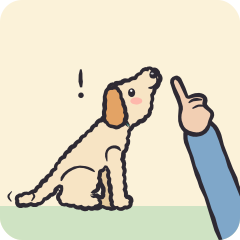 Core skill Understanding Cues Telling “Weave” from “Walk-through,” and the standing cue from the walking cue.
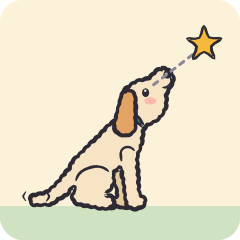 Core skill Focus Keeping her mind on your hands and legs while she’s on the move.
- ExerciseHand Target: How to Teach Your Dog “Touch” — and Use It for Recall and Passing Other DogsDoable at home (Steps 1–3 at home)Read →
- ExerciseCharging Your Marker Word: How to Teach Your Dog That “Yes” Means a RewardDoable at home (Steps 1–4 at home)Read →
Sources
- Battersea Dogs & Cats Home — How to teach your dog to weave between your legs
- AKC Trick Dog Participant and Evaluator Guide (PDF)
- American Kennel Club — Advanced Dog Tricks
- American Kennel Club — Why Dog Core Strength Matters
- American Kennel Club — Lure-and-Reward Training
- Whole Dog Journal — Clean Up Your Cues
- Karen Pryor Clicker Training — The Ten Laws of Shaping
- Cornell University Riney Canine Health Center — Recognizing pain in dogs
- American College of Veterinary Surgeons — Patellar Luxations
- Dogs Trust — Top ten dog training tips