 BAUDOG The dictionary of dog–human communication
Contents
- The finished behavior
- Assessment: where is your dog now?
- The cue
- How to signal
- Teaching steps
- When to reward
- Heel vs loose leash walking
- When should you use heel?
- No leash pops, no choke chains
- Left or right?
- A good sign to move on
- If it isn’t working
- Prescription: a suggested order
- In the moment: do / don’t
- Sources
The finished behavior
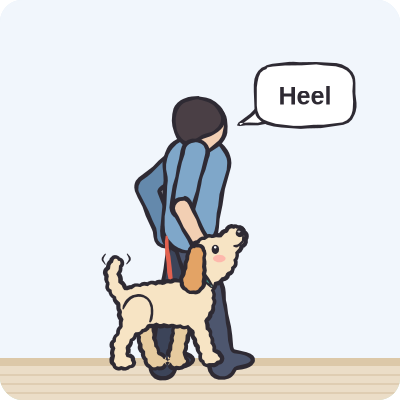
You say “Heel,” and your dog comes to your left side, her shoulder level with your leg; when you stop, she stops, and when you turn, she stays with you. That’s heel. It’s a precise way of walking for short stretches — through crowds, past people, crossing the road. It isn’t something to ask for the whole walk.
Assessment: where is your dog now?
Before you start, a trainer might check three things.
On everyday walks, is the leash tight most of the time?
→If so, start with Loose-Leash Walking. Once she can walk on a loose leash, moving on to a close heel is easier for both of you.
Does she turn to her name? Does she sometimes look up at you on her own?
→If she hardly ever looks at you, start Check-Ins alongside. Heel is walking while keeping track of you.
Do you want to compete (obedience, rally), or do you just want her close for a moment in a crowd?
→For competition, you’ll build the exact position on the left and the attentive head carriage in detail. For everyday life, a consistent position at your side is enough.
The cue
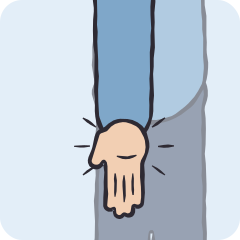
The verbal cue is “Heel.” Whatever word you choose, everyone in the family uses the same one. Competition heeling is traditionally on the left. For everyday use the right side is fine, but pick one side and don’t switch. The hand signal is a light pat on your thigh on the side you want her — the same as “Heel” in the hand-signal list for deaf dogs from Louisiana State University’s veterinary school. Like the word, add it once she comes to your side on her own. It’s a different movement from the hand signal for “Let’s go” (swinging your palm forward in the direction you’re heading).
How to signal
- Voice
Say “Heel” once. “Yes” the instant she’s in position at your side. While you walk, quiet praise is fine.
- Hand
Hold your treat hand still at chest height (don’t dangle it at her nose). To deliver, use the hand on her side and give the treat right by your leg.
- Leash
Hold the leash loosely in the hand on the other side from her. Never pull her back into position with it.
- Body
Walk facing straight ahead. If she drifts out of position, stop and wait, or change direction, and wait for her to come back to your side.
Teaching steps
- 1
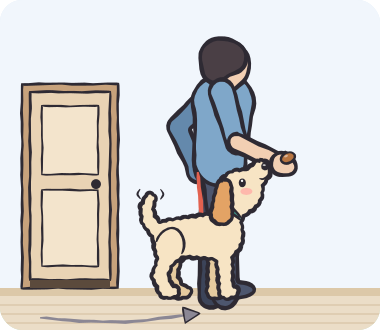
At your left side, a treat by your leg At home, quiet
Reward the spot at your side
In a big room or hallway at home, standing still. Say her name and lure her to your left side with a treat in your left hand. The instant your dog arrives at your side, “Yes” → treat from your left hand, right by your leg. After a few reps, stop luring and reward her when she comes to your side by herself.
A good sign to move onShe comes to your left side on her own while you stand still (our rule of thumb: 8 out of 10 times)
- 2
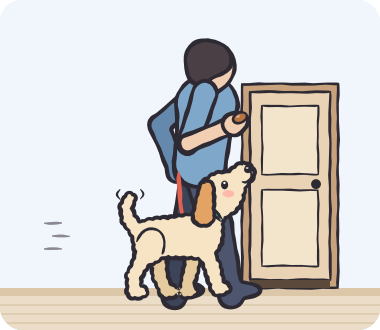
Treat hand at chest height At home, quiet
One or two steps at a time
With her at your side, take one or two steps; if she’s still there, “Yes” → treat by your leg. If she drifts, stop and wait for her to come back to your side. Little by little, add steps before the reward.
A good sign to move onShe stays at your side for about 10 steps
- 3
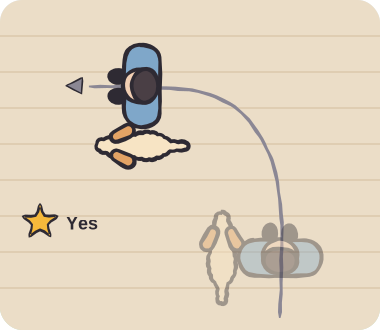
Through turns, she finds her place again At home, small distractions
Stops, turns and changes of pace
Speed up, slow down, turn, stop. If your dog loses the position but finds her own way back to your side, give her a jackpot. Add the word “Heel” and the hand signal (a light pat on your left thigh) once she reliably comes back to your side on her own, just before you set off.
A good sign to move onOn “Heel” she comes to your side and stays with you through turns and stops
- 4
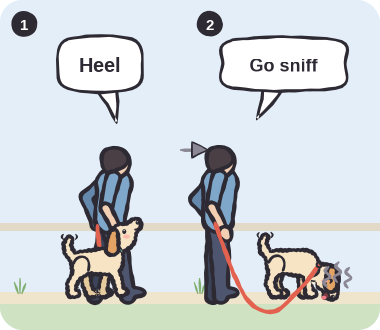
A short heel, then “Off you go” Yard, doorstep, outside the house
Outside, in short bursts
On leash in front of your house, walk about 10 steps on “Heel,” then say “Off you go” and let her sniff. Outside, use better treats than indoors and start with short stretches again. Build up, a little at a time, toward using it for passing people or crossing the road.
A good sign to move onIn front of your house, 10 steps on “Heel,” 8 out of 10 times
When to reward
Just right
“Yes” the instant her shoulder lines up with your leg. Deliver the treat with the hand on her side, right by your leg.
Too late
Giving the treat after she has forged ahead or drifted away. Then forging ahead, or crossing in front of you, is what got rewarded.
Heel vs loose leash walking
Both mean walking without pulling, but they differ in how exact the position is and how long you ask for it. Battersea in the UK also separates a close heel from simply walking without pulling, and says both are built on the same foundation skills.
- Heel: close at the side you choose, shoulder level with your leg, staying with you through stops and turns. For short stretches — crowds, passing people, crossing the road.
- Loose leash walking: as long as the leash is slack, she can be a little ahead or to the side. The everyday way of walking, with time to sniff. See Loose-Leash Walking.
When should you use heel?
Passing people or bikes on a narrow sidewalk, crossing a road, walking past a dog she finds difficult, busy stations and shopping streets. Ask for a short “Heel,” then once you’re past, release her with “Free.” Keeping her glued to your side the whole time tires her out and takes away the pleasure of sniffing.
If it falls apart near a dog or person she finds hard, don’t try to force the heel on the spot — get some distance first. How to manage distance from things she finds hard is covered on Barking at Other Dogs.
No leash pops, no choke chains
Older training methods taught heel by snapping the leash when the dog moved ahead (a “leash pop” or “collar correction”) or by tightening a choke chain. We don’t recommend them. The American Veterinary Society of Animal Behavior (AVSAB) says the evidence supports reward-based methods for all dog training. Oregon Humane Society notes that choke chains and prong collars may irritate and frustrate your dog.
You may also hear that if you don’t walk in front, your dog will think she’s the leader. AVSAB answers this directly: even in a wolf pack, the highest-ranking wolves lead the hunt only a fraction of the time, and they don’t travel in a tight line by rank. It adds that most problem behaviors in pets aren’t about status, but come from the behavior being accidentally rewarded. A dog moving ahead is mostly explained by dogs walking faster than people and by a history of pulling getting them where they want to go — Dogs Trust says the main reason dogs pull is that they’ve learned pulling means they move forward faster.
Left or right?
In obedience and rally competitions, heel is traditionally on the left (AKC). For everyday life, the right is fine. What matters is choosing one side and having everyone in the family stick to it. Give treats with the hand on that side, by the leg on that side. Treating from the other hand teaches her to cut across in front of you.
A good sign to move on
- When she holds the position at your side 8 out of 10 times at the current step, move on (our rule of thumb)
- Build the number of steps between rewards gradually — for example 1–2 → 5 → 10. When you move outside, go back to short stretches
- Make it harder one thing at a time (number of steps, changes of pace, or place — just one)
If it isn’t working
She chases the treat hand and jumps at it
Your treat hand is too low. Hold it still at chest height and lower it to your leg only to deliver.
She cuts in front of me and ends up on the other side
Are you treating in front of your body, or from your other hand? Deliver with the hand on her side, by your leg. If she crosses in front, stop and wait for her to come back to the right side.
She keeps forging ahead
You’re asking for too many steps before the reward. Go back to rewarding every one or two steps. If she moves ahead, stop; when she comes back to your side, praise her and set off again. Don’t pull her back with the leash.
She does it at home but not outside
Outside, smells and sounds beat treats. Start again somewhere quiet in front of your house, with shorter stretches and better treats than at home. A short play session before you go out can help her burn off some energy.
She was doing well, and as a teenager it suddenly fell apart
Progress often dips during adolescence (Battersea). Don’t scold her — go back indoors, or to shorter stretches.
Prescription: a suggested order
The order we recommend. Once she can walk on a loose leash and checks in with you on her own, heel gets much easier. You can work on them side by side.
- ExerciseLoose Leash Walking: Stop When It’s Tight, Reward at Your Side (Starting Indoors)Start at home, finish outside (Steps 1–2 at home)The foundation of everyday walks: walking near you with the leash slack. Heel is a more precise way of walking built on top of it.Read →
- ExerciseCheck-Ins: Teach Your Dog to Look at You Without Being AskedDoable at home (Step 1 at home)Builds the habit of looking up at you on her own as you walk — which is what keeps her in position at your side.Read →
In the moment: do / don’t
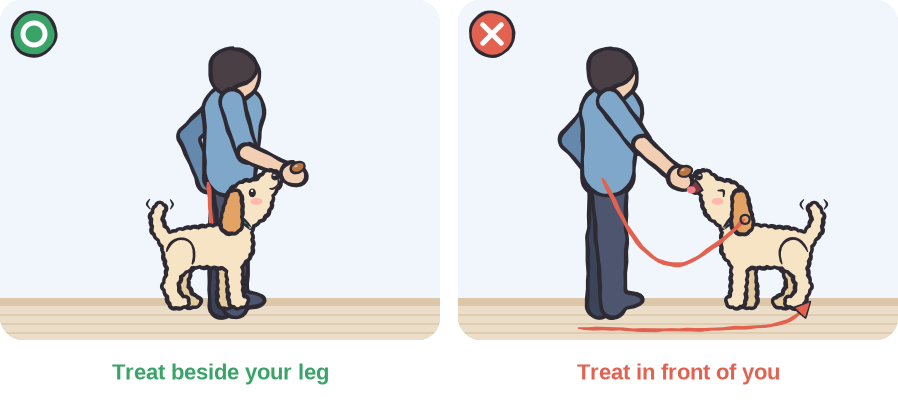
Do
- “Yes” the instant she’s in position at your side
- Deliver treats with the hand on her side, by your leg
- Hold your treat hand still at chest height
- After a short heel, say “Off you go” and let her sniff
Don’t
- Jerk the leash to put her back in position
- Use choke chains, prong collars or shock collars
- Make her heel for the entire walk
- Treat after she has forged ahead or crossed in front of you
The skills behind this command
 Core skill Focus Keeping track of what you’re doing (stopping, turning) as you walk.
 Core skill Impulse Control Staying at your side even though she wants to rush ahead.
- ExerciseLoose Leash Walking: Stop When It’s Tight, Reward at Your Side (Starting Indoors)Start at home, finish outside (Steps 1–2 at home)Read →
- ExerciseCheck-Ins: Teach Your Dog to Look at You Without Being AskedDoable at home (Step 1 at home)Read →
Sources
- American Kennel Club — Fun With Heeling: It’s Easy to Teach Your Dog to Walk Beside You
- American Kennel Club — Leash Training: How to Train a Dog or Puppy to Walk on a Leash
- Battersea — Train your dog to walk on a lead
- Oregon Humane Society — Loose-leash walking
- AVSAB — Position Statement on Humane Dog Training (2021)
- AVSAB — Position Statement on the Use of Dominance Theory in Behavior Modification of Animals
- LSU School of Veterinary Medicine — Hand Commands for Communicating with Deaf Animals
- American Kennel Club — Dog Training Duration, Distance, Distraction (the 3 Ds)
- Dogs Trust — Pulling on lead